

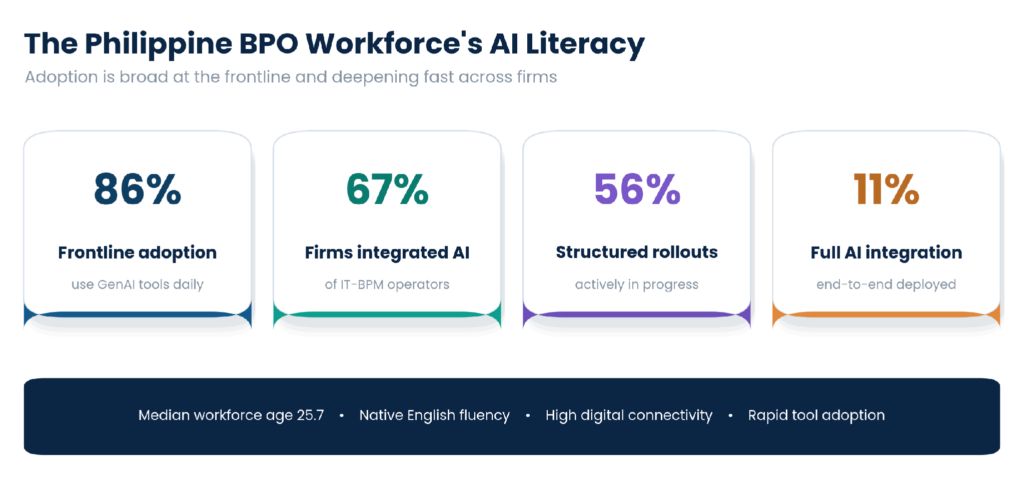
Exceptionally high. About 86% of front-line Philippine BPO professionals now use generative AI and automation tools in their daily workflows, and 67% of IT-BPM firms have formally integrated AI into operations — effectively turning traditional agents into specialized AI co-pilots.
Conventional wisdom holds that artificial intelligence will hollow out the call-center economies of the developing world. The Philippines is quietly proving the opposite. Far from being displaced, its BPO workforce has absorbed generative AI faster than almost any comparable labor pool on earth, turning a perceived threat into a structural advantage. The result is not a smaller industry but a more valuable one — staffed by people who behave less like script-readers and more like AI co-pilots.
How Does AI Literacy in the Philippines Compare to Other Outsourcing Hubs?
Far ahead on practical tool use. Broad national digital-readiness indices rate emerging economies conservatively, but the Philippine BPO sector operates inside an insulated, advanced ecosystem where front-line agents outpace global enterprise averages. Roughly 11% of operations have full AI integration and 56% are mid-rollout.
The gap is driven less by infrastructure than by attitude and demography. With a median workforce age of 25.7 years, near-universal digital connectivity, and native-level English fluency, Filipino professionals adopted conversational AI platforms, LLM productivity wrappers, and automated ticket-tagging tools to strip out administrative friction rather than resisting them. Benchmarking the country against generic national digital-readiness scores badly understates the sector; the relevant comparison is enterprise tool fluency, where it leads. In practice, that fluency is what an enterprise buyer actually consumes — not an abstract country score, but agents who can already drive the tools the buyer runs.
Which Roles Does AI Replace, and Which Does It Amplify?
Mostly amplify. Using the IMF’s exposure-and-complementarity lens, high-value roles — complex CX, back-office, and technical support — score high on both axes, meaning AI augments rather than replaces them. Only routine Tier-1 work sits under genuine automation pressure; leadership stays strategic.
Exposure measures how much of a role AI can touch; complementarity measures how much AI amplifies the human rather than substituting for them. In the Philippines’ high-value verticals, the balance is tilting decisively toward augmentation. Complex CX specialists, back-office and tech-support teams, and shared-services leadership all pair high exposure with high complementarity — the zone where automation makes people more productive, not redundant. Only routine Tier-1 work faces real automation pressure, and even there it is freed for higher-value tasks rather than eliminated. That distribution is the real story: the same technology that pressures one quadrant is precisely what makes the other three more valuable.
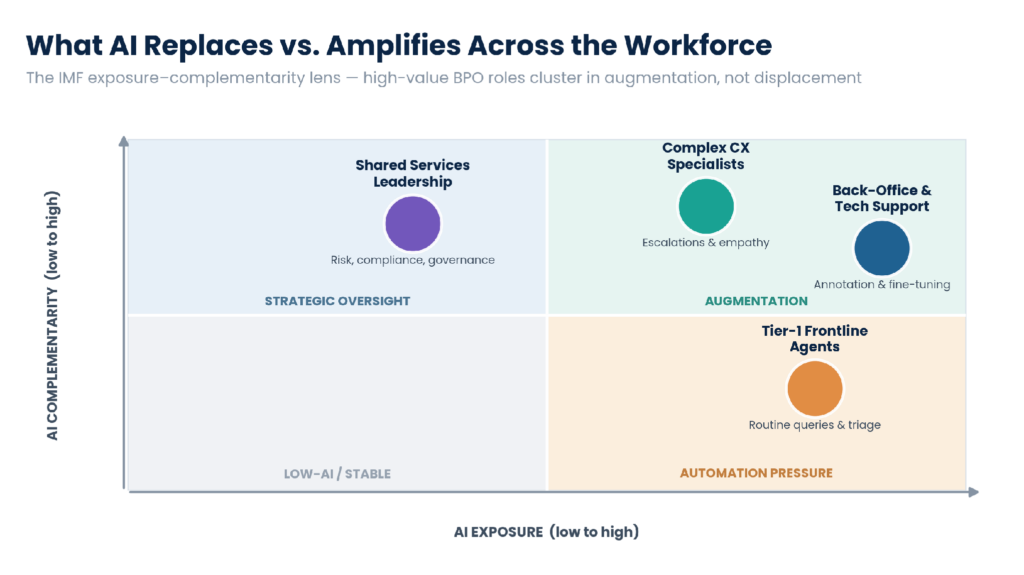
Each bubble is a workforce segment, plotted by how exposed it is to AI and how much AI amplifies the human role.
What Operational Metrics Define AI-Augmented BPO Performance?
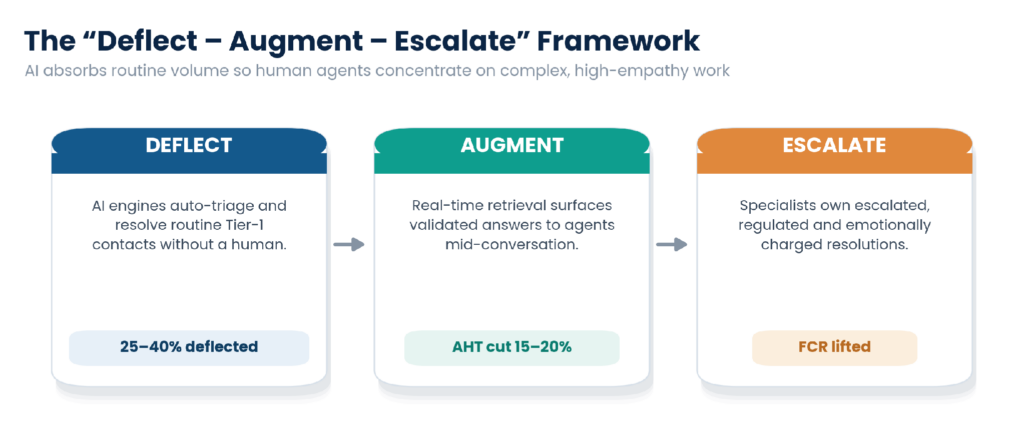
A “Deflect-Augment-Escalate” model. AI engines autonomously deflect 25–40% of routine Tier-1 contacts; real-time retrieval then augments agents, cutting Average Handle Time 15–20% and lifting First Contact Resolution; and humans own the complex escalations that models cannot safely resolve.
A highly literate workforce shows up directly in unit economics. Because front-line talent already possesses strong foundational AI literacy, onboarding cycles for complex enterprise accounts have shortened markedly, and agents lean on real-time AI knowledge-retrieval systems instead of fighting their tooling. The deflection is selective rather than blunt — low-value repetitive contacts leave the human queue while revenue-sensitive interactions are deliberately preserved for people.
“The global market initially misread the impact of AI on the Philippines. They expected a mass contraction in seat count. Instead, we are seeing a massive value expansion — vendors are using an incredibly tech-nimble workforce to execute complex AI orchestration. The human element isn’t being replaced; it is being supercharged to handle the multi-layered escalations that AI models fail to resolve.”
— John Maczynski, CEO of PITON-Global
How Did a Silicon Valley FinTech Optimize Support with AI Co-Pilots?
Quick answer: A fintech facing a 200% volume surge and strict compliance was matched to an elite AI co-pilot vendor. A three-layer system deflected 35% of Tier-1 traffic, routed regulated cases in under three seconds, and augmented agents in real time — cutting cost-per-contact 32%, AHT from 8.2 to 5.4 minutes, and lifting CSAT to 94.5%.
Standalone LLM chatbots could not safely execute the client’s compliance-grade support, so PITON-Global audited its network of more than 100 Philippine partners to find a vendor with a fully deployed AI co-pilot infrastructure and a dedicated internal academy training agents in prompt engineering and model fine-tuning for financial services.

The architecture was layered rather than monolithic: custom LLM layers triaged and resolved routine traffic, regulated cases routed to specialists with automated timeline summaries and sentiment analysis, and agents drew on real-time recommendations to surface validated financial answers and cut system-navigation time.
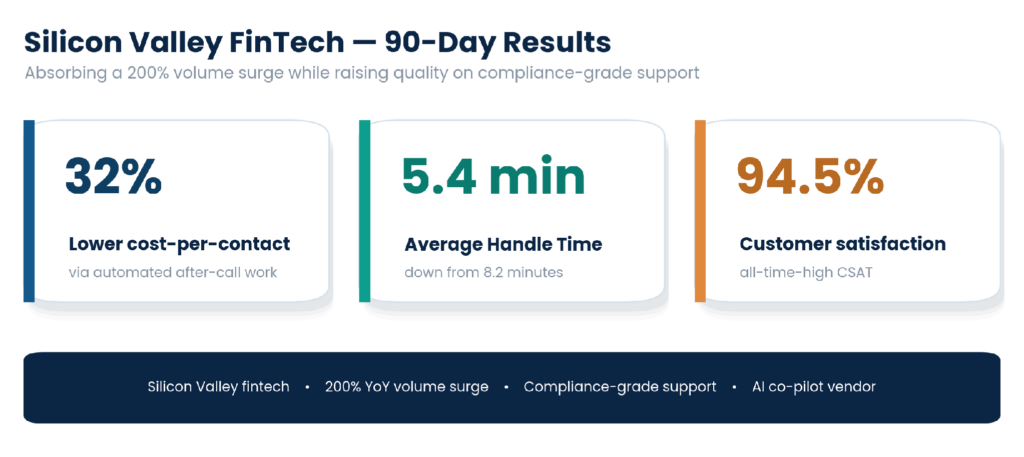
Within 90 days the gains were unmistakable, and customer satisfaction reached an all-time high — driven less by raw automation than by agents who were finally free to focus on empathy rather than navigating systems.
How Should Enterprises Adapt Their Procurement Strategy?
Look past superficial AI marketing. Since most firms now use AI tools, the real differentiator is how deeply they’re woven into talent development — so demand evidence of continuous upskilling, and shift from headcount-based pricing toward output- or outcome-based models that reward efficiency.
When two-thirds of IBPAP member firms already use AI tools, a logo-filled slide proves nothing. Procurement teams should require evidence of continuous upskilling frameworks and move away from input-based headcount pricing toward outcome-based models, so the efficiency an AI-literate workforce generates rewards both the client’s bottom line and the vendor’s incentives. Specialized advisory firms help cut through the noise, matching enterprises with verified, AI-mature vendors that can turn technological literacy into measurable financial returns. In effect, the contract should be written to reward intelligence and outcomes, not hours logged or seats filled.