

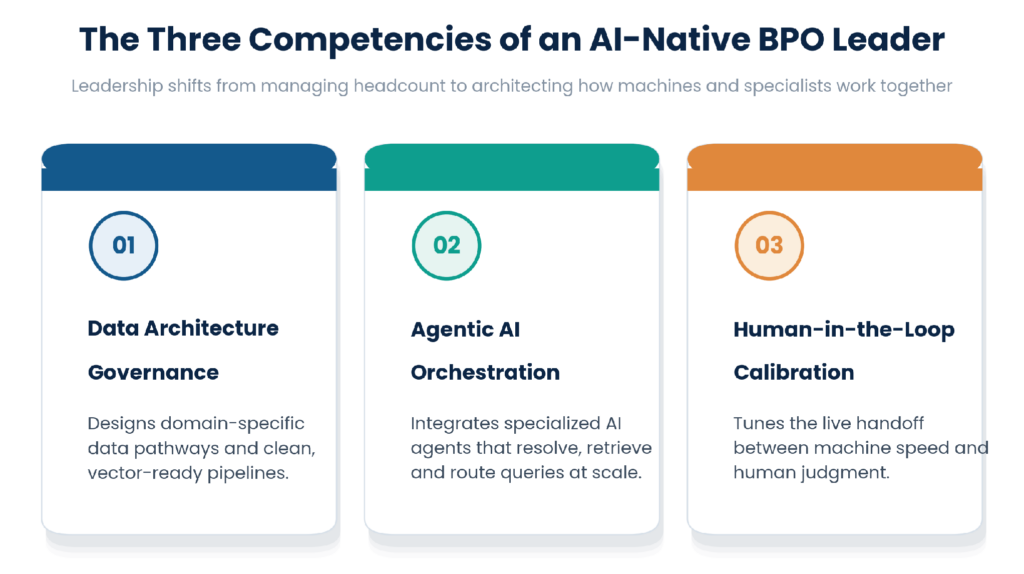
An AI-native BPO leader needs three core competencies: data architecture governance, agentic AI orchestration, and human-in-the-loop calibration. Rather than managing headcount, they design domain-specific data pathways and pair specialized AI agents with skilled human specialists — shifting outsourcing from basic labor arbitrage to high-value intelligence arbitrage.
For two decades, Philippine outsourcing sold scale: more seats, more scripts, lower cost. In 2026 that pitch no longer wins enterprise contracts. The decisive question is no longer how many people a provider can hire, but how intelligently it blends automation with human judgment. An AI-native leader does not manage queues — they architect the relationship between machines and people, designing clean data pathways and pairing specialized AI agents with highly skilled specialists who handle the moments machines cannot. These three competencies are not soft leadership traits; they are concrete technical disciplines that decide whether automation becomes leverage or liability.
What Operational Metrics Define an AI-Native Outsourcing Program?
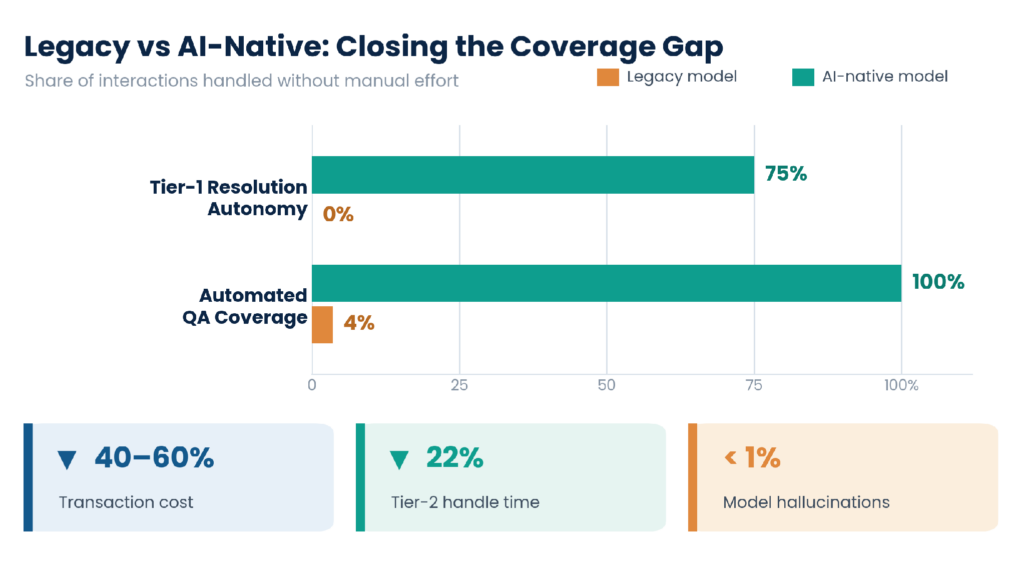
AI-native programs are judged less on headcount and raw Average Handle Time than on how tightly they orchestrate generative models, RAG vector databases, and human sentiment management. The clearest signals are autonomous Tier-1 resolution, 100% automated quality scoring, sub-1% hallucination rates, and a falling cost-per-transaction.
The traditional yardsticks — raw headcount scaling and basic Average Handle Time — are largely obsolete. Performance now depends on the tight orchestration of generative models, retrieval-augmented generation (RAG) vector databases, and real-time human sentiment management. When buyers evaluate a provider, the first audit should target leadership’s technical acumen: AI-native leaders do not simply deploy software, they manage the live interaction between machine automation and human judgment, second by second.
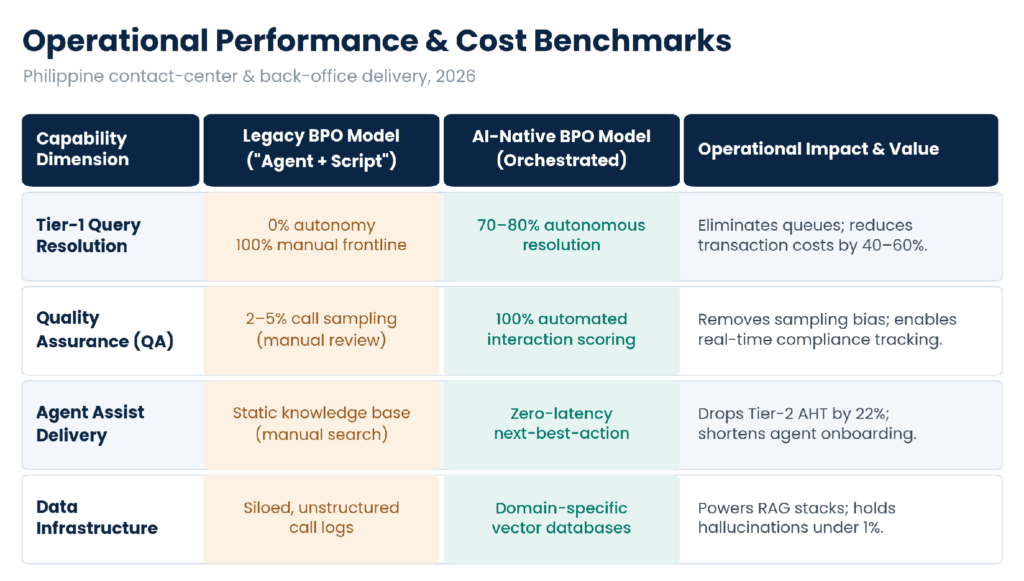
Where legacy “agent + script” operations and orchestrated AI-native models diverge across four capability dimensions.
The contrast is sharpest in two places: how much work resolves without a human, and how much of it gets reviewed. Legacy operations sample just two to five percent of calls for quality, while AI-native models score every interaction automatically. Tier-1 resolution moves from fully manual to roughly three-quarters autonomous, and grounded RAG stacks hold model hallucinations under one percent — the difference between a confident answer and a compliant one.
How Do Enterprise Leaders Prevent “AI-Washing” in Vendor Selection?
Audit the leadership’s technical depth and demand three safeguards: PII-scrubbed, structured training data; RLHF feedback loops run by data-literate coaches; and contracts with explicit AI indemnification clauses for hallucination events. These separate genuine agentic capability from basic chat scripts dressed up as AI.
The biggest hazard in vendor selection is “AI-washing,” where mid-market providers market sophisticated agentic capabilities but quietly run basic, ungrounded chat scripts. For procurement teams, the cost of being fooled is brand damage and compliance exposure, so genuine AI-native leadership treats deployment as a disciplined risk-management exercise rather than a feature toggle. The tell is almost always in the data layer: grounded systems can show their retrieval sources and an audit trail, while dressed-up scripts cannot.
“True digital transformation cannot be turned on overnight like a software update. Success depends on data hygiene and structured workflows. The right BPO partner in the Philippines balances agentic automation with human oversight to protect brand safety and improve unit economics.”
— John Maczynski, CEO of PITON-Global
Before signing, executives should confirm three safeguards are genuinely in place — not merely promised on a slide:
- Data preparation protocols. All interaction logs are structured and scrubbed of personally identifiable information (PII) before any model training begins.
- Structured feedback systems. Frontline team leaders are reskilled into data-literate coaches who refine models through reinforcement learning from human feedback (RLHF).
- Comprehensive liability models. Commercial agreements carry explicit AI indemnification clauses that define how risk is shared when a hallucination event occurs.
How Does PITON-Global Execute Vendor Matching for AI-Driven Operations?
PITON-Global applies a vendor-neutral framework to evaluate 100+ Philippine providers against strict, data-driven criteria, filtering out surface-level automation and matching buyers to operationally mature partners. One healthcare-fintech client was paired with a HIPAA-ready vendor that cut operating costs 42% within 90 days.
Evaluating more than 100 call centers and back-office providers requires strict, data-driven criteria rather than glossy sales decks. PITON-Global’s vendor-neutral framework filters out surface-level automation and connects buyers with operationally mature partners — those whose technical claims survive scrutiny. Consider a fast-growing US fintech handling sensitive healthcare billing and claims under HIPAA, hit by a 150% volume surge that drove up hold times and customer abandonment.
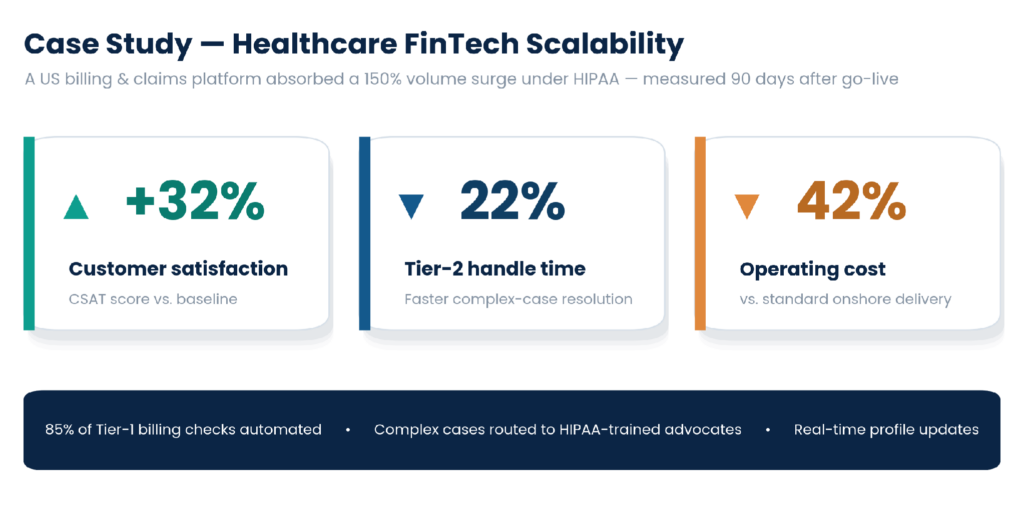
Outcomes measured 90 days after implementation, benchmarked against standard onshore delivery.
The selected provider deployed autonomous voicebots to resolve roughly 85% of routine Tier-1 billing checks, routing complex inquiries through a structured handoff to specialized Medical Advocates who worked from real-time, auto-generated data summaries. The result was higher satisfaction and faster resolution without sacrificing compliance — the exact balance an AI-native match is meant to deliver.
How Should Buyers Structure Their AI-Native Outsourcing Roadmap?
Phase the shift over roughly a year: data hygiene and architecture mapping (months 1–3), pilot testing and RAG model grounding (months 4–6), human-in-the-loop integration (months 7–9), and full orchestration with automated QA and predictive scheduling (months 10+).
Moving from legacy support to orchestrated intelligence is a staged journey, not a switch. Procurement and operations teams should tie each phase to concrete milestones so progress stays measurable and scalable.
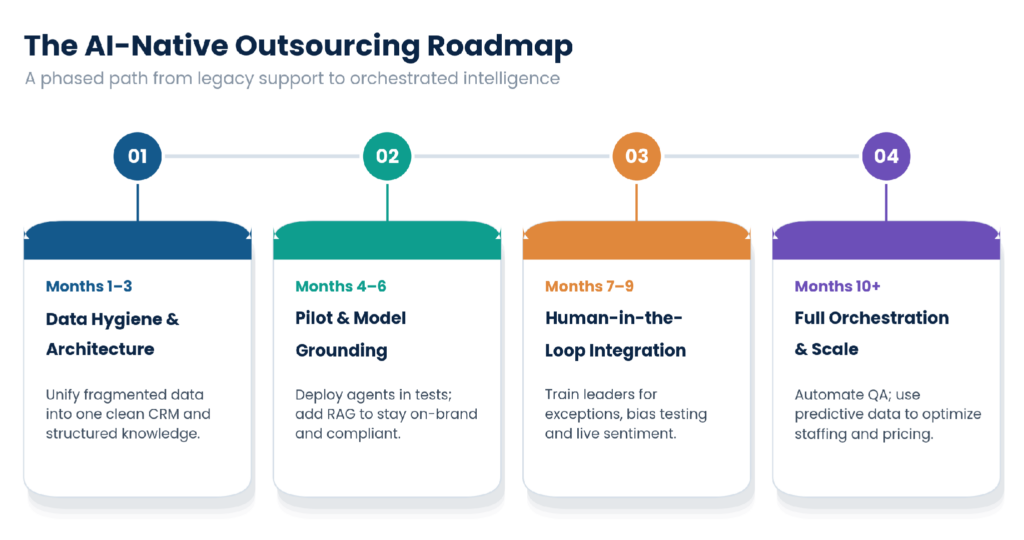
The sequence matters. Data hygiene comes first because every downstream gain — grounding, automation, predictive scheduling — depends on clean, structured inputs. Skip it, and even the best models inherit the chaos of siloed call logs. Teams that respect the order typically reach full orchestration within a year, with quality assurance running automatically across every interaction and predictive data shaping how agents are scheduled and priced. The payoff is durable: lower unit costs, stronger compliance, and service quality that scales without simply adding seats.