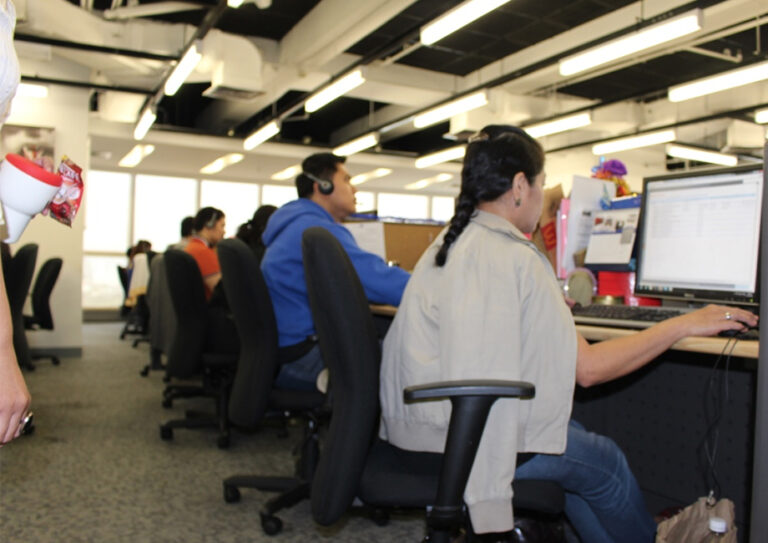

Conversational voice AI, agentic workflows that complete tasks, big-data personalization, elastic cloud capacity and visual assistance will reach North American queues in roughly that order, and each arrival changes what call center technology in customer support asks of the offshore agent. The buyer’s problem is not predicting the wave but contracting for it, because most outsourcing agreements signed today will still be running when each of these arrives. This article lays out what a Philippine support desk takes on as each technology lands, what changes for the agent, and how to write terms that keep pace.
The next wave, in the order it will reach your queue
Five technologies are close enough to production to plan around, and each one shifts work between the customer, the machine and the offshore agent in a different way. Treating them as a sequence rather than a list lets a VP of customer experience decide which to pilot in year one and which to hold for a contract renewal.
Conversational voice AI
Natural-language voice assistants now handle authentication, order status, appointment changes and simple payments without a menu tree, and they hand off to a live agent with the transcript attached. The effect on the desk is that the remaining voice contacts are longer and harder, so handle-time targets set for the old mix stop making sense. A Philippine team in Manila or Cebu that inherits the escalations needs the authority and the training to resolve them, and the contract needs a mechanism to re-baseline handle time as the mix shifts.
Agentic workflows
Where a chatbot answers, an agentic system acts: it issues the refund within policy, rebooks the shipment, updates the address in three systems and confirms by email. This is the technology most likely to change staffing, and also the one most in need of human oversight because a wrong action costs more than a wrong answer. The sensible deployment gives the offshore team the review queue, so agents approve, correct or reverse automated actions and feed the exceptions back into the rules. That role requires judgment and product knowledge, which is why it belongs with experienced Filipino agents rather than being automated away.
Big-data personalization
Interaction history, purchase behavior and product telemetry combine to tell the agent who is calling and why before the greeting ends. The useful version is modest: the last three contacts summarized, the open order, the likely reason for the call and the offer the customer is eligible for. It depends on the Philippine provider’s agents working inside your CRM rather than a parallel tool, and on data agreements that let the offshore team read from the systems that hold the history.
Elastic cloud capacity
Cloud contact-center platforms already let a provider add seats in days, and the next step is capacity that flexes by the hour across on-site, hybrid and remote agents on the same routing. For a retailer with a holiday peak or a fintech launching a product, that means a surge plan with the Philippine provider written into the agreement rather than an emergency hiring request. It also removes the argument for keeping a permanently oversized onshore team as insurance.
Visual and augmented assistance
Camera sharing from the customer’s phone, with the agent annotating the screen, is already in use for device setup, damage claims and home-service triage; augmented-reality overlays that guide the customer step by step are the following stage. For technical and hardware support this shortens resolution and cuts repeat visits, and it favors agents with patience and clear spoken English, since the customer is being coached through a physical task in real time.
What changes for the agent, and why Filipino teams adapt fastest
Every technology above removes routine work and leaves the agent with exceptions, judgment calls and emotionally charged conversations, so the value of a well-run Philippine team rises rather than falls as the wave arrives. The country’s workforce is large enough to staff that shift: the IT-BPM sector generated more than $40 billion in revenue in 2025 and employed 1.9 million digital workers, up from 1.82 million in 2024, with a 2026 target of $42 billion and 1.97 million jobs, according to industry figures reported by the Philippine Star in January 2026. A provider drawing on that pool can recruit agents who have already worked North American programs and step them into review and escalation roles.
Language quality also matters more, not less, once the easy contacts are automated. The EF English Proficiency Index ranks the Philippines 28th globally with a score of 569 in its 2025 edition, and the practical result is an agent who can rephrase an AI-drafted answer for an anxious customer instead of reading it. The complete picture of how these teams are recruited, trained and measured is in our customer experience excellence guide; the point here is that the next wave rewards the human skills the country is known for.
Hybrid and work-from-home delivery becomes a contract term
Remote delivery is no longer a pandemic workaround but a regulated option that Philippine providers can offer within their incentive regimes. The CREATE MORE Act, signed in November 2024, allows registered business enterprises to run work-from-home arrangements for up to half their workforce without losing tax incentives, as reported by the Daily Tribune. For a buyer that means hybrid staffing can be written into the agreement with explicit rules: which queues may be worked remotely, which must stay on a governed floor because of payment or health data, and what endpoint security applies to each.
The technology wave makes this practical. Cloud routing, screen recording and data-loss prevention now work the same on a home endpoint as on a Clark or Cebu floor, so the decision becomes a risk classification rather than a capability limit. Buyers running front-office information and account-servicing queues have found this model keeps continuity through storms and transport disruption; we describe how in our piece on consistent front-office support.
How to write a contract that keeps pace with the technology
Assume the contract will outlive at least two of the technologies above and write terms that let the program change without renegotiating from scratch. Five clauses do most of the work:
- A mix re-baseline: when automation changes the share of simple contacts by an agreed margin, handle-time and occupancy targets are reset from measured data rather than the original bid.
- A pilot right: the buyer may run a defined technology pilot on a subset of the offshore team, with costs and success criteria agreed in a short schedule rather than an amendment.
- Data and model ownership: transcripts, knowledge articles and any model tuning built on your customers’ interactions are yours, delivered at exit and not reused elsewhere.
- Human-oversight rules: which decisions an automated system may take alone, which require agent approval, and how errors are logged and reviewed.
- Outcome metrics that survive the mix change: first-contact resolution, repeat-contact rate and CSAT stay as the governing measures even as handle time and volume move.
The reason to anchor on outcomes is that technology changes what the work looks like but not what the customer wants. A proptech platform whose tenants and owners still expect a person to pick up when a payment fails is a good illustration; the case for keeping the human touch in proptech support is really a case for measuring the desk on resolution and loyalty regardless of how much of the contact the machine handled.
What to budget in 2026
Most of the technology in the wave arrives bundled in the seat rate rather than as separate licenses, so the labor rate remains the budget anchor. The PITON pricing calculator uses a 2026 fully loaded base of $12 per hour, already including team-lead and QA supervision, against a US in-house benchmark of $33 per hour, and models typical savings of 50–70% compared with a domestic desk; the assumptions are set out on our pricing page. Where a buyer brings its own platform or licenses an AI layer directly, those components are carved out and the seat rate adjusts.
The savings are best treated as the funding source for the wave rather than as the whole prize. A buyer that redirects part of the difference into pilots, review roles and knowledge management ends up with a desk that improves every quarter; one that takes the entire saving to the bottom line ends up with a cheaper version of the desk it had before.
Frequently asked questions
Will the next wave shrink the offshore team I contract for?
It changes the roles before it changes the headcount. Simple contacts move to automation while review, escalation and proactive work grow, so most programs hold seat counts roughly steady in the first year and shift the mix toward experienced agents. Plan for a re-baseline, not a cliff.
Should I wait for the technology to mature before outsourcing?
No. A well-governed Philippine desk adopts each technology through the provider’s shared platforms faster than most in-house teams can fund it, and a contract with pilot rights and a mix re-baseline lets you take each wave as it arrives without renegotiating.
Which technology should I pilot first?
Agent assist with automatic summaries, because it improves every contact immediately, carries little customer-facing risk and produces the transcript data the later technologies depend on. Voice AI and agentic workflows follow once the knowledge base and oversight rules are proven.
How do I keep control of customer data as automation grows?
Keep the data in systems you control where possible, require SOC 2 Type II and PCI-DSS evidence from the provider, classify queues by sensitivity to decide what may be worked remotely, and write model and transcript ownership into the agreement before the first pilot.