

On this page
- Key Takeaways
- What Are the Strategic Tradeoffs Between Capital-Intensive Automation and Philippine Sourcing?
- How Do Process Exception Rates Dictate the Financial Breakeven Point?
- What Does a Hybrid Model Deliver in Practice?
- What Is PITON-Global and How Does It Guide Strategic Expansion?
- Frequently Asked Questions
Leaders should compare the two on total cost of ownership, deployment velocity, and process exception rates. Automation offers low marginal cost for standardized transactions, but Philippine outsourcing delivers immediate, flexible human capital for complex exceptions, contextual problem-solving, and empathetic interactions at 50–70% below onshore cost.
Key Takeaways
- Embrace the hybrid imperative. Transformations succeed by deploying a hybrid model where Philippine teams manage automation exceptions — not by choosing one path.
- Weigh capital velocity. Automation demands high upfront CapEx and long builds; Philippine outsourcing scales OpEx dynamically with sub-30-day deployment.
- Respect nuance and context. Regulated or empathetic workflows suffer under pure algorithms, favoring the culturally aligned Philippine workforce.
- Account for maintenance drift. Pure automation suffers API breakages and system drift — hidden costs seasoned operations absorb naturally.
- Let exception rates decide. Above roughly a 15% exception rate, pure automation loses viability as remediation costs erode nominal savings.
What Are the Strategic Tradeoffs Between Capital-Intensive Automation and Philippine Sourcing?
Automation promises algorithmic execution but carries heavy development friction and rigidity, with 6-to-18-month builds before any cost relief. Philippine sourcing shifts cost to a predictable monthly run-rate that scales within 30 days — trading high upfront CapEx for flexible, dynamic OpEx and avoiding bespoke-code technical debt.
Executive leadership must weigh the structural realities of both paths. The primary financial lens is Upfront Capital Expenditure versus Dynamic Operational Expenditure. Deploying advanced RPA or custom intelligence layers demands massive initial investment in licensing, integration, and data-pipeline structuring, with development cycles of 6 to 12 months during which no cost relief is realized.
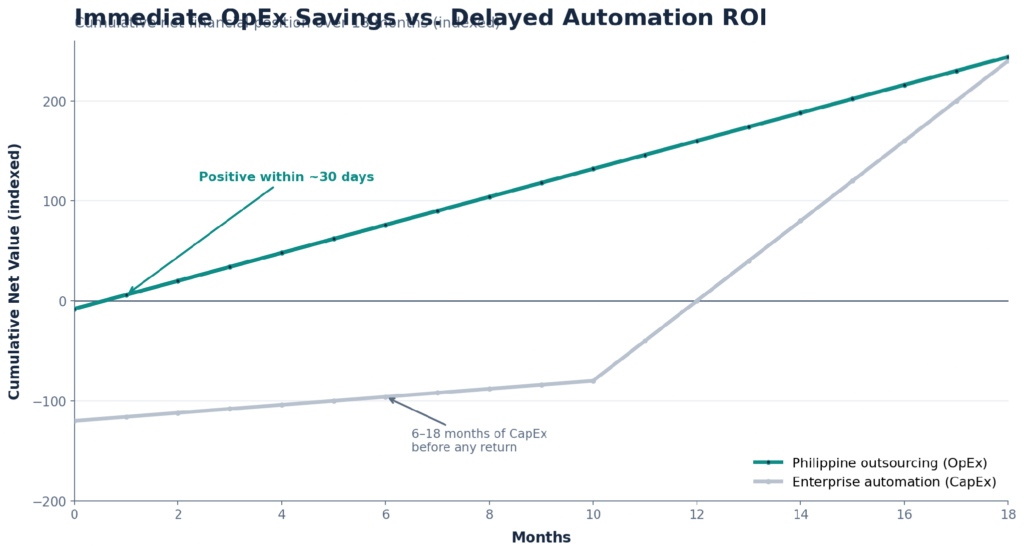
Figure 1. Philippine outsourcing returns value in weeks; automation recovers its CapEx only after months.
Partnering with a premier provider in Manila or Cebu shifts cost to a predictable monthly run-rate that scales within 30 days, bypassing the technical debt of building, debugging, and maintaining bespoke automation. Across the dimensions that shape total cost of ownership, each path has a distinct profile.
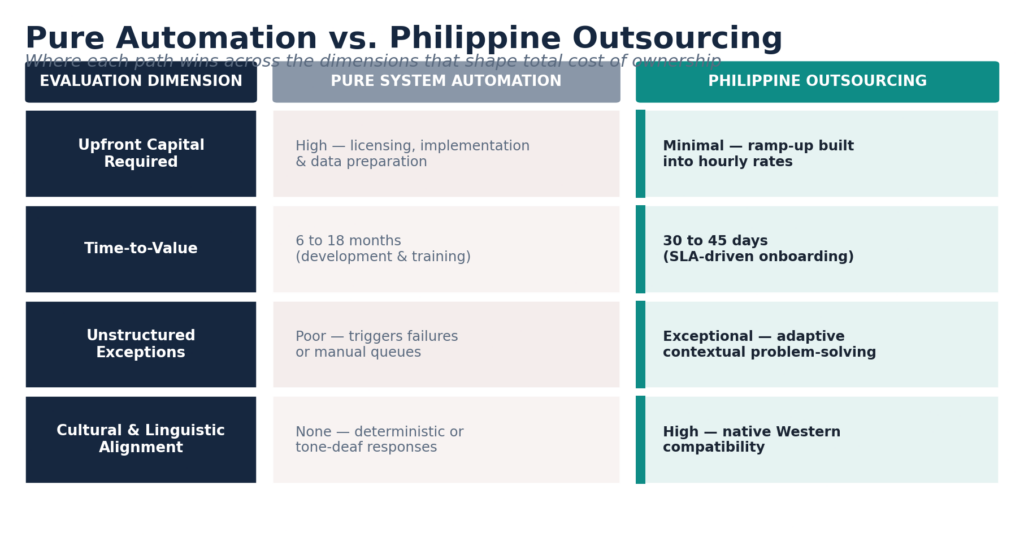
Figure 2. Pure automation versus Philippine outsourcing across four decision dimensions.
How Do Process Exception Rates Dictate the Financial Breakeven Point?
Every workflow has an exception rate — the share of transactions falling outside standard rules. Above roughly 15%, pure automation loses viability because each exception requires costly human remediation. The profitable pattern automates the predictable ~70% and routes the complex, judgment-heavy ~30% to skilled Philippine specialists.
Every corporate workflow has an exception rate, and this metric dictates whether an automated system flourishes or collapses into an expensive manual backlog. When an invoice-processing or claims workflow exceeds a 15% exception rate, pure automation rapidly loses financial viability: each exception requires human intervention to review, correct, and re-enter data, and onshore remediation quickly erodes the software’s nominal savings.
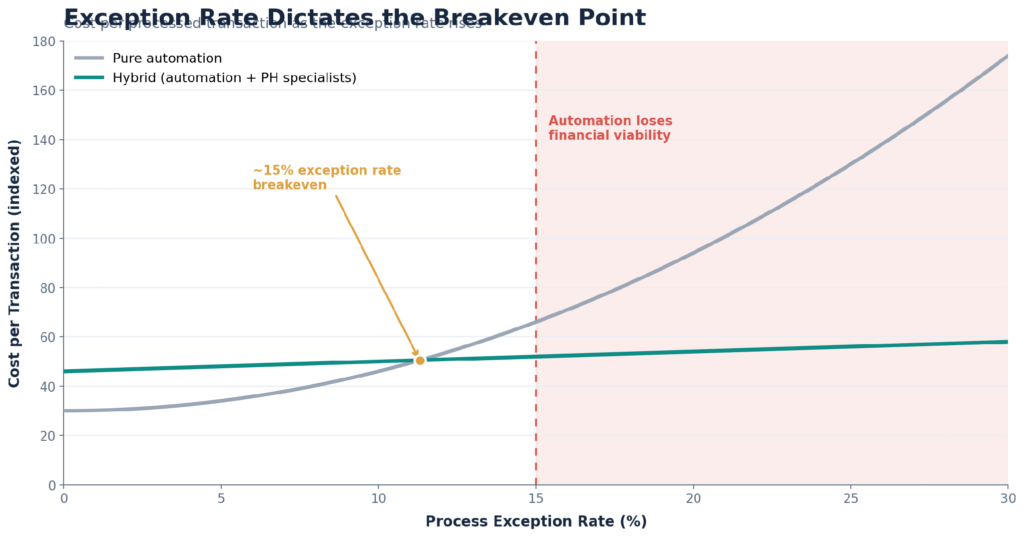
Figure 3. Past a ~15% exception rate, pure-automation cost per transaction climbs sharply.
The solution is synchronization, not replacement. By automating the predictable majority and routing complex exceptions to a dedicated, highly educated Philippine team, enterprises safeguard core workflows with professionals who can evaluate edge cases, manage ambiguous communications, and execute policy-driven adjustments algorithms cannot replicate.
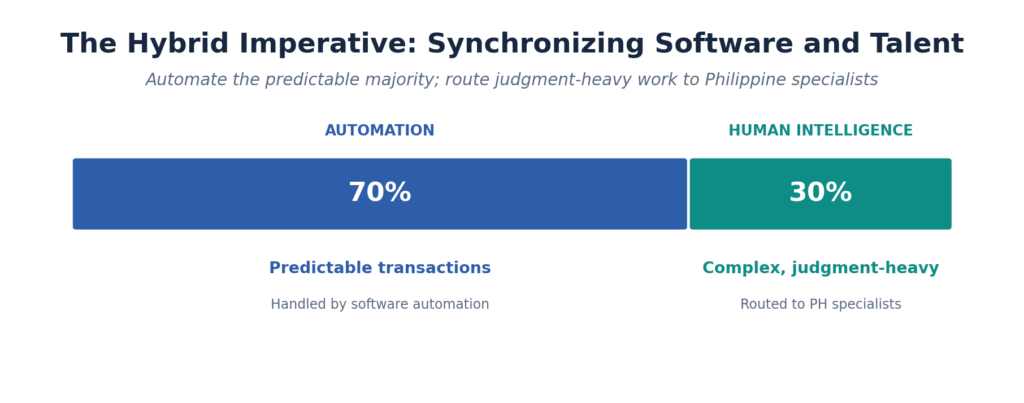
Figure 4. The hybrid model: automate the predictable 70%, route the judgment-heavy 30% to specialists.
“Many enterprise buyers mistake automation for a complete human replacement. In reality, the most profitable companies use software to handle the predictable 70% of transactions, then route the complex, judgment-heavy 30% to highly skilled specialists in the Philippines. It’s not an either-or scenario; it’s a strategic synchronization of technology and human talent.”
— John Maczynski, CEO, PITON-Global
What Does a Hybrid Model Deliver in Practice?
It rescues automation that has hit its exception ceiling. When a US medical-billing platform’s RPA overhaul saw exception rates spike to 28%, a PITON-Global-matched provider added a 60-FTE specialist team alongside the tool — clearing a 60-day backlog in 45 days, cutting DSO 22%, and reducing delivery cost 55%.
A prominent US medical billing and insurance platform attempted a pure RPA-driven overhaul, but changing insurer requirements pushed exception rates to 28%, causing massive backlogs, compliance errors, and millions in delayed revenue. PITON-Global assessed the workflow and matched the platform with a specialized Metro Manila healthcare provider offering pre-trained medical coding and billing talent.
The provider deployed a 60-FTE team of billing analysts to work alongside the automated data-capture tool — managing high-complexity exceptions, running real-time quality audits, and correcting data mismatches the software flagged.

Figure 5. Backlog, cash-flow, cost, and exception-handling outcomes of the hybrid deployment.
Lesson Learned
Relying solely on algorithms for dynamic, regulation-heavy workflows creates severe risk. True cost-efficiency comes from using automation as a tool for human operators, not a replacement.
What Is PITON-Global and How Does It Guide Strategic Expansion?
PITON-Global is an independent, advisory-led consultancy that shields enterprises from the risk of choosing among 1,000+ Philippine providers. Backed by a vetted network of 100+ premium providers, it maps vendor selection against a company’s technology and cost-containment roadmap to protect migration capital and ensure data security.
Who Is PITON-Global?
PITON-Global operates as an independent, advisory-led consultancy backed by a rigorously vetted network of more than 100 premium call-center and back-office providers, guiding enterprise leadership through precise provider matching across the Philippines.
How Does PITON-Global Differ From Traditional Outsourcing Brokers?
Unlike transactional brokers, PITON-Global takes an active advisory role, mapping vendor selections against a company’s long-term technology and cost-containment roadmaps rather than chasing deal volume — aligning its guidance with the client’s strategic outcomes.
How Does Its Network of 100+ Vetted Philippine BPO Providers Benefit Organizations?
Navigating 1,000+ providers independently carries significant risk. The vetted network of 100+ premium providers lets enterprises reach specialists matched to their complexity, compliance, and technology needs — protecting migration capital and ensuring data security.
How Does Its Advisory-Led Vendor Matching Process Work?
PITON-Global filters providers through a strategic evaluation matrix — process complexity, compliance frameworks, technology stacks, and linguistic capabilities — to ensure a perfect operational fit and build a resilient operational bridge to the Philippines.
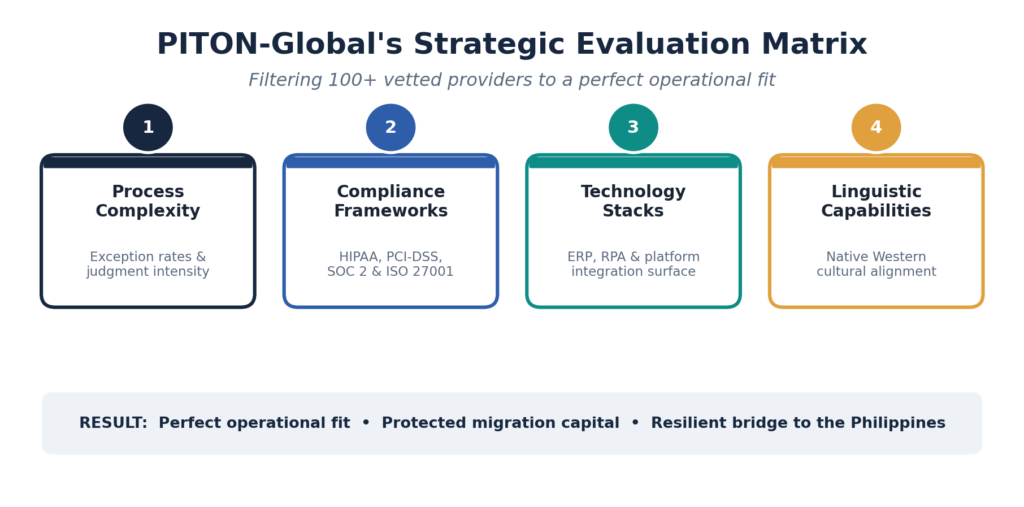
Figure 6. The evaluation matrix that filters 100+ providers to a perfect operational fit.
Why Do Organizations Use PITON-Global?
Global enterprises use PITON-Global to mitigate the risk of independent market navigation, protect migration capital, ensure data security, and build a resilient bridge to the Philippines — securing a provider matched to both their automation strategy and cost roadmap.
Frequently Asked Questions
Which business processes should be automated rather than outsourced?
Highly repetitive, rules-based, low-judgment tasks with perfectly structured data — such as basic data entry, simple batch reporting, or system-to-system syncing — are ideal candidates for pure automation.
What is the wage differential for high-skill analytical roles in the Philippines?
For complex back-office roles like financial analysts, compliance officers, and medical billers, fully-loaded salaries are typically 60–70% lower than equivalent North American or Western European roles.
How do we handle data privacy when combining automation with offshore personnel?
Ensure your provider maintains verified ISO 27001, SOC 2 Type II, and PCI-DSS compliance, so data handled by human specialists is as secure as an automated cloud environment.
Can a Philippine team help build and optimize our automated systems?
Yes. Many premium providers offer hybrid services with skilled data scientists, RPA developers, and QA analysts who build, train, and continuously optimize the automation systems they support.
How does cultural compatibility affect customer-facing automation?
Exceptional Western cultural alignment, native-level English, and high emotional intelligence make Philippine professionals far more effective than voicebots at de-escalating complex, sensitive, or high-value interactions.