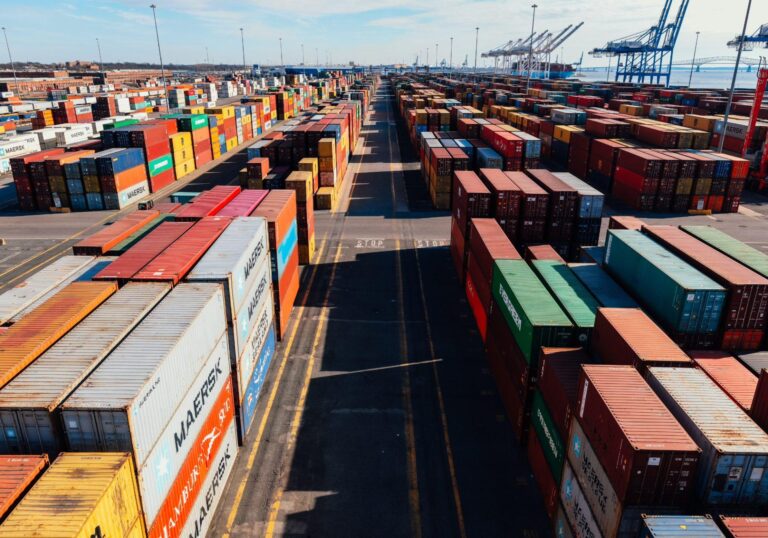

The 30-Second Executive Briefing
- The Problem: In 2026, global supply chain volatility remains at an all-time high. Inaccurate inventory forecasting and “Dark Stock” (inventory lost in transit or unlisted) cost e-commerce brands a significant share of annual revenue.
- The Shift: Supply chain support has moved from a back-office administrative task to a Predictive Resilience Function—a core part of how offshore store support recovers lost sales.
- The Solution: Implementing ecommerce inventory & supply chain support outsourcing Philippines to manage real-time stock orchestration, vendor coordination, and demand forecasting using Agentic AI.
- The Bottom Line: Premium Manila inventory teams cut stockout events sharply while slashing administrative overhead, ensuring that capital is never trapped in stagnant inventory.
Executive Summary: The Pulse of Profitability
Inventory is either a high-velocity retailer’s greatest asset or its heaviest liability. Ecommerce inventory & supply chain support outsourcing Philippines through strategic partners provides the specialized analytical power needed to manage complex, multi-node fulfillment networks. By centralizing supply chain oversight in a high-skill Manila hub, brands can synchronize factory output with real-time demand signals, ensuring the right product is in the right warehouse at the exact moment of purchase. This model is reinforced by strategic RMA management, where returned inventory is rapidly assessed, reclassified, and reintegrated into sellable stock to prevent margin erosion and dead capital buildup. Supply chain resilience is a primary outcome of the outsourced retail operations framework we advocate.
Brands that want inventory and returns work handled offshore can turn to our page on e-commerce outsourcing in the Philippines, which explains the order in which online sellers outsource, from support to orders, returns and the work behind the storefront.
Navigating Volatility: The Manila Stock-Control Nerve Center
In 2026, global supply chain volatility is the primary threat to ecommerce margins. This infographic details how specialized offshore inventory teams transition support from back-office administration to a Predictive Resilience Function. By leveraging Agentic AI Orchestration, Manila-based specialists achieve near-perfect inventory accuracy and a marked reduction in stockout events. This model replaces “Just-in-Time” logic with real-time stock orchestration, synchronizing factory output across multi-node fulfillment networks. With substantial net savings, brands can deploy a 24/7 “Nerve Center” that manages vendor coordination, landed cost analysis, and “Dark Stock” recovery, ensuring capital is never trapped in stagnant inventory.
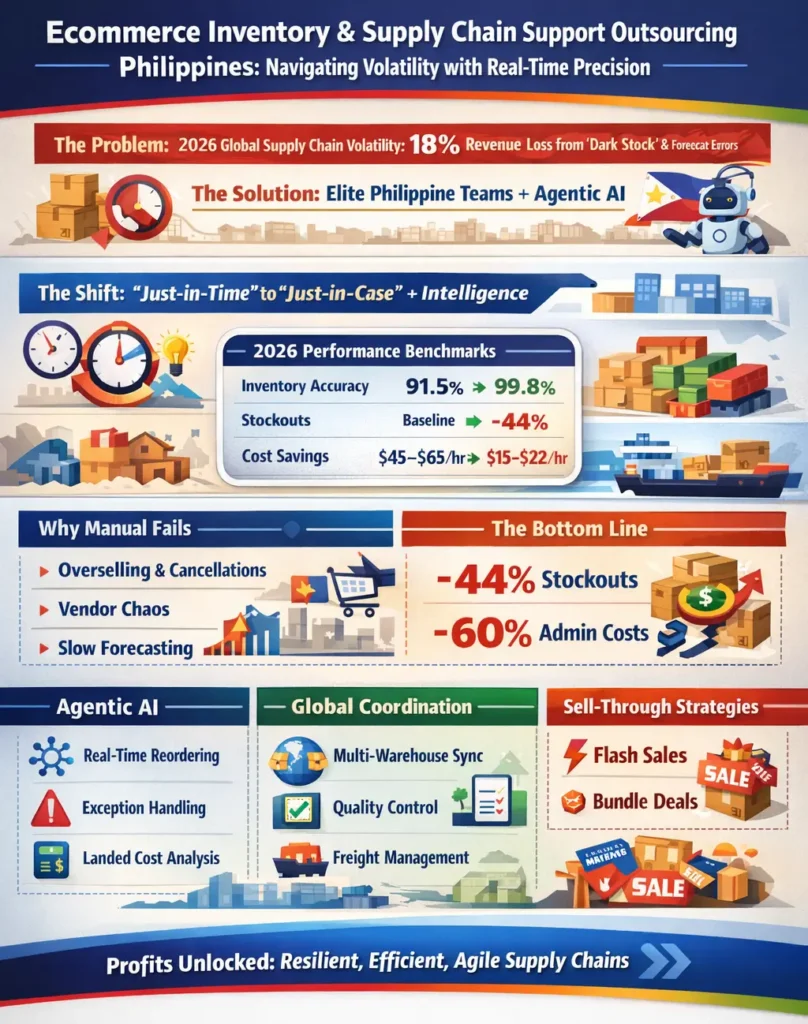
This visual breakdown highlights the Capital Efficiency Matrix of the offshore model. Key benchmarks demonstrate the shift from 24-hour vendor response times to under 2 hours, facilitating faster lead times and higher “Available to Promise” (ATP) accuracy. The infographic illustrates how Agentic AI monitors velocity thresholds to trigger autonomous reordering while specialists handle high-level exception management, such as port disruptions or viral demand spikes. By centralizing oversight in Manila, brands gain a strategic hub that manages the lifecycle of every SKU—from factory WIP reports to RMA reintegration—turning the supply chain into a formidable competitive moat.
The Death of “Just-in-Time” Inventory
In 2026, “Just-in-Time” has been replaced by “Just-in-Case” + Intelligence. Relying on static spreadsheets leads to catastrophic failures during sudden viral social trends or port disruptions.
Why Manual Inventory Management Fails:
- The Latency Trap: Data that is even 4 hours old leads to “Overselling,” resulting in canceled orders and marketplace penalties—plus a wave of “where is my order?” messages that a resolution-first email support team then has to absorb.
- Vendor Fragmentation: Managing 50+ manufacturers across different time zones leads to communication breakdowns and production delays.
- Forecasting Blindness: In-house teams often lack the bandwidth to correlate marketing spend with inventory lead times, leading to stockouts during your biggest sales.
Unit Economics: The “Capital Efficiency” Matrix
Outsourcing to the Philippines allows brands to convert fixed logistics costs into variable, high-output strategic assets.
Table 1: 2026 Supply Chain Performance Benchmarks
| Metric | In-House (Legacy) | Philippine Elite (Agentic) | Strategic Impact |
| Inventory Accuracy | 91.5% | 99.8% | Reduced “Ghost” Stock |
| Stockout Incidents | Baseline | -44% Reduction | Recovered Sales |
| Vendor Response Time | 12–24 Hours | <2 Hours | Faster Lead Times |
| Fully Burdened Rate | US$45 – $65 / hr | **$15 – $22 / hr** | ~65% Net Savings |
Agentic Supply Chain Orchestration: The 2026 Edge
Elite Manila-based teams utilize Agentic AI to manage the lifecycle of every SKU:
- Autonomous Reordering: AI agents monitor velocity across all channels (Amazon, Shopify, TikTok Shop). When stock hits a “Smart Threshold,” the Manila specialist is prompted to approve a pre-drafted PO to the manufacturer.
- Exception Management: If a shipment is flagged as delayed in a port strike, the Manila team proactively shifts “Available to Promise” (ATP) inventory from a secondary warehouse to prevent site-wide stockouts.
- Landed Cost Analysis: Specialists use AI tools to calculate real-time profitability per SKU, factoring in fluctuating freight costs and duties, allowing for dynamic pricing adjustments.
The Expert Perspective: The Strategic Hub
John Maczynski, CEO of PITON-Global, notes: “The supply chain is where the most ‘silent’ money is lost. Having operated at the intersection of global BPO and e-commerce scaling for decades, I can tell you that you cannot effectively manage global inventory from a headquarters in London or New York alone. You need a 24/7 ‘Nerve Center’ in the Philippines. Data across our BPO partners shows that when teams in Manila move beyond ‘tracking boxes’ to managing the actual flow of capital, the results are transformative. By integrating a disciplined operational mindset with real-time analytical oversight, our partners are turning the supply chain from a traditional cost center into a formidable competitive moat.”
Global Vendor & 3PL Coordination
Elite offshore partners act as the primary liaison between your brand and the world:
- Multi-Warehouse Sync: Ensuring inventory levels are perfectly balanced between US-East, US-West, EU, and UK nodes.
- Quality Control Oversight: Remotely managing factory inspections and ensuring that “Work-in-Progress” (WIP) reports are accurate.
- Freight & Drayage Support: Coordinating with freight forwarders to ensure the “Last Mile” to the 3PL is as efficient as the “First Mile” from the factory.
Turning Data into “Sell-Through”
A unique 2026 insight: Inventory data is actually a marketing tool. Specialists provide real-time reports on “Slow-Movers.” Instead of waiting for a quarterly review, they alert the marketing team instantly to run a “Flash Sale” or a “Bundle Deal” on overstocked items, freeing up cash flow immediately.
Expert FAQ: The Stock & Vendor Briefing
Q: Can they handle proprietary ERPs?
Yes. Premium Manila teams are platform-agnostic, with deep expertise in NetSuite, SAP, Microsoft Dynamics 365, and Linnworks.
Q: How do they handle time-zone differences with vendors?
The Philippines’ 24/7 work culture means agents can sync with China/Vietnam in the morning and the US/EU in the evening, ensuring 24-hour vendor coverage.
Q: Is this only for large enterprises?
No. Middle-market brands see the highest ROI by utilizing offshore teams to manage their 3PL relationships, which are often the source of most logistical friction.