

The 30-Second Executive Briefing
- The Problem: In 2026, e-commerce return rates keep climbing, especially in apparel. Most brands treat returns as a “sunk cost,” losing inventory value to slow processing and “WISMR” (Where Is My Refund) inquiries.
- The Shift: Returns management has evolved from a back-office burden to a Revenue Recovery & Retention strategy, one pillar of Philippine customer service for online retail brands.
- The Solution: Specialized ecommerce returns & RMA management outsourcing Philippines that uses Agentic AI to convert a large share of return requests into exchanges or store credit instantly.
- The Bottom Line: Premium Manila-based teams cut refund processing times dramatically while recovering at-risk revenue through high-EQ “Save-the-Sale” interactions.
Executive Summary: The Strategic “Second Impression”
A return is not the end of a customer relationship; it is a critical “second impression” that determines long-term loyalty. Ecommerce returns & RMA management outsourcing Philippines through vetted partners shifts the focus from passive refunding to active recovery. By integrating Filipino service excellence with real-time API connectivity to Shopify, Amazon, and ERP systems, brands can ensure that returns are authorized, inspected, and restocked (or exchanged) with zero friction, protecting both the balance sheet and the brand’s reputation. This architecture is reinforced by advanced ecommerce fraud prevention protocols that detect serial return abuse, synthetic identity patterns, and policy manipulation before inventory or revenue is compromised. Optimizing reverse logistics is a key efficiency lever in the modern ecommerce outsourcing guide.
From Sunk Cost to Success: The Philippine Returns & RMA Model
In 2026, with apparel return rates at record highs, reverse logistics is the ultimate margin-killer. This infographic demonstrates how specialized offshore RMA teams transform this burden into a Revenue Recovery strategy. By utilizing Agentic AI for instant exchange logic and visual verification, Manila-based specialists convert a large share of return requests into exchanges or store credit. This model slashes refund processing times and sharply reduces “WISMR” (Where Is My Refund) tickets. With substantial net savings, brands can deploy high-EQ “Save-the-Sale” interactions that protect the balance sheet, detect serial return fraud, and provide a critical product feedback loop for R&D.
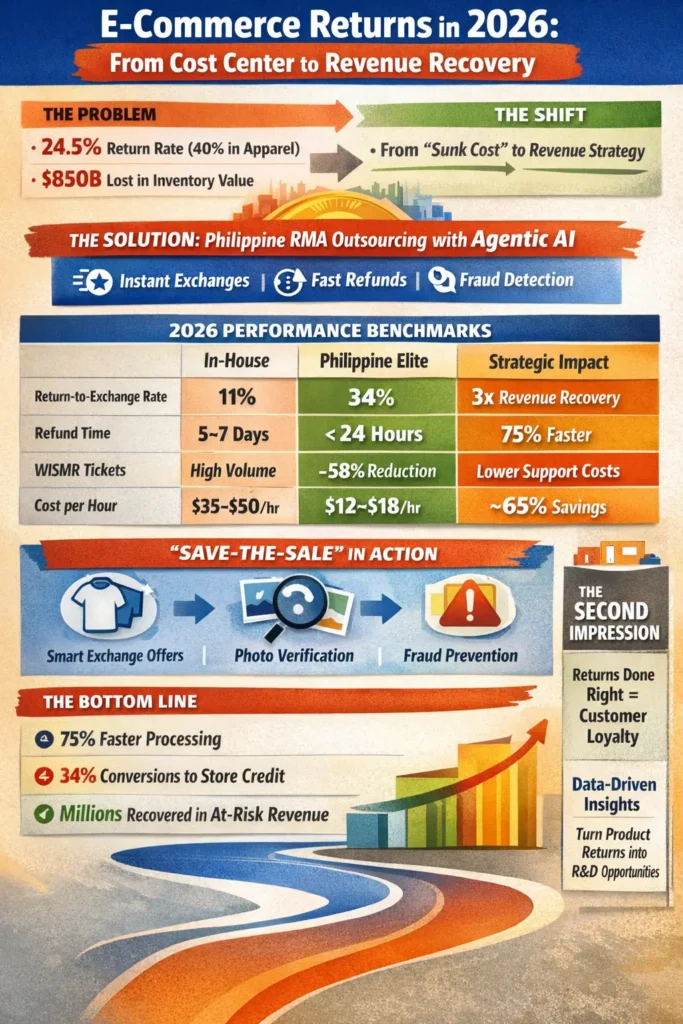
This visual guide highlights the Strategic ROI of the offshore model. Key benchmarks show the jump in exchange rates over legacy handling through proactive consultative support. The infographic illustrates the End-to-End RMA Orchestration—from QR-coded labelless returns to 72-hour warehouse restocking. By integrating Predictive Fraud Detection and Visual Verification, Manila specialists ensure that only sellable inventory is shipped back, saving millions in wasted freight. This “Human-in-the-Loop” approach ensures that every return is treated as a loyalty-building “second impression” rather than a terminal transaction.
The Hidden Cost of the “Refund-First” Mentality
In 2026, the cost to process a single return—factoring in reverse logistics, inspection, and administrative labor—is substantial for every item.
Why Traditional RMA Processes Fail:
- The “Limbo” Effect: Returned items often sit in a warehouse for 10–14 days before being “graded,” causing inventory stagnation and seasonal markdowns.
- The Support Surge: A large share of all customer service tickets are “Where is my refund?” or “How do I return this?”, overwhelming domestic teams and driving up CAC (Customer Acquisition Cost).
- Missing the Exchange: Without a dedicated “Revenue Recovery” specialist, most systems default to a refund, permanently losing the sale and the customer.
Unit Economics: The “Revenue Recovery” ROI
Outsourcing returns to the Philippines transforms a cost center into a self-funding retention engine.
Table 1: 2026 Returns & RMA Performance Benchmarks
| Metric | In-House (Legacy) | Philippine Elite (Agentic) | Strategic Impact |
| Return-to-Exchange Rate | 11% | 34% | 3x Revenue Recovery |
| Refund Processing Time | 5–7 Days | <24 Hours | Improved CSAT |
| “WISMR” Ticket Volume | Baseline | -58% Reduction | Lower Support Costs |
| Fully Burdened Rate | US$35 – $50 / hr | **$12 – $18 / hr** | ~65% Net Savings |
The “Save-the-Sale” Framework in Action
Elite Manila hubs utilize Agentic AI and high-skill specialists to intercept the return:
- Instant Exchange Logic: When a customer initiates a return for “fit” or “color,” the agent is prompted with real-time inventory to offer an immediate replacement or a “Style-Upgrade” at a discount, keeping the cash within the brand.
- Visual Verification (RMA): Specialists use AI-assisted image review to verify the condition of returned goods via customer-uploaded photos before the shipping label is issued, drastically reducing shipping costs for “unsellable” items.
- Predictive Fraud Detection: AI pattern-matching identifies “serial returners” or “wardrobing” behavior in real-time, allowing the Manila team to flag high-risk RMAs for manual review.
The Expert Perspective: Reclaiming the Margin
Expert Insights: Mastering the Reverse Loop
John Maczynski, CEO of PITON-Global, notes: “In the 2026 retail environment, the winners are those who master the ‘Reverse Loop.’ Retailers can no longer afford a ‘refund-by-default’ strategy. The Philippine workforce possesses a unique combination of high emotional intelligence and technical proficiency. When a customer is frustrated, a Manila-based agent can empathize, troubleshoot, and suggest a better alternative in real-time. This isn’t just processing a return; it’s an active recovery of the margin that would otherwise disappear, effectively turning a logistical loss into a retention win.”
End-to-End RMA Orchestration
The 2026 offshore returns specialist manages the entire lifecycle of the reverse supply chain:
- RMA Authorization: Multi-channel support (Chat, SMS, WhatsApp) to guide customers through the return portal and issue QR-coded labelless returns.
- Warehouse Liaison: Coordinating with 3PLs to ensure that “Received” items are graded (New, Open-Box, Damaged) and back on the “Digital Shelf” within 72 hours.
- Refund Reconciliation: Working within the ERP to ensure refunds are triggered only after physical verification, preventing the “Double-Refund” errors common in manual systems—an extension of the disciplined order management for online retail that keeps forward orders clean.
Returns as a Product Feedback Loop
A unique 2026 insight: Your returns are your best “Product R&D” data. Offshore teams categorize return reasons with granular precision. If a notable share of returns for a specific SKU cite “zipper failure,” the Manila hub provides an instant alert to the supply chain team to address the defect at the factory level, preventing thousands of future returns.
Expert FAQ: The Returns Management Briefing
Q: Can they handle cross-border returns?
Yes. Manila teams are experts at managing “Duty Drawbacks” and international customs documentation for returns originating in the US, UK, and EU.
Q: How do you handle “Return Fraud”?
We implement “Behavioral Biometrics” and history-tracking. If a customer has an unusually high return-to-purchase ratio, the Manila team applies stricter verification protocols.
Q: Can this be integrated with Shopify/Loop/Returns Center?
Absolutely. Elite offshore partners are certified on all major 2026 returns platforms and integrate via API for seamless data flow.