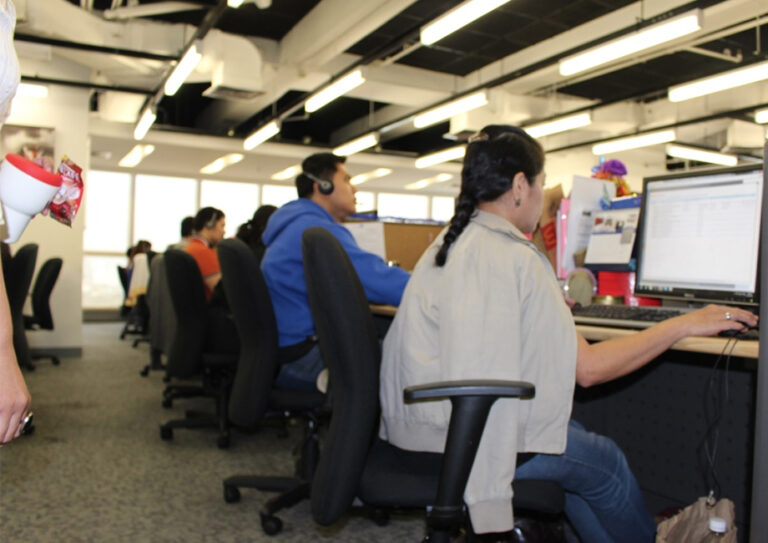
The Manila support floor a North American buyer contracts in 2026 is a platform operation first and a room full of headsets second. Advanced tech now sits underneath every customer support interaction the offshore team handles: AI triages and drafts, voice biometrics verifies the caller, a single omnichannel record follows the customer from chat to phone, and the analytics layer tells the vendor where resolution is slipping before the client notices. That matters to a VP of CX because the technology, not the hourly rate, decides whether a managed customer support team in the Philippines protects first-contact resolution as volume grows. This post walks through the six layers that changed, what each one does for the customer, and what a buyer should ask to see before signing.
What changed: from voice floors to platform-run desks
The change is that the provider’s software stack, rather than its headcount, now sets the quality ceiling. A decade ago a Philippine center sold English-fluent agents and a dialer; today the same vendor sells an integrated platform in which the agent is one component among routing engines, knowledge bases, identity systems and reporting. The industry that grew up on that shift is large: IBPAP reported through the Philippine Star in January 2026 that IT-BPM revenue passed $40 billion in 2025 with 1.9 million digital workers, and set a 2026 baseline of $42 billion. Scale like that is only manageable when the tooling does the heavy lifting.
For the buyer, the practical consequence is that vendor selection has become a technology audit as much as a people audit. The broader story of how the Philippine CX sector reached its current position is worth reading alongside this one, but the sections below stay on the tools themselves.
AI on the front line: deflection, agent assist and predictive routing
AI earns its place in three distinct jobs, and a serious vendor will show you all three separately rather than talking about “AI-powered support” in general.
Deflection of routine contacts
Chatbots and virtual agents absorb order status, password resets, balance inquiries and appointment changes. Done well, the bot resolves the simple contact end to end; done badly, it becomes a maze the customer escapes by typing “agent” four times. Ask the provider for containment rate and for the escape rate, and ask how often a deflected contact returns as a phone call within 48 hours. That last number tells you whether the bot resolved anything or only delayed the human contact.
Agent assist during the live contact
Agent assist listens to or reads the interaction and surfaces the relevant knowledge article, the customer’s recent history and a suggested next step. It shortens handle time, but its real value is consistency: a six-week-tenure Filipino agent in Cebu and a six-year veteran give the same answer to the same warranty question. It also drafts the after-call summary, which removes the two or three minutes of wrap-up that used to pad every call.
Predictive routing and anticipation
Predictive models score each inbound contact for intent, churn risk and complexity, then route it to the queue or agent most likely to resolve it. The same models flag accounts that are about to call, so the offshore team can reach out first about a delayed shipment or a failed payment. Proactive contact is one of the cleanest ways to lift first-contact resolution, because the customer never has to explain the problem twice.
Voice biometrics and identity verification
Voice biometrics replaces the knowledge-based questions (mother’s maiden name, last four digits) with a match against the caller’s enrolled voiceprint, and it does two things at once: it cuts 30 to 60 seconds of friction from the start of every call, and it removes the weakest link in account takeover, since a fraudster who has bought a customer’s personal data still does not have their voice.
Banking, insurance, fintech and healthcare programs delivered from Manila were the earliest adopters because their regulators demand strong authentication and their customers punish slow authentication. A buyer in those verticals should ask the vendor three things: whether enrollment is passive (built up during normal conversation) or active (the customer records a phrase), how the system handles a poor match without stranding the caller, and where voiceprints are stored, because under PCI DSS and GDPR that biometric is regulated data. The provider’s answers belong in the security schedule of the contract, not in a slide deck.
Omnichannel platforms: one record across voice, chat, email and social
Omnichannel means the customer who started on chat, moved to email and finally called does not repeat themselves, because the agent sees all three threads in one timeline. Multichannel, by contrast, means the vendor answers on five channels with five separate tools and five separate histories. Many providers still sell the second while describing the first.
The test is simple. During a site visit or a remote demo, ask an agent in Manila to pull up a customer who has contacted the brand on at least two channels in the past week and show you the unified history. If the agent alt-tabs between systems, the platform is multichannel. Social channels deserve special scrutiny because they are public: a delayed or inconsistent reply on X or Facebook is a reputation event, not a queue metric. The desk also needs a route for emerging channels; the sibling piece on how Philippine centers are preparing for immersive and virtual channels shows how far ahead some vendors are planning.
Cloud, distributed work and continuity
Cloud contact-center platforms let a Philippine vendor move an entire program between a Manila site, a Cebu site and agents’ homes without the customer noticing, and that portability is now a continuity requirement rather than a pandemic memory. Typhoons, transport strikes and power interruptions are planning assumptions in the archipelago, and a cloud-hosted desk with hybrid staffing rides through them.
Policy caught up with practice. The CREATE MORE Act, signed in November 2024, allows registered enterprises to run work-from-home arrangements for up to half their workforce without losing their fiscal incentives, which removed the last regulatory reason for vendors to keep every seat on site. Ask a prospective provider what share of your program would be on site, remote and hybrid, and how the endpoint controls (virtual desktops, device management, clean-desk monitoring) differ between the three.
Analytics: turning contacts into decisions
Speech and text analytics read every interaction, not a sampled handful, and that changes what quality assurance can see. Instead of a QA analyst scoring five calls per agent per month, the platform tags every contact for sentiment, compliance phrases, silence, repeat-contact reason and product mention. The output is a weekly view of why customers are calling and which root causes upstream of the desk (a confusing invoice, a broken returns flow) are generating volume the client could remove entirely.
Buyers should insist on receiving the raw contact-reason data, not only the vendor’s summary, and should agree in advance which contact center KPIs the analytics layer will be held to. Retention-oriented programs also tie the analytics to commercial outcomes; back-office and information-services work runs on the same principle, as the piece on keeping front-office support consistent through information-services delivery from the Philippines explains.
Immersive training: simulation, VR and gamified practice
Simulation training lets a new hire in Davao handle a furious billing dispute or a distressed patient in a controlled environment before a real customer is on the line. Virtual and augmented reality modules go a step further for product-heavy programs, walking an agent through a router setup or a medical device so they can guide the customer with their hands, not just a script. Gamified practice keeps tenured agents sharp on rare scenarios that a normal month never produces.
The buyer’s question is whether the training investment shows up in the ramp curve. Ask for time-to-proficiency by cohort and for the quality scores of agents in their first 30 days versus their first 90. A vendor that uses simulation seriously will have those numbers to hand.
What the technology means for cost and for the buyer’s checklist
The technology layer is already priced into a Philippine desk, which is why the economics hold even as the tooling gets richer. PITON-Global’s 2026 pricing calculator uses a $12 per hour fully-loaded base rate that already includes team-lead and QA supervision, against a US in-house benchmark of $33 per hour, for typical savings of 50 to 70 percent. The platform costs above sit inside that loaded rate at any provider worth shortlisting.
Before signing, a buyer should be able to tick every item on this list from evidence the provider showed, not described.
- The bot’s containment rate and its 48-hour recontact rate, side by side.
- A live demonstration of a unified customer timeline across at least two channels.
- The identity method for each channel, and where any biometric data is stored.
- The on-site, remote and hybrid split for your program, with the endpoint controls for each.
- A sample weekly contact-reason report from an existing client, anonymized.
- Time-to-proficiency by cohort for the last two hiring waves.
Frequently asked questions
Does more automation mean fewer Filipino agents on my program?
Usually it means a different mix rather than a smaller one. Deflection removes the simplest contacts, so the remaining human work is more complex and longer, and the seats that stay are more senior. Expect the vendor to propose fewer entry-level seats and more retention, escalation and technical roles over the life of the contract.
Should I bring my own platform or use the vendor’s?
Bring your own if you already run a cloud contact-center platform and your data-residency rules favor it; the Manila team logs into your tenant and your reporting stays intact. Use the vendor’s when you are standing up support from scratch or consolidating several tools, and negotiate data-export rights so the interaction history remains yours if you change providers.
How do I know the analytics are not just vanity dashboards?
Ask what decision the client changed last quarter because of the vendor’s analytics, and ask to see the report that drove it. A useful analytics function produces a short list of root causes the client can fix upstream; a decorative one produces sentiment gauges.
Is voice biometrics appropriate for a non-regulated consumer brand?
It can be, if account takeover or refund fraud is a material cost. For a low-risk program, a lighter verification method is cheaper and less intrusive. The decision should follow your fraud data, not the vendor’s feature list.