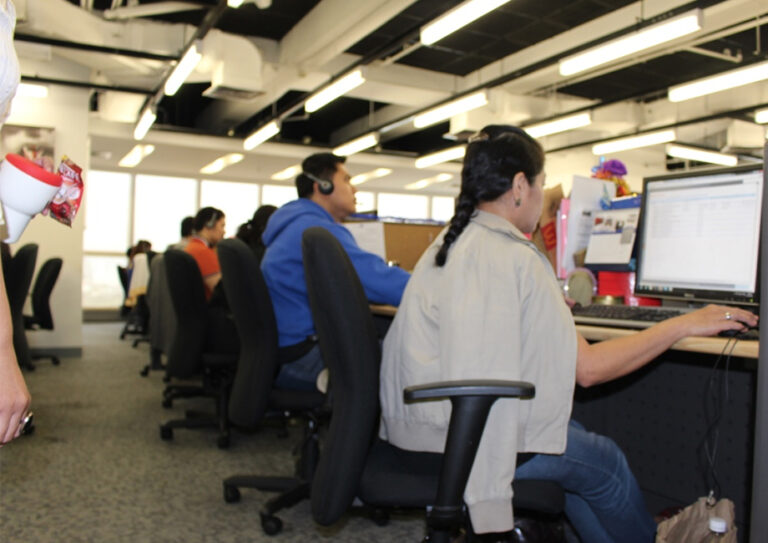

TL;DR: The Key Takeaway
Autonomous vehicle data labeling outsourcing in the Philippines is the critical enabler for the self-driving revolution, providing the meticulously verified and context-rich data that autonomous systems require to navigate the complexities of the real world. This strategic partnership delivers the human-powered validation essential for achieving certifiable levels of safety and reliability in AI-driven mobility.
The transition to dependable autonomous mobility relies on massive quantities of human-verified training data that exceed the limits of automation. Filipino data specialists provide the essential cognitive reasoning and edge-case validation required to minimize phantom braking and enhance pedestrian detection. By serving as a “human firewall,” these experts ensure the logical consistency and certifiable safety of the datasets powering the world’s leading self-driving platforms in 2026.
- Accuracy Over Volume: Developers have shifted focus from cost-per-hour to the tangible impact of high-fidelity data on vehicle safety metrics.
- Cognitive Specialization: The Philippines offers a workforce uniquely skilled in behavioral prediction and complex scenario analysis.
- Strategic Validation: Local teams act as “AI Pilots,” auditing machine-generated labels to ensure they align with real-world physics and logic.
- Risk Mitigation: Expert human-in-the-loop (HITL) processes systematically eliminate “edge case blindness” that can lead to system failure.
- PITON-Global’s Edge: The firm bridges the gap between AV innovators and elite Philippine labs capable of delivering mission-critical training data.
The Unseen Engine of Autonomy: High-Fidelity Data
Constructing a fully autonomous vehicle stands as one of the most daunting technical hurdles of the modern era. While high-performance LiDAR and neural networks often steal the spotlight, the true driver of progress is the underlying quality of the training data. A vehicle’s capacity to navigate a chaotic intersection or anticipate a cyclist’s swerve is not an inherent trait; it is a learned behavior refined through millions of exposures to expertly curated information.
Every camera feed and radar pulse is merely a stream of raw sensory noise until a human interprets it. This translation process—data annotation—involves identifying and contextualizing every variable in the driving environment. Precise labeling is non-negotiable; a single inaccurately drawn polygon or a misidentified traffic signal can feed the AI a “poisoned” lesson, resulting in dangerous real-world errors. As the industry advances toward Level 4 and Level 5 autonomy, the demand for this high-stakes cognitive work has made quality data the primary bottleneck for commercial deployment.
From Bounding Boxes to Behavioral Prediction: The Evolving Role of the Human Annotator
In the early days of autonomy, the task was simple: draw boxes around cars in a static image. However, the requirements for 2026-era Advanced Driver-Assistance Systems (ADAS) have moved far beyond basic geometry. Today’s models require a deep, predictive understanding of human intent.
Modern annotators must look past the pixels to determine if a pedestrian is actively entering a crosswalk or merely standing on the sidewalk. They must assess a motorcyclist’s body language to predict a lane change before it happens. This level of intuition cannot be simulated by current software; it requires human reasoning and real-world experience. The Philippine workforce, known for its analytical depth and familiarity with complex, high-density traffic environments, has become the global standard for this nuanced behavioral labeling.
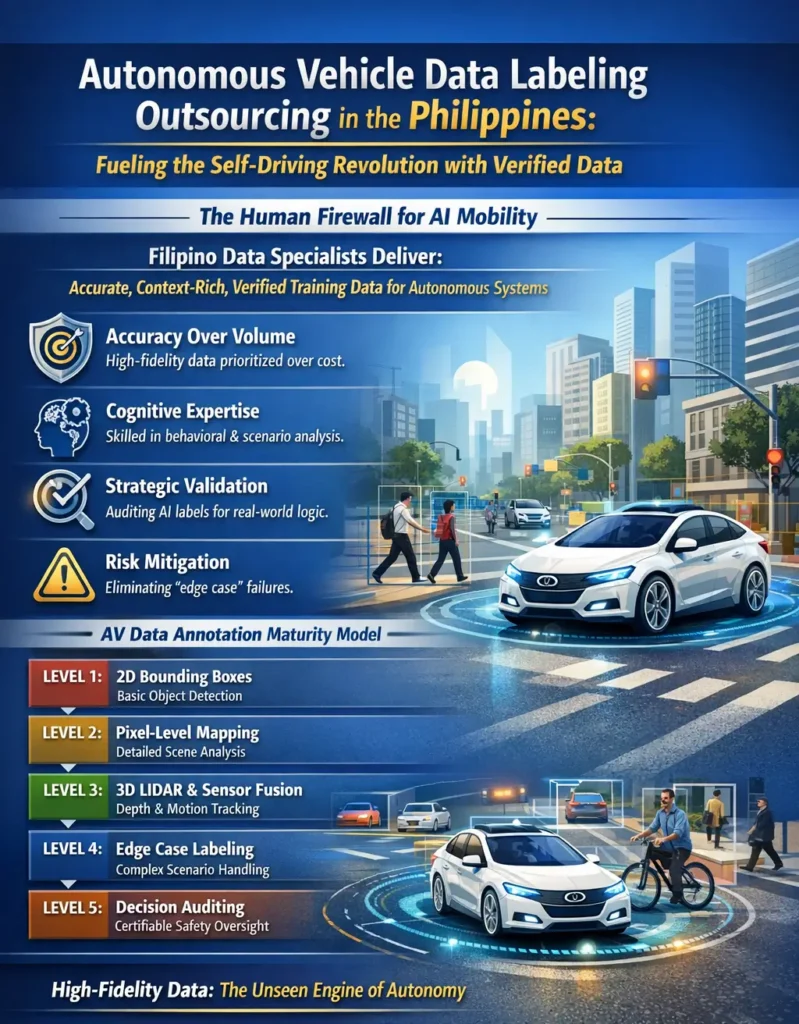
AV Data Annotation Maturity Model: From Raw Data to Verifiable Safety
The path to commercial autonomy is defined by five distinct levels of data sophistication. This hierarchy demonstrates how the role of Philippine teams evolves from simple identification to critical safety governance.
| Maturity Level | Primary Task | Strategic Impact |
| Level 1: Foundational | 2D Bounding Boxes | Supports basic features like lane departure warnings. |
| Level 2: Semantic | Pixel-level Scene Mapping | Enhances the AI’s total environmental comprehension. |
| Level 3: Multi-Modal | 3D LiDAR & Point Cloud | Critical for depth perception and collision avoidance. |
| Level 4: Contextual | Edge Case & Scenario Labeling | Improves the AI’s ability to handle rare, unpredictable events. |
| Level 5: Agentic | Decision Validation & Auditing | Provides the ultimate layer of certifiable safety and trust. |
Intelligence Arbitrage: The New Currency in AV Development
The old outsourcing playbook focused on labor arbitrage—saving money through lower wages. In the high-stakes world of self-driving technology, that model is dead. It has been replaced by Intelligence Arbitrage, where the goal is to gain a competitive advantage through superior cognitive input. For developers, this means faster model convergence, fewer “hallucinations,” and a swifter path to regulatory approval.
“AV pioneers are no longer looking for teams that can just draw boxes. They need a ‘truth layer’ that can challenge the AI’s assumptions. Our specialized teams in the Philippines serve as safety auditors, providing the human judgment that turns a prototype into a certifiably safe product. We aren’t just delivering data; we’re delivering the confidence to deploy.” — John Maczynski, CEO, PITON-Global
This focus on high-value cognitive talent is why the Philippines has become the epicenter of the self-driving support ecosystem. Local providers are no longer vendors; they are essential R&D partners embedded in the development of the world’s most advanced mobility systems.
Agentic Governance: The Human Firewall for AI Mobility
As autonomous systems take more control, the concept of Agentic Governance has emerged as the final safeguard. This discipline involves human experts auditing the AI’s actual decision-making logs. If a vehicle experiences a “phantom braking” event—stopping for no apparent reason—specialists in the Philippines dissect the sensor data to find the root cause. This human oversight ensures that the AI’s logic is not just technically functional, but also rational and safe for public roads. This represents the peak of human-in-the-loop technology, and it is being pioneered within the Philippine BPO sector.
Mitigating Critical Risks through Expert Validation
The following table highlights how professional human intervention prevents the most common and dangerous AI failure modes.
| Critical Risk | AI Failure Mode | Human-in-the-Loop Mitigation |
| Object Confusion | Misidentifying a harmless object as a threat. | Semantic Nuance: Humans label based on context, reducing false positives. |
| Edge Case Blindness | Failure to handle novel or rare scenarios. | Targeted Sourcing: Teams find and label rare events to expand AI knowledge. |
| Sensor Conflict | Conflicting data from LiDAR and cameras. | Fusion Validation: Humans cross-reference streams to establish “Ground Truth.” |
| Logical Flaws | Making technically “correct” but unsafe choices. | Agentic Governance: Auditors ensure AI behavior follows human safety protocols. |
Expert FAQs
Why isn’t synthetic data enough to train these vehicles? While synthetic data is excellent for scaling, it lacks the messy, unpredictable “noise” of the real world. Expertly labeled real-world data provides the “ground truth” that validates whether the AI can handle actual human behavior and environmental unpredictability.
What makes Filipino specialists uniquely qualified for this work? It is a blend of high analytical aptitude and cultural context. Their fluency in English allows for the interpretation of complex, multi-layered annotation guidelines, while their experience in dense urban centers provides an intuitive understanding of traffic flow that a remote algorithm simply cannot match.
Does higher-quality labeling actually reduce overall costs? Yes. By investing in “Intelligence Arbitrage” early, developers avoid the massive costs of retraining models due to bad data. High-quality initial labeling accelerates the R&D cycle and reduces the risk of catastrophic public failures, providing a much higher return on investment.
What happens to human annotators as AI-powered labeling improves? Their role is shifting from manual entry to high-level oversight. Humans are becoming the “judges” of the AI’s work. As “AI Safety Auditors,” they focus on the 5% of cases that confuse the machine, ensuring the final output is 100% safe.