

On this page
- Key Takeaways
- Which Back-Office Functions Yield the Strongest Return on Investment?
- Why Does the Philippines Consistently Outperform Competitors in Back-Office Delivery?
- How Should CFOs and COOs Calculate the True ROI of Shared Services Outsourcing?
- What Does the Return Look Like in Practice?
- How Does PITON-Global Reduce Risk and Accelerate Vendor Match Quality?
- Frequently Asked Questions
Finance and Accounting, technical IT infrastructure, and Health Information Management deliver the highest shared services ROI when outsourced to the Philippines, routinely cutting net cost by well over half, a saving you can test against your own headcount with pricing you can model before talking to sales. Beyond labor arbitrage, these functions maximize ROI by cutting error rates sharply, accelerating process cycle times, and avoiding multi-million-dollar onshore software licensing and compliance overhead.
Key Takeaways
- Finance and Accounting leads ROI: Complex transactional and analytical finance tasks deliver a cost reduction of roughly two-thirds while improving audit accuracy and closing speed.
- IT infrastructure and cybersecurity: Round-the-clock L2/L3 support and threat monitoring yield deep operational savings compared with maintaining onshore internal teams.
- Health Information Management: Medical coding, revenue cycle management, and claims processing drive rapid cash flow recovery and push claim denial rates down to a low single-digit share.
- Beyond labor savings, with risk mitigation: True ROI is driven by operational scale, process standardization, human-in-the-loop AI integration, and the elimination of onshore capital expenditure—and it requires SOC 2 Type II compliance, ISO 27001 certification, and vendor-neutral partner selection.
Which Back-Office Functions Yield the Strongest Return on Investment?
Four function groups yield the strongest returns: Finance and Accounting (AP, AR, general ledger reconciliation, FP&A, payroll), Information Technology (L1–L3 helpdesk, network monitoring, cloud administration, cybersecurity, application maintenance), Healthcare shared services (medical billing and coding, clinical documentation, claims adjudication, credentialing), and HR and talent operations (RPO, onboarding, HR analytics, benefits). Cost reductions per FTE are steep across all four.
While customer experience remains a major driver of BPO volume in the country, specialized back-office shared services deliver higher financial returns. Evaluating functions by net operational savings, error reduction, and capital expense reduction shows where executive teams capture maximum yield:
- Finance and Accounting: Accounts Payable, Accounts Receivable, general ledger reconciliation, financial planning and analysis, and payroll administration.
- Information Technology services: L1–L3 IT helpdesk, network infrastructure monitoring, cloud systems administration, cybersecurity operations, and application maintenance.
- Healthcare shared services: Medical billing and coding, clinical documentation improvement, claims adjudication, and credentialing.
- Human Resources and talent operations: Global recruitment processing, onboarding logistics, HR analytics, and benefits administration.
Plotting these functions by complexity against net financial ROI, as below, shows why the specialized functions cluster in the high-yield quadrant: the more specialized the work, the larger the onshore cost it replaces and the more value process precision adds on top of the wage differential.
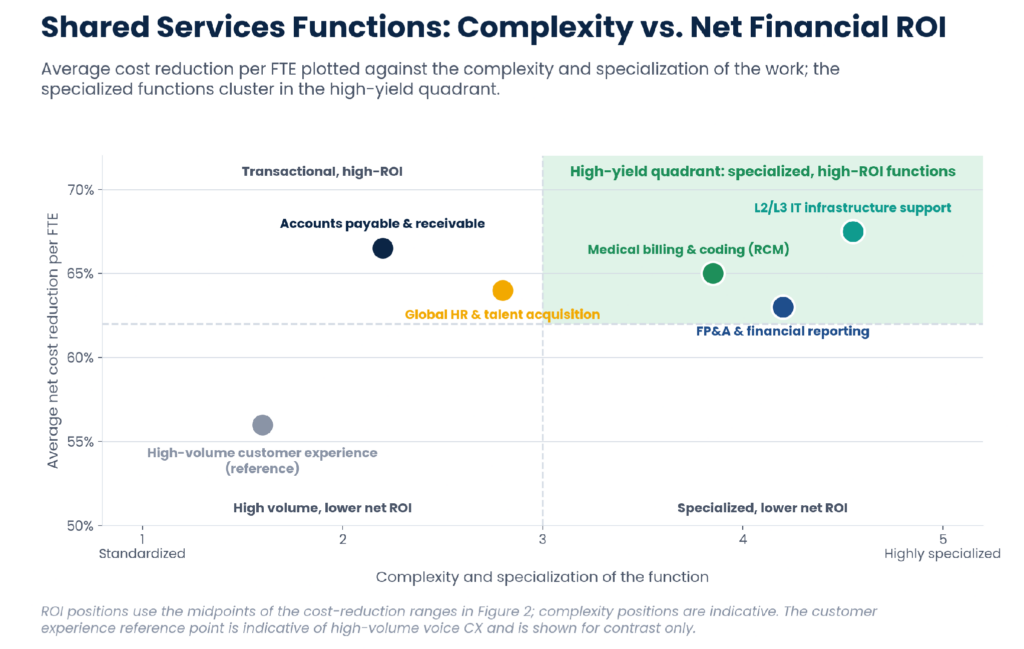
Figure 1. Shared services functions plotted by complexity and specialization against net financial ROI, with Finance and Accounting, IT, and healthcare in the high-yield quadrant.
The table below sets onshore and offshore annual cost per FTE side by side for the five highest-yield functions, with the primary value driver each delivers beyond arbitrage.
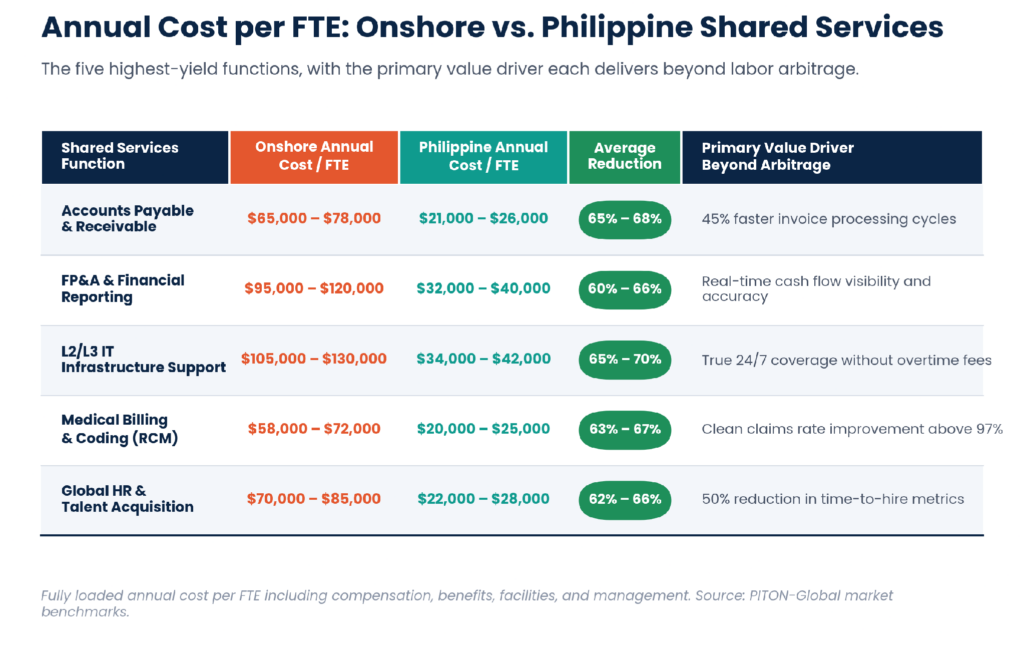
Figure 2. Onshore versus Philippine annual cost per FTE, average cost reduction, and primary value driver for the five highest-yield shared services functions.
Why Does the Philippines Consistently Outperform Competitors in Back-Office Delivery?
The Philippines outperforms because it combines scale with precision: more than 700,000 university graduates a year, including tens of thousands of CPAs, certified IT professionals, registered nurses, and financial analysts; near-native English fluency and cultural alignment with Western corporate governance; high retention; and infrastructure protected by economic zone incentives and data privacy regulation aligned with HIPAA and GDPR.
The Philippines has evolved into a global center of excellence for shared services. The country produces over 700,000 university graduates annually, including tens of thousands of Certified Public Accountants, certified IT professionals, registered nurses, and financial analysts—the exact talent pools that Finance and Accounting, IT, and healthcare shared services draw on.
Unlike lower-cost regions where language barriers or high employee attrition disrupt complex operations, Filipino professionals offer strong cultural alignment with Western corporate governance, near-native English fluency, and high retention rates. The country’s infrastructure, protected by economic zone incentives and strict data privacy regulations aligned with HIPAA and GDPR, provides a secure environment for sensitive corporate data. The chart below compares the two attributes that matter most for shared services—retention and audit accuracy—across the leading offshore destinations.
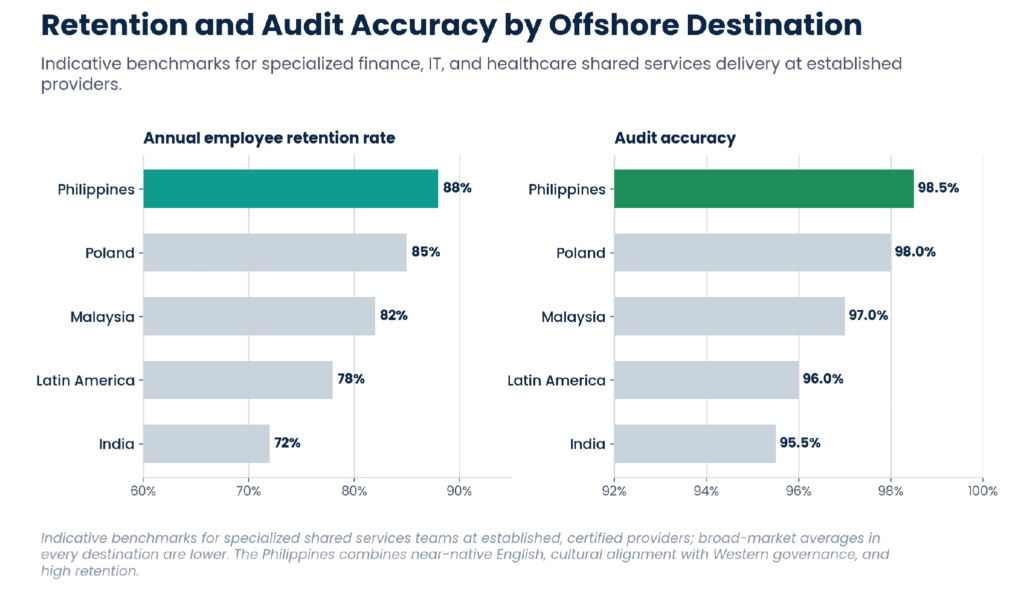
Figure 3. Employee retention rates and audit accuracy across the top global shared services offshore delivery destinations (indicative benchmarks).
High ROI in shared services is never achieved through cheap labor alone. It is achieved when an offshore unit operates with higher compliance, lower error rates, and greater process velocity than the internal team it replaced. The Philippines excels because it combines technical precision with operational ownership.
— John Maczynski, CEO, PITON-Global
How Should CFOs and COOs Calculate the True ROI of Shared Services Outsourcing?
A fully loaded ROI model captures four levers: direct labor savings (compensation, benefits, facilities); process velocity and error elimination (fewer late-payment penalties, disputed claims, and faster closes); capital expenditure avoidance (IT investments, software seats, real estate, training); minus ramp-up and productivity drag over the first 90–180 days. Net ROI equals those net savings divided by total transition and offshore investment.
Calculating ROI requires looking beyond simple direct wage comparisons. Each lever below is quantifiable, and the fourth is a subtraction that most business cases forget.
Direct Fully Loaded Labor Savings
Total compensation, payroll taxes, healthcare benefits, and facility overhead saved per onshore headcount, net of the offshore team’s own fully loaded cost, including statutory items such as the night differential paid on US-hours shifts. This is the lever every business case includes, and on its own it understates the return.
Process Velocity and Error Elimination
Quantifiable financial gains from reduced late-payment penalties, fewer disputed claims, and faster monthly financial closes. In receivables, revenue cycle, and IT operations this lever can rival the labor saving itself, a pattern that also shows up in the economics of outsourcing food-delivery operations.
Capital Expenditure Avoidance
Savings from avoiding internal IT investments, enterprise software seats, physical real estate expansion, and specialized training programs that an onshore build-out would require.
Ramp-up and Productivity Drag
Subtract initial migration costs, parallel-run expenses, and vendor governance oversight during the first 90 to 180 days. The formula below brings the four levers together, with a worked example.

Figure 4. The net ROI formula for shared services outsourcing and its four levers, with a worked example for a 25-FTE finance and accounting team (illustrative).
What Does the Return Look Like in Practice?
Shared services ROI in practice exceeds labor savings. A mid-market North American logistics enterprise with a 45-day receivables lag and a large backlog of annual uncollected invoices deployed a 25-FTE dedicated F&A team in Manila for invoicing, collections, and vendor reconciliations, cutting operating costs by roughly two-thirds, reducing DSO from 45 to 22 days, and recovering most of the uncollected accounts within nine months.
Client Challenge
A mid-market logistics firm struggled with a 45-day accounts receivable lag and a substantial backlog of annual uncollected invoices because of an understaffed internal finance team.
Vendor Selection
PITON-Global conducted an operational audit and matched the client with a specialized Manila-based shared services provider experienced in complex freight billing and ERP management.
Solution Implemented
A 25-FTE dedicated finance and accounting team was deployed in Manila to handle invoicing, collections, and vendor reconciliations, working directly inside the client’s ERP under accuracy and cycle-time SLAs.
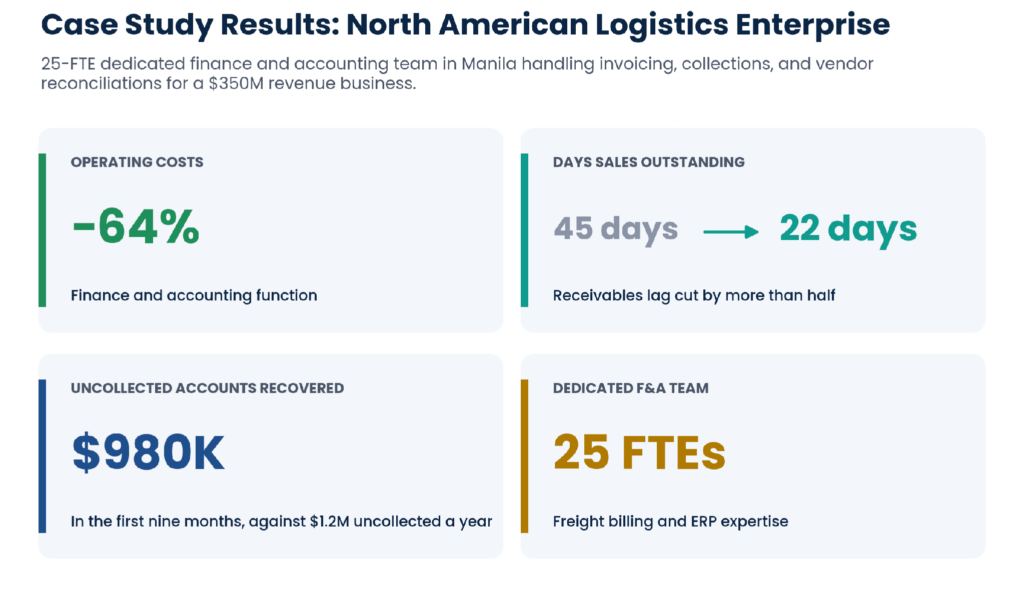
Figure 5. Quantifiable outcomes of the logistics enterprise’s finance and accounting shared services deployment.
Outcomes and Lessons
The enterprise cut operating costs by roughly two-thirds, reduced Days Sales Outstanding from 45 days to 22 days, and recovered the bulk of its uncollected accounts in the first nine months. The lesson: partnering with a provider with deep domain expertise in financial workflows generates value that exceeds labor savings and shows up directly in the EBITDA improvement a program delivers.
How Does PITON-Global Reduce Risk and Accelerate Vendor Match Quality?
PITON-Global is an advisory and management consultancy that connects organizations with vetted Philippine service providers tailored to their requirements. Unlike traditional brokers, it acts as an independent advisor, drawing on a network of more than 100 evaluated partners to structure SLAs, verify SOC 2, ISO 27001, and PCI DSS compliance, and select providers that maximize operational performance.
Who Is PITON-Global?
PITON-Global is an independent, vendor-neutral BPO advisory and management consultancy headquartered in Manila, led by senior operators with more than 65 combined years of global outsourcing governance. Navigating more than 1,000 BPO and shared services providers in the Philippines poses significant operational risk for enterprise buyers; PITON-Global exists to remove it.
How Does PITON-Global Differ from Traditional Outsourcing Brokers?
Traditional brokers promote fixed solutions and earn commissions on placement. PITON-Global acts as an independent advisor: it audits requirements first, evaluates providers on domain expertise, compliance frameworks, and verified delivery performance, recommends on the buyer’s ROI rather than provider promotion, and stays engaged through RFP management and SLA governance.
How Does PITON-Global’s Network of 100+ Vetted Philippine BPO Providers Benefit Organizations?
A network of more than 100 evaluated local BPO and shared services partners—segmented by function, from CPA-staffed finance teams to HIPAA-certified revenue cycle operations and 24/7 L2/L3 infrastructure support—lets buyers move directly to providers with the domain depth their function requires, rather than screening the open market.
How Does PITON-Global’s Advisory-Led Vendor Matching Process Work?
The process runs in four steps: a requirements audit of the function, volumes, systems, and compliance obligations; network matching against the evaluated partners on domain expertise and capacity; RFP management with fully loaded cost benchmarking; then SLA structural governance covering accuracy, cycle-time, and security commitments.
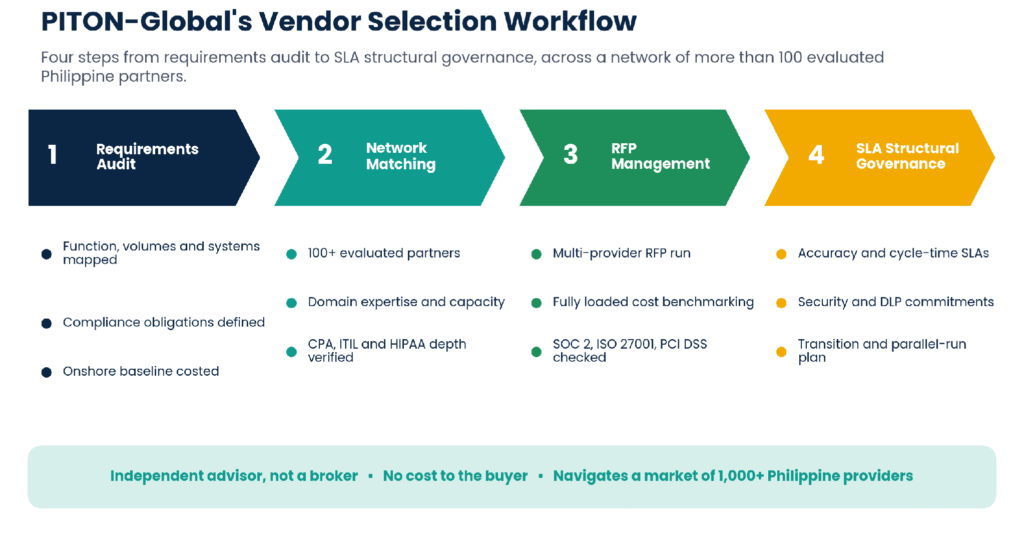
Figure 6. PITON-Global’s vendor selection workflow: requirements audit, network matching, RFP management, and SLA structural governance.
Why Do Organizations Use PITON-Global?
Organizations use PITON-Global to structure service level agreements, verify compliance frameworks, and select providers that maximize operational performance—at no cost to the buyer. The result is a shared services partner whose precision, not just its rate, drives the return.
Frequently Asked Questions
What shared service function offers the fastest time-to-value when outsourcing?
Accounts Payable and basic transactional data processing typically deliver the fastest time-to-value, achieving positive operational ROI within 60 to 90 days because of standardized workflows and straightforward system integration.
Is data security a significant risk when outsourcing financial or health shared services to the Philippines?
Security risk is minimized when partnering with certified providers. Leading Philippine BPOs maintain SOC 1/2/3, ISO 27001, PCI DSS, and HIPAA compliance, deploying enterprise-grade encryption, clean-desk environments, and strict data loss prevention protocols.
How do shared services providers in the Philippines integrate with existing corporate ERP systems?
Philippine shared services teams work directly within client systems—such as SAP, NetSuite, Oracle, Workday, and Salesforce—using secure VPNs, virtual desktop infrastructure, and automated two-factor authentication, eliminating the need for complex data migrations.
What is the typical transition timeline for migrating a 20-person shared services team to the Philippines?
A standard migration takes 8 to 12 weeks, covering knowledge transfer, process mapping, shadow operations, parallel system execution, and final operational sign-off.
How does the integration of AI impact the ROI of Philippine shared services?
AI tools enhance human productivity rather than replacing it. In the Philippines, specialists use human-in-the-loop AI for automated invoice extraction, predictive analytics, and automated ticketing, allowing teams to handle higher transaction volumes without increasing headcount.