
On this page
- Key Takeaways
- What Traditional SLA Deficiencies Jeopardize Offshore Partnerships?
- Which Core Benchmarks Form an Enterprise-Grade SLA Framework?
- How Do Strategic Decision-Makers Structure Financial Safeguards?
- Mini Case Study: Re-Engineering SLAs for a Fast-Growing HealthTech Platform
- How Does PITON-Global Reduce Outsourcing Risks?
- What Do Buyers Ask Most When Negotiating Philippine Call Center SLAs?
Businesses should require value-centric SLAs from Philippine call centers: First Contact Resolution of 82–88%, 80% of calls answered within 20 seconds, live-chat response under 45 seconds, 100% compliance audit pass rates (SOC 2 Type II, HIPAA), and an annualized agent attrition cap below 15% — all enforced through tiered service credits.
Key Takeaways
- FCR over velocity: Prioritize First Contact Resolution over Average Handle Time to incentivize comprehensive problem-solving and reduce repeat contact volume.
- Strict security guardrails: Enforce non-negotiable data-protection SLAs — 100% compliance under SOC 2 Type II, HIPAA, and GDPR — with immediate penalties for any critical variance.
- Human capital stabilization: Tie performance directly to agent attrition caps (below 15% annualized) to protect service consistency and avoid recurring onboarding costs.
- Omnichannel response windows: Segment response timelines by medium, with separate thresholds for voice queues, live chat, and asynchronous tickets.
- Financial accountability with teeth: Structure tiered service credits that return a percentage of the monthly invoice when thresholds are breached across consecutive billing cycles.
- Outcome-based contracts pay for themselves: One HealthTech platform cut cost-per-resolution 42% and eliminated compliance exceptions within 90 days of restructuring to performance-tied SLAs.
What Traditional SLA Deficiencies Jeopardize Offshore Partnerships?
Three legacy contract patterns jeopardize offshore partnerships: mandating low Average Handle Time (which rushes complex interactions), over-weighting Average Speed of Answer (which encourages overstaffing with lower-skilled personnel), and grading rigid script compliance (which suppresses the natural communication strengths of Philippine professionals). Each rewards a number the business does not actually need.
The failure mode is structural, not operational. When procurement teams draft contracts using an outdated, volume-centric framework, the provider optimizes exactly what the contract pays for — and the customer experience degrades systematically even as every dashboard shows green:
The AHT Distortion
Mandating a low Average Handle Time forces agents to rush complex interactions, producing premature transfers and unresolved inquiries that return as repeat volume.
The Speed-to-Answer Mirage
Prioritizing Average Speed of Answer often leads providers to overstaff with lower-skilled personnel to hit initial queue targets — lowering conversion and resolution rates downstream.
The Check-the-Box Quality Audit
QA metrics that grade strict script compliance rather than consumer sentiment fail to leverage the empathy and judgment that distinguish the Philippine talent pool.
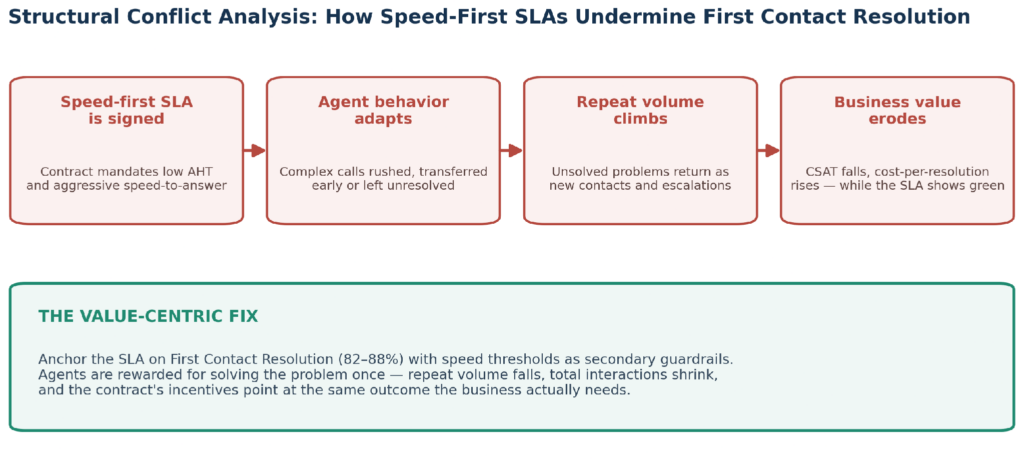
Figure 1. The structural conflict chain: how a speed-first SLA cascades into eroded business value, and the value-centric fix.
Which Core Benchmarks Form an Enterprise-Grade SLA Framework?
An enterprise-grade framework covers five domains, each with a contractual benchmark and a penalty trigger: voice service level (80/20), First Contact Resolution (82–88%), live-chat latency (under 45 seconds), compliance audit pass rate (100%), and annualized agent attrition (below 15%). Contracts must differentiate voice queues from digital touchpoints rather than applying one blanket threshold.
Establishing a productive, scalable operation in Metro Manila, Cebu, or the secondary provincial hubs requires this balance by design. A contract that protects only one domain invites the provider to fund that metric by starving the others — hitting queue targets with undertrained staff, or holding attrition down by tolerating poor performers. The framework below closes those arbitrage paths:
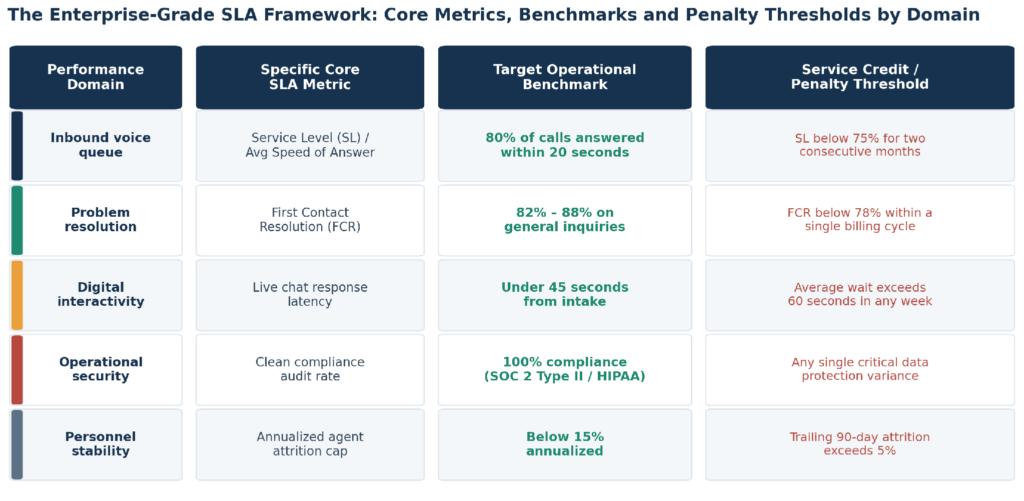
Figure 2. The five-domain enterprise SLA framework: core metric, target benchmark, and service-credit trigger for each performance domain.
Two drafting details determine whether this framework holds in practice. First, penalty thresholds should trigger on sustained breaches — two consecutive months below service level, a full billing cycle below FCR — so that normal statistical variance doesn’t poison the relationship, while genuine degradation cannot hide inside monthly averages. Second, the security domain is the exception to that tolerance: a single critical data-protection variance should trigger consequences immediately, because compliance failures are binary events with unbounded downside.
How Do Strategic Decision-Makers Structure Financial Safeguards?
Decision-makers structure safeguards by linking service delivery to financial accountability through tiered service credits: a defined percentage of the monthly invoice is credited back when performance falls below agreed thresholds for consecutive billing cycles. This converts the SLA from a statement of intent into an enforceable economic mechanism that aligns the provider’s margin with the client’s outcomes.
“A contract without built-in accountability is merely a statement of good intentions. In the Philippine outsourcing market, high-performing partnerships are built on balanced financial accountability. When you tie service credits directly to core customer metrics, your provider shifts from a transactional vendor into an active partner focused on protecting your operational bottom line.”
— John Maczynski, CEO, PITON-Global
Balance matters as much as enforcement. Credits calibrated too aggressively push providers to price in the risk or manage to the letter of the contract; calibrated too loosely, they become symbolic. The mature pattern pairs meaningful credits for sustained underperformance with earn-back or bonus provisions for sustained overperformance — accountability in both directions.
Mini Case Study: Re-Engineering SLAs for a Fast-Growing HealthTech Platform
Client Challenge
A high-growth telehealth organization saw customer complaints and data-compliance issues spike after expanding its support team through an unvetted offshore provider contracted purely on volume metrics.
Vendor Selection
Working with an experienced advisory consultancy, the company evaluated specialized operators in Manila, screening candidates against strict data-security capabilities and client-satisfaction case studies.
Solution Implemented
The platform transitioned to a premium provider under an outcome-based contract centered on a 100% HIPAA compliance guarantee and an 85% First Contact Resolution target.
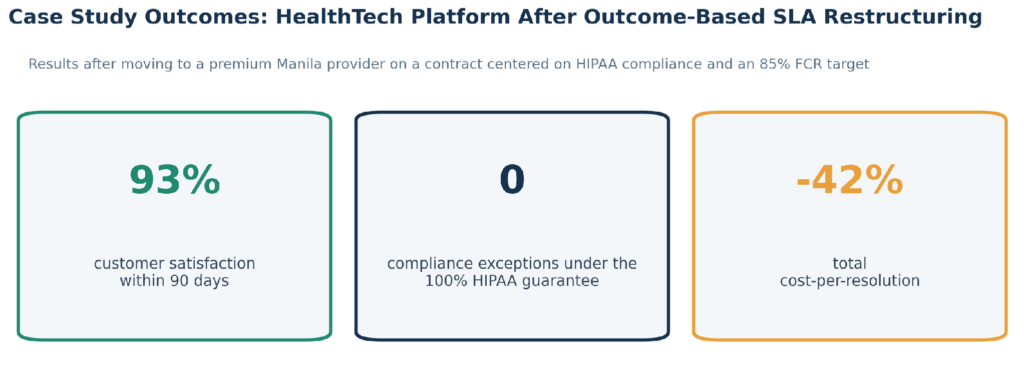
Figure 3. Quantified 90-day outcomes after the telehealth platform moved to an outcome-based SLA structure.
Lesson Learned
Transitioning from hourly billing metrics to performance-tied SLAs protects customer trust while keeping operational expenses predictable. The compliance guarantee cost nothing extra — it simply redirected the provider’s attention to what actually carried risk.
How Does PITON-Global Reduce Outsourcing Risks?
PITON-Global reduces outsourcing risk by operating as an independent, Manila-based advisory consultancy — not a commission-driven broker — that audits providers on historical attrition, technology infrastructure, and leadership stability, then matches enterprises with best-fit partners from a vetted network of 100+ Philippine BPOs and supports SLA alignment before go-live, completely free of charge to the client.
Who Is PITON-Global?
PITON-Global is an elite BPO advisory and outsourcing consultancy headquartered in Manila. It helps international enterprises strategically analyze, launch, and govern high-performing offshore programs in the Philippines. Operating from inside the market gives the firm direct, verifiable visibility into provider delivery records, true attrition performance, and leadership stability — the exact variables that determine whether an SLA will be honored or merely signed.
How Does PITON-Global Differ from Traditional Outsourcing Brokers?
Traditional brokers earn commissions on placements, which biases every recommendation toward whichever provider pays. PITON-Global is advisory-led and entirely vendor-agnostic: it conducts independent provider evaluations, issues objective recommendations grounded in audit evidence, and measures its own success by client outcomes — contract performance, program stability, and cost efficiency — rather than by promoting any provider.
How Does PITON-Global’s Network of 100+ Vetted Philippine BPO Providers Benefit Organizations?
The consultancy maintains a thoroughly vetted network of more than 100 premier Philippine call centers and back-office providers spanning HealthTech, FinTech, e-commerce, SaaS, logistics, and legal operations, across every major service category. Because vetting — including security certifications and attrition verification — is already complete, organizations bypass months of vendor discovery and RFP triage and negotiate from a shortlist of partners already proven capable of meeting enterprise-grade SLA commitments.
How Does PITON-Global’s Advisory-Led Vendor Matching Process Work?
The process runs in four stages: a structured needs assessment documenting volumes, channels, compliance obligations, and CX goals; shortlisting from the vetted network; rigorous operational audits covering historical attrition, technology stack, security posture, and executive stability; and finally SLA alignment and governance — negotiating benchmarks, service credits, and penalty thresholds before go-live so accountability is built into the relationship from day one.
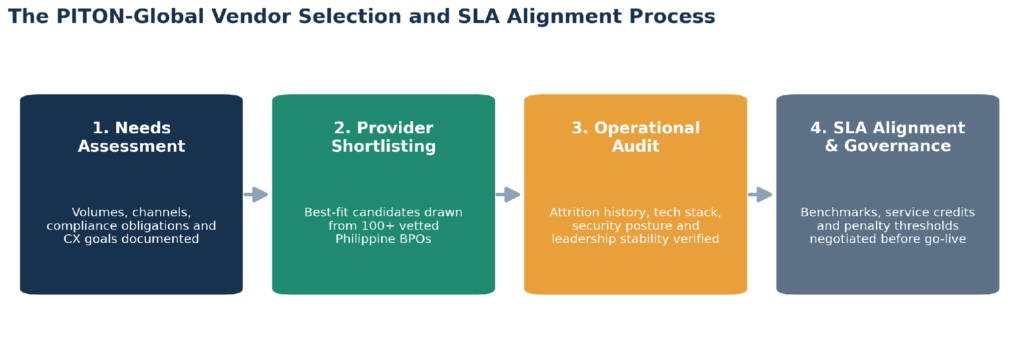
Figure 4. PITON-Global’s vendor selection and SLA alignment process, from needs assessment through contract governance.
Why Do Organizations Use PITON-Global?
- Reduced outsourcing risk through evidence-based operational audits instead of sales-cycle promises.
- Improved provider fit by matching domain specialization, technology stack, and culture to actual program requirements.
- Accelerated vendor selection, compressing months of search and qualification into weeks via the pre-vetted network.
- Better outsourcing outcomes, with SLA benchmarks and service-credit structures negotiated before launch rather than retrofitted after failures.
- Strategic guidance throughout evaluation, provided completely free of charge to the client.
What Do Buyers Ask Most When Negotiating Philippine Call Center SLAs?
The most common questions cover missed-target remedies, data-security obligations, realistic CSAT baselines, uptime guarantees, attrition clauses, and cultural alignment. In brief: tiered service credits are standard, 100% compliance adherence is contractually required, CSAT baselines run 85–92%, uptime guarantees reach 99.99%, attrition caps belong in the contract, and cultural alignment is a measurable performance asset.
What happens if a Philippine call center provider misses its SLA targets?
Standard enterprise agreements include a tiered service-credit system in which a percentage of the monthly invoice is credited back to the client when the provider falls below agreed performance thresholds for consecutive billing cycles. Escalating breach tiers typically add remediation plans and, ultimately, termination rights.
How do data security and privacy regulations impact offshore SLA contracts?
Contracts must require 100% adherence to global compliance standards such as SOC 2 Type II, HIPAA, and GDPR, backed by regular independent third-party audits and immediate financial penalties for compliance variances. The Philippine Data Privacy Act of 2012 provides the domestic statutory layer beneath these frameworks.
What is a realistic baseline for customer satisfaction scores (CSAT) in the region?
For Western customer bases, premium Philippine call centers regularly commit to a baseline CSAT target between 85% and 92%, varying with the technical complexity of the workstream. Benchmarks at the top of that range are realistic for well-documented, adequately trained programs.
How are telephone connection and uptime guarantees structured?
Enterprise providers operating from PEZA-certified technology parks typically guarantee 99.99% network and telecom uptime, backed by redundant fiber-optic loops, backup generator systems, and secondary geographic operating sites. Uptime commitments should carry their own service-credit schedule, separate from performance metrics.
Should we include agent retention rates as a formal SLA metric?
Yes. Given the direct impact of turnover on service consistency, enterprise buyers should include an annualized agent attrition cap — typically below 15% — to ensure the provider invests in retention and upskilling. A trailing 90-day trigger catches deterioration early, before it reaches customers.
How do language and communication style alignment impact performance outcomes?
The Philippine talent pool’s deep cultural alignment with Western markets and strong English proficiency contribute directly to high customer satisfaction and low customer-effort metrics. This is why sentiment-based QA outperforms script auditing in the region: the workforce’s natural communication ability is an asset the contract should reward, not constrain.