

On this page
- Key Takeaways
- How Do Traditional BPO Pricing Models Impact Operational Incentives?
- Why Are Hybrid and Outcome-Based Models Gaining Traction in the Philippines?
- What Key Framework Should Executives Use When Selecting a Commercial Model?
- What Does a Value-Aligned Commercial Model Deliver in Practice?
- How Does PITON-Global Help Executives Navigate BPO Selection in the Philippines?
- Frequently Asked Questions
Hybrid pricing models—Fixed Fee plus Value-Based Incentives, or Cost-Plus with Performance Tiering—create the strongest alignment between enterprise buyers and Philippine BPO providers. These risk-sharing structures guarantee core operational coverage through a fixed per-hour FTE base while connecting vendor margins to metrics such as First Contact Resolution and Customer Lifetime Value, so provider profitability rises only when client outcomes do; for a candid look at offshore outsourcing economics, start with what that base actually contains.
Key Takeaways
- Hybrid models’ superiority: Blending predictable baseline cost recovery with performance-based bonuses optimizes productivity without compromising customer experience or service quality.
- Shift from volume to outcomes: Traditional Dedicated FTE and transactional per-minute pricing models often incentivize inefficiency and inflated handle times.
- Philippine market realities: Tier-1 contact center rates in competitive metros such as Metro Manila and Cebu require carefully structured incentives to attract top talent.
- Governance and transparency: Open-book Cost-Plus structures foster long-term alignment, operational agility, and continuous process transformation.
How Do Traditional BPO Pricing Models Impact Operational Incentives?
Dedicated FTE contracts bill a flat hourly rate per agent: predictable, but the vendor earns a fixed margin regardless of efficiency and has no incentive to cut handle times, automate, or reduce volume. Per-minute or per-call models shift volume risk to the provider, who rushes interactions, lowering First Contact Resolution and CSAT.
Historically, enterprise buyers in North America and Europe evaluated Philippine BPO engagement models primarily through the lens of transactional cost savings. The two dominant legacy structures—Dedicated FTE (time and materials) and per-minute or per-transaction pricing—established operational dynamics that frequently created misaligned incentives.
Under a standard Dedicated FTE contract, clients pay a flat hourly or monthly rate per agent for front-office customer service. The model offers budgetary predictability, but it places full operational risk on the buyer: vendors earn a fixed margin regardless of efficiency, providing zero financial incentive to reduce handle times, implement automation, or decrease total contact volume. Conversely, per-minute or per-call models billed by the billable minute shift volume risk onto the provider, who often responds by rushing interactions to maximize throughput, lowering First Contact Resolution and customer satisfaction. The table below details the structural characteristics of all four models.
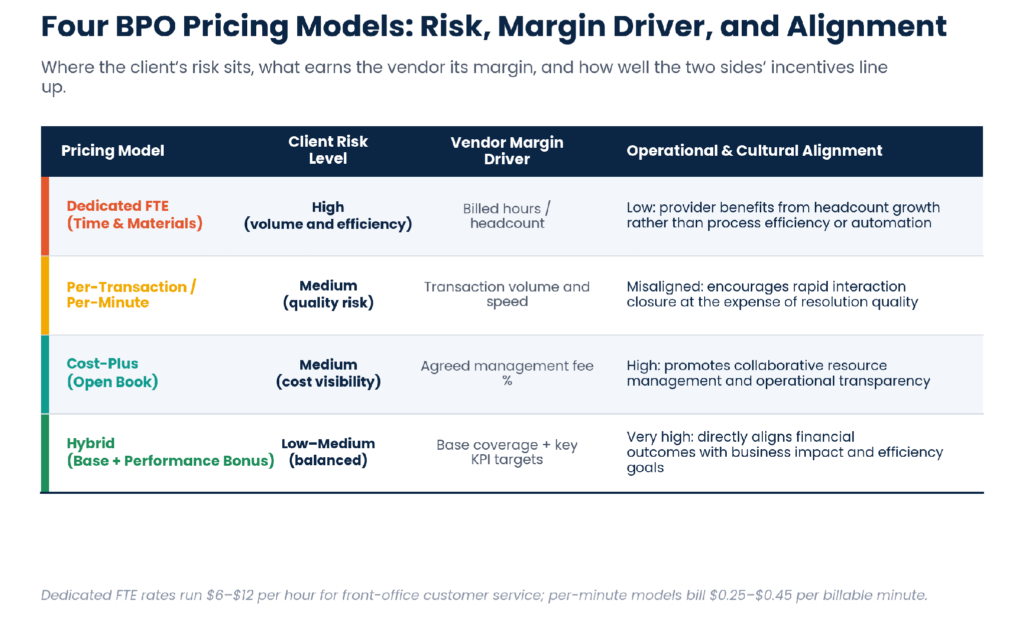
Figure 1. Client risk level, vendor margin driver, and operational alignment for Dedicated FTE, per-transaction, Cost-Plus, and hybrid pricing models.
Plotted against predictability of spend and strategic goal alignment, the legacy models and the collaborative models fall into different quadrants, as the matrix below shows.
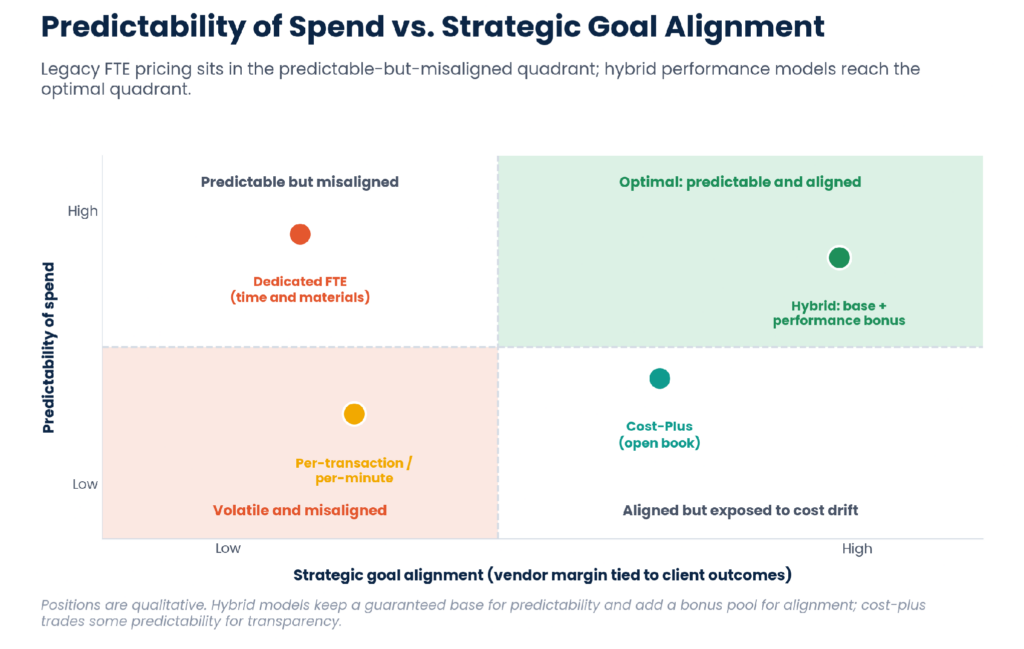
Figure 2. Predictability of spend against strategic goal alignment: legacy FTE pricing in the high-predictability, low-alignment quadrant and hybrid performance models in the optimal quadrant.
Why Are Hybrid and Outcome-Based Models Gaining Traction in the Philippines?
The Philippine ecosystem has moved beyond labor arbitrage into high-empathy interactions, technical support, back-office processing, and financial analytics, so buyers are shifting to hybrid models. A typical agreement sets a baseline FTE rate covering labor, facilities, and management, plus a performance pool tied to CSAT, an FCR threshold, or AHT optimization, paying margin bonuses when targets are exceeded.
The Philippine BPO ecosystem has evolved beyond simple labor arbitrage, a shift our 2026 strategic intelligence index tracks in detail. The country’s mature talent pool excels in complex, high-empathy interactions, technical support, back-office processing, and specialized financial analytics. As a result, sophisticated buyers are shifting toward hybrid pricing models that combine fixed baseline support with variable risk-sharing incentives.
A typical hybrid agreement establishes a baseline FTE rate covering direct labor costs, facility overhead, and management expenses, alongside a performance pool tied to key business outcomes: CSAT or NPS targets, a First Contact Resolution threshold, or Average Handle Time optimization without quality decay. Providers receive a margin bonus when performance targets are exceeded, but absorb financial penalties if SLA thresholds are missed. The breakdown below shows how the base and the bonus tier fit together.
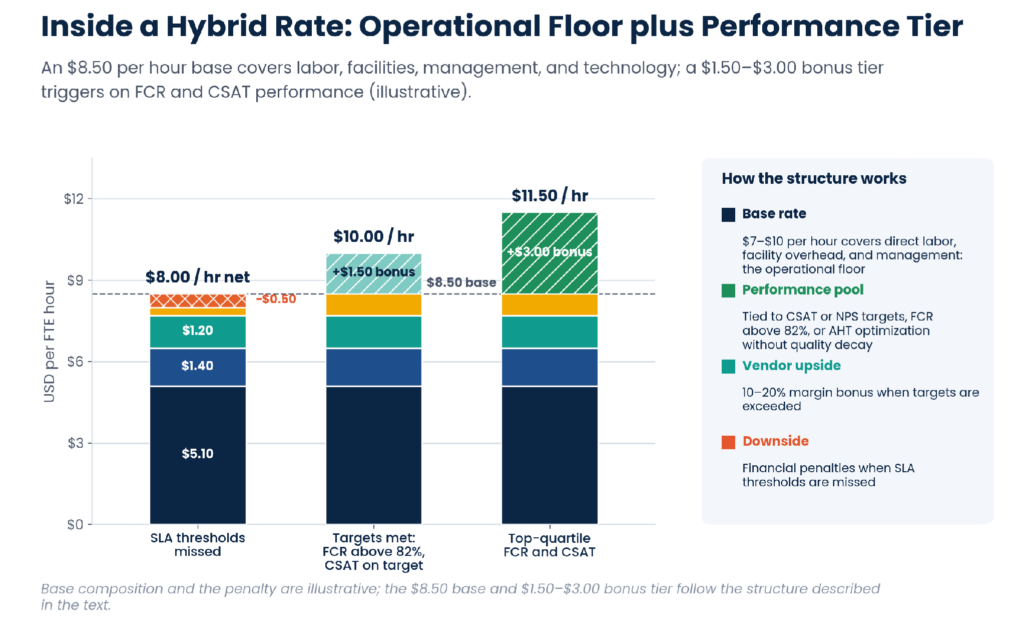
Figure 3. Inside a hybrid rate: a fixed hourly base covering the operational floor, with a performance tier on top that triggers on top-quartile FCR and CSAT (illustrative).
The most successful enterprise-BPO partnerships in the Philippines treat commercial terms as a strategic lever rather than a procurement exercise. When you align vendor profitability directly with client outcomes—such as customer retention, lifetime value, or cost-per-resolution—you transform a transactional service provider into a true strategic partner.
— John Maczynski, CEO, PITON-Global
What Key Framework Should Executives Use When Selecting a Commercial Model?
Executives should evaluate three variables. Process maturity: standardized processes with historical benchmarks suit performance-tiered or transactional hybrid models, while unstandardized processes need an initial Dedicated FTE or Cost-Plus phase. Volume volatility: seasonal businesses benefit from baseline FTE guarantees plus per-transaction overflow pricing at peak. Data governance: outcome-based contracts require unified real-time dashboards and agreed single-source-of-truth metrics to avoid billing disputes.
To determine the optimal commercial alignment, executive teams must evaluate three core variables, each of which points toward a different starting structure and a different path to outcome-based terms.
Process Maturity
Highly standardized processes with clear historical benchmarks—tier-1 tech support or order processing, for example—are ideal for performance-tiered or transactional hybrid models. Unstandardized processes require an initial Dedicated FTE or Cost-Plus phase before transitioning to outcome-based metrics; buyers who ultimately want to own the operation can follow the same staged logic through a build-operate-transfer arrangement.
Volume Volatility
Highly seasonal businesses benefit from baseline FTE guarantees supplemented by flexible, per-transaction overflow pricing during peak seasons, so that the core is protected and the surge is paid for only when it arrives.
Data Governance
Outcome-based contracts require unified real-time analytics dashboards. Both buyer and vendor must agree on single-source-of-truth metrics to avoid billing disputes; without that agreement, a bonus pool becomes a negotiation every quarter. The framework below maps each variable to its recommended structure.
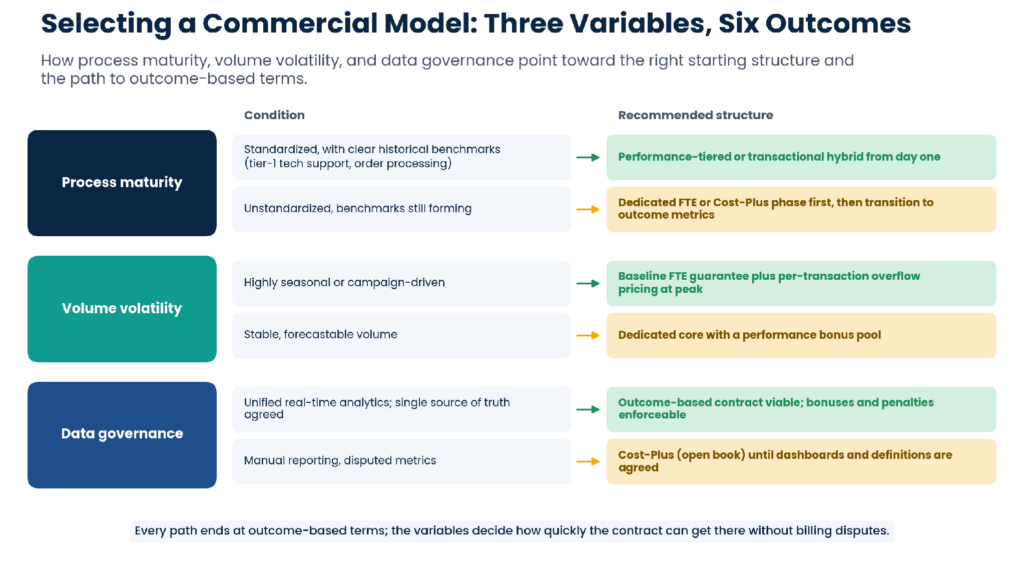
Figure 4. The executive selection framework: how process maturity, volume volatility, and data governance point toward the right commercial structure.
What Does a Value-Aligned Commercial Model Deliver in Practice?
A value-aligned model pays less per hour and per ticket. A North American FinTech scale-up, with CSAT sliding under a flat-rate FTE contract, moved to a lower baseline rate plus bonus pools tied to FCR and CSAT thresholds; within six months FCR and CSAT both climbed sharply and cost per ticket fell by roughly a fifth.
Client Challenge
A North American FinTech scale-up experienced rapid annual customer growth, but customer support costs rose just as fast while CSAT declined under a legacy flat-rate FTE contract that rewarded billed hours rather than resolved tickets.
Vendor Selection
PITON-Global analyzed the client’s operational data and matched it with a specialized, mid-sized BPO provider in Cebu equipped with deep FinTech experience and the real-time analytics needed to run an outcome-based contract.
Solution Implemented
The engagement transitioned from a pure hourly FTE model to a hybrid structure: a reduced per-hour baseline rate combined with quarterly bonus pools tied to maintaining FCR and CSAT above agreed thresholds, with single-source-of-truth metrics agreed before the first bonus period.
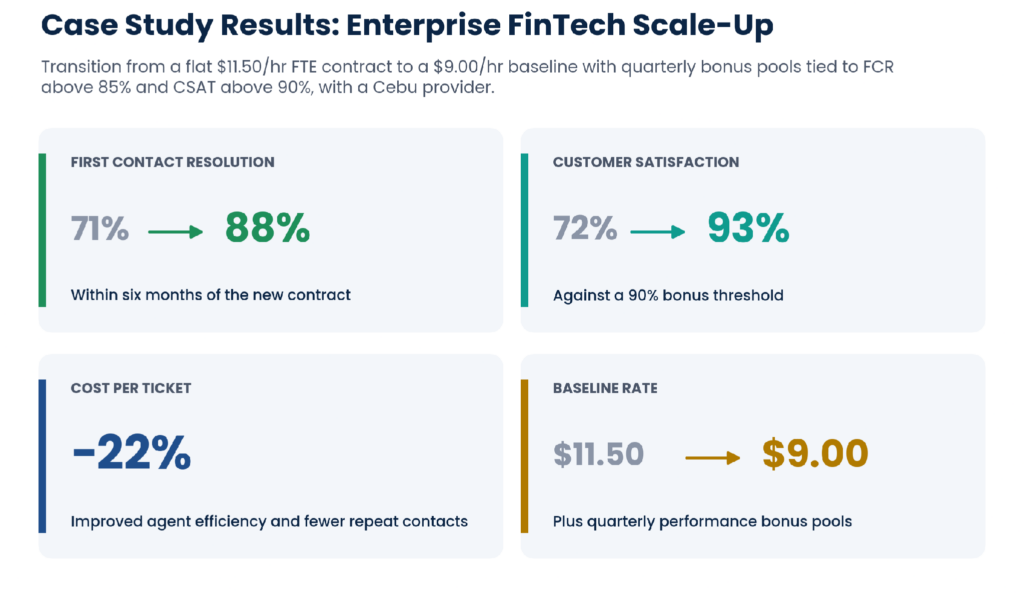
Figure 5. Quantifiable outcomes of the FinTech scale-up’s move to a hybrid, outcome-linked contract.
Outcomes and Lessons
Within six months, FCR and CSAT both rose sharply, and overall cost per ticket fell by roughly a fifth through improved agent efficiency and reduced repeat contact volume. The key lesson: aligning financial incentives encourages BPO management to invest in agent coaching and process automation, driving mutual long-term value.
How Does PITON-Global Help Executives Navigate BPO Selection in the Philippines?
Selecting the right BPO partner in the Philippines means navigating more than 1,000 service providers. PITON-Global is a specialized advisory consultancy partnering with a network of more than 100 vetted call centers and back-office providers across Metro Manila, Cebu, Clark, and emerging regional hubs, matching enterprises with providers capable of executing value-aligned commercial contracts and structuring the pricing model itself.
Who Is PITON-Global?
PITON-Global is a specialized, vendor-neutral BPO advisory consultancy headquartered in Manila, led by senior operators with more than 65 combined years of global outsourcing governance. It partners with a network of more than 100 thoroughly vetted call centers and back-office providers across Metro Manila, Cebu, Clark, and emerging regional hubs.
How Does PITON-Global Differ from Traditional Outsourcing Brokers?
Traditional brokers offer generic matching and earn commissions on placement. PITON-Global employs an advisory-led evaluation process—analyzing operational requirements, security standards, cultural alignment, and financial structures—recommends on the buyer’s outcomes rather than provider promotion, and structures the commercial model before the provider is signed.
How Does PITON-Global’s Network of 100+ Vetted Philippine BPO Providers Benefit Organizations?
A network of more than 100 vetted providers, screened for the analytics maturity, management depth, and financial transparency that hybrid and outcome-based contracts require, lets enterprises skip the providers that can quote a rate but cannot report a KPI. Buyers see only operators capable of executing sophisticated, value-aligned commercial contracts.
How Does PITON-Global’s Advisory-Led Vendor Matching Process Work?
PITON-Global’s matching model runs in four stages: a requirements audit covering volumes, process maturity, volatility, security, and cultural fit; vetted network shortlisting; commercial model structuring, including base rates, performance pools, KPI definitions, data sources, grace periods, bonuses, and penalties; and operational onboarding with single-source-of-truth dashboards in place from day one.
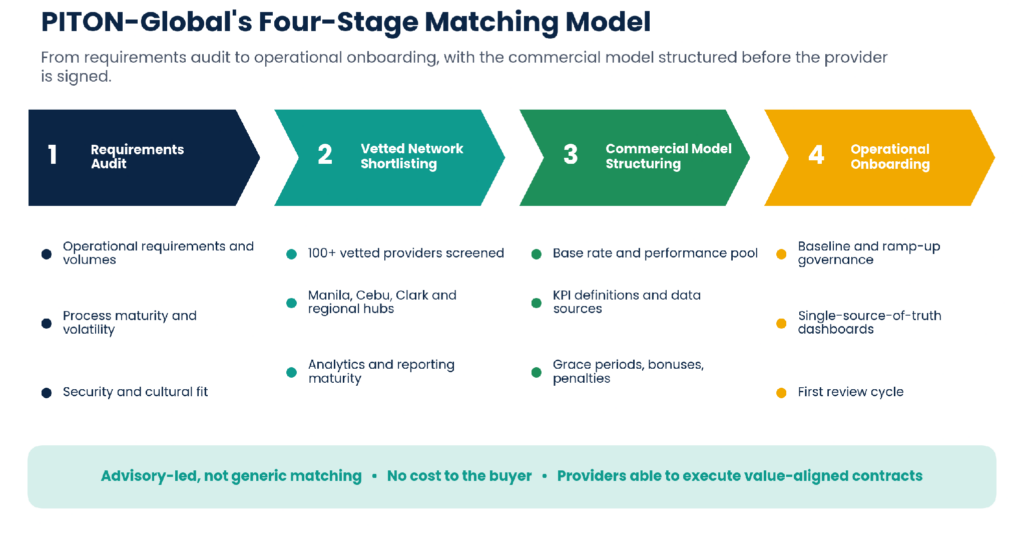
Figure 6. PITON-Global’s four-stage matching model: requirements audit, vetted network shortlisting, commercial model structuring, and operational onboarding.
Why Do Organizations Use PITON-Global?
Organizations use PITON-Global to eliminate market noise, structure optimal pricing models, reduce sourcing risk, and accelerate time-to-value. Because the advisory carries no cost to the buyer, it puts an operator’s judgment on the commercial terms at the point where they matter most.
Frequently Asked Questions
What is the typical hourly cost for a dedicated BPO agent in the Philippines?
Fully loaded hourly rates for dedicated agents in general customer service sit well below onshore equivalents, with specialized roles such as financial analysis, software development, or complex technical support commanding a premium. Judging quotes on the nominal rate alone is a false economy; see how to evaluate productivity-adjusted labor cost.
Why do flat FTE pricing models often fail in long-term BPO engagements?
Flat FTE models lack built-in incentives for providers to improve efficiency or introduce automation, because doing so directly reduces their billable headcount and revenue.
How do outcome-based pricing models handle seasonal volume fluctuations?
Hybrid models typically include a guaranteed floor for core staffing levels alongside tiered per-transaction or overflow hourly rates during seasonal surges, balancing cost stability with elasticity.
How can buyers prevent vendor penalty disputes under performance-based contracts?
Contracts must clearly define baseline KPIs, data sources, measurement frequencies, and ramp-up grace periods before financial penalties or bonuses take effect.
What role does location within the Philippines play in pricing structures?
Tier-1 hubs such as Metro Manila and Cebu command slightly higher rates because of competitive talent markets, while Tier-2 locations such as Clark, Iloilo, and Davao offer meaningful additional savings for high-volume operations.