
On this page
- Key Takeaways
- What Impact Does Offshoring Back-Office Operations Have on Corporate G&A Ratios?
- How Does Outsourcing Convert Static Capital Overhead into Variable Operating Expenses?
- How Does the Integration of Agentic AI Accelerate Administrative Yield?
- What Does G&A Optimization Look Like in Practice?
- Why Do Corporate Decision-Makers Partner with PITON-Global for BPO Advisory?
- Frequently Asked Questions
Outsourcing to the Philippines systematically reduces General and Administrative cost ratios by converting fixed corporate overhead into scalable variable operating expenses. By leveraging labor cost efficiencies of 60%–70%, optimizing workforce utilization, and integrating automated workflows, enterprise organizations typically compress administrative expenses from 15%–20% of revenue down to sustainable 6%–9% industry benchmarks.
Key Takeaways
- G&A ratio compression: Offshoring back-office functions directly reduces administrative overhead as a percentage of gross revenue by 40% to 60%.
- Fixed-to-variable cost transformation and arbitrage beyond labor: Moving from internal payroll, real estate, and software licensing to a fully loaded BPO model converts static capital costs into elastic operating expense, with savings extending to eliminated payroll taxes, benefit burdens, recruitment overhead, and facility costs.
- Agentic AI efficiency yield: Modern Philippine BPOs combine skilled specialists with real-time AI desktop tools, reducing task handling times and administrative error rates.
- Risk-mitigated sourcing: Independent BPO advisory services prevent procurement pitfalls, matching buyers with verified providers to secure contract terms and performance standards.
What Impact Does Offshoring Back-Office Operations Have on Corporate G&A Ratios?
G&A expenses—executive overhead, legal, finance, HR, accounting, and corporate support—often consume 15%–22% of revenue in growing mid-market and enterprise organizations. Transferring non-core back-office tasks to Philippine specialists at $8–$14 per hour fully loaded, versus $28–$45 domestically with a 25%–35% benefit load on top, compresses the ratio to 6%–9%, reallocating 10–13 points of revenue toward growth.
General and Administrative expenses include executive overhead, legal, finance, human resources, accounting, and general corporate support. In growing mid-market and enterprise organizations, unoptimized internal administrative support often consumes 15% to 22% of total revenue, diverting liquidity away from revenue-generating activities such as research, sales, and capital investment. The administrative cost ratio is simply total G&A expense divided by total gross revenue, multiplied by 100—and transferring non-core back-office tasks such as accounts payable, payroll processing, customer support, and HR administration to specialized Philippine providers restructures that balance, as the table below shows.
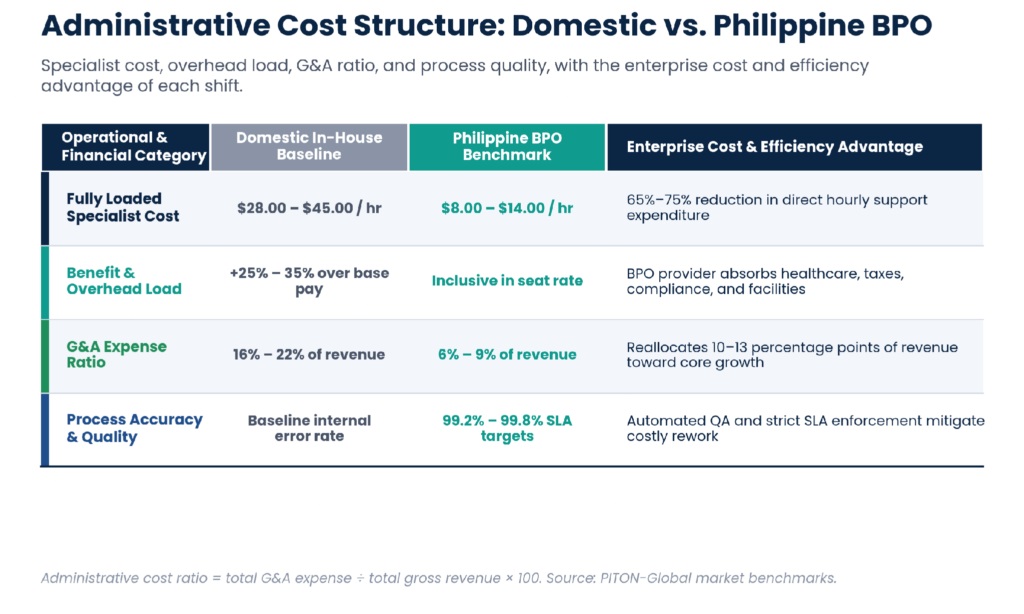
Figure 1. Administrative cost structure: domestic in-house baseline versus Philippine BPO benchmark, with the enterprise cost and efficiency advantage of each category.
By lowering unit-level processing costs, companies compress their overall G&A footprint, enabling corporate margins to expand without sacrificing operational capacity. The stacked comparison below shows how a representative G&A structure moves from 18% of revenue to 7% after migration.
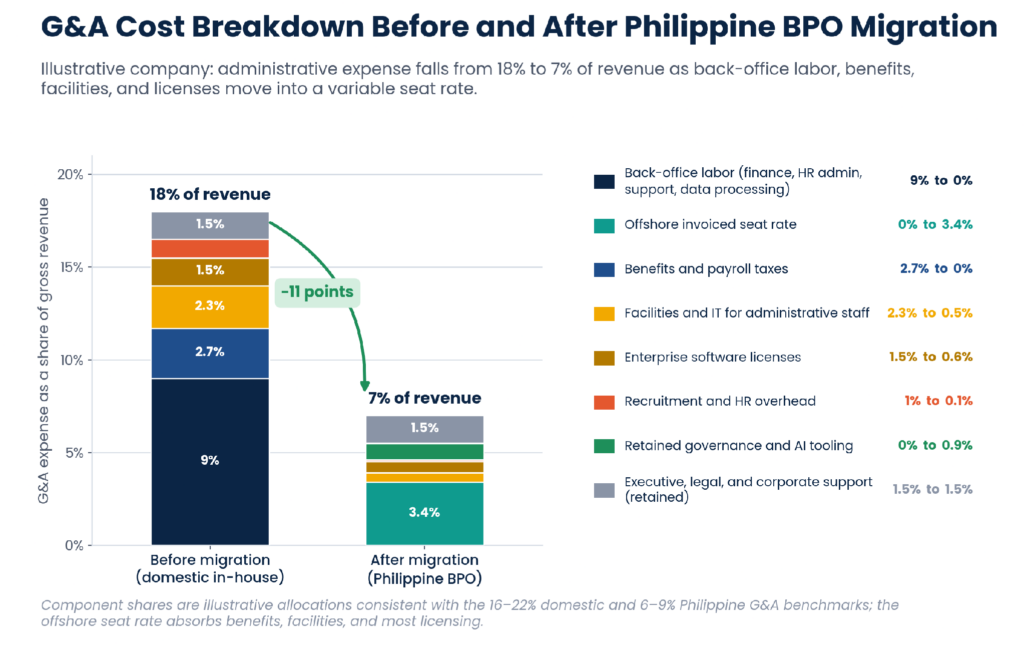
Figure 2. G&A cost breakdown before and after Philippine BPO migration, from 18% to 7% of revenue (illustrative).
How Does Outsourcing Convert Static Capital Overhead into Variable Operating Expenses?
Internal administrative infrastructure carries capital expenditure and fixed operating expense—facilities leases, software licenses, recruitment overhead—that stays constant regardless of volume. Offshoring replaces those burdens with a consumption-based model: BPO-furnished infrastructure built into the rate, FTE footprints that scale without severance or recruiting cost, and vendor-handled recruitment, onboarding, benefits, and retention. Savings equal domestic overhead minus invoiced rate plus retained governance.
Maintaining an internal administrative infrastructure requires substantial capital expenditure and fixed operating expense. Facilities leases, desktop hardware, enterprise software licenses, and recruitment overhead remain constant regardless of market volatility or transaction volume fluctuations. Fully loaded FTE savings therefore equal domestic total overhead minus the offshore invoiced rate plus retained governance—and three mechanisms produce them.
Elimination of Facility and IT CapEx
Philippine BPOs furnish enterprise-grade infrastructure, redundant power, telecom ties, and security certifications—SOC 2, PCI DSS, ISO 27001—built directly into the hourly or transactional rate, so no lease, hardware refresh, or audit program sits on the buyer’s balance sheet.
Dynamic Scale Flexibility
Contracting capacity allows organizations to scale FTE footprints up or down in response to seasonal volume shifts without incurring severance or recruiting expenses. The chart below shows what that does to total administrative cost as volume fluctuates.
Reduced Internal HR Overhead
The BPO vendor handles recruitment, onboarding, benefits administration, and talent retention, reducing internal HR requirements and the recruitment overhead that otherwise runs constantly regardless of headcount.
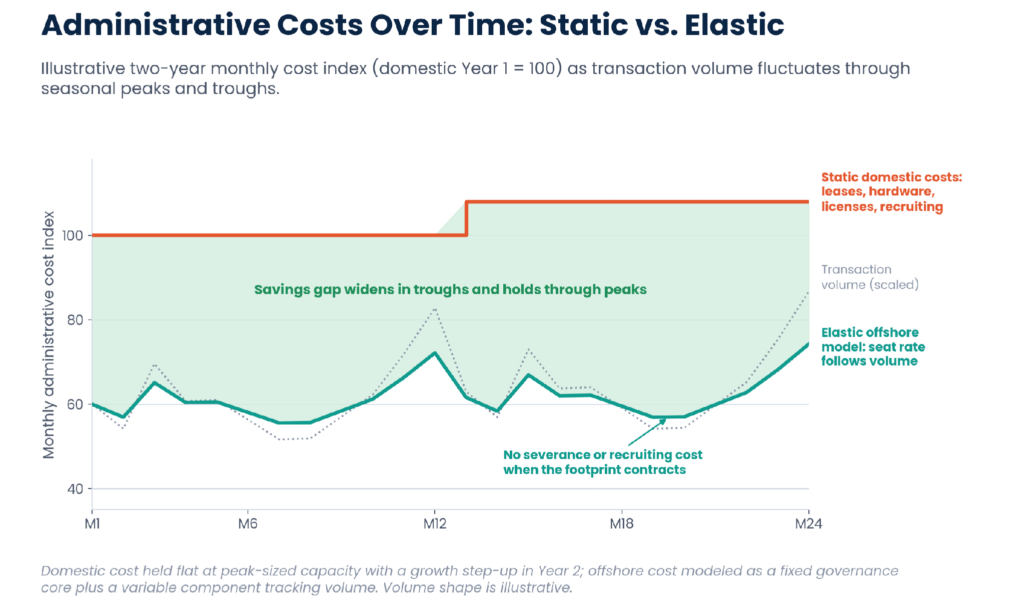
Figure 3. Total administrative costs over time during volume fluctuations: static fixed domestic costs versus the elastic, variable offshore model (illustrative index).
How Does the Integration of Agentic AI Accelerate Administrative Yield?
Modern Philippine delivery centers pair specialists with agentic AI—real-time copilots that handle repetitive administrative steps. Where staff once spent hours on manual data entry, cross-referencing systems, and CRM documentation, AI extracts and validates each document or ticket, specialists review exceptions, and the CRM updates automatically. Transaction throughput efficiency—baseline processing time divided by AI-assisted time—rises, increasing capacity while lowering processing cost.
In traditional back-office operations, administrative personnel spend significant time on manual data entry, cross-referencing systems, and documenting CRM records. Agentic AI tools streamline these steps during the transaction, and the gain is measured as transaction throughput efficiency: baseline task processing time divided by AI-assisted task processing time. The workflow below shows where the time goes.
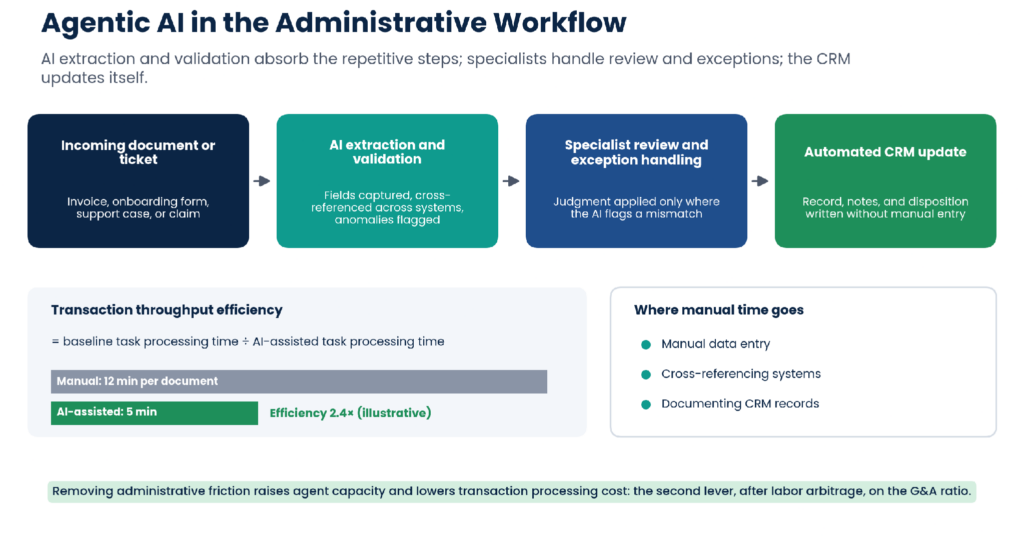
Figure 4. The agentic AI administrative workflow—extraction and validation, specialist exception handling, automated CRM update—with an illustrative throughput efficiency example.
By removing administrative friction from daily workflows, AI-assisted operations increase agent capacity while lowering transaction processing costs—the second lever, after labor arbitrage, that pushes the G&A ratio toward the 6%–9% benchmark.
Compressing G&A cost ratios is not simply about shifting payroll to a lower-cost geography. The true strategic transformation occurs when you pair the process discipline and cultural alignment of the Filipino workforce with real-time AI automation. This combination allows enterprise organizations to shrink their administrative overhead by up to 60% while simultaneously increasing operational output and accuracy.
— John Maczynski, CEO, PITON-Global
What Does G&A Optimization Look Like in Practice?
G&A optimization pairs labor arbitrage with technology and oversight. A North American B2B SaaS platform whose administrative cost ratio had swelled to 19.5% of revenue migrated 85 back-office and support roles to a Manila BPO with AI-assisted ticketing, adherence monitoring, and automated QA, cutting the ratio to 7.2% within 180 days, saving $4.1M annually, and accelerating invoice processing 300%.
Client Challenge
A North American B2B SaaS platform experienced rapid revenue growth, but its administrative cost ratio swelled to 19.5% of gross revenue. High domestic labor rates and inefficient back-office workflows created operational bottlenecks in billing, customer onboarding, and tier-1 technical support.
Vendor Selection
The software provider engaged PITON-Global to restructure its administrative service architecture. PITON-Global evaluated the client’s operational requirements against its database of more than 100 vetted Philippine BPO partners, identifying three mid-market operators with proven SaaS back-office experience and automated WFM integration.
Solution Implemented
The company migrated 85 back-office and customer support roles to a Manila-based BPO partner. The provider introduced AI-assisted ticketing, real-time schedule adherence monitoring, and automated quality assurance audits. The flow below maps the transition from the unoptimized domestic ratio to the streamlined offshore model.
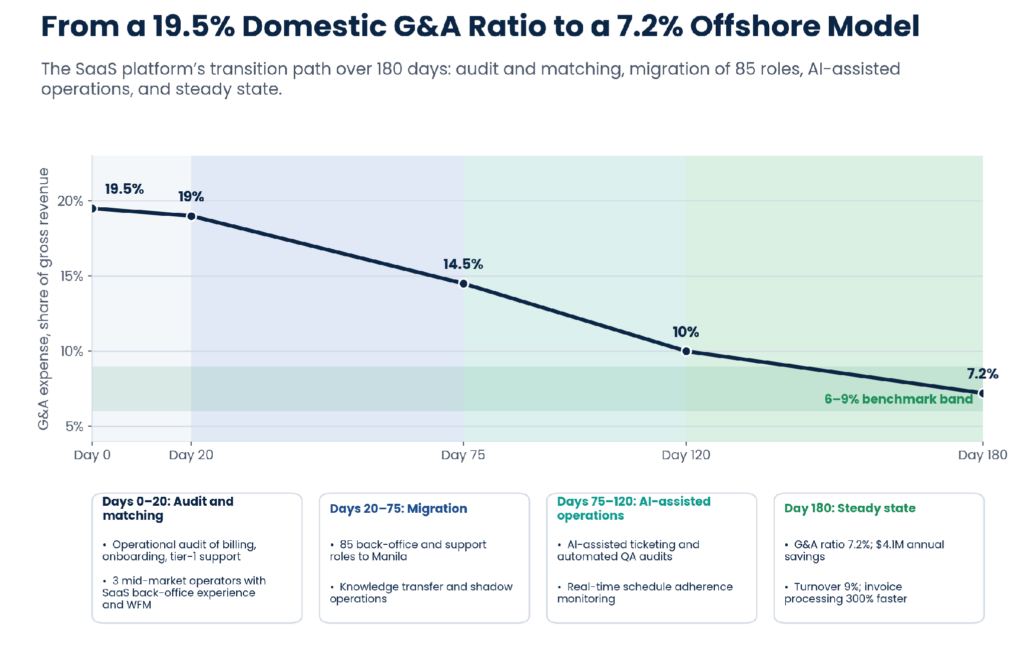
Figure 5. The client’s transition from an unoptimized 19.5% domestic G&A cost ratio to a streamlined 7.2% offshore model over 180 days.
Outcomes and Lessons
Administrative expenses as a percentage of gross revenue fell 12.3 percentage points to 7.2% within 180 days. Direct operating expenditure decreased 64% against domestic baselines, an annual saving of $4.1M; AI-assisted workflows increased invoice processing speed by 300%, cutting billing dispute resolution from four days to under 24 hours; and dedicated talent management held turnover at 9%, maintaining team stability and program continuity. The key lesson: compressing administrative ratios requires combining structural labor arbitrage with advanced technology integration and operational oversight.
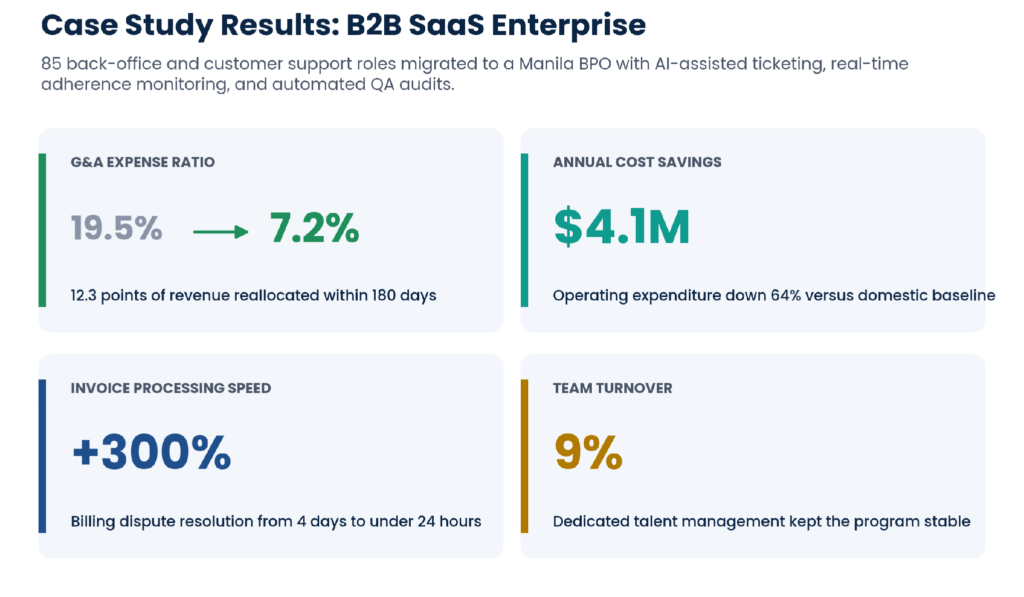
Figure 6. Quantifiable outcomes of the SaaS enterprise’s G&A restructuring.
Why Do Corporate Decision-Makers Partner with PITON-Global for BPO Advisory?
Among more than 1,000 BPO operators in the Philippines, only a select tier maintain the technological capabilities, management depth, and security standards needed to deliver administrative savings. PITON-Global, an independent, vendor-neutral sourcing advisory led by CEO John Maczynski and CSO Ralf Ellspermann, evaluates candidates against proprietary performance metrics across more than 100 vetted providers, securing optimal terms within 48–72 hours.
Who Is PITON-Global?
PITON-Global is an independent, vendor-neutral BPO sourcing advisory firm headquartered in Manila. Led by Chief Executive Officer John Maczynski and Founder and Chief Strategy Officer Ralf Ellspermann, who bring a combined 65-plus years of hands-on global BPO executive experience, the firm provides buyer-side advisory grounded in deep operational authority.
How Does PITON-Global Differ from Traditional Outsourcing Brokers?
Selecting a provider on sales pitches or low hourly rates introduces operational and compliance risk. PITON-Global evaluates vendor candidates against proprietary performance metrics—utilization, accuracy, attrition, security posture—recommends on the buyer’s administrative cost ratio rather than provider promotion, and stays engaged through contract structuring and transition.
How Does PITON-Global’s Network of 100+ Vetted Philippine BPO Providers Benefit Organizations?
A network of more than 100 vetted Philippine service providers is what turns 1,000-plus operators into six to ten qualified candidates and one optimal partner. Buyers are matched with specialized, mid-sized BPOs where their program receives direct executive leadership—the tier that maintains the technology, management depth, and security standards administrative savings depend on.
How Does PITON-Global’s Advisory-Led Vendor Matching Process Work?
The process runs from G&A baseline to contract terms: establishing the current administrative cost ratio and the functions driving it; matching requirements against the vetted network on domain experience, WFM integration, and AI capability; delivering six to ten qualified candidates and a shortlist within 48–72 hours; verifying performance metrics and certifications; then securing optimal contract terms with scale flexibility and governance defined.
Why Do Organizations Use PITON-Global?
Corporate decision-makers partner with PITON-Global to eliminate vendor selection risk, accelerate procurement timelines to 48–72 hours, and secure optimal contract terms. Because the advisory carries no cost to the buyer, it protects the G&A compression it helps to deliver.
Frequently Asked Questions
How quickly can a company expect to see reductions in its administrative cost ratio after outsourcing?
Most organizations begin realizing measurable G&A cost compression within 60 to 90 days following initial team migration, with full steady-state savings achieved between months four and six.
Which specific administrative functions offer the highest cost reduction potential in the Philippines?
Finance and accounting (AP/AR, reconciliation), HR administration, customer support, data processing, revenue cycle management, and IT helpdesk support consistently yield 60%–70% cost reductions when transitioned offshore.
What is the average fully loaded hourly rate for back-office processing specialists in the Philippines?
In 2026, fully loaded hourly rates for back-office and administrative processing specialists range between $7.00 and $12.00 per hour, depending on required technical skills, compliance standards, and specialized software experience.
Does outsourcing administrative functions create compliance or data security risks?
Top-tier Philippine BPOs maintain strict international compliance frameworks, including SOC 2 Type II, PCI DSS, GDPR, and HIPAA, utilizing zero-trust network access, desktop monitoring, and clean-desk policies to protect sensitive client data.
How does outsourcing back-office workflows affect internal corporate culture?
Outsourcing routine administrative tasks relieves domestic staff from repetitive workloads, allowing internal teams to focus on strategic initiatives, core business growth, and high-value customer relationships.