

On this page
- Key Takeaways
- Which Commercial Frameworks Balance Financial Predictability with Accountability?
- How Do Philippine Labor Market Realities Influence Performance-Based Pricing?
- How Should the Incentive Reach the People Who Deliver It?
- How Should Procurement Design the Pricing Architecture?
- What Does a Balanced Pricing Structure Deliver in Practice?
- Why Partner with PITON-Global for Strategic Offshore BPO Selection?
- Frequently Asked Questions
The most effective performance-based structures combine a predictable base labor fee with variable bonuses or deductions tied to core operational metrics such as First Contact Resolution and Net Promoter Score. The base only works if it reflects how a fully loaded rate gets assembled; successful hybrid contracts then align incentives with local delivery realities through balanced risk-reward thresholds and reasonable liability caps.
Key Takeaways
- Hybrid cost structures. Blend a secure baseline FTE cost with variable bonuses or penalties to protect vendor margins while enforcing accountability.
- Core metric alignment. Tie incentives strictly to objective benchmarks: First Contact Resolution, customer satisfaction, and schedule adherence.
- Symmetrical risk-reward. Suppliers should earn premiums for exceeding targets and absorb tiered credits for chronic failure, not one without the other.
- Operational buffer integration. Design around statutory holiday multipliers, training curves, and telecommunications redundancy rather than despite them.
- Independent advisory structuring. Negotiate equitable structures that prevent supplier distress and protect service continuity.
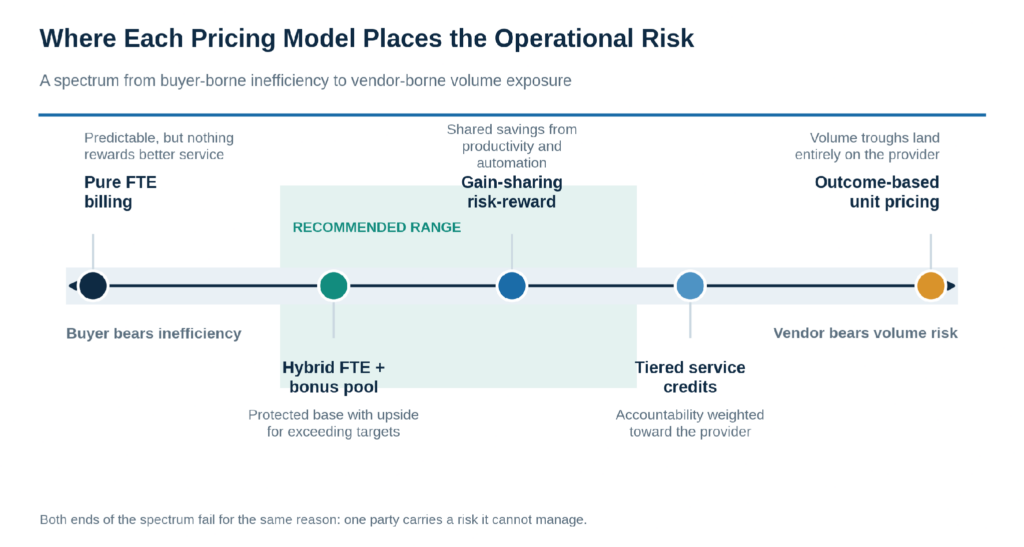
Figure 1. Where each pricing model places operational risk, from buyer-borne inefficiency to vendor-borne volume exposure.
Which Commercial Frameworks Balance Financial Predictability with Accountability?
Four structures dominate: hybrid FTE plus bonus pool, tiered service credits, gain-sharing risk-reward, and outcome-based unit pricing. Hybrid suits high-touch customer experience, credits suit transactional back office, gain-sharing suits transformation programs, and unit pricing suits high-volume standardized processing.
Traditional FTE models in Metro Manila, Cebu, or Clark deliver predictable budgets and incentivize nothing: the provider earns the same whether resolution rates rise or fall. Pure outcome-based pricing corrects that and overshoots, shifting volume risk entirely onto the provider so that a demand trough it did not cause becomes a margin event it cannot absorb. Both failures are the same failure — one party carrying a risk it has no ability to manage.
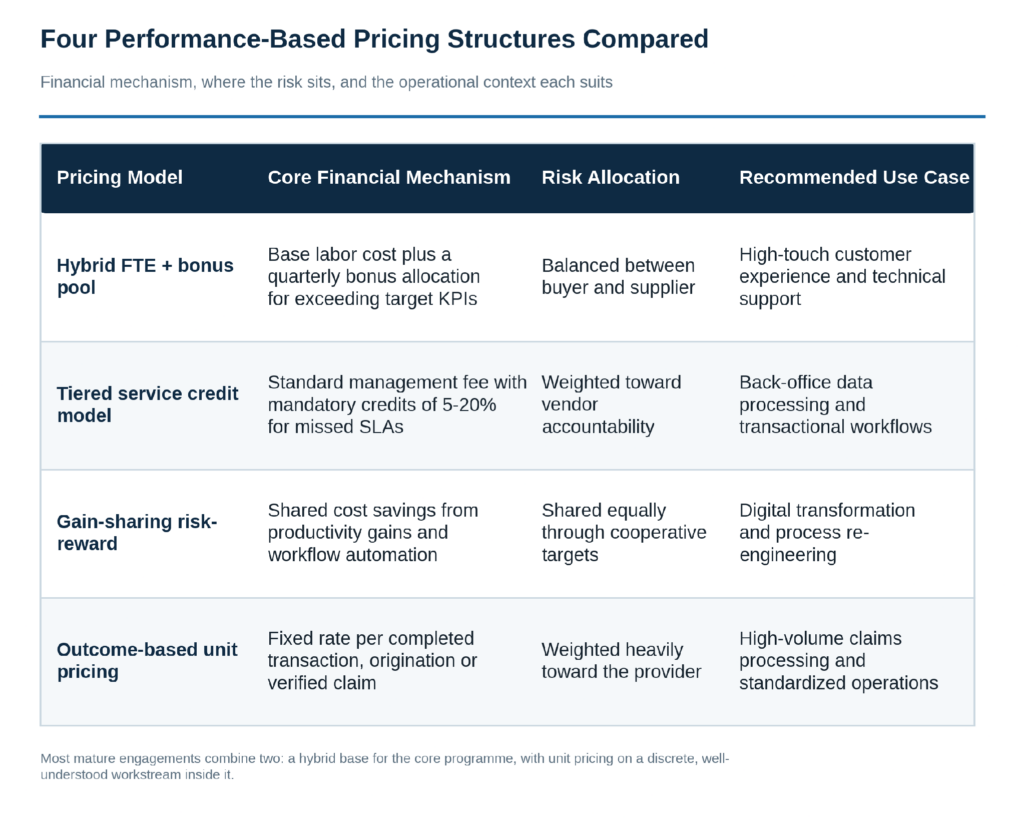
Figure 2. Four performance-based pricing structures compared on mechanism, risk allocation, and best-fit use case.
Hybrid FTE Plus Bonus Pool
A base labor cost covering fully loaded delivery, plus a bonus allocation released for exceeding target KPIs. This is the default for high-touch customer experience and technical support because it protects the staffing model that produces quality while still paying for outperformance. The design question is not whether to use it but how large the pool should be.
Tiered Service Credits
A standard management fee with mandatory credits for missed SLA thresholds, scaled to the severity of the miss. It suits structured, transactional back-office work where outputs are countable and targets are unambiguous. Credits alone tend to produce minimum compliance, so pair them with an upside pool wherever quality rather than throughput is the objective.
Gain-Sharing Risk-Reward
Savings from productivity gains and workflow automation are shared against cooperative efficiency targets. This fits transformation and process re-engineering programs, and it requires clarity on one question before signature: who funds the automation. If the provider builds and funds it, sharing the savings is fair; if the buyer supplies the platform, a gain-share pays for a benefit the buyer already owns.
Outcome-Based Unit Pricing
A fixed rate per completed transaction, origination, or verified claim, suited to high-volume standardized operations. The risk is well documented: paying per unit invites rushing, so any unit-priced scope needs an accuracy threshold, a sampling regime, and a rework clawback. Most mature engagements use it on a discrete workstream inside a hybrid contract rather than as the whole structure.
How Do Philippine Labor Market Realities Influence Performance-Based Pricing?
Providers carry fixed statutory obligations regardless of performance: 13th-month pay, night differential, holiday premiums, and mandatory contributions. Base compensation must be insulated from deductions, or the penalty is funded from agent pay and returns to the buyer as attrition and quality loss.
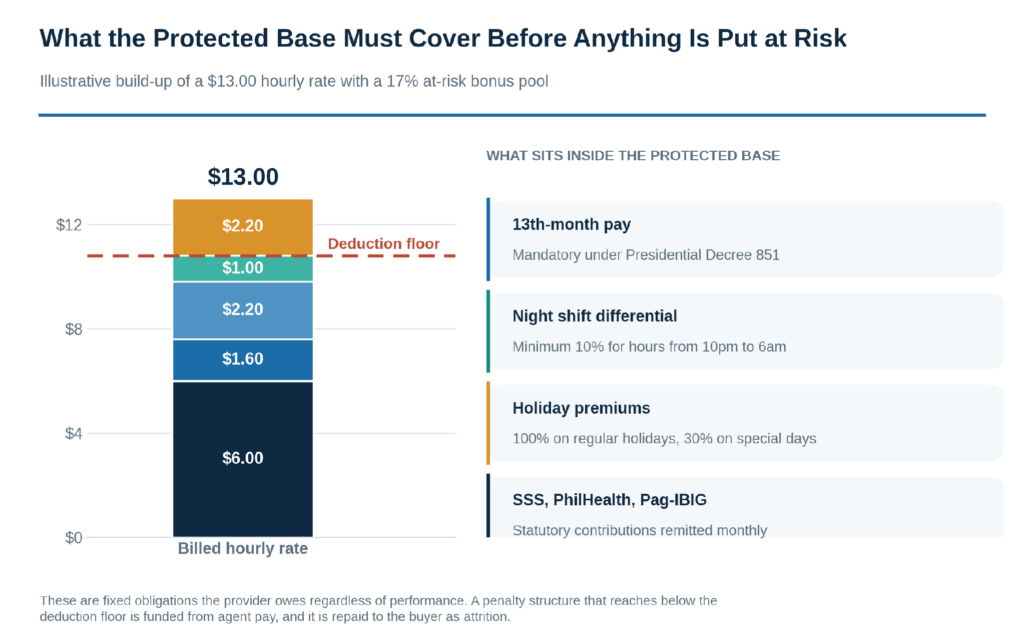
Figure 3. What the protected base must cover before any portion of the fee is placed at risk.
Executing a performance-based agreement here means designing around obligations enforced under Department of Labor and Employment rules, not treating them as overhead the provider can flex. The 13th-month payment mandated by Presidential Decree 851, the statutory night shift differential for hours between 10pm and 6am, premium pay on regular and special holidays, and monthly SSS, PhilHealth, and Pag-IBIG remittances are all fixed costs owed whether the program hits its targets or misses them.
Set a Deduction Floor and Write It Into the Contract
The practical control is a floor below which deductions cannot reach. Above it sits the at-risk pool; below it sit agent pay, statutory obligations, and the supervision ratio the buyer contracted for. A penalty regime that breaches the floor is funded from the wage line, and Philippine attrition dynamics convert that into a service problem within one or two quarters — which means the buyer pays twice for a saving it never received.
Allow a Stabilization Window
New programs need 60 to 90 days after go-live to tune workflows before penalties or bonuses take full effect. Beyond fairness, the window produces the measured baseline that makes eventual targets defensible: numbers agreed during procurement are negotiating positions, while numbers measured on the buyer’s actual contact mix are evidence.
Many corporate buyers attempt to force rigid, penalty-heavy performance models onto Philippine providers without recognizing local cost structures. The most successful pricing structures are collaborative, pairing clear accountability metrics with financial upside that motivates agent retention and operational excellence.
— John Maczynski, CEO, PITON-Global
How Should the Incentive Reach the People Who Deliver It?
A bonus pool that stops at the provider’s P&L changes provider reporting, not agent behavior. Contracts should require a defined share of performance incentives to flow through to frontline agents through transparent bonus structures, and should treat that flow-through as a verifiable term rather than an assumption.
This is the mechanism most performance-based contracts leave implicit, and it is where the model either works or quietly does not. The metrics being rewarded — resolution rate, satisfaction, quality scores — are produced by individual agents on individual contacts. If the financial upside is absorbed at the corporate level, the agent handling the contact experiences no change in incentive, and performance moves only as far as supervision can push it.
Passing a share of the pool through to the floor also addresses retention directly. Agents who can see the connection between quality and their own compensation leave less often, and tenure is the single largest driver of the resolution rates the bonus is paying for. Make the flow-through percentage explicit, and make it auditable alongside the other performance data.
How Should Procurement Design the Pricing Architecture?
Four steps: audit the cost baseline so the base genuinely covers loaded delivery cost, size the at-risk share as a bounded minority of contract value, select three to five controllable metrics with guardrails, then set the stabilization window, elasticity bands, and review cadence.
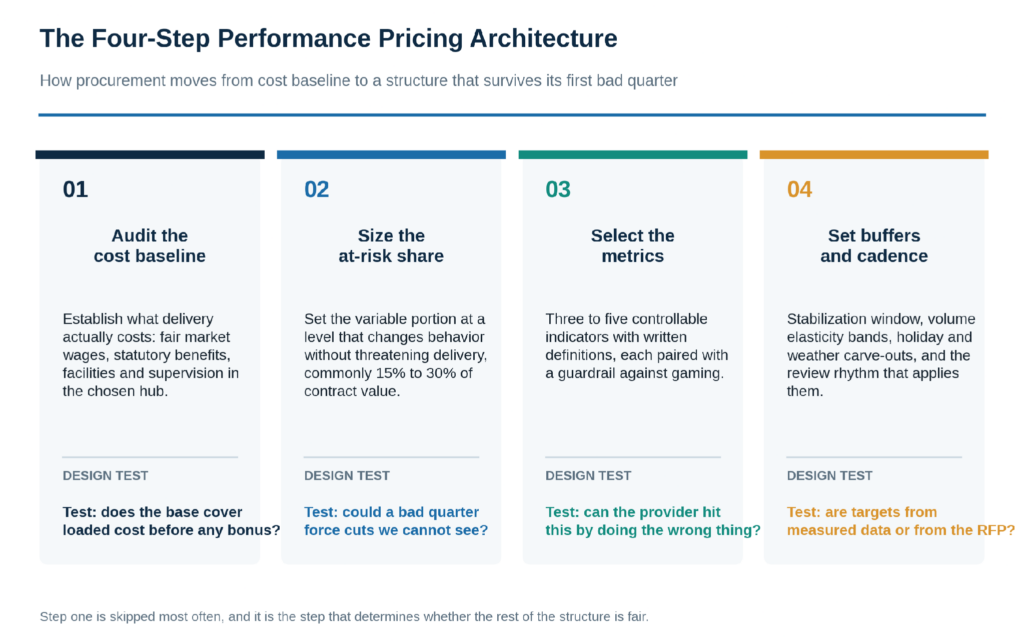
Figure 4. The four-step performance pricing architecture, with the design test to apply at each stage.
Start with an Independent Cost Baseline
Independent cost auditing establishes whether the base rate reflects fair market wages, statutory benefits, and infrastructure overhead in the chosen hub. It is the step most often skipped and the one that determines whether everything downstream is fair—the hidden costs of offshore outsourcing surface exactly here: an at-risk structure layered on a base that already understates delivery cost is not a performance model, it is a discount with extra reporting.
Size the At-Risk Share Deliberately
A variable portion sized as a meaningful minority of contract value is large enough to change how a provider staffs and coaches an account, and small enough that a difficult quarter does not force cuts the buyer cannot see. The right point inside that band depends on how much of the outcome the provider genuinely controls, which is a different question for inbound support than for outbound sales.
Build In the Buffers Before You Need Them
Volume elasticity bands, adjusted thresholds during retail or seasonal peaks, statutory holiday staffing, and telecommunications redundancy allowances should be agreed before the first measurement period. A buffer negotiated after a peak season is a dispute; the same buffer written in advance is simply how the contract works.
What Does a Balanced Pricing Structure Deliver in Practice?
A scaling digital healthcare platform replaced rigid fixed-cost billing with a protected base FTE rate and a monthly bonus pool tied to First Contact Resolution and QA scores. Resolution improved markedly, billing disputes fell sharply, and incentives stayed aligned across a three-year contract.
Client Challenge
The platform faced rising customer escalation rates under a flat-rate arrangement with its legacy Philippine provider. The structure contained no mechanism to reward faster resolution, so the provider’s economics were identical whether escalations rose or fell — and with volumes growing, the fixed-cost model was becoming more expensive precisely as service was becoming less reliable.
Vendor Selection Process
PITON-Global audited the client’s operational cost architecture to establish what delivery genuinely cost, then used its network of more than 100 vetted Philippine providers to source a partner experienced in hybrid gain-sharing models—applying the strategic-fit test for BPO suppliers rather than ranking on size. Experience running a bonus structure mattered as much as capability, since a provider operating one for the first time tends to price the uncertainty into its base.
Solution Implemented
The customized master services agreement paired a protected base FTE rate covering fully loaded delivery cost with a monthly performance bonus pool tied directly to First Contact Resolution and QA audit scores, with a stabilization window before the pool went live.
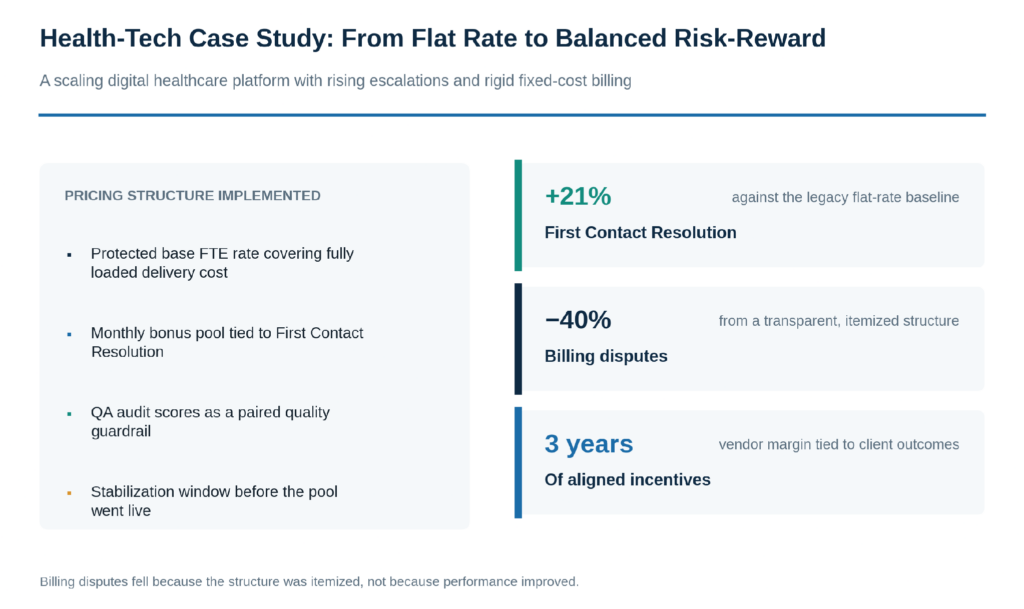
Figure 5. The pricing structure implemented and the outcomes across the three-year agreement.
Outcomes and Lessons
First Contact Resolution improved markedly, billing disputes fell sharply, and vendor incentives remained aligned with enterprise objectives across the term. The two results have different causes worth separating: resolution improved because the bonus pool changed how the account was staffed and coached, while disputes fell because the itemized structure made the invoice explainable. The second benefit is available to any buyer who unbundles a rate, whether or not they add a performance element, and it is one of the financial outcomes that justify scaling a program.
Why Partner with PITON-Global for Strategic Offshore BPO Selection?
PITON-Global is a BPO advisory and outsourcing consultancy delivering advisory-led matching across a network of more than 100 top-tier Philippine providers, combining operational benchmarking with financial risk evaluation to optimize pricing models and minimize exposure.
Who Is PITON-Global?
PITON-Global advises enterprise buyers on Philippine outsourcing across provider selection, cost modeling, and commercial structuring. Its relevance to performance pricing is specific: whether a proposed structure is workable depends on what delivery actually costs in the chosen hub, whether the provider has margin headroom above the at-risk share, and whether it can operate a bonus pool at all. In a market of more than 1,000 providers, none of that appears in a rate card.
How Does PITON-Global Differ from Traditional Outsourcing Brokers?
Traditional brokers are motivated by volume commissions, which favors placing volume rather than structuring it, and their involvement ends at introduction — before the pricing model is designed. An advisory-led approach is organized around the buyer’s outcome: objective evaluation, recommendations that may include providers with no commercial relationship to the advisor, and continued engagement through cost modeling, negotiation, and governance.
How Does PITON-Global’s Network of 100+ Vetted Philippine BPO Providers Benefit Organizations?
Providers are assessed on cost base transparency, performance evidence, model capability, and financial headroom before reaching a buyer. The distinction that matters is between providers willing to sign a performance structure and providers able to operate one — including passing incentives through to agents. Coverage spans voice and CX, back office and finance, healthcare administration, and specialist verticals across Manila, Cebu, Clark, and Davao.
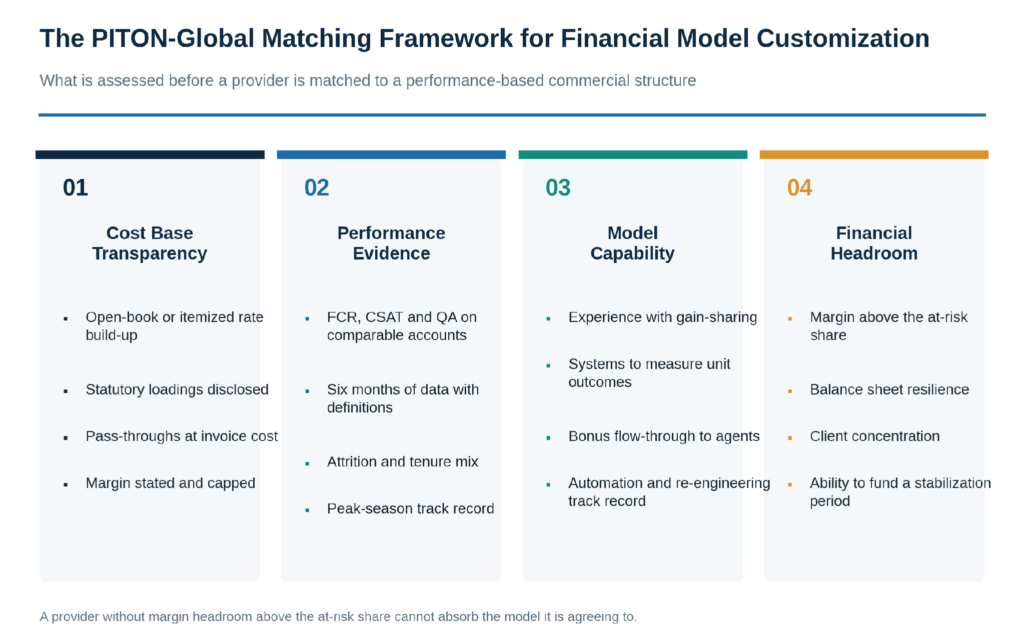
Figure 6. The matching framework for financial model customization, applied before a provider reaches a performance-based structure.
How Does PITON-Global’s Advisory-Led Vendor Matching Process Work?
Requirements, volumes, and target performance levels are documented; the vetted network is filtered on domain expertise and capacity; candidates are assessed on itemized cost build-up, account-level performance evidence, and margin headroom against the proposed at-risk share; and the buyer is supported through baseline auditing, pool design, buffer drafting, and the governance cadence that runs the structure after signature.
Why Do Organizations Use PITON-Global?
- Workable pricing structures. At-risk shares sized against what a provider can absorb rather than what it will agree to.
- Verified cost baselines. Base rates tested against fair market wages, statutory loadings, and hub-specific overhead.
- Improved provider fit. Delivery capability and model capability assessed together, including bonus flow-through to agents.
- Reduced supplier distress. Structures that enforce accountability without pushing a capable partner below its cost floor.
- Support beyond signature. Governance design that reviews targets, buffers, and pool performance rather than leaving them fixed.
Frequently Asked Questions
What is the most reliable pricing model for complex customer support operations?
A hybrid combining a secure baseline FTE rate with a quarterly performance bonus pool tied to satisfaction and resolution metrics. It protects the staffing stability that produces quality while still paying for outperformance, which is why it is the default for high-touch programs.
How do performance bonuses affect agent retention in Philippine BPOs?
Where a share of the incentive flows through to frontline agents via transparent bonus structures, monthly attrition falls measurably. Bonuses retained entirely at the corporate level change provider reporting rather than agent behavior, and retention is what sustains the metrics being rewarded.
What risks are associated with pure outcome-based BPO pricing?
Paying strictly per transaction invites rushing: agents optimize for closure rather than resolution, repeat contacts climb, and brand experience degrades while the volume metrics look healthy. Any unit-priced scope needs an accuracy threshold and a rework clawback.
How should contracts handle seasonal volume spikes under performance pricing?
Through volume elasticity bands and adjusted SLA thresholds during peak periods such as retail holiday rushes. Without them, a provider staffed against forecast is penalized for queue times generated by a surge the buyer produced.
What role do baseline cost audits play in contract negotiations?
An independent audit confirms the base rate reflects fair market wages, statutory benefits, and infrastructure overhead in hubs such as Manila or Cebu. It is what distinguishes a genuine performance structure from a rate reduction with performance language attached.
Why are stabilization periods essential for new performance-based contracts?
Providers need 60 to 90 days to tune workflows and reach steady-state performance before penalties or bonuses take full effect. The period also produces the measured baseline that makes the eventual targets defensible rather than assumed.