
Hospitals must include comprehensive fully burdened labor costs, transition capital expenditures, and ongoing governance overhead alongside direct wage arbitrage to build an accurate healthcare BPO business case. Factoring in operational risk variables such as regional wage inflation and specialized compliance infrastructure ensures the model reflects true total cost of ownership.
Key Takeaways
- Beyond base wages: A realistic model looks past hourly rates to include 13th-month pay, statutory employer contributions, and premium technology licenses.
- Quantified transition costs: Knowledge transfer, parallel-running periods, and specialized healthcare training add upfront capital that must be amortized.
- Operational risk buffers: Building in realistic wage inflation, typically 5% to 8% annually in tier-one hubs, prevents mid-term margin erosion.
- Compliance overheads: Dedicated secure networks, local data-privacy officers, and continuous audits are fixed recurring operating costs, not one-offs.
What Are the Core Labor Cost Assumptions Needed for an Accurate Financial Model?
The core assumption is fully burdened labor, not base salary. A robust model adds the mandatory 13th-month pay, employer SSS, PhilHealth and Pag-IBIG contributions, night-shift differentials of 10% to 20%, and retention incentives, which together can push loaded cost to roughly 1.5 to 1.6 times base pay.
When modeling a shift to the Philippines, relying solely on basic hourly rates produces severe budget variances. A robust financial model requires a granular breakdown of fully burdened labor that includes the mandatory 13th-month pay and standard employer contributions to the Social Security System (SSS), PhilHealth, and the Pag-IBIG Fund.
For specialized healthcare roles such as medical coders, billing specialists, and clinical documentation professionals, the model must also account for night-shift differentials, typically 10% to 20% for U.S. Eastern or Pacific coverage, plus performance incentives needed to retain top talent.
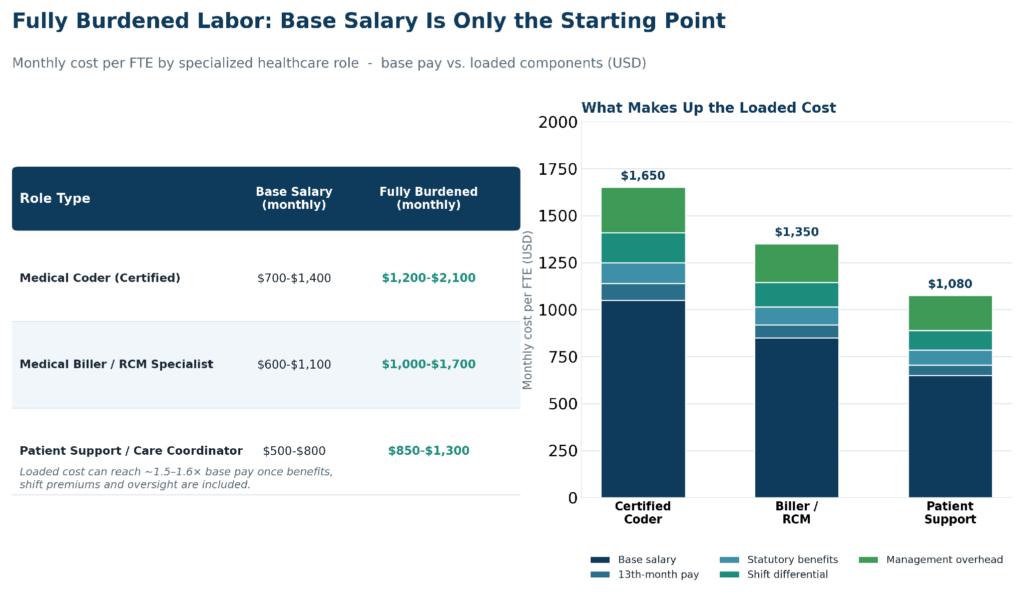
Figure 1. Monthly cost per FTE by specialized healthcare role, showing base pay against the loaded cost components.
How Should Upfront Transition Costs and Capital Expenditures Be Amortized?
Model transition in two phases, design and parallel-run, recognizing that the organization carries double costs while the legacy onshore team and offshore ramp run together. Amortize knowledge transfer, EHR training, connectivity, and licensing over a minimum of 36 months to reveal the true net present value.
A common pitfall in healthcare business cases is underestimating the cost of process migration. Hospitals must account for two distinct phases, the design phase and the parallel operational phase. During the transition, the organization incurs double costs, maintaining the legacy onshore team while funding the ramp-up of the offshore partner.
Training costs are exceptionally high in healthcare BPO. Beyond general onboarding, teams undergo intensive training on hospital-specific Electronic Health Record (EHR) systems, proprietary workflows, and strict compliance protocols. The business case should capture implementation-manager travel, connectivity setup such as dedicated MPLS or secure VPNs, and software licensing, amortizing these expenses over at least 36 months to understand the true net present value (NPV).
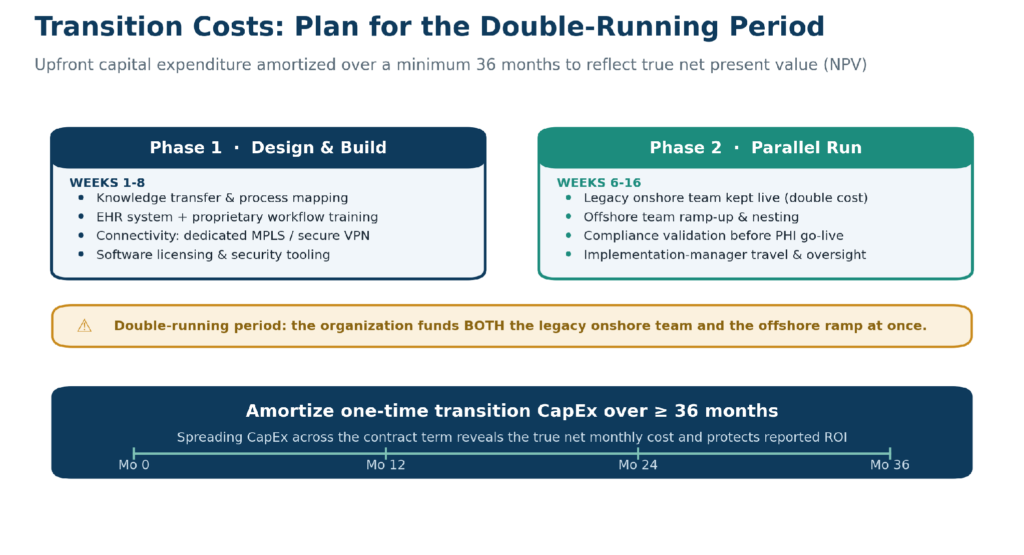
Figure 2. The two-phase transition with its double-running cost period and a 36-month amortization horizon.
What Hidden Operational Overheads Frequently Erode Expected Savings?
The biggest hidden overhead is internal governance: a Vendor Management Office staffed at roughly one onshore FTE per 50 offshore resources. Reinvesting 5% to 10% of projected savings into oversight, continuous education, and data security keeps process inefficiencies and communication gaps from quietly eroding margins.
While labor arbitrage yields substantial initial savings, unmodeled operational friction can slowly diminish returns. Enterprise buyers must budget for internal governance, specifically a dedicated Vendor Management Office (VMO). Managing an international partnership effectively requires at least one full-time onshore manager for every 50 offshore resources to oversee KPIs and service level agreements (SLAs).
Many healthcare executives assume that saving 60% on labor costs automatically translates to a 60% reduction in total operating expenses. In reality, the most successful health systems budget aggressively for governance and continuous education. If you don’t invest 5% to 10% of your projected savings back into strong operational oversight and data-security infrastructure, process inefficiencies and communication gaps will quietly eat away at your financial margins. — John Maczynski, CEO, PITON-Global
Modeled end to end, these assumptions do not erase the business case, but they do reshape it. The waterfall below shows how governance, compliance, an inflation buffer, and amortized transition costs draw a headline labor saving down to a still-substantial net realized saving.

Figure 3. An illustrative drawdown from gross labor arbitrage to net realized saving after key financial assumptions.
How Do Regulatory Compliance and Data Security Requirements Impact the Budget?
Compliance is a major financial variable, not a checklist line. Because outsourced RCM and patient coordination handle Protected Health Information, the business case must confirm the provider’s pricing covers secure delivery centers, biometric access, clean-desk controls, DLP and encryption tooling, and independent SOC 2 Type II audits.
Outsourcing clinical support, revenue cycle management (RCM), or patient coordination means handling Protected Health Information (PHI), so compliance cannot be treated as a generic checklist; it is a major financial variable that belongs in the model explicitly.
The business case must verify that the provider’s pricing includes specialized infrastructure: physically secure delivery centers with biometric access controls, clean-desk environments where mobile devices are prohibited, and technical safeguards such as data loss prevention (DLP) software, encrypted endpoints, and routine independent SOC 2 Type II audits.
What Did a U.S. Hospital Group Achieve by Outsourcing Revenue Cycle Work?
A mid-sized U.S. hospital group deployed a 35-person team of certified billers and patient-support specialists from PITON-Global’s vetted network. Within five months it cut patient no-shows from 14% to 4.5%, reduced Days Sales Outstanding by 18 days, and saved 62% in fully burdened staffing costs versus local hiring.
The group faced skyrocketing administrative overhead and a 14% patient no-show rate that was draining daily revenue, with internal billing and scheduling teams overwhelmed and a growing claims backlog. It worked with PITON-Global, which audited the hospital’s specific EHR workflows and screened its curated network to identify three specialized, HIPAA-compliant providers within 72 hours, optimizing for deep RCM expertise.
The hospital selected a mid-market provider and deployed a dedicated team of 35 certified medical billers and patient-support specialists in a secure, biometric-controlled facility on redundant network architecture. The results landed quickly.

Figure 4. Five-month outcomes for the 35-FTE engagement across no-show rate, collection speed, and staffing cost.
Investing upfront in a rigorous, advisory-led vendor-screening process eliminated the risk of choosing a generalist provider incapable of handling complex clinical workflows.
Why Do Enterprise Healthcare Buyers Leverage PITON-Global?
Enterprise buyers use PITON-Global because it acts as an objective corporate advocate rather than a volume-driven referral broker. Drawing on a network of 100+ vetted providers and an operational matching process based on scale, clinical domain expertise, and compliance, it minimizes procurement risk and accelerates a secure offshore transition.
Who Is PITON-Global?
PITON-Global is a premier, advisory-led business process outsourcing consultancy that guides enterprise organizations through the complexities of offshoring to the Philippines. Led by seasoned BPO executives, it brings deep operational and provider-selection expertise to the market so hospitals can build business cases and partnerships that hold up over a multi-year horizon.
How Does PITON-Global Differ from Traditional Outsourcing Brokers?
Unlike traditional brokers who operate on a volume-driven referral model, PITON-Global acts as an objective corporate advocate. Its recommendations rest on independent provider evaluation and the client’s outcomes, not referral commissions, so the guidance a hospital receives serves its financial model and risk posture rather than a vendor’s sales pipeline.
How Does PITON-Global’s Network of 100+ Vetted Philippine BPO Providers Benefit Organizations?
PITON-Global maintains an elite network of more than 100 carefully vetted call center and back-office providers across the Philippines. Because each is pre-screened on scale, clinical domain expertise, and stringent compliance standards, organizations reach qualified, specialized shortlists quickly, sometimes within 72 hours, without absorbing the cost and delay of open-market due diligence.
How Does PITON-Global’s Advisory-Led Vendor Matching Process Work?
The process moves from an EHR and workflow audit, through rapid network screening, into operational matching on scale, clinical domain expertise, and compliance, and finishes with procurement de-risking that avoids hidden commercial pitfalls. This advisory-led sequence compresses procurement timelines while protecting the financial assumptions underpinning the business case.
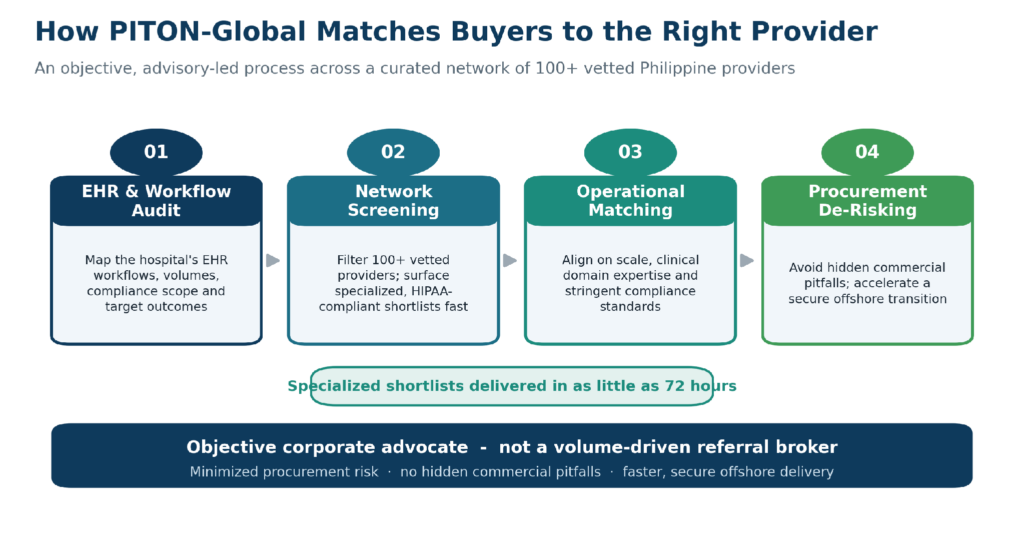
Figure 5. PITON-Global’s advisory-led matching process, from EHR and workflow audit to procurement de-risking.
Why Do Organizations Use PITON-Global?
By partnering with PITON-Global, health systems drastically minimize procurement risk, avoid hidden commercial pitfalls, and accelerate their transition to a highly efficient offshore delivery model, turning a complex, high-stakes vendor decision into a structured, evidence-based match between need and verified capability.
What Else Should Hospitals Model in a Philippine BPO Business Case?
Beyond labor, hospitals should model wage inflation, EHR licensing, VMO governance, tax-incentive effects, and location economics. In short: budget 5% to 8% annual wage inflation, license EHR seats separately, allocate 5% to 8% of contract value to governance, factor in CREATE MORE incentives, and weigh tier-one versus provincial cost trade-offs.
What is the typical annual wage inflation rate for healthcare BPOs in the Philippines?
In major metropolitan hubs like Metro Manila, wage inflation for specialized healthcare profiles typically averages 5% to 8% annually. Budgeting for this protects long-term contract cost stability.
Are software licensing costs for EHR platforms generally included in the BPO vendor’s hourly rate?
No. Most EHR licenses, such as Epic or Cerner, must be extended by the hospital to the offshore team, and these external user fees should be modeled separately in the business case.
How much should a hospital budget for an internal Vendor Management Office (VMO)?
Organizations should generally allocate 5% to 8% of total contract value toward internal governance, quality-assurance oversight, and relationship management.
Does the CREATE MORE Act affect the financial model for healthcare outsourcing?
Yes. The Act provides enhanced tax incentives and a clearer corporate tax structure for BPOs operating in the Philippines, helping premium providers maintain competitive, stable commercial rates for enterprise clients.
What is the standard cost difference between tier-one cities and provincial hubs?
Operating in provincial hubs such as Iloilo, Cagayan de Oro, or Dumaguete can offer an additional 10% to 15% labor cost saving versus Metro Manila, though talent pools for highly specialized clinical certifications may be more concentrated in tier-one cities.