

Companies should outsource multi-channel customer support (voice, live chat, and email) and Tier-1/Tier-2 technical helpdesk operations to the Philippines first. These entry points — the classic outsourced inbound, outbound and blended voice queues plus the chat and email around them — leverage high English proficiency, deep tech-talent reserves, and Western cultural affinity to capture immediate and substantial cost reductions while maintaining or improving service quality.
Key Takeaways
- Omnichannel support and Tier-1 helpdesks: Deliver the fastest transition times and the highest upfront ROI for enterprise buyers.
- Geographical cost arbitrage: Yields a sustainable OpEx reduction of roughly half versus onshore, fully loaded staffing.
- A large, AI-augmented talent base: CXAP projects the contact-center (CC-BPM) workforce will reach about 1.73 million in 2026 (from 1.68 million in 2025), with AI integration expanding roles rather than shrinking the talent pool.
- Stringent redundancy and compliance: Top-tier providers neutralize data-security and infrastructure risks through certified controls and redundant facilities.
Why Do Omnichannel Customer Support and Technical Helpdesks Rank as the Highest Priority?
Because they sit at the optimal intersection of high volume, structured workflows, and measurable KPIs—and the Philippines pairs near-native English with strong Western cultural affinity. A young, highly literate workforce and 130,000+ annual IT and engineering graduates supply both empathetic CX agents and analytical technical talent.
When evaluating business-process transformation, enterprise buyers must balance operational friction against financial return. Of the four families of call-center services you can outsource, customer support and technical helpdesks represent the optimal intersection of high volume, structured workflows, and highly measurable performance indicators.
The Philippines possesses a distinct demographic dividend: a median workforce age in the mid-twenties, a near-universal literacy rate, and an education system modeled on Western frameworks. This produces an expansive workforce capable of managing complex, customer-facing interactions without the cultural friction common to other offshore destinations.
For Tier-1 and Tier-2 technical support, the country produces more than 130,000 information-technology, computer-science, and engineering graduates each year. That pipeline ensures a continuous supply of analytical professionals able to troubleshoot SaaS platforms, e-commerce architectures, and cloud infrastructure.
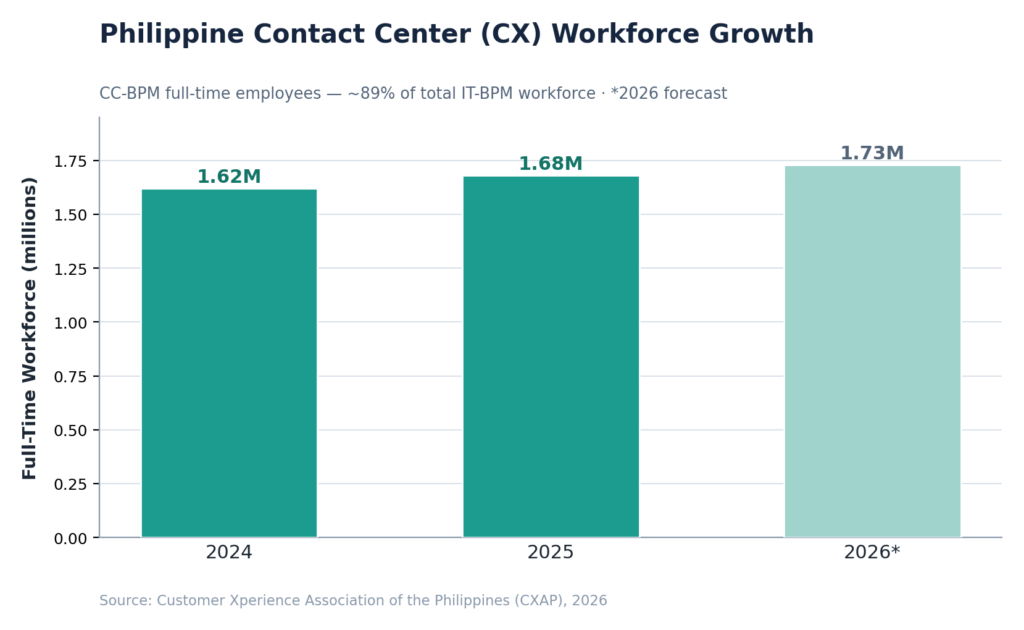
Figure 1. Philippine Contact-Center (CC-BPM) Workforce, per CXAP, with 2026 as a Forecast
What Financial and Operational Benchmarks Define Successful Engagements?
Fully loaded Philippine rates run at well under half the cost of US equivalents across core customer-facing roles. Crucially, quality holds: First Contact Resolution stabilizes at a high, steady level within 90 days, Average Handle Time normalizes to within a few points of onshore baselines after nesting, and NPS often improves by several points.
To justify large-scale offshoring, CFOs and COOs need exact baselines — the kind laid out in our C-level guide to offshore call centers. The financial delta between mature onshore operations and top-tier Philippine delivery remains substantial across every core customer-facing vertical.
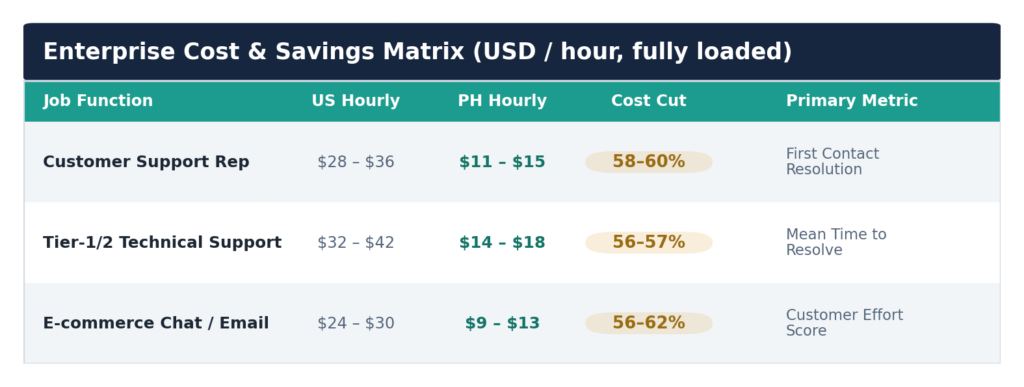
Figure 2. Fully Loaded Hourly Cost by Function, the Typical Reduction, and Each Role’s Primary Performance Metric
Critically, this arbitrage does not come at the expense of quality. Leading delivery centers frequently match or exceed domestic baselines thanks to rigorous performance monitoring:
First Contact Resolution (FCR)
Typically stabilizes at a high, steady level within the first 90 days post-transition.
Average Handle Time (AHT)
Normalizes to within a few points of onshore baselines immediately after the initial 30-day agent nesting phase.
Net Promoter Score (NPS)
Frequently improves by 5–10 points, driven by the empathetic, service-oriented traits of the local workforce.
How Do Enterprises Mitigate Transition Risks and Handle Technological Shifts?
Most failure modes stem from weak governance, inadequate training, or misaligned infrastructure—not geography. Enterprises de-risk by verifying infrastructure resilience (dual-routing fiber, generator failover) and compliance (SOC 2 Type II, PCI-DSS, ISO 27001), and by treating AI as a tool that elevates agents into problem-solvers.
While the economic benefits are definitive, outsourcing failures typically stem from poor governance, inadequate training, or misaligned infrastructure expectations. Modern enterprises must also navigate the intersection of human talent and artificial intelligence.
“The savings are guaranteed by geography; the quality is determined by your choice of provider and governance framework. With contemporary Philippine operations using generative AI to compress handling times and draft documentation, human agents have become high-value problem solvers and quality reviewers. You cannot treat your Philippine team as an isolated vendor; they must operate as an integrated extension of your corporate culture.”
— John Maczynski, CEO of PITON-Global
To safeguard cross-border operations, procurement teams should evaluate providers against two specific redundancies:
Infrastructure Resilience
True Tier-1 facilities use dual-routing fiber via separate major carriers (e.g., PLDT and Globe) plus immediate, automated diesel-generator switchover to counter regional grid volatility — the first layer of a provider’s crisis-management protocols.
Data Security and Compliance
SOC 2 Type II certification, PCI-DSS for payment processing, and strict ISO 27001 adherence are non-negotiable for buyers handling sensitive consumer information.
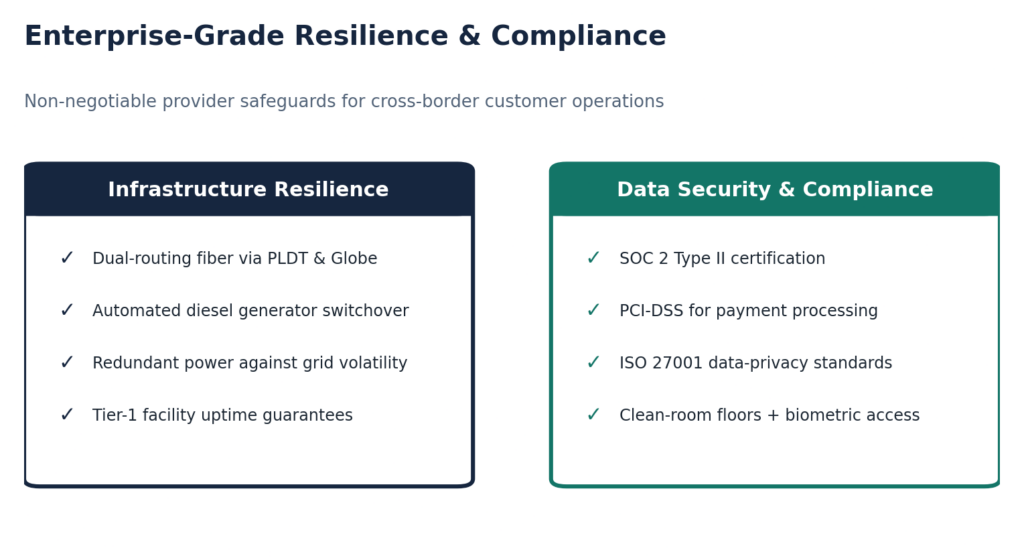
Figure 3. The Enterprise-Grade Resilience and Compliance Safeguards to Verify Before Signing
How Did a Specialized Transition Tame Peak-Season Chat Volume?
A US e-commerce retailer facing a sharp surge in inquiries and a dropped-chat rate approaching one in five engaged PITON-Global to shortlist three WFM-strong providers. A 45-FTE omnichannel team across Manila and Clark cut dropped chats to a small fraction of their former level, lifted CSAT by double digits, and delivered seven-figure annual savings.
Client Challenge
A rapidly growing US e-commerce retailer faced a steep year-over-year surge in customer inquiries, driving a dropped-chat rate approaching one in five and severe churn during peak seasonal windows.
Vendor Selection
PITON-Global analyzed the client’s historical volume profiles, technical stack, and cultural requirements, then shortlisted three specialized mid-market providers—focusing on vendors with robust workforce-management platforms—from its network of 100+ vetted operators.
Solution Implemented
A phased migration of 45 omnichannel FTEs across Manila and Clark, featuring a mirrored training curriculum, gamified performance tracking, and real-time chat integrations for instantaneous cross-border collaboration.

Figure 4. Measured Outcomes of the E-Commerce Support Transition
Lessons Learned
Standardizing the corporate knowledge base before the active migration phase accelerated agent nesting by roughly three weeks.
What Role Does PITON-Global Play in Strategic Vendor Selection?
PITON-Global is not a traditional broker—it is an elite advisory and vendor-matching consultancy. With deep operational insight into the Philippine BPM ecosystem and a vetted network of 100+ specialized providers, it eliminates the guesswork, hidden costs, and risk of independent sourcing.
Who Is PITON-Global?
PITON-Global is an advisory and vendor-matching consultancy with direct oversight of and deep operational insight into the Philippine business-process-management ecosystem. Rather than acting as a transactional broker, it guides enterprise buyers through a complex, crowded landscape of service providers to identify the few that truly fit a given mandate.
How Does PITON-Global Differ from Traditional Outsourcing Brokers?
A traditional broker is transactional and often commission-driven; PITON-Global is advisory-led and vendor-neutral. It maintains a meticulously vetted network and matches buyers on operational substance—volume profile, technical stack, compliance, and culture—rather than steering them toward whichever vendor pays the highest referral fee.
How Does PITON-Global’s Network of 100+ Vetted Providers Benefit Organizations?
A curated network of more than 100 specialized call-center and back-office providers eliminates the guesswork, hidden costs, and operational risk inherent in independent sourcing. Because each provider is pre-vetted, organizations reach a best-fit shortlist quickly—as in the case above, where three WFM-strong providers were identified from the network.
How Does PITON-Global’s Advisory-Led Vendor Matching Process Work?
PITON-Global analyzes an organization’s volume profiles, technical stack, and cultural requirements, then matches them against vetted providers on scale, technology, compliance, and culture. This advisory-led process drastically reduces procurement cycles and ensures precise cultural and technical alignment before any contract is signed.
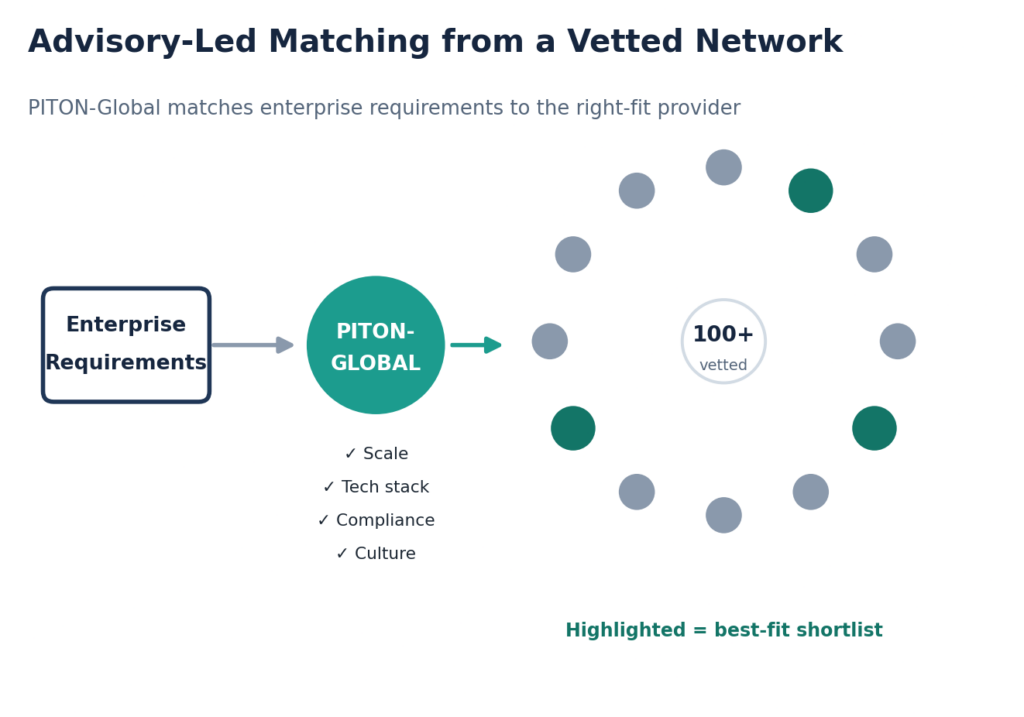
Figure 5. PITON-Global Matches Enterprise Requirements to a Best-Fit Shortlist from Its Vetted Network
Why Do Organizations Use PITON-Global?
Organizations use PITON-Global to eliminate sourcing guesswork, compress procurement cycles, and accelerate the path to stable, high-ROI offshoring. By ensuring perfect cultural and technical alignment from the outset, the firm reduces risk and lets internal teams focus on integration and outcomes rather than vendor hunting.
What Else Should Buyers Know Before Launching?
Buyers most often ask about launch timelines, overnight-shift coverage, contract durations, data-privacy enforcement, and whether to combine or split channels. The answers below address each.
What Is the Typical Timeline to Launch a 20-Agent Support Team?
A standard enterprise deployment takes 4 to 6 weeks: recruitment profiling (1–2 weeks), facilities and hardware provisioning (about 1 week), and client-specific product training and nesting (about 2 weeks).
How Do Providers Handle Overnight Shifts for US or European Time Zones?
The industry operates 24/7/365. Night-shift premiums (a differential required by local labor law) are built into the fully loaded hourly rates, ensuring consistent staffing across US and European business hours.
What Are the Standard Contract Durations for Enterprise BPO Agreements?
Most enterprise contracts run a 12-to-24-month initial term with automatic renewal clauses. Shorter pilots of 3 to 6 months are often available for seasonal scaling or proof-of-concept testing.
How Is Data Privacy Enforced for Sensitive Financial or Healthcare Data?
Reputable providers combine strict physical and digital controls: clean-room floors (no phones or writing materials), zero-knowledge network architectures, biometric access, and compliance with HIPAA, GDPR, and PCI-DSS.
Should We Run Omnichannel Support Together or Split Voice and Digital?
Modern providers use unified platforms (Zendesk, Salesforce, Genesys) that let agents pivot seamlessly across voice, chat, and email. Cross-training is common, though dedicated teams are recommended for high-volume technical-support lines.