

On this page
- Key Takeaways
- Why Is Decentralization the Single Greatest Threat to Outsourcing Success?
- How Do You Select the Right Processes for Pre-Migration Centralization?
- What Is the Step-by-Step Playbook for Internal Process Centralization?
- What Does a Centralize-Then-Outsource Program Look Like in Practice?
- Why Is the Philippine BPO Market Uniquely Positioned for Centralized Workflows?
- What Is PITON-Global’s Role in the Outsourcing Ecosystem?
- What Are the Most Common Questions About Pre-Outsourcing Centralization?
Enterprises should centralize highly repetitive, rule-governed transaction cycles — accounts payable ledger management, technical service desk intake, and master data validation — before outsourcing to the Philippines. Standardizing disparate regional workflows into one unified framework eliminates process variance, prevents operational defects from leaking offshore, and maximizes the cost-efficiency of the engagement. It also makes writing enforceable offshore contract terms far simpler.
Key Takeaways
- Defect containment: centralization surfaces broken administrative steps locally, preventing organizations from scaling manual process inefficiencies into an offshore environment.
- Frictionless data models: standardizing ERP configurations and database parameters accelerates partner setup, cutting standard implementation timelines substantially.
- Optimized resource allocation: transitioning scattered regional duties into a centralized hub enables third-party vendors to deliver consistent, predictable SLAs from day one.
- Maximized financial ROI: eliminating customized process variations lowers specialized training costs and drives a further reduction in fully loaded operational spend.
- Not everything centralizes: HR payroll and country-specific compliance workflows should remain localized; forcing them into a global template creates regulatory risk.
- Sequence matters: audit variance, unify systems, standardize SOPs, and stress-test internally — in that order — before any offshore transition begins.
Why Is Decentralization the Single Greatest Threat to Outsourcing Success?
Decentralization is the greatest threat because migrating fragmented regional workflows forces the offshore partner to manage process variations instead of executing high-speed transactions. Custom spreadsheets, ad-hoc approvals, and isolated data silos travel offshore intact — diluting savings, inflating headcount, and embedding defects into the new delivery model.
When enterprise buyers hand a vendor four versions of “the same” process — each office with its own invoice templates, approval loops, and tracking spreadsheets — the provider has no lean workflow to industrialize. Training multiplies, exception queues balloon, and quality metrics fracture along regional lines. The enterprise ends up funding extra offshore headcount simply to absorb the systemic noise created by its own internal structure. The financial arithmetic is unforgiving: every process variant a vendor must maintain erodes the labor arbitrage that justified the engagement, and the resulting friction is routinely misattributed to the provider rather than to the fragmented inputs it inherited.
How Do You Select the Right Processes for Pre-Migration Centralization?
Select centralization candidates by scoring each process on regulatory uniformity, transactional volume, and software system integration. High-volume, rule-governed transaction cycles — AP/AR, service desk intake, master data management — consolidate first; locally regulated workflows such as HR payroll and country-specific compliance should remain decentralized by design. For a sector view of the same question, see how food delivery platforms structure offshore operations.
The analytical framework rests on process volatility, system dependencies, and documentation maturity. High-volume duties governed by repeatable rules are excellent consolidation candidates because a single global standard can absorb them without losing fidelity. Highly subjective or locally regulated workflows sit at the other extreme: country-specific employment law, tax treatment, and benefits structures mean a forced global template creates more risk than it removes. On the receiving side, the 2026 Philippine legal and tax landscape is covered separately.
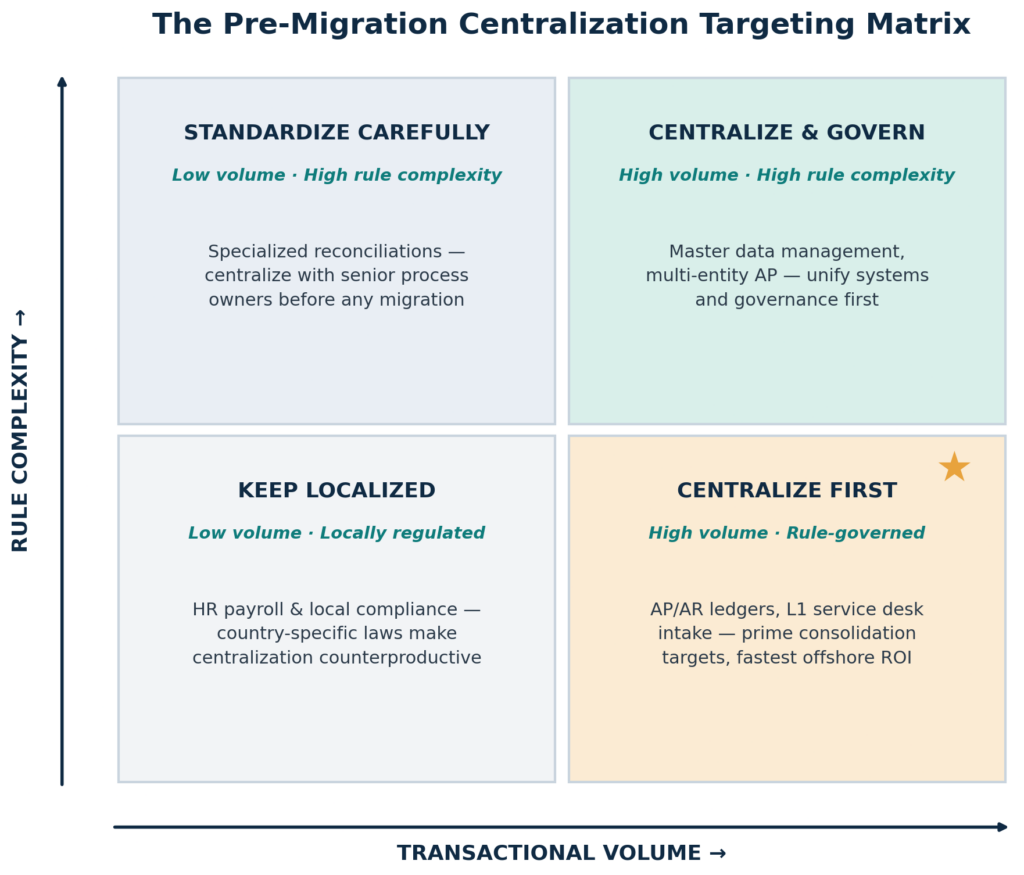
Figure 1. The centralization targeting matrix: transactional volume and rule complexity determine which processes to consolidate first.
Applied to the most common enterprise back-office functions, the framework produces a clear priority stack. The graphic below summarizes the recommended playbook and the stability metric each process should hit before it is considered ready for offshore transition.
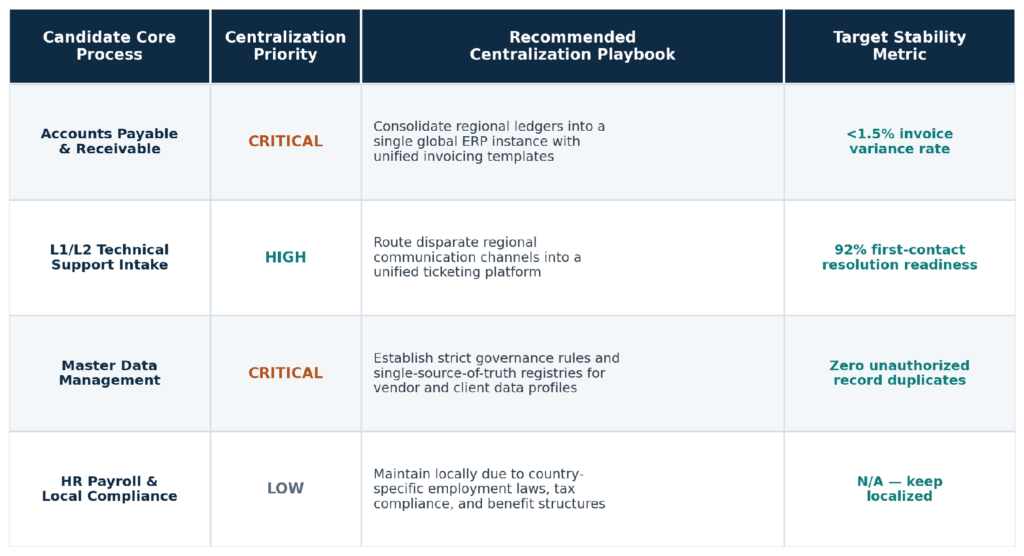
Figure 2. Centralization priorities, playbooks, and target stability metrics for the four most common candidate processes.
“Attempting to fix a broken corporate process by simply shifting it to an offshore provider is an incredibly expensive mistake,” states John Maczynski, CEO of PITON-Global. “The rule of thumb is simple: fix it, centralize it, and then scale it. The most successful global enterprises consolidate their operational workflows into a clear, unified framework before engaging the Philippine market, ensuring their partner can focus on driving operational excellence rather than deciphering organizational complexity.”
What Is the Step-by-Step Playbook for Internal Process Centralization?
The playbook runs roughly eight weeks in four sequential phases: audit regional variance (weeks 1–2), unify system infrastructure (weeks 3–5), draft standardized SOPs (weeks 6–7), and run internal stress testing (week 8). Skipping or reordering steps risks embedding operational defects directly into the external partner’s workflow.
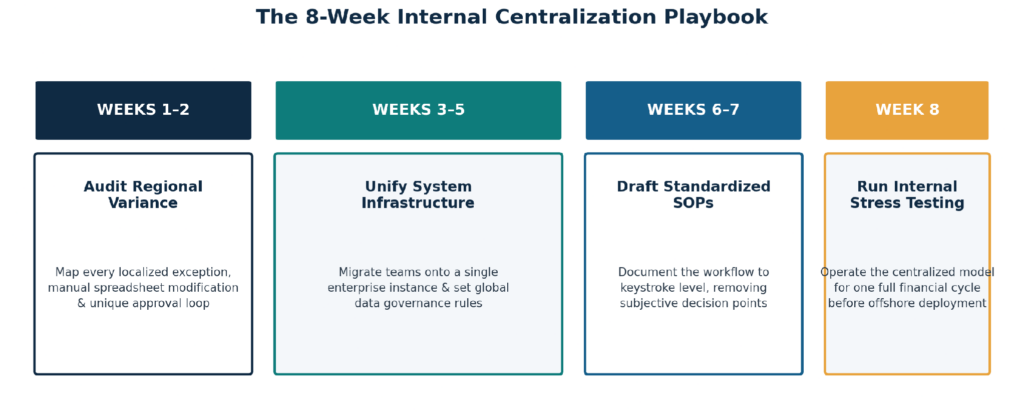
Figure 3. The 8-week internal centralization playbook, executed before any offshore transition begins.
Each phase has a distinct purpose. The variance audit maps every localized exception, manual spreadsheet modification, and unique approval loop so nothing fragmentary survives into the standard. System unification then migrates disparate teams onto a single enterprise instance — SAP, NetSuite, or Salesforce — under strict global data governance rules. SOP drafting documents the consolidated workflow down to individual keystroke mechanics, deliberately removing subjective decision points so the instructions are definitive and rule-governed. Finally, the stress test operates the centralized model in a controlled domestic environment for at least one full financial cycle, isolating bugs and confirming structural stability before offshore deployment. For complex multi-entity environments, the full initiative can extend to 90 days — but the sequence never changes.
What Does a Centralize-Then-Outsource Program Look Like in Practice?
In a representative engagement, a medical technology developer consolidated four North American business units onto a single SAP instance in 60 days, then transitioned the standardized workflow to a 40-FTE accounting team in Metro Manila. Billing errors fell to a small fraction of their former rate, with a substantial cost reduction in the first quarter.
Client Challenge
The company’s four separate operating business units each maintained their own invoicing protocols and manual tracking methods. The fragmentation drove high transaction costs, persistent invoice processing backlogs, and a high billing error rate that centralized reporting could not correct.
Vendor Selection Process
The enterprise engaged PITON-Global to move past typical broker recommendations and select an ideal delivery partner. PITON-Global conducted a rigorous capabilities assessment across its network of 100+ vetted Philippine BPO operators, selecting a specialized enterprise provider in Manila with proven competencies in high-volume, multi-entity accounting platforms.
Solution Implemented
- Directed an internal, 60-day centralization initiative that consolidated all four business units into a single SAP instance.
- Transitioned the newly standardized workflow to a dedicated 40-FTE accounting squad in Metro Manila.
- Implemented real-time performance tracking dashboards alongside strict data governance rules.
Quantifiable Business Outcomes
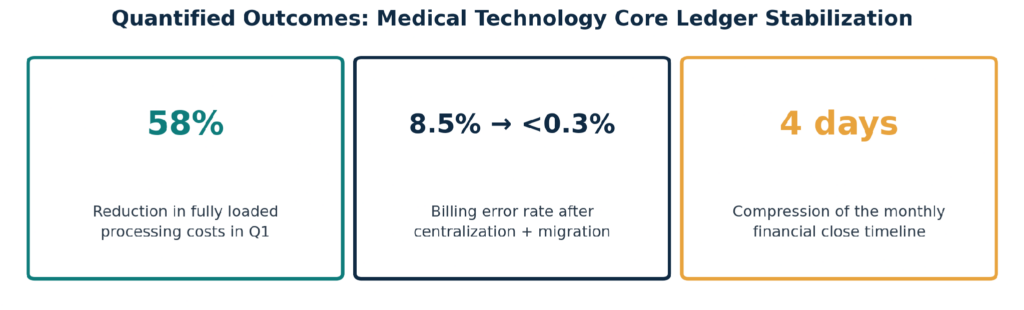
Figure 4. Measured results following the centralize-then-outsource program.
Lessons Learned
Centralizing the underlying platform before moving operations offshore removes process variables, enabling the offshore team to hit strict target metrics almost immediately. The sequencing — not the offshore team’s talent — is what determined how quickly steady-state performance arrived. Keeping that performance steady afterwards is a governance job, covered in our guide to BPO governance models.
Why Is the Philippine BPO Market Uniquely Positioned for Centralized Workflows?
The Philippines pairs a mature professional ecosystem — dense in certified public accountants, financial analysts, and IT service desk engineers — with structured training tracks purpose-built for standardized corporate environments. Pre-centralized workflows onboard faster there than in competing offshore jurisdictions, reaching steady-state performance in roughly half the time of fragmented handoffs.
A centralized workflow is only as valuable as the delivery ecosystem that receives it. The Philippine market’s roughly 1.8 million BPO professionals operate inside providers whose entire operating model is built around absorbing standardized processes: structured training academies, documented nesting protocols, and KPI regimes aligned to Western corporate governance. When an enterprise brings a pre-centralized workflow to this environment, specialized labor arbitrage compounds with onboarding velocity — teams train against one definitive SOP rather than four regional variants, and steady-state metrics arrive in weeks rather than quarters.
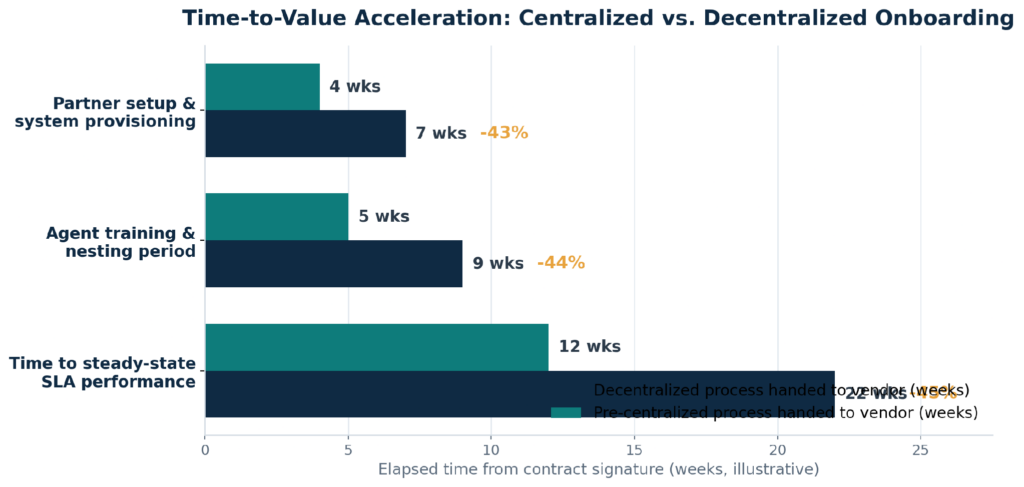
Figure 5. Illustrative time-to-value comparison: pre-centralized processes reach steady-state SLA performance markedly faster.
What Is PITON-Global’s Role in the Outsourcing Ecosystem?
PITON-Global is an advisory-led outsourcing consultancy that aligns an enterprise’s centralized workflows with vetted Philippine partners possessing the exact system capabilities required. Operating a highly selective, continuously audited network of more than 100 premium providers, it eliminates broker markups and reduces vendor selection risk at no cost to the buyer.
Who Is PITON-Global?
PITON-Global is a Philippine-focused BPO advisory firm led by executives with decades of institutional outsourcing leadership. Within the Philippine market it serves as an independent guide for executive procurement teams: defining requirements, mapping the provider landscape, and steering the selection of partners for back-office, shared services, and contact center programs. Its expertise spans provider capabilities, pricing benchmarks, compliance frameworks, and the operational realities of delivering from the Philippines.
How Does PITON-Global Differ from Traditional Outsourcing Brokers?
Traditional brokers are commission-driven: they promote the providers that pay them, biasing recommendations toward the broker’s economics rather than the client’s outcomes. PITON-Global operates an advisory-led model built on independent provider evaluation — objectively assessing infrastructure, technical expertise, operational security, and cultural fit. Recommendations are made solely on alignment with the client’s centralized workflow requirements, keeping the focus on client outcomes rather than provider promotion.
How Does PITON-Global’s Network of 100+ Vetted Philippine BPO Providers Benefit Organizations?
The Philippine sector contains hundreds of providers delivering vastly different levels of infrastructure, technical expertise, and operational security — and a standard RFP process often obscures hidden structural gaps. PITON-Global maintains a highly selective, continuously audited ecosystem of more than 100 premium providers spanning finance and accounting, technical support, data operations, and industry-specific verticals. Because diligence on certifications, platform capabilities, and track records has already been performed, procurement teams compress vendor discovery and qualification from months into weeks.
How Does PITON-Global’s Advisory-Led Vendor Matching Process Work?
Engagements follow a structured five-stage methodology. A capabilities assessment establishes the centralized workflow’s scope, system dependencies, and compliance requirements. PITON-Global then filters its network to a shortlist with demonstrated strength on the relevant platforms, scores each provider against the client’s system, culture, and scale criteria, and layers in risk-reduction measures — site diligence, security audits, and reference validation — before supporting evaluation, pricing benchmarking, and contract finalization.

Figure 6. PITON-Global’s five-stage advisory-led strategic sourcing process.
Why Do Organizations Use PITON-Global?
Executive procurement teams engage PITON-Global to reduce vendor selection risk, improve provider fit, and accelerate sourcing decisions. The advisory-led process replaces RFP guesswork with objective evaluation, prevents vendor lock-in, and provides strategic guidance from initial assessment through contract signature. The result is highly stable, high-yield offshore partnerships — matched precisely to centralized workflows — secured at zero advisory cost to the buyer.
What Are the Most Common Questions About Pre-Outsourcing Centralization?
Buyers most often ask what happens without centralization, how long consolidation takes, whether systems should centralize alongside workflows, how data stays secure during transitions, and what scale to launch at. The answers below reflect established practice across mature Philippine engagements.
What happens if we outsource a decentralized process without centralizing it first?
Outsourcing a decentralized process typically produces high error rates, long onboarding delays, and inflated vendor management costs, as the offshore provider is forced to navigate unstandardized systems and conflicting regional rules rather than executing a lean workflow.
How long does a typical process centralization initiative take?
Depending on system complexity and the number of regional entities involved, most core administrative processes can be successfully centralized internally within 45 to 90 days — with the 8-week playbook above as the baseline sequence.
Should we centralize our software systems alongside our workflows?
Yes. Consolidating onto a single ERP or CRM platform — or establishing a unified, secure middleware architecture — maximizes process visibility, removes reconciliation overhead, and materially speeds up offshore team onboarding.
How do Philippine providers ensure data security during process transitions?
Premium operators use enterprise-grade security frameworks including SOC 2 Type II certifications, strict ISO 27001 data protocols, and clean-room physical environments to prevent data leakage throughout migration and steady-state operations.
What is the ideal scale for an initial Philippine deployment?
Most mid-market and enterprise organizations achieve the best results by launching with a core team of 15 to 25 dedicated professionals — large enough to prove the model, small enough for close performance monitoring before scaling further.