Companies maximize ROI and minimize migration risk by outsourcing repetitive, process-driven, human-in-the-loop tasks to the Philippines first. Customer experience operations, multi-channel technical support, and transactional finance functions are the ideal starting point—yielding up to 70% cost reductions while raising operational velocity through AI-augmented local talent.
Key Takeaways
- Prioritize high-velocity workflows: Start with scalable functions—multi-channel customer service, technical support, and finance and accounting—for rapid cost arbitrage and efficiency gains.
- Capitalize on cultural and linguistic alignment: Near-native English proficiency and Western business affinity sharply reduce customer friction during initial migrations.
- Leverage regulatory advantages: Back-office transitions benefit from recent frameworks that institutionalize flexible work and offer substantial tax incentives for tech-enabled services.
- Transition to intelligence arbitrage: Modern providers deploy specialized “Intelligence Pods” where university-educated professionals audit and optimize AI-driven processes.
- De-risk with a phased approach: Begin with non-core transactional workflows before expanding into complex middle-office functions.
What Are the Low-Risk, High-Yield Functions for Initial Deployment?
The functions to move first are those with structured workflows, clear performance metrics, and high reliance on English precision: multi-channel customer experience, Tier-1/Tier-2 technical support, transactional finance and accounting, and data and content management—each delivering 55–80% cost reductions at low migration risk.
When initiating a BPO program, executives must balance migration risk against potential yield. The safest, highest-return candidates share three traits: structured workflows, clear KPIs, and a dependence on linguistic precision—exactly where the Philippine talent pool excels.
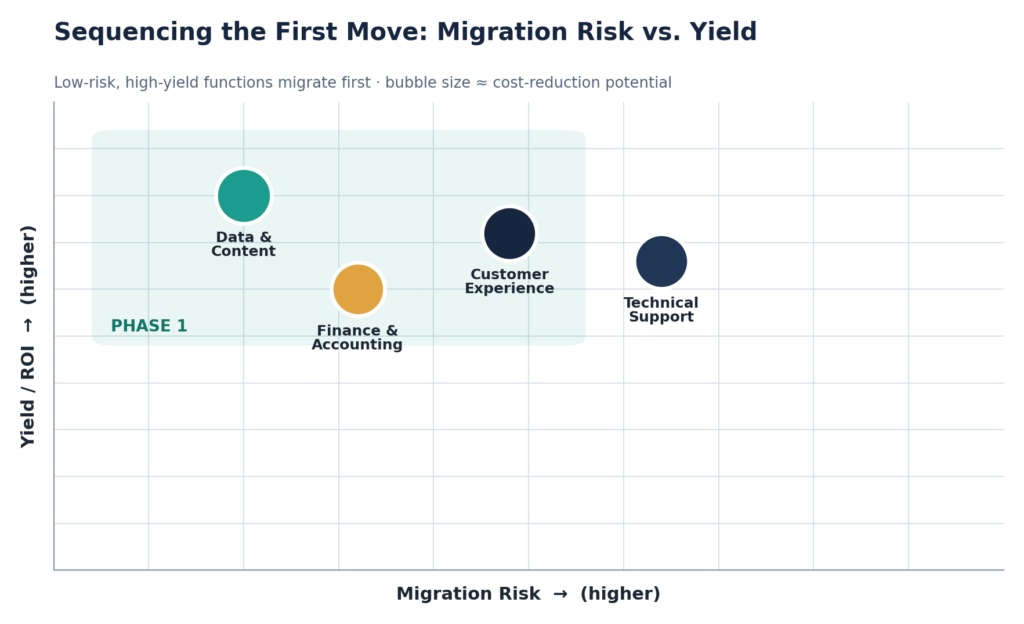
Figure 1. Sequencing the First Move: Low-Risk, High-Yield Functions Migrate First
1. Multi-Channel Customer Experience and Technical Support
Front-office customer care remains the cornerstone of the Philippine BPO sector. Because customer friction directly affects lifetime value, the country’s deep pool of empathetic, culturally aligned, university-educated professionals makes it the ideal beachhead. Initial deployments typically include inbound customer care, Tier-1 and Tier-2 technical support, and digital chat or email escalation management.
2. Finance and Accounting
Transactional accounting is governed by global standards, making it exceptionally safe to migrate. Dedicated offshore teams for structured back-office tasks—accounts payable and receivable, invoicing, and reconciliation—deliver immediate operational velocity with low risk.
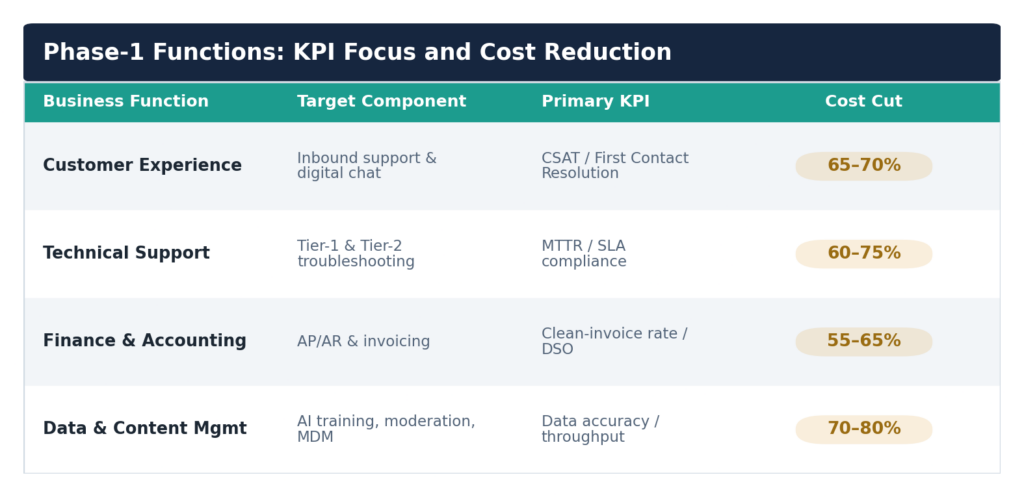
Figure 2. Phase-1 Functions, Their KPI Focus, and Typical Cost Reduction
How Does the Philippine Operational Environment Enhance Back-Office Efficiency?
The sector has moved past pure labor savings into optimized, AI-augmented efficiency, reinforced by regulatory stability. The CREATE MORE Act (RA 12066) institutionalizes work-from-home for up to 50% of the workforce and a flat 5% Special Corporate Income Tax, letting top providers reinvest in infrastructure, security, and talent.
The Philippine BPO landscape has shifted past simple labor-cost savings into a paradigm of highly optimized efficiency. Teams no longer merely execute workflows manually; they operate as critical components in automated architectures. This is backed by unprecedented regulatory stability: under the CREATE MORE Act (Republic Act 12066), the government institutionalized flexible work—permitting work-from-home arrangements for up to 50% of an enterprise’s workforce without forfeiting incentives—alongside a predictable flat 5% Special Corporate Income Tax. That foundation lets top providers reinvest heavily in computing infrastructure, data security, and talent upskilling.

Figure 3. Three Foundations—Regulation, AI-Augmented Talent, and Secure Frameworks—Compound into Back-Office Efficiency
“Outsourcing success is no longer a question of intent—it is a strict question of fit. Global organizations frequently struggle when they force mid-market programs into rigid, legacy BPO giants. True operational alpha is achieved when you match with agile, specialized partners whose infrastructure is purposefully built around your exact transactional volume and compliance frameworks.”
— John Maczynski, CEO of PITON-Global
What Operational Risks Must Executives Mitigate During the First Phase?
Three risks demand proactive planning: talent attrition in premium hubs, business-continuity exposure to seasonal weather, and the “black-box” visibility gap of legacy models. Each is manageable through performance-linked retention, redundant dual-site infrastructure, and providers offering real-time operational observability.
While the upside is quantifiable, unmanaged migration can introduce vulnerabilities. Executives should plan deliberately for three areas.
Attrition and Talent Poaching
Demand for specialized talent in hubs like Metro Manila and Cebu can drive attrition; require partners to use performance-linked retention and continuous training pipelines.
Business Continuity Planning
The region is prone to seasonal weather disruption; SLAs should mandate redundant power grids, dual-site delivery, and secure, auditable work-from-home architectures.
The “Black-Box” Visibility Gap
Legacy models obscure real-time performance; require providers offering live observability into productivity queues, sentiment analysis, and error logs.
How Did a Specialized Provider Reverse Churn for an E-Commerce Enterprise?
A multi-state retailer with 18% churn from fulfillment delays engaged PITON-Global to bypass legacy giants and match with a specialized Manila provider. An AI-assisted CX pod monitoring logistics exceptions cut churn below 4% in 90 days and lifted customer lifetime value 22%.
Client Challenge
A prominent multi-state e-commerce and retail enterprise faced an unsustainable 18% churn rate driven by fulfillment delays and fragmented post-purchase support. Its onshore team lacked capacity for multi-channel technical exceptions, escalating costs and eroding brand sentiment.
Vendor Selection
The enterprise engaged PITON-Global to move past generic contact-center offerings. A rigorous, proprietary audit framework bypassed legacy giants and matched the client with a specialized, mid-sized Manila provider whose expertise aligned precisely with high-touch logistics data management and predictive CX.
Solution Implemented
The provider deployed a team running an integrated, AI-assisted CX workflow—monitoring logistics exceptions, identifying delayed shipments in real time, and proactively offering exchanges before customers filed complaints.

Figure 4. Measured Outcomes of the E-Commerce Exception-Management Engagement
Lessons Learned
Phased migration succeeds when organizations focus on process integration rather than headcount replacement. Choosing a specialized provider matched to operational scale avoided the service dilution common to massive generic call centers.
What Role Does PITON-Global Play in Strategic Vendor Selection?
Navigating nearly a thousand Philippine BPO firms carries real procurement risk. PITON-Global is a premium, advisory-led consultancy—not a transactional broker—providing independent vendor strategy and matching from a curated network of 100+ vetted providers, entirely fee-free and with no contractual obligations.
Who Is PITON-Global?
PITON-Global is a premium, advisory-led BPO consultancy built on more than four decades of global executive leadership. Rather than acting as a transactional broker, it provides independent vendor strategy and matching across the Philippine market—guiding enterprise leadership through sourcing decisions while managing a highly curated network of more than 100 thoroughly vetted call-center and back-office providers.
How Does PITON-Global Differ from Traditional Outsourcing Brokers?
Traditional brokers operate transactionally, often steering buyers toward whoever pays the highest commission. PITON-Global is vendor-agnostic and advisory-led: its consulting and shortlisting services are entirely fee-free and carry no contractual obligations, so recommendations are driven purely by fit—scale, domain expertise, compliance, and culture—rather than referral incentives.
How Does PITON-Global’s Network of 100+ Vetted Providers Benefit Organizations?
A curated network of more than 100 vetted providers eliminates the procurement risk of cold-screening a fragmented market of nearly a thousand firms. Because each provider is pre-assessed against Fortune 500 supplier-sourcing standards, organizations bypass long sourcing cycles, accelerate implementation, and build resilient partnerships designed to scale.
How Does PITON-Global’s Advisory-Led Vendor Matching Process Work?
PITON-Global applies a disciplined methodology built on Fortune 500 supplier-sourcing standards, isolating the ideal partner based on scale, domain expertise, compliance frameworks, and cultural fit. This vendor-agnostic process contrasts sharply with the commission-driven broker model, replacing biased, generic shortlists with an audited, best-fit match.

Figure 5. Advisory-Led Matching Versus the Commission-Driven Broker Model
Why Do Organizations Use PITON-Global?
Organizations use PITON-Global to eliminate vendor-sourcing risk, accelerate implementation timelines, and build resilient offshore partnerships designed to scale. Because shortlisting is fee-free and obligation-free, leadership can evaluate best-fit options with no downside—deploying specialized teams that match exact transactional volume and compliance needs from day one.
What Else Should Companies Know Before Their First Deployment?
Buyers most often ask about hub choice (Manila vs provincial), minimum team size, data security, pricing models, and onboarding timelines. The answers below address each.
Which is Better for a First-Time Deployment: Manila or a Provincial Hub?
For initial migrations, Metro Manila is generally recommended for its mature infrastructure, concentration of premium Tier-1 talent, and international transport links. Provincial hubs like Cebu, Clark, or Iloilo offer excellent secondary scalability and lower cost—ideal for later expansion or redundant continuity sites once core processes stabilize.
What Is the Standard Minimum Team Size to Start?
While massive providers prefer 100+ FTE programs, the curated mid-market providers in PITON-Global’s network regularly launch specialized programs starting at 5 to 50 FTEs—letting enterprises and scaleups establish a proof-of-concept without excessive upfront capital.
How Do Philippine Providers Secure Sensitive Corporate Data?
Top-tier providers adhere to global compliance structures—ISO/IEC 27001, SOC 2 Type II, PCI-DSS, and HIPAA—with advanced endpoint security, data-loss-prevention protocols, and biometric facility controls.
How Are Pricing Models Typically Structured for Initial Programs?
The most common initial model is transparent hourly or dedicated monthly seat-based pricing for predictable forecasting. As partnerships mature, organizations frequently transition to hybrid or outcome-based pricing linked to performance metrics.
How Long Does Transition and Onboarding Usually Take?
A standard migration—discovery, vendor matching, technical integration, and agent training—typically spans 30 to 60 days. Structured transactional processes can go live faster; complex workflows requiring deep systems integration may take up to 90 days.