

On this page
- Key Takeaways
- How Do Physical Infrastructure and Grid Instability Impact Financial Projections?
- How Should Talent Attrition and Wage Inflation Be Quantified in Offshore Budgets?
- How Do Regulatory and Data Security Risks Materialize in Financial Models?
- What Continuity Reserves Should a Financial Model Actually Carry?
- What Does Properly Modeled Continuity Look Like in Practice?
- What Role Does PITON-Global Play in Reducing Offshore Disruption Risk?
- Frequently Asked Questions
Business continuity risks belong in every financial model for Philippine outsourcing: grid instability, severe weather disruption, talent attrition, infrastructure redundancy, data privacy breaches, and regulatory shifts. Factoring in dual-utility power, secondary ISP failover, wage inflation, and SLA penalty-incentive structures prevents margin erosion and produces genuine operational resilience, on top of the continuity, privacy and certification checks a vendor should already pass.
Key Takeaways
- Infrastructure redundancy has a price. Model a standing buffer for dual-active ISP circuits and diesel fuel reserves during grid destabilization.
- Weather-induced absenteeism is seasonal and predictable. Typhoon season from July to October requires an overtime surge premium built into base operating cost.
- Attrition is a continuity risk, not an HR metric. Per-seat replacement costs must be amortized inside the unit-rate model.
- Regulatory exposure needs its own reserve. Penalties under GDPR, HIPAA, or the Philippine Data Privacy Act require liability reserves and insurance sub-limits.
- Split-site deployment buys disproportionate protection. Two hubs add modestly to facility cost and cut localized downtime risk sharply.
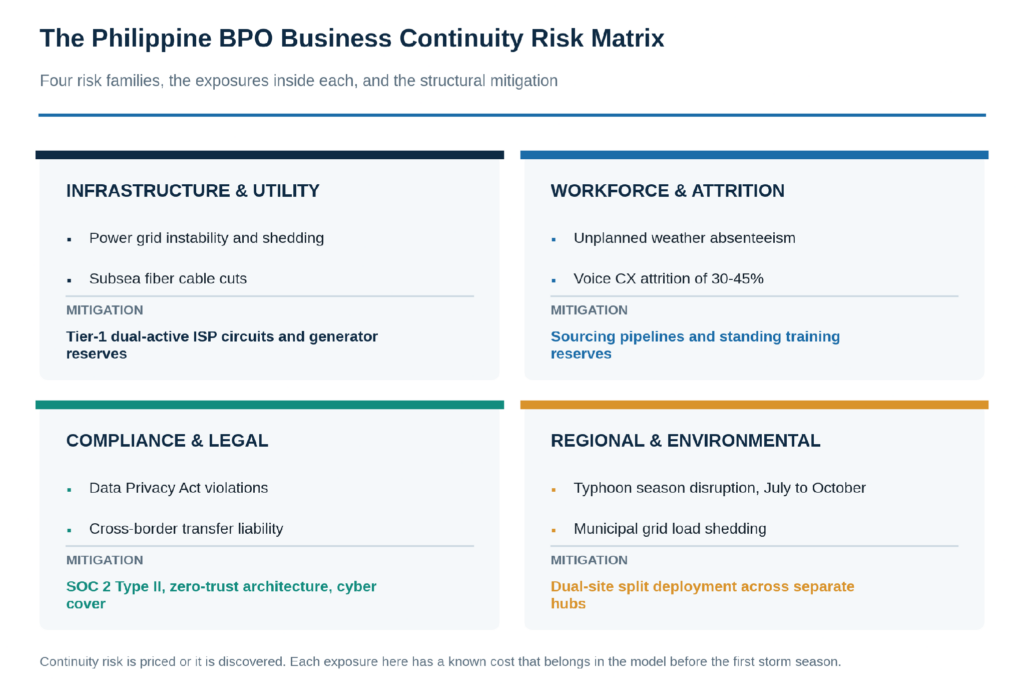
Figure 1. The Philippine BPO business continuity risk matrix: four risk families, their exposures, and the structural mitigation for each.
How Do Physical Infrastructure and Grid Instability Impact Financial Projections?
Metro Manila, Cebu, and Clark carry modern telecommunications, but localized outages and fiber cuts remain recurring operational realities. A model built on baseline hourly rates alone captures none of the overhead required to hold uptime through them, so the cost surfaces later as unbilled downtime and SLA penalties.
The distinction that matters is between infrastructure a provider has and infrastructure a provider contracts to maintain. Most enterprise-grade facilities have generators; fewer guarantee a fuel reserve in hours. Most have two carriers; fewer run them dual-active on separate subsea paths with automatic routing. The difference costs money, and it belongs in the facility fee rather than in a crisis invoice.
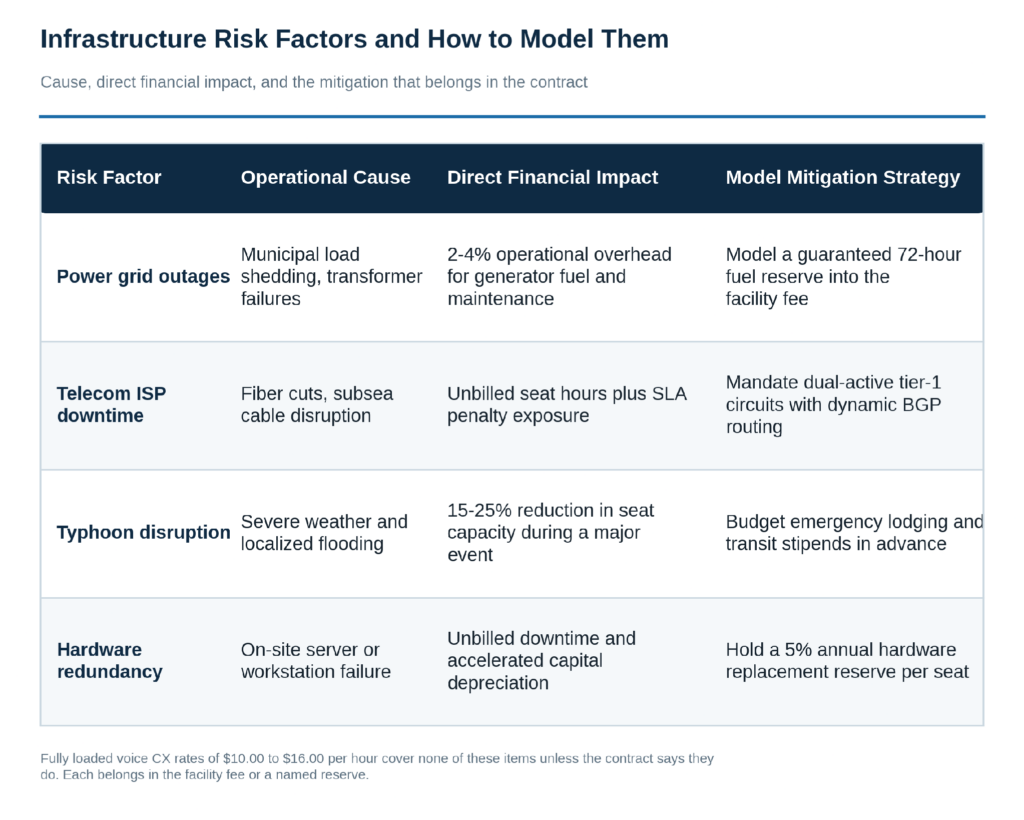
Figure 2. Infrastructure risk factors, their financial impact, and the mitigation that belongs in the contract.
Cap the Fuel, Don’t Pass It Through
Facilities in tier-2 and tier-3 cities lean more heavily on generator power, which makes diesel a genuine cost line rather than a contingency. Verify that fuel surcharges are capped within the vendor agreement instead of billed as open-ended pass-through, and that the guaranteed reserve is expressed in hours of continuous operation — 72 hours is a defensible standard — rather than in tank capacity.
Dual-Active Routing Is the Single Highest-Value Control
A single-carrier facility fails completely on a single fiber cut, and subsea cable disruption is not rare in the region. Dual-active tier-1 circuits on separate physical routes, with dynamic BGP failover, convert that event from a lost day into a degraded few seconds.
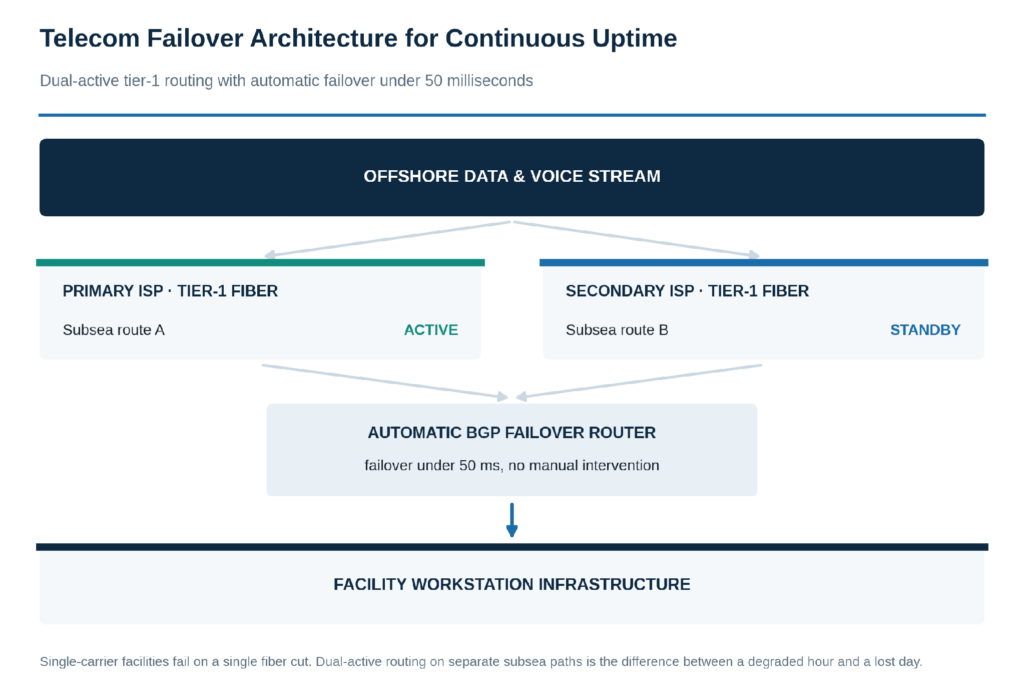
Figure 3. Telecom failover architecture: dual-active tier-1 routing with automatic BGP failover.
How Should Talent Attrition and Wage Inflation Be Quantified in Offshore Budgets?
Budget a per-agent replacement cost for sourcing, screening, background checks, and training runway; carry an annual wage escalator for local inflation and wage board adjustments; and hold a contingency for shift-differential and weekend premium pay during volume spikes.
The Philippine IT-BPM sector employed roughly 1.9 million people at the end of 2025 according to IBPAP, which gives buyers exceptional depth and simultaneously creates intense competition for specialized skills. Voice roles frequently run high annual attrition, and each departure carries recruitment, classroom time, and a productivity ramp during which the buyer is billed for partial output.
Treat Attrition as a Continuity Failure
Turnover belongs in the continuity section of a model rather than the workforce section, because its effect is identical to an outage: capability that was contracted for is not available. The difference is that an outage is visible and attrition is not. A floor running at high turnover rarely holds a majority of fully productive agents, so the buyer pays the agreed rate for a permanently junior operation and absorbs the resulting handle time, error rate, and escalation volume without a single line item explaining why.
Separate Escalators From Reserves
Wage escalation and continuity reserves are different instruments and should be modeled separately. An escalator is a run-rate adjustment reflecting inflation and regional wage board movement; a continuity reserve is capital held against events that may not occur. Blending the two produces a number that is defensible in neither direction. Currency and policy exposure deserve the same discipline, as our guide to economic and geopolitical risk for finance leaders explains.
BPO buyers frequently miscalculate continuity risk by focusing strictly on facility outages while ignoring workforce attrition. High agent turnover is a structural business continuity failure that quietly erodes customer experience and inflates true cost per contact.
— John Maczynski, CEO, PITON-Global
How Do Regulatory and Data Security Risks Materialize in Financial Models?
Cross-border processing engages GDPR, HIPAA, PCI-DSS, and the Philippine Data Privacy Act of 2012. Model zero-trust licensing, clean-desk monitoring, endpoint management, and annual SOC 2 Type II audits as recurring cost, and treat vendor liability caps of three to twelve months of billings as insufficient on their own.
The financial structure here is straightforward once stated plainly: the cap limits what the vendor owes, not what a breach costs. Regulatory fines, notification obligations, remediation, and reputational damage are unrelated to contract value, which is why privacy breaches are normally carved out of the liability cap and covered under a separate policy sub-limit sized to the exposure rather than to the contract.
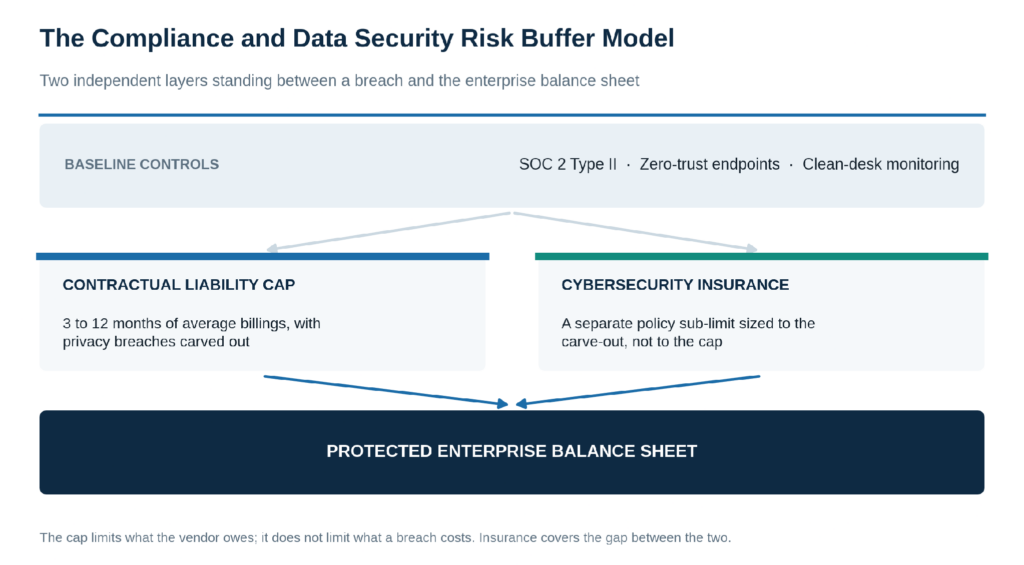
Figure 4. The compliance and data security risk buffer model: two independent layers between a breach and the balance sheet.
Verify Scope, Not Certification
A certificate number establishes that something was certified; the scope establishes whether it was the operation running your program. Read the ISO 27001 Statement of Applicability and the SOC 2 exceptions section rather than the cover page, and confirm the assessed environment includes the specific site, the specific service, and the specific data flows your contacts will touch. The controls behind that scope are set out in our guide to data security in outsourced operations.
What Continuity Reserves Should a Financial Model Actually Carry?
Expressed on one denominator, genuine continuity adds a material share to program operating cost: infrastructure redundancy, annualized weather overtime, compliance and security tooling, attrition amortization, split-site premium, and hardware reserve. Wage escalation sits on top as a separate run-rate item.
Continuity items are usually quoted on different bases — a percentage of billing here, a per-seat dollar figure there, a share of facility cost elsewhere — which is precisely why they rarely make it into the same model. Restating them on a single denominator makes the total visible and, more usefully, makes the trade-offs comparable.
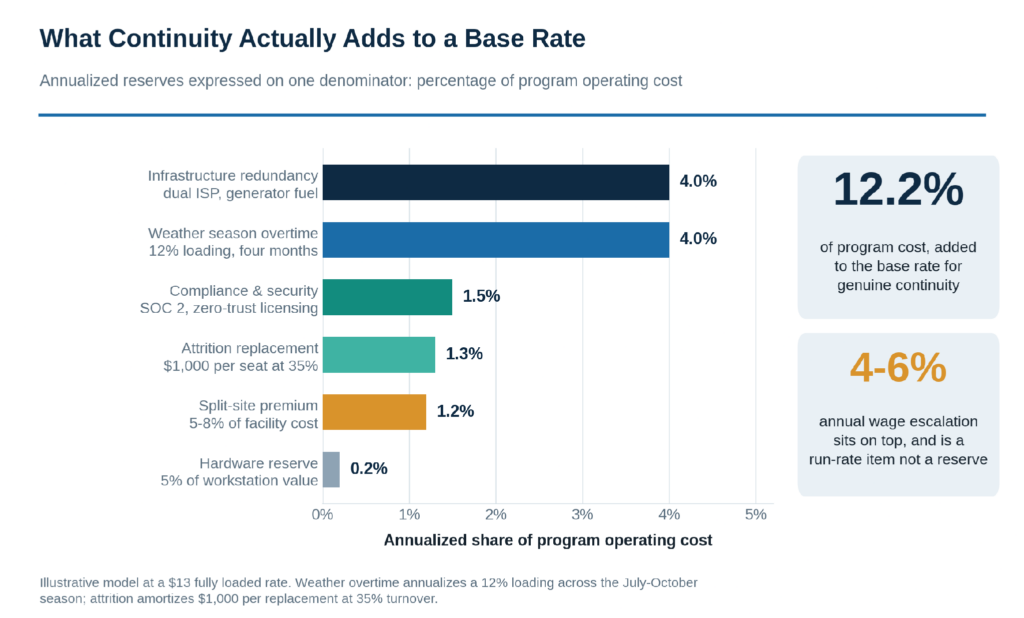
Figure 5. Continuity reserves restated on one denominator, as an annualized share of program operating cost.
Where the Money Actually Goes
Two items dominate. Infrastructure redundancy is a standing cost that buys availability every day of the year. Weather overtime is concentrated: the loading applied during the July to October season is an annual cost, but it arrives in four months rather than twelve, which is a cash flow question as much as a cost question. The remaining items are smaller individually and still worth naming, because an unnamed reserve is an unfunded one.
The Split-Site Trade-Off Is the Best Value on the List
Deploying across two geographically distinct hubs — Metro Manila and Cebu, or Manila and Clark — typically raises facility management cost modestly while sharply reducing total operational downtime risk during localized weather events. Few controls in an outsourcing model offer that ratio, and it is the single decision most likely to determine whether a storm season produces a service report or an incident report.
What Does Properly Modeled Continuity Look Like in Practice?
A US payments platform facing heavy cost overruns each typhoon season moved to a split-site Manila and Clark deployment with dual ISP failover and pre-budgeted emergency stipends. It held near-continuous uptime through subsequent major storm seasons, cut unexpected continuity expense substantially, and lifted first contact resolution.
Client Challenge
A mid-sized US payments platform was absorbing a large cost overrun during typhoon seasons, driven by unbudgeted vendor downtime premiums and SLA penalties. The overruns were not caused by unusual weather — typhoon season arrives every year — but by a commercial structure that treated a predictable seasonal event as an exception to be invoiced after the fact. How well-run centers plan for those events is covered in how Philippine call centers build resilient operations.
Vendor Selection Process
PITON-Global evaluated candidate providers across its Philippine network, filtering specifically for dual-location redundancy, generator reserve capacity, and zero-trust IT capability. Continuity capability was treated as a threshold criterion rather than a scored attribute, on the reasoning that a provider without split-site capacity cannot deliver split-site resilience at any price.
Solution Implemented
The client transitioned to a top-tier provider running a split-site strategy across Manila and Clark, with dual ISP failover and emergency housing stipends pre-budgeted into the facility fee rather than billed during events. The commercial change was as important as the operational one: costs that had previously arrived as surprise invoices became a known line in the rate.
Quantifiable Business Outcomes
- Near-continuous operational uptime sustained through subsequent major storm seasons.
- A substantial reduction in unexpected continuity expenses across the program.
- Higher first contact resolution, supported by a workforce that stayed available through disruption.
Lessons Learned
Explicitly modeling continuity contingencies inside baseline vendor pricing eliminates surprise operational invoices during crisis events. The saving did not come from spending less on resilience — the split-site structure costs more to run. It came from converting an unpredictable, penalty-bearing exposure into a budgeted, contracted cost, which is what a financial model is for.
What Role Does PITON-Global Play in Reducing Offshore Disruption Risk?
PITON-Global is an independent BPO sourcing advisory firm headquartered in Manila with more than 25 years of on-the-ground experience. It audits provider infrastructure resilience, generator capability, network redundancy, financial health, and data security standards through a seven-step vetting framework.
Who Is PITON-Global?
PITON-Global advises enterprise buyers on Philippine outsourcing across provider selection, commercial structuring, and continuity diligence. Its relevance to a continuity assessment is specific and local: knowing which facilities actually hold 72-hour fuel reserves, which carriers share physical subsea routes, and which providers have rehearsed a live failover rather than documented one requires presence in the market. Across an ecosystem of more than 1,000 providers, none of that appears in a capability deck.
How Does PITON-Global Differ from Traditional Outsourcing Brokers?
A transactional broker earns when a placement happens, which narrows the recommendation set to whichever providers pay best and ends the relationship at introduction. An advisory-led model is organized around the buyer’s outcome: objective evaluation, recommendations that may include providers with no commercial relationship to the advisor, and continued engagement through structuring and governance. On continuity work the distinction is concrete, because an intermediary paid on placement has no reason to report that a shortlisted facility runs both its carriers down the same cable route.
How Does PITON-Global’s Network of 100+ Vetted Philippine BPO Providers Benefit Organizations?
The network gives buyers access to providers already audited on infrastructure resilience, redundancy architecture, financial health, and security standards — the top tier of a market of more than 1,000 operators. Because the screening has happened in advance, a buyer evaluating continuity begins from a field where every candidate can actually deliver it, and shortlists arrive within 48 to 72 hours at no cost to the buyer.
How Does PITON-Global’s Advisory-Led Vendor Matching Process Work?
Requirements, volumes, coverage hours, and continuity tolerance are documented; the vetted network is filtered against them; candidates are audited through the seven-step framework; and the buyer is supported through commercial structuring — including BCP cost allocation, balanced SLA frameworks, and the reserves that belong in the base rate rather than in a crisis invoice.
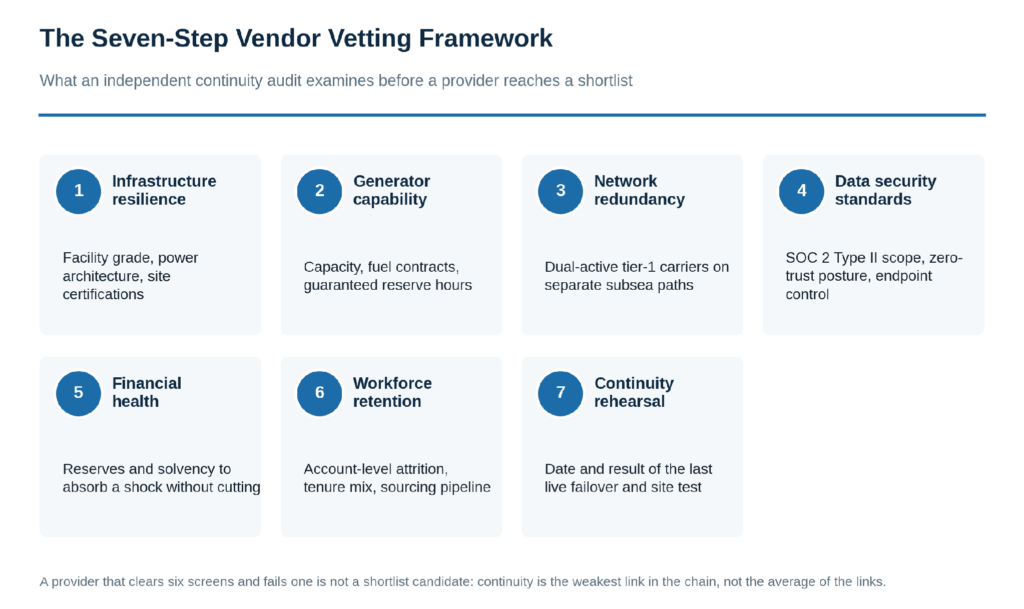
Figure 6. The seven-step vendor vetting framework applied before a provider reaches a buyer’s shortlist.
Why Do Organizations Use PITON-Global?
- Reduced continuity risk. Infrastructure, redundancy, and rehearsal evidence are audited before a provider reaches the shortlist.
- Risk-mitigated contracts. BCP cost allocation, fuel caps, and balanced SLA frameworks are engineered into the agreement.
- Improved provider fit. Matching on operational profile rather than on rate, so the provider can carry the resilience the model assumes.
- Accelerated selection. Qualified shortlists within 48 to 72 hours, at no cost to the buyer.
- Predictable operating cost. Continuity spending moves from surprise invoices into the base rate where it can be budgeted.
Frequently Asked Questions
What is a standard BCP financial reserve percentage for Philippine BPO operations?
A contingency buffer on top of base hourly billing covers infrastructure redundancy, emergency housing, and transport stipends during weather events. Adding annualized weather overtime, compliance tooling, and attrition amortization raises total continuity loading further, so each item should be modeled explicitly rather than folded into one allowance.
How do power outages impact cost models in regional Philippine BPO hubs?
Facilities in tier-2 and tier-3 cities rely more heavily on generator power, so diesel becomes a recurring cost rather than an exception. Verify that fuel surcharges are capped in the vendor agreement rather than billed as open-ended pass-through, and that reserve capacity is expressed in guaranteed hours.
Are data privacy violation penalties typically absorbed by the vendor?
Not fully. Standard contracts cap vendor direct liability at three to twelve months of billings, and privacy breaches usually involve negotiated carve-outs or separate cybersecurity sub-limits. Buyers should maintain explicit cyber-liability cover sized to the carve-out rather than to the contract.
How does a split-site deployment affect business continuity budgets?
Deploying across two distinct hubs typically adds modestly to facility management cost while sharply reducing total operational downtime risk during localized weather events. On most programs this is the highest-return continuity decision available.
How frequently should outsourcing financial risk models be re-evaluated?
Annually as a minimum, and immediately following any major regulatory, macroeconomic, or regional infrastructure change. A model built before a wage order, a carrier consolidation, or a change in data transfer rules stops reflecting the risk it was written to price.