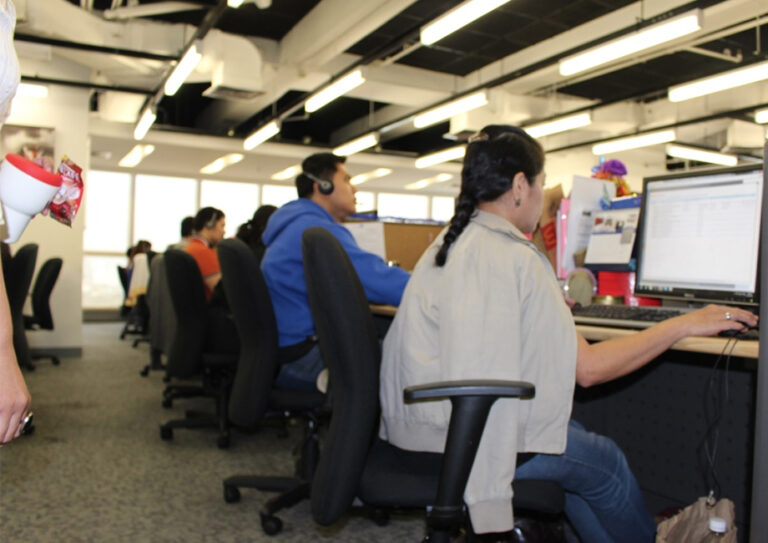
Most of the seats are in Metro Manila, a second tier sits in Cebu and Clark, and a widening ring of regional cities now hosts governed delivery centers that did not exist when this question was first asked. Where the call centers in the Philippines are located follows three things a North American buyer should care about: the depth of the local graduate pool, the resilience of power and fiber, and how easily an executive can get there for a site visit. This post maps the geography city by city and explains what each location implies for cost, attrition and continuity. For the broader decision, our complete guide to Philippine contact center outsourcing covers vendor tiers, pricing and governance.
The short answer: Manila first, then Cebu and Clark, then the regions
Metro Manila still holds the largest concentration of voice operations, clustered in a handful of business districts: Makati, Bonifacio Global City in Taguig, the Ortigas Center spanning Pasig and Mandaluyong, Quezon City’s Eastwood area, and Alabang in the south. Cebu City and the Clark Freeport Zone north of Manila form the second tier. Beyond them, PITON-Global’s own vetted network spans eight governed delivery hubs: Metro Manila, Cebu, Clark, Davao, Iloilo, Bacolod, Baguio and Cagayan de Oro, with a further seven next-wave cities, including Sta. Rosa and Dumaguete, coming online (PITON-Global capabilities).
The pattern is a hub-and-spoke network rather than a single city. That is a meaningful change from a decade ago, when a buyer could reasonably be told to look nowhere but Manila. Today the sensible advice is to decide what your program needs, then match it to a city, because the trade-offs between capital and regional delivery are real and predictable.
Why Manila still anchors the industry
Manila anchors the sector because it has the largest labor market, the densest university system, the most redundant infrastructure and the country’s main international airport. Those four advantages compound. The graduate pool means a vendor can staff a two-hundred-seat program in weeks; the universities refill that pool every year; the business districts were built with the dual power feeds and multi-carrier fiber that a voice floor needs; and a buyer flying from Los Angeles, Chicago or Toronto can be on a Makati production floor the morning after landing.
The scale of the workforce is what makes selective hiring possible. IBPAP, the industry association, reported 1.9 million digital workers nationally for 2025, up from 1.82 million in 2024, with export revenue above $40 billion and a 2026 target of $42 billion (Philippine Star, January 2026). A large share of that workforce is in the capital, which is why the most demanding programs, such as regulated financial services, complex technical support and multilingual queues, still tend to land there first.
Manila’s disadvantages are the mirror of its strengths. Competition for experienced agents is fiercest, so attrition and wage pressure run higher than in the regions, and traffic congestion lengthens commutes in a way that affects night-shift retention. The capital remains the right default for a first program or a complex one; it is no longer the automatic choice for a large, steady-state, tier-1 support queue.
Why Cebu and Clark became the second tier
Cebu offers Manila-grade delivery with less labor-market congestion, and Clark offers freeport incentives and a purpose-built business environment an hour and a half north of the capital. Both have their own international airports, both host tier-1 global providers alongside strong mid-market vendors, and both have matured to the point where a buyer gives up little in capability by choosing them.
Cebu
Cebu City and the surrounding metro area in the central Visayas form the country’s second-largest urban economy, with a cluster of universities that feeds a graduate pool known for clear, neutral English. Vendors there commonly report steadier tenure than in the capital, which shows up as deeper product knowledge on long-running programs. The IT parks in Cebu City, Lapu-Lapu and Mandaue were built for the industry and carry the same redundancy standards as their Manila counterparts.
Clark
The Clark Freeport Zone in Pampanga occupies a former US air base, which left it with wide roads, a large planned footprint and its own international airport. Registered enterprises in the zone operate under investment incentives, and the surrounding province of Pampanga plus nearby Bulacan and Tarlac supply graduates who would otherwise have commuted to Manila. Clark’s practical appeal to a buyer is a modern, uncongested campus environment with capital-region talent at regional attrition levels.
The regional hubs and why they matter now
Davao, Iloilo, Bacolod, Baguio and Cagayan de Oro have become credible delivery cities because the graduate supply exists, the infrastructure was built, and vendors learned to run governed operations outside the two major metros. Each has a distinct profile. Davao is the largest city in Mindanao and the natural anchor for the south. Iloilo and Bacolod in the western Visayas are university towns with strong English and comparatively low cost of living. Baguio in northern Luzon is a highland university city with a steady stream of graduates. Cagayan de Oro serves as northern Mindanao’s commercial center.
For a buyer, regional hubs bring three benefits. Cost is lower than in the capital, largely because wages track the local cost of living. Attrition tends to be lower because agents are working in their home city with fewer competing employers. And geographic diversity is a continuity asset: a program split between Manila and Iloilo is not taken down by one typhoon track or one metro-wide power event. The trade-offs are a smaller pool of highly specialized talent and, in some cities, fewer direct international flights for site visits.
The next-wave cities such as Sta. Rosa in Laguna and Dumaguete in Negros Oriental extend this logic further. They are suitable today for well-defined, stable queues staffed by a vendor that already runs governed regional operations, and less suitable as the sole site for a complex or fast-changing program.
How remote work changed the map
Work-from-home and hybrid delivery mean “where” now describes a vendor’s governance footprint as much as its floor space. The regulatory position settled in November 2024, when the CREATE MORE Act (Republic Act No. 12066) allowed registered business enterprises to run work-from-home arrangements for up to half their workforce without losing their incentives (Daily Tribune, November 2024). In practice, a Manila-headquartered provider can now staff part of a program with agents in provincial cities who never enter a production floor.
That widens the talent pool and adds continuity, but it shifts the buyer’s diligence. Ask how remote agents are secured, monitored and coached; whether the vendor supplies managed devices and backup connectivity; and how it audits home environments for regulated work. Delivery models of on-site, remote and hybrid are now standard options, and the right mix depends on data sensitivity and the complexity of the queue rather than on cost alone.
What location means for a North American buyer
Location shapes four things in a program: cost, attrition, continuity and the kind of work the team can take on. Time zone is not one of them, because every city in the archipelago sits in the same zone, twelve to sixteen hours ahead of the continental United States, and every established vendor runs overnight shifts that map to North American business hours.
The kind of work matters most when a program grows beyond support. Sales, lead qualification, market research and product feedback loops draw on a deeper bench of experienced, commercially minded agents, and that bench is largest in the capital and Cebu. Our look at how Philippine call centers are moving into sales, marketing and R&D shows what that expanded scope looks like in practice.
Whatever the city, the buyer’s experience of the operation is determined by the quality of the front line rather than the address on the building. The standards we describe in front-line excellence in offshore customer engagement hold in Davao as much as in Makati when the vendor’s recruiting, training and quality systems are mature. And because customers experience the brand through those agents, the location question ultimately feeds into whether an offshore team can improve brand reputation: a resilient, well-staffed operation in the right city protects it, and a congested, high-attrition one erodes it.
A practical way to use this map is to shortlist vendors by the cities they actually operate in, then visit. A provider that claims a Cebu site but staffs your program from a Manila overflow floor is not delivering what it sold. Our directory of call center companies in the Philippines lists where vetted providers deliver from.
Frequently asked questions
Is Manila still the safest choice for a first program?
For a complex or regulated first program, yes: the capital has the deepest specialized talent and the easiest access for site visits. For a stable, high-volume support queue, Cebu, Clark or a regional hub often delivers equal quality at lower cost and attrition.
Should I split a program across two cities?
Once a program passes roughly fifty seats, splitting between two hubs is a sound continuity measure, provided one vendor governs both sites under the same quality system. Splitting across two vendors in two cities doubles governance overhead and is rarely worth it below several hundred seats.
Do regional cities have reliable power and internet?
The governed delivery hubs do. Established vendors build with generator backup, uninterruptible power and multiple fiber carriers regardless of city. What differs is the depth of the surrounding infrastructure, so ask for the site’s uptime record and its business-continuity plan rather than assuming by geography.
How does work-from-home affect where my agents are?
Since the 2024 CREATE MORE Act, registered providers can run up to half their workforce remotely without losing incentives, so agents on your program may live in cities where the vendor has no floor. Ask for the home-city distribution of your team and the security controls applied to remote seats.