

Philippine healthcare outsourcing providers enable rapid, elastic scalability — giving growing health systems immediate access to a specialized pool of licensed clinical and administrative talent. Using 24/7 operating models and secure digital workflows, healthcare admin teams that grow with health systems can expand service capacity in weeks rather than months, cut fixed overhead, and maintain rigorous HIPAA and global compliance.
Key Takeaways
- Elastic staffing: Unlike the slow, linear growth of domestic hiring, Philippine providers offer modular, on-demand teams that scale with real-time patient volume and seasonal demand.
- Clinical literacy: The sector supplies licensed nurses and medical professionals who bring the clinical vocabulary and training that complex administrative workflows require.
- Operational resilience: A complementary time zone delivers genuine business continuity — 24/7 claims processing, patient engagement, and administrative support.
- Risk-adjusted economics: Shifting from high-fixed-cost domestic models to scalable, performance-based structures optimizes capital allocation and improves margin resilience.
- Seamless co-sourcing: Modern engagements operate as a high-trust extension of internal departments under shared governance — not detached, transactional task-handling.
How Does the Philippine Healthcare Model Differ from Traditional Internal Growth?
It replaces slow, fixed-cost internal scaling with a “plug-and-play” talent infrastructure. Where adding 50 coders or support staff in-house can take months of recruitment and overhead ramp-up, the Philippine ecosystem maintains a mature pipeline of pre-vetted, English-proficient, clinically trained personnel ready to deploy in weeks.
The contrast is structural. Domestic scaling is constrained by persistent hospital workforce shortages, real-estate costs, and rigid payroll. Healthcare roles are among the slowest to fill anywhere: industry benchmarks put general clinical roles at 50–60 days, experienced nurses at 70–90, and specialists at 90-plus — before onboarding and ramp. Each open seat also carries a daily vacancy cost. Outsourcing converts that fixed, slow-moving burden into variable capacity that flexes with demand.
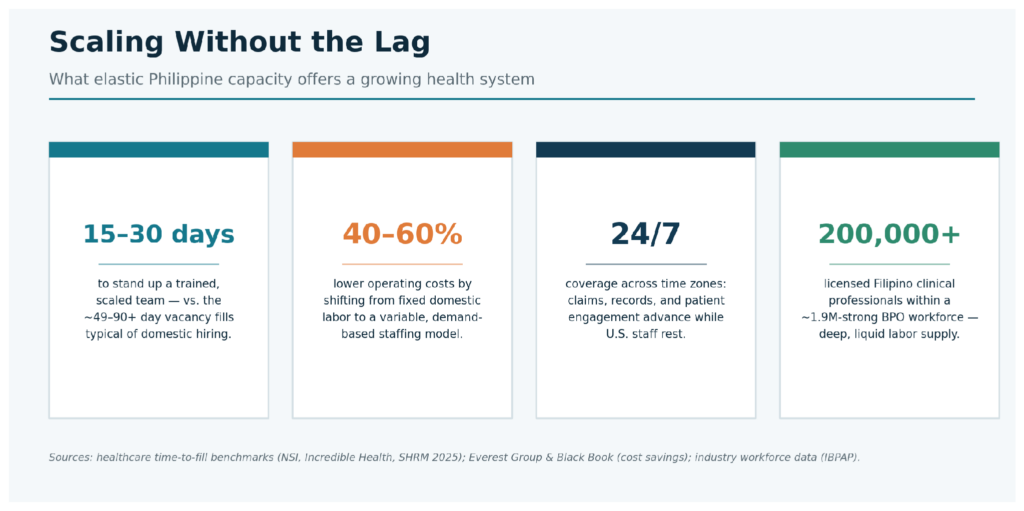
Figure 1. What elastic Philippine capacity offers a growing health system.
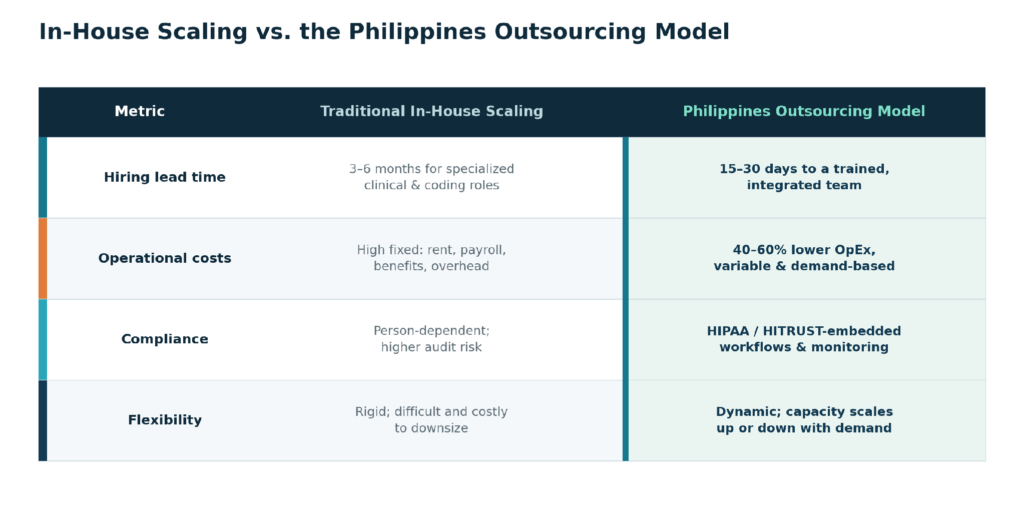
Figure 2. In-house scaling versus the Philippines outsourcing model across four decisive metrics.
Translated into the two numbers leaders care about most — how fast capacity comes online and what it costs — the gap is wide, as the comparison below shows.

Figure 3. Time-to-productivity and relative cost to scale: internal team versus outsourced team.
What Does Elastic Scalability Actually Look Like in Practice?
It means service capacity that tracks demand in near real time — expanding for seasonal spikes and contracting afterward — instead of lagging months behind it. A domestic-only model leaves a widening shortfall when volume surges; an elastic offshore layer absorbs the surge and clears the backlog.
Consider a flu-season or expansion-driven surge in claims and patient contacts. Domestic hiring simply cannot ramp fast enough, so backlogs and overtime accumulate while requisitions sit open. With a pre-trained offshore pool, a health system can stand up “burst capacity” in days and stand it down just as quickly when volume normalizes — turning a fixed cost into a responsive one, the same logic behind department-level staffing flexibility.
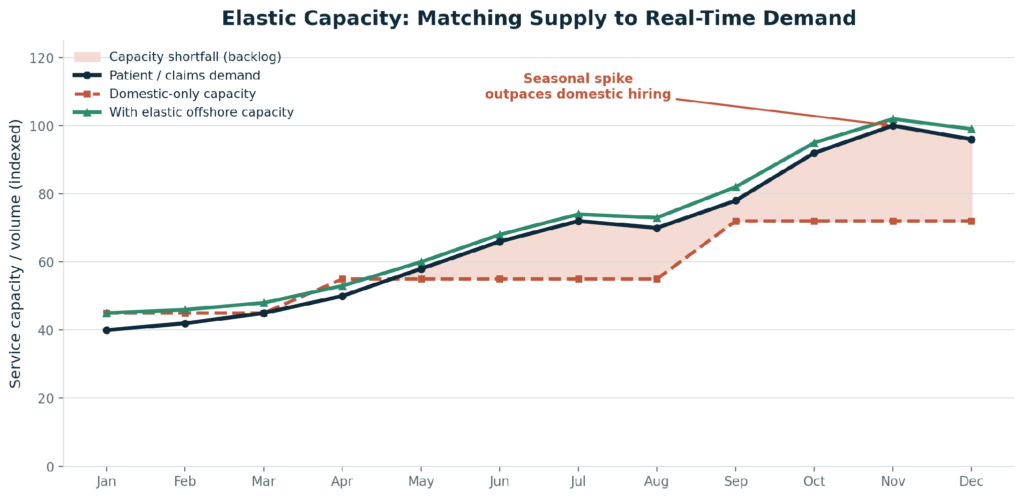
Figure 4. Elastic offshore capacity tracks demand; domestic-only capacity leaves a shortfall during surges.
What Specific Functions Are Most Effectively Scaled Through These Providers?
The strongest candidates are administrative, data-intensive, and privacy-sensitive functions — revenue cycle management, clinical data management, patient engagement, and back-end administration — where specialized offshore teams can scale quickly without touching high-acuity clinical decisions.
In practice, four domains are consistently optimized. Revenue Cycle Management covers manual and automated coding reviews, denial management, and claims reconciliation. Clinical Data Management organizes records and keeps EHR/EMR systems current to support physician decision-making. Patient Engagement handles 24/7 telehealth triage, scheduling, and follow-up. Back-end Administration manages prior-authorization workflows and health-information-system maintenance.
Offloading this work has a second-order benefit: it returns scarce clinical hours to the bedside. With clinicians spending roughly two hours on administrative tasks for every hour of direct care, moving routine work offshore directly expands effective clinical capacity.
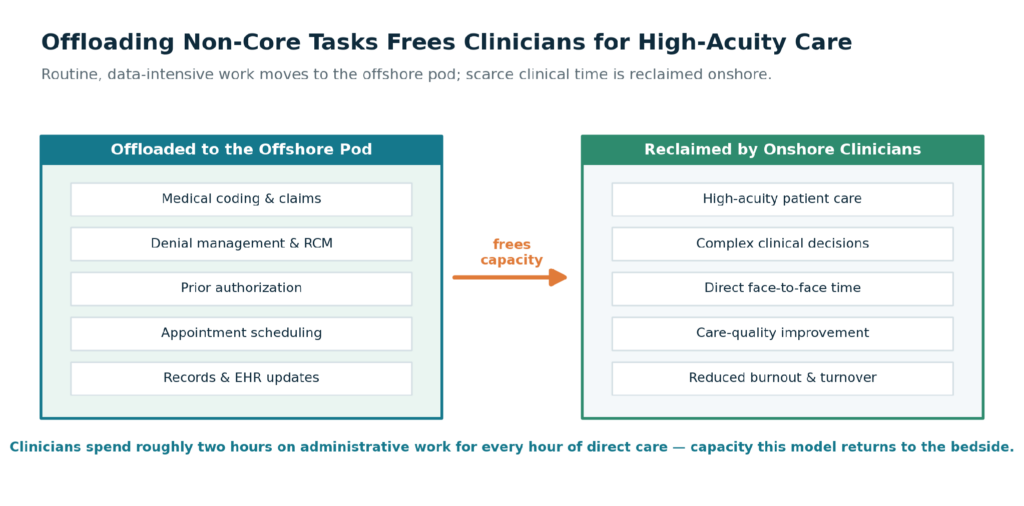
Figure 5. Offloading non-core tasks to the offshore pod frees onshore clinicians for high-acuity care.
“The true value of Philippine healthcare outsourcing lies in its capacity for high-touch clinical support, not just high-volume processing. If a vendor cannot demonstrate a granular understanding of the specific billing or patient-intake protocols that define your system’s reputation, they are not a strategic partner — they are a liability.”
— John Maczynski, CEO, PITON-Global
How Do Health Systems Mitigate Risks During Rapid Scaling?
They treat outsourcing as a “co-sourcing” architecture — mirroring internal governance, security protocols, QA cadences, and reporting metrics inside the offshore environment. Control comes from shared standards and outcome-based benchmarking, not from keeping the work physically close.
Three practices separate resilient programs from risky ones. Hardened data environments use restricted-access “clean-room” facilities with active monitoring. Outcome-based benchmarking measures success by error rates, turnaround times, and clean-claim percentages rather than raw seat count. And technology integration pairs human teams with RPA and AI-assisted tools so accuracy holds as volume scales. Together these keep a rapidly growing offshore team aligned with the system’s quality and compliance bar, on the same foundations that keep offshore healthcare teams stable.
What Does a Successful Scaling Engagement Look Like?
A successful engagement scales fast without sacrificing quality — integrating into the client’s exact tech stack in weeks and improving revenue-cycle metrics within months. The representative composite below shows the pattern when a workflow-matched team is deployed against a denial surge.
Consider a mid-sized U.S. health system hit by a sharp rise in claim denials from staffing shortages, just as it expanded facilities. Rather than a generic vendor, it ran a deep audit of its EHR environment and engaged a partner certified in its specific billing software, with demonstrated clinical history. The team integrated into the proprietary tech stack within 21 days.
Over the first six months, the system achieved a marked improvement in clean-claim rates and cut administrative write-offs substantially. The figures here are an illustrative composite of typical workflow-matched outcomes rather than a single named client, but they reflect the consistent pattern: speed and quality rise together when specialization matches the environment.
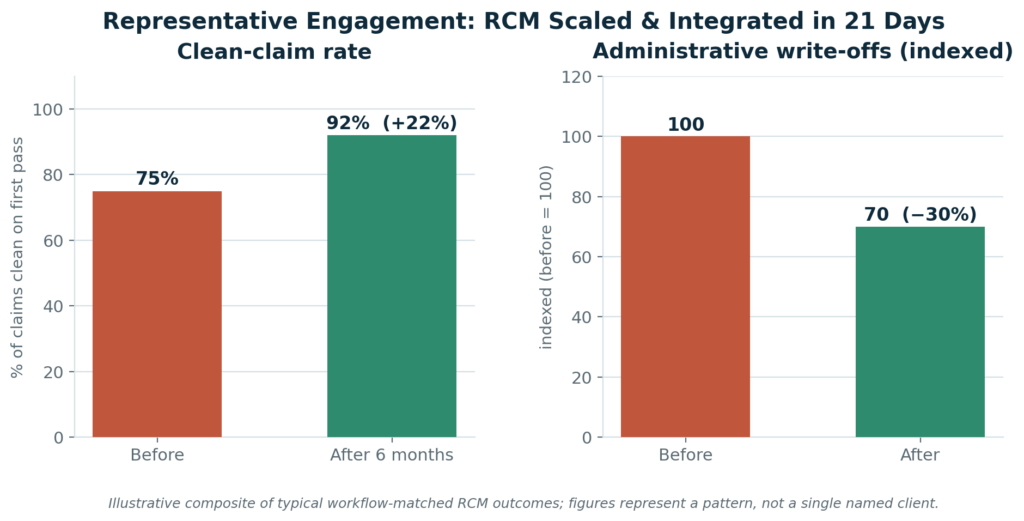
Figure 6. Representative before-and-after results from a workflow-matched RCM scaling engagement (illustrative composite).
What Role Does PITON-Global Play in the Philippine Outsourcing Ecosystem?
PITON-Global is an independent, advisory-led firm — not a broker or “finder” service. Led by veteran operators and entirely vendor-agnostic, it represents the client’s interests, designing the outsourcing architecture before any vendor is contacted and matching needs to capability across a network of 100+ vetted providers.
Who Is PITON-Global?
PITON-Global is an outsourcing advisory firm specializing in the Philippine BPO market, with deep expertise in healthcare operations such as revenue cycle management, clinical data, and patient engagement. It acts as an extension of the enterprise’s leadership team rather than a vendor sales channel.
How Does PITON-Global Differ from Traditional Outsourcing Brokers?
Brokers are typically paid by vendor commissions, which can bias recommendations toward whoever pays. PITON-Global’s vendor-agnostic, advisory-led model emphasizes independent evaluation and objective recommendations, designing the architecture and managing the competitive bid in the client’s interest.
How Does PITON-Global’s Network of 100+ Vetted Philippine BPO Providers Benefit Organizations?
A curated network of more than 100 vetted providers compresses vendor discovery from months to days. Because capability, compliance, and clinical-training maturity are pre-screened, organizations can quickly shortlist healthcare-specialized partners suited to their exact complexity — including agile mid-sized firms larger brokers often overlook.
How Does PITON-Global’s Advisory-Led Vendor Matching Process Work?
The process runs through four disciplined stages: auditing requirements (EHR, workflows, and governance) before any vendor is contacted; filtering the vetted network for capability and compliance fit; designing the RFP and managing a structured competitive bid; and overseeing selection, integration, and ongoing performance.
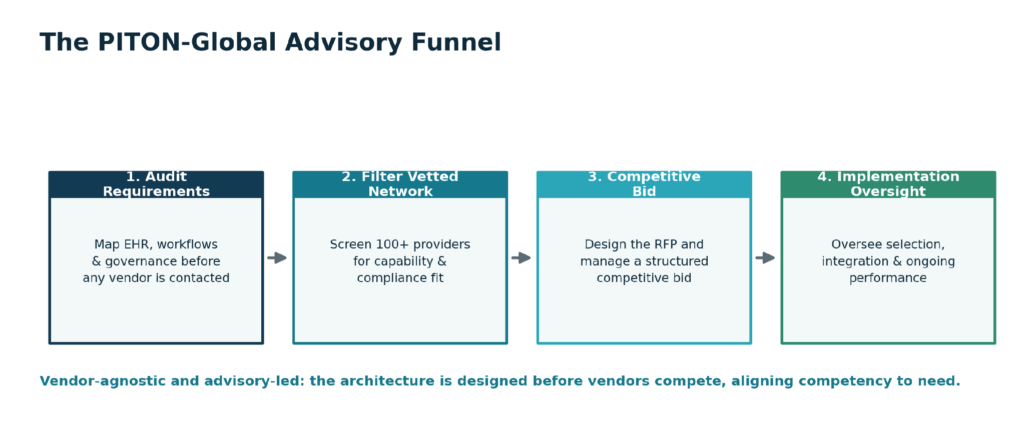
Figure 7. The four-stage, vendor-agnostic PITON-Global advisory funnel.
Why Do Organizations Use PITON-Global?
Organizations engage PITON-Global to reduce outsourcing risk, improve provider fit, and accelerate vendor selection — achieving better outcomes by designing the architecture before vendors compete. The advisory model replaces costly trial-and-error with an evidence-based path to a partner whose competency truly aligns with operational requirements.
Frequently Asked Questions
Leaders most often ask about HIPAA compliance, clinical quality during transition, the effect on domestic staff, seasonal scaling, and team management. The concise answers below address each.
Is Philippine healthcare outsourcing HIPAA-compliant?
Yes. Top-tier providers maintain HIPAA and SOC 2 Type II certifications, restrict workstations, and audit data-handling regularly to meet U.S. healthcare standards — typically under signed Business Associate Agreements.
How do we ensure clinical quality during the transition?
Most providers recruit licensed Filipino nurses who undergo secondary training in the client’s specific Western clinical protocols and EHR systems to ensure seamless alignment before going live.
Does outsourcing replace our domestic administrative staff?
No. Health systems typically use outsourcing to clear backlogs and handle routine tasks, freeing internal staff to focus on higher-acuity care and system-level improvements.
Can this model scale for seasonal demand?
Yes. The Philippine market’s labor liquidity allows rapid assembly and training of “burst capacity” teams that deploy for seasonal volume spikes and stand down afterward.
How are these teams managed?
An office-based delivery model is recommended, with on-site supervisors and QA teams overseeing performance in real time to maintain operational control and security.