

To protect patient experience, hospitals should require biometric multi-factor authentication, non-persistent virtual desktop infrastructure, and clinical governance led by licensed medical professionals — plus service-level agreements tied to patient-satisfaction scores rather than transaction volumes. These operational and technical boundaries, the foundation of healthcare outsourcing built around PHI safeguards, keep offshore workflows secure, empathetic, and fully aligned with hospital standards.
Key Takeaways
- Clinical governance moat: Mandate that patient-facing and complex back-office workflows are overseen by licensed clinicians who bridge technical execution and medical empathy.
- Zero-trust technical safeguards: Enforce strict data boundaries with non-persistent VDI, data-loss-prevention tooling, and continuous AI anomaly detection.
- Patient-experience-centric SLAs: Shift from transaction metrics to quality benchmarks, tying vendor compensation to CSAT, FCR, and net sentiment.
- Cultural alignment & malasakit: Leverage Filipino professionals’ innate empathy by embedding patient-advocacy training into standard onboarding.
- Right-sized provider fit: Match with a mid-market provider scaled to your patient volumes, so support staff have time to demonstrate genuine empathy.
What Technical and Security Guardrails Must Be Established?
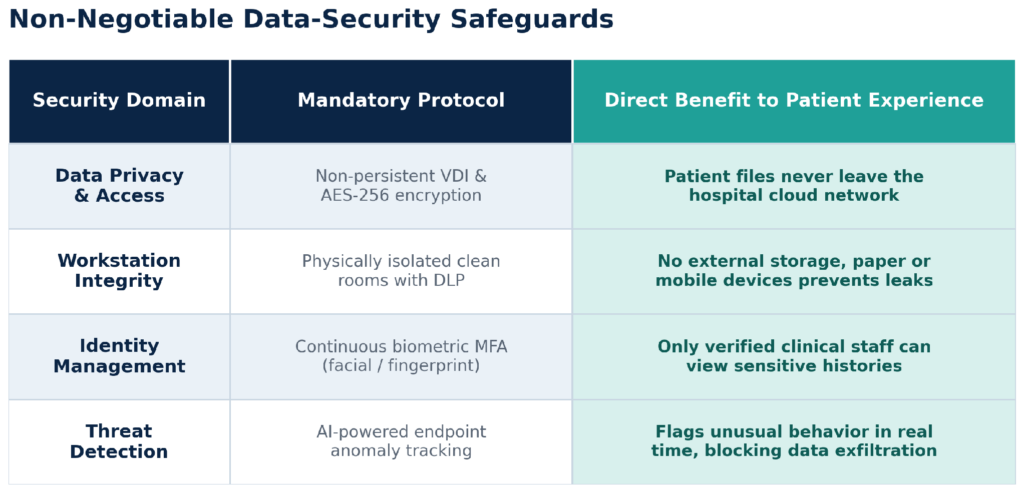
Protecting patient experience starts with protecting patient data, and standard compliance checklists are insufficient. Hospitals must demand a zero-trust architecture: non-persistent VDI and AES-256 encryption, physically isolated clean rooms with DLP, continuous biometric MFA, and AI-powered anomaly detection — so PHI never rests on an offshore device.
A single data breach destroys hospital trust instantly, so the connection between a U.S. hospital EHR and a Philippine delivery center must be engineered as a sealed, zero-trust pathway. The architecture below shows how patient data stays inside the hospital cloud while authorized agents work through a secured gateway.
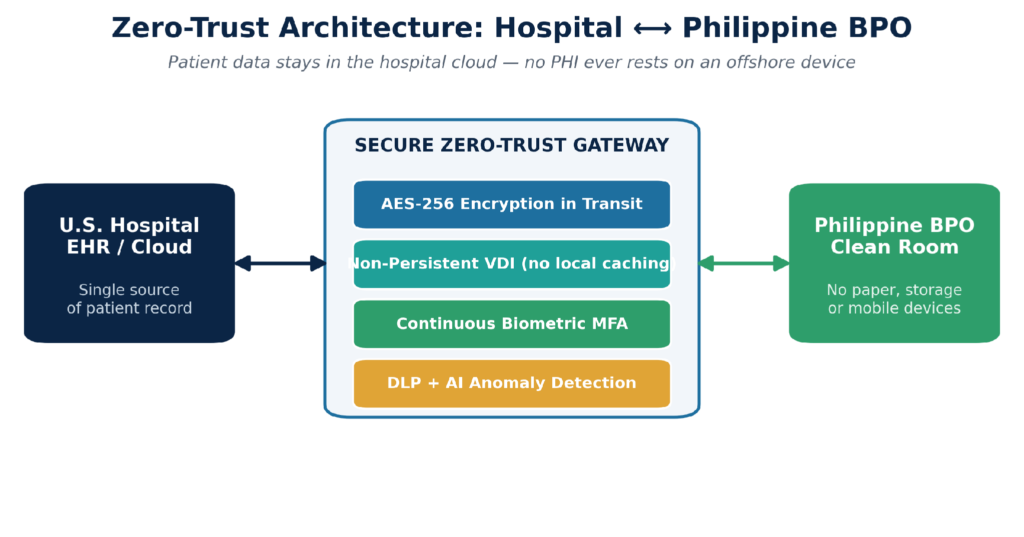
Each safeguard maps directly to a patient-experience benefit: data that never leaves the hospital network, workstations that cannot leak it, identities that are continuously verified, and behavior that is monitored in real time. The table below lists the non-negotiables.
How Do We Align Operational Performance with Patient Satisfaction?
Stop measuring success by Average Handle Time. In healthcare, rushing a patient off the phone destroys satisfaction. Align performance with experience by adopting patient-centric call durations, embedding clinical literacy, and matching with a provider whose operating model is scaled to your volumes — not to the lowest cost and highest speed.
Enterprise buyers often default to legacy contact-center metrics, but optimizing for raw speed quietly incentivizes a rushed, lower-quality patient experience. Elite Philippine providers replace standard call-center logic with clinical literacy, giving support staff the time to resolve issues accurately and with genuine empathy.
If you structuralize your partnership purely around low cost and high speed, you inherently incentivize a rushed patient experience. True optimization comes from matching with a mid-market provider whose operational model is scaled exactly to your patient volumes, allowing clinical support staff the time required to demonstrate genuine empathy. — John Maczynski, CEO, PITON-Global

This is why hospitals should look to the Philippine Healthcare Information Management Services (HIMS) sector, which features tertiary-educated professionals — including licensed nurses — who understand ICD-10/11 coding and medical terminology. That clinical foundation, reinforced by deep experience with U.S. healthcare workflows, lets them handle complex scheduling and revenue-cycle-management tasks accurately on the first attempt, raising resolution and reducing downstream billing disputes.
What Results Can a Health System Expect from the Right Safeguards?
A mid-sized U.S. hospital network replaced 15-minute wait times with sub-45-second response, lifted patient CSAT markedly, and cut operating expense substantially within 90 days — with zero compliance or security incidents. The key was a specialized, right-sized partner with embedded clinical oversight, not a global conglomerate.
The Challenge
A mid-sized U.S. hospital network faced severe internal staff attrition, which drove 15-minute call wait times, mounting scheduling errors, and a steep drop in patient-satisfaction scores.
The Solution
The network engaged PITON-Global to move away from large global BPO conglomerates, auditing a vetted network of more than 100 providers to select a specialized, highly compliant mid-sized healthcare BPO in Manila. A dedicated team of 40 healthcare-trained professionals deployed on secure, non-persistent VDIs and integrated into the hospital’s EHR, with clinical-oversight managers embedded to audit every complex patient query.
The Outcomes
- Wait times: reduced from 15 minutes to under 45 seconds.
- Patient CSAT: increased markedly within the first 90 days.
- Operating expense: cut substantially versus domestic costs.
- Data security: zero compliance or security incidents.

Aligning with a specialized partner that matches account size avoids the operational neglect common with larger providers, ensuring superior data security and patient care alike.
How Does PITON-Global Help Hospitals Select the Right Philippine BPO Partner?
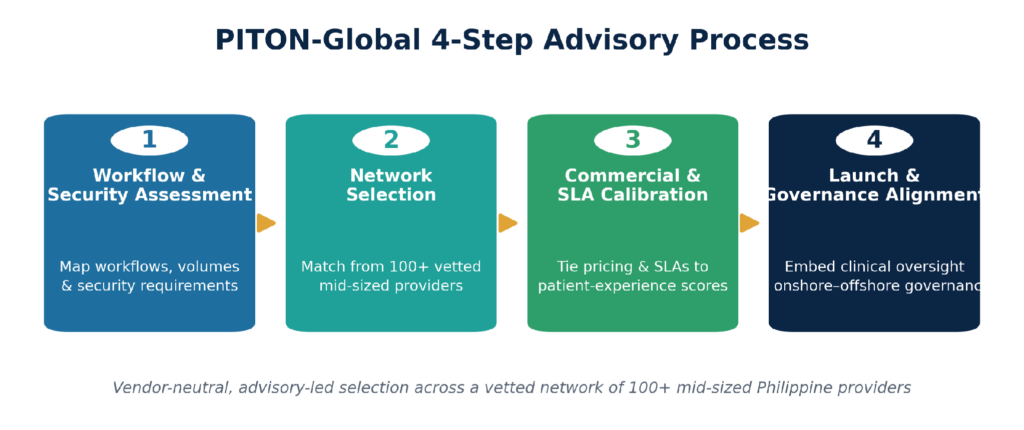
PITON-Global is a vendor-neutral advisory firm with 25-plus years in the Philippine BPO sector. Rather than passing leads to the highest bidder, it grants hospital executives access to a curated network of more than 100 vetted, mid-sized providers and a disciplined four-step framework that matches each hospital to the right technical, clinical, and operational fit.
Who Is PITON-Global?
PITON-Global is a specialized, vendor-neutral outsourcing advisory firm with more than 25 years of hands-on experience in the Philippine BPO sector. It operates as an independent strategic advisor to hospital executives navigating a high-stakes offshore transition, focused on protecting and elevating the patient experience.
How Does PITON-Global Differ from Traditional Outsourcing Brokers?
Unlike traditional brokers that simply pass leads to the highest bidder, PITON-Global acts as an independent advisor accountable to client outcomes. It recommends on technical infrastructure, clinical credentials, and operational scale — the factors that protect patient experience — rather than on whichever provider pays the most.
How Does PITON-Global’s Network of 100+ Vetted Philippine BPO Providers Benefit Organizations?
The firm maintains a curated network of more than 100 thoroughly vetted, mid-sized providers across the Philippines. Mid-sized matters: a provider scaled to a hospital’s volume is far less likely to deliver the operational neglect common at large conglomerates, and every partner is pre-screened for technical infrastructure, clinical credentials, and compliance.
How Does PITON-Global’s Advisory-Led Vendor Matching Process Work?
The process follows four disciplined steps: a workflow and security assessment; network selection from the 100-plus vetted partners; commercial and SLA calibration that ties pricing and service levels to patient-experience scores; and launch and governance alignment that embeds clinical oversight across onshore and offshore teams.
Why Do Organizations Use PITON-Global?
Hospitals use PITON-Global to de-risk the offshore transition and protect patient experience. Once leadership has confirmed the hospital is ready for an offshore healthcare partner, the firm matches it with providers that have the precise technical infrastructure, clinical credentials, and operational scale required, removing the guesswork — and the mismatched-scale failures — that derail offshore programs.
What Else Should Hospital Leaders Know About Safeguarding Outsourced Patient Experience?
Common questions concern baseline certifications, cultural communication, whether back-office outsourcing helps clinical care, business-continuity safeguards, and onboarding timelines. In each case, elite Philippine providers are built to protect both data and the patient relationship.
What baseline compliance certifications should a Philippine healthcare BPO possess?
At minimum, providers must be HIPAA-compliant, SOC 2 Type II audited, and ISO 27001 certified. Elite providers also implement the HITRUST CSF framework to keep the right technical safeguards active.
How do Philippine BPOs handle cultural differences in patient communication?
Leading providers run cultural-alignment and patient-advocacy programs that combine the natural empathy of Filipino culture (malasakit) with training on U.S. regional accents and healthcare nuances.
Can outsourcing non-clinical back-office tasks improve the clinical patient experience?
Yes. Offshoring repeatable administrative tasks such as eligibility verification and denials management reduces processing backlogs, freeing domestic clinicians to focus entirely on direct patient care — the same shift that makes room for newer care models built on healthtech outsourcing.
What happens to patient data if a BPO experiences a localized power outage?
Top-tier providers operate from Class-A facilities with redundant power, multiple fiber-optic feeds, and robust business-continuity plans that ensure zero operational downtime.
How long does it take to onboard a secure healthcare team in the Philippines?
Depending on workflow complexity and security configuration, a specialized, fully compliant team can typically be launched and embedded within 30 to 60 days.