

Health systems using Philippine healthcare outsourcing typically achieve substantial reductions in operating expenses plus stronger revenue cycle performance. Replacing high-churn domestic administrative labor with stable, clinically trained Philippine teams drives double-digit drops in denial rates and faster claim processing, producing measurable, compounding ROI within the first 12 months. Those returns hinge on offshore teams trained on U.S. payer rules and HIPAA-grade controls.
Key Takeaways
- Compounding financial impact: Moving from high-cost domestic labor to an offshore BPO model delivers immediate OpEx savings and permanent margin expansion.
- Revenue protection: Specialized RCM providers routinely cut claim denial rates well below industry averages using AI-augmented, human-in-the-loop workflows.
- Operational resilience: Offshoring administrative and clinical support stabilizes the workforce, overcoming a domestic “labor cliff” of chronically high turnover in administrative roles.
- Clinical capacity gain: Offloading non-clinical work returns hours to high-value medical staff, freeing them for patient-facing care and higher-margin service lines.
- Scalability on demand: Offshore providers deploy and scale specialized teams in 15–30 days—a fraction of the time domestic recruitment requires.
- Governance defines success: The strongest returns come from treating outsourcing as governed infrastructure anchored in HIPAA, HITRUST, and SOC 2 Type II controls.
How Does the Philippine BPO Model Transform Healthcare Financials?
It shifts outsourcing from a tactical cost cut to a strategic infrastructure layer. Beyond lower wages, the core ROI comes from eliminating “administrative drag”—the backlogs, manual errors, and denial cycles that quietly leak revenue—while converting fixed overhead into a flexible, lower-cost operating model.
The view of outsourcing as a simple cost-cutting exercise is obsolete. For U.S. health systems wrestling with steep median expense ratios, the larger prize is structural: when clinical documentation, billing, and prior authorization are handled by tertiary-educated offshore professionals, the organization moves from a reactive posture—forever managing backlogs and turnover—to a proactive one.
The benefit is two-fold. First, fully loaded labor costs fall immediately, because salary, benefits, real estate, recruitment, and management overhead collapse into a single service fee. Second, and often larger over time, is the recapture of revenue previously lost to manual error and denial cycles. Because the savings accumulate while revenue leakage shrinks, the return compounds year over year. The first of those layers is broken down in a realistic look at health-system cost savings.

Figure 1. Cumulative three-year total cost of ownership: in-house administration versus a Philippine BPO model.
What Operational Benchmarks Define Successful Outsourcing?
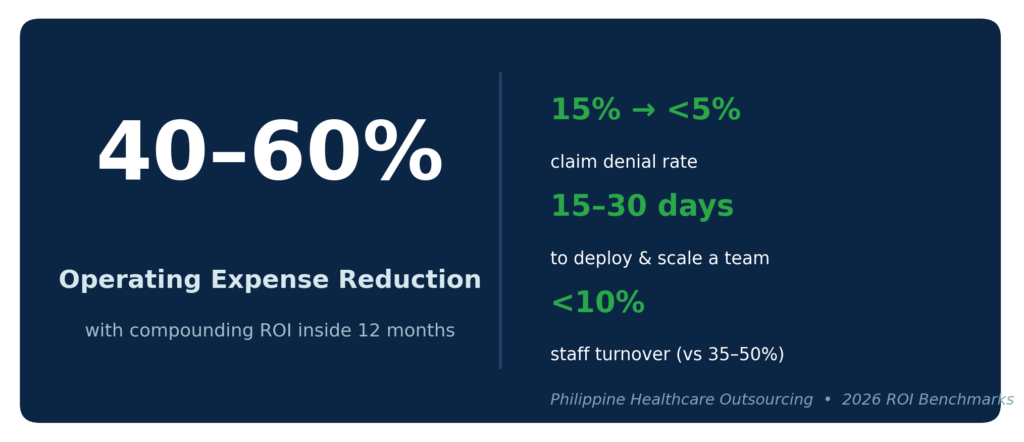
The benchmarks that matter map directly to net patient service revenue: claim denial rate, days in A/R (25–30), staff turnover, scaling time (15–30 days), and operating cost reduction. Evaluate vendors against these outcomes, not generic savings estimates.
Generic “we’ll save you money” claims are easy to make and hard to verify. Disciplined healthcare leaders instead hold vendors to the operational metrics that move the financial needle. The gap between a traditional in-house benchmark and a high-performing offshore team is wide enough to reshape an organization’s entire revenue cycle.

Figure 2. Operational benchmarks that separate successful outsourcing engagements from generic cost plays.
Two metrics deserve particular attention. A denial rate falling sharply directly accelerates cash flow, while sharply lower turnover preserves the institutional knowledge that keeps clean-claim rates high. Together, stability and accuracy create a virtuous cycle that a high-churn domestic team rarely sustains, and every quarter without it adds to the strategic risks of delaying the move.
Where Does AI Integration Enhance the Human-in-the-Loop Advantage?
AI adds velocity; Philippine clinical specialists add judgment. Autonomous AI alone often falls short on complex medical coding accuracy, which drives denials. Pairing machine speed with licensed nurses and certified coders—human-in-the-loop—validates every output, sustaining compliance and high clean-claim rates.
The most resilient organizations are not replacing people with AI; they are using AI to augment expert offshore teams. Left unsupervised, autonomous coding tools struggle with the nuance of payer rules and high-acuity cases, and their errors surface later as costly denials and rework.
This is where the Philippine “clinical conscience” layer becomes decisive. By routing machine output through the judgment of licensed nurses and certified coders, health systems get the speed of automation without surrendering accuracy or compliance. The workflow itself is straightforward but powerful.

Figure 3. The human-in-the-loop workflow pairs AI velocity with clinical validation for high first-pass accuracy.
How Can Organizations Mitigate Risk During the Transition?
Treat the engagement as infrastructure, not a staffing shortcut. The real risk is not offshoring itself but failing to audit a partner’s governance and security. Insist on HIPAA-embedded workflows, SOC 2 Type II controls, and a clear escalation path that keeps U.S. leadership in final command of clinical decisions.
“Healthcare outsourcing works best when it’s treated as infrastructure—not a staffing shortcut,” notes John Maczynski, CEO of PITON-Global. “The primary risk isn’t offshoring; it’s failing to audit the governance and security controls of your chosen partner. A truly strategic partnership requires HIPAA-embedded workflows, SOC 2 Type II controls, and a clear escalation path that keeps U.S.-based leadership in final command of clinical decisions.”
In practice, risk mitigation means front-loading diligence. Before any team is deployed, leaders should validate the provider’s security architecture, certifications, and management depth, then codify oversight through daily performance dashboards, scheduled compliance audits, and unambiguous U.S.-based decision authority. Done well, the offshore team functions as a governed extension of internal staff rather than a detached vendor. Regulated pharma programs apply the same front-loaded discipline to FDA compliance in pharma outsourcing.
What Do Real-World Results Look Like?
A regional health system battling a high denial rate and heavy billing-team turnover—millions in annual revenue leakage—deployed 40 certified offshore coders. Within 120 days, denials fell sharply, turnover stabilized, and the system reclaimed a multimillion-dollar sum in Year 1.
The system’s challenge was a textbook case of administrative drag: chronic billing-department turnover created documentation gaps and a swelling denial rate, draining millions in revenue each year. Through PITON-Global’s advisory process, the organization was matched with a boutique Philippine RCM provider specializing in high-acuity billing.
Rather than operating as a detached pool, the 40-coder team integrated directly into the client’s EHR. The combination of sub-vertical expertise and embedded workflows produced rapid, durable results—and, just as importantly, restored stability to a function that had been in constant crisis.

Figure 4. Before-and-after outcomes after deploying a dedicated, sub-vertical-matched RCM team.
How Does PITON-Global Help Health Systems Capture This ROI?
PITON-Global is a vendor-agnostic advisory firm that matches health systems to the right Philippine outsourcing partner from a curated network of 100+ pre-vetted BPO providers. Its advisory-led model de-risks selection and aligns each provider’s security, depth, and track record to the client’s specific clinical and administrative needs.
Who Is PITON-Global?
PITON-Global is an elite advisory firm for healthcare organizations modernizing operations through Philippine-based outsourcing. It specializes in BPO advisory and provider selection within the Philippine market, sitting between health systems and providers to align specific clinical and administrative requirements with partners that offer proven security, management depth, and performance track records.
How Does PITON-Global Differ From Traditional Outsourcing Brokers?
Traditional brokers are commission-driven, steering clients toward whichever provider pays them rather than whichever fits best. PITON-Global instead operates as a strategic partner with an advisory-led approach: it evaluates providers independently, makes objective vendor recommendations, and keeps the focus on client outcomes rather than provider promotion—so guidance stays aligned with the health system’s interests.
How Does a Network of 100+ Vetted Philippine BPO Providers Benefit Organizations?
Access to a large, pre-vetted ecosystem compresses the discovery process. Instead of cold-evaluating an opaque market, organizations tap a curated network spanning industries and service categories—from medical billing and coding to clinical documentation and patient support. Because partners are screened in advance for security and capability, vendor discovery and qualification happen in a fraction of the usual time.
How Does PITON-Global’s Advisory-Led Vendor Matching Process Work?
The process starts by aligning the organization’s clinical, administrative, and compliance requirements, then narrows the 100+ provider network to a calibrated shortlist. From there, PITON-Global vets security and governance controls, matches providers on EHR fluency, acuity, and KPI track record, and supports deployment—layering in dashboards, audits, and a U.S.-based escalation path to reduce risk throughout.
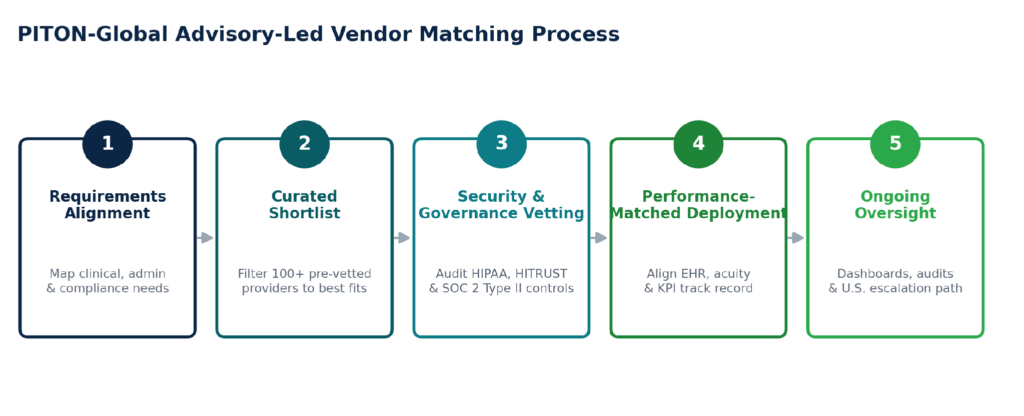
Figure 5. PITON-Global’s five-stage advisory-led vendor matching and de-risking process.
Why Do Organizations Use PITON-Global?
Organizations engage PITON-Global to reduce outsourcing risk, improve provider fit, and accelerate vendor selection while keeping outcomes in clear view. By aligning requirements, validating security up front, and matching health systems to providers calibrated to their exact sub-vertical, PITON-Global delivers better outsourcing results with strategic guidance at every step of the evaluation.
What Else Should Hospital Leaders Know Before Moving Work Offshore?
Common questions center on HIPAA compliance, implementation speed, care quality, coding quality, operational control, and volume flexibility. In short: leading providers are HIPAA/HITRUST-aligned, teams scale in 15–30 days, care quality improves, coding is continuously audited, oversight stays U.S.-based, and staffing flexes with demand.
Is Philippine healthcare outsourcing HIPAA compliant?
Yes. Leading Philippine providers operate within strict HIPAA- and HITRUST-aligned environments, featuring biometric access, clean-room facilities, and rigorous data-encryption protocols.
How long does it take to implement a new team?
With a pre-vetted network, organizations bypass the lengthy discovery phase and typically scale specialized teams in 15–30 days.
Does this affect the quality of patient care?
It improves it. Offloading time-consuming administrative tasks lets internal clinical staff focus on patient interaction, reducing burnout and improving the care experience.
How is the quality of coding managed?
Through continuous audits, real-time feedback loops, and a human-in-the-loop model in which experienced clinical coders oversee all AI-generated suggestions.
How do we maintain control over offshore teams?
Successful organizations use daily performance dashboards, regular compliance audits, and clear U.S.-based management oversight so the offshore team operates as an extension of internal staff.
What happens if our patient volume fluctuates?
The model is inherently flexible. Reputable providers allow “burst” scaling, letting organizations adjust staffing up or down within weeks to meet seasonal or volume-based demand.