

Hospital CEOs should evaluate three core risks before selecting a Philippine healthcare BPO: clinical alignment, data security, and operational resilience. Substandard medical-coding accuracy or compliance failures can trigger severe revenue leakage and regulatory penalties. Mitigating them requires accuracy-first clinical operations for hospital leaders: a partner with robust infrastructure, HITRUST-grade compliance, and stringent healthcare-specific training — ideally chosen through an advisory-led vetting process.
Key Takeaways
- Financial risk: Inaccurate clinical coding by third-party teams can push claim-denial rates sharply higher.
- Compliance risk: Alignment with HIPAA and HITRUST frameworks is non-negotiable for safeguarding patient data.
- Operational risk: Redundant infrastructure is vital to prevent costly workflow disruptions during severe weather and grid events.
- Strategic de-risking: An advisory-led vetting process significantly reduces the hazards of vendor selection.
- Specialized over generic: Risk mitigation depends on certified coders and licensed nurses, not generalist agents with a generic degree.
What Are the Primary Clinical and Financial Risks of Substandard Medical Coding?
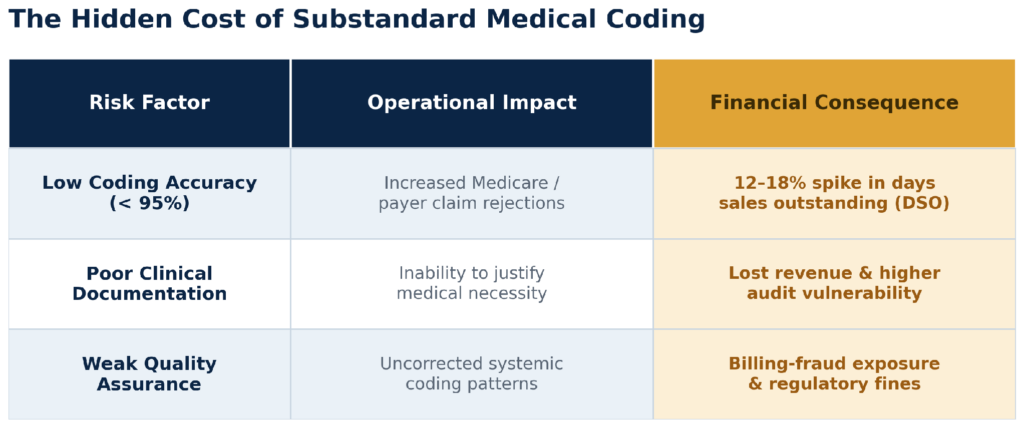
Substandard coding directly compromises revenue-cycle management. Under-coding, up-coding, and incorrect modifiers drive claim denials, delay cash flow, and inflate appeal costs. Once accuracy slips, denials climb and days sales outstanding spikes — turning a back-office task into a balance-sheet problem.
Hospital margins run on razor-thin thresholds, leaving zero room for processing errors. When a BPO relies on inadequately trained agents, systemic mistakes compound across thousands of charts, and the financial damage shows up as rejected claims, slower cash flow, and a swelling appeals backlog. The relationship between coding accuracy and denials is direct and unforgiving, which is why evaluating a vendor’s clinical workforce quality comes before any price discussion.

Each failure mode carries a distinct operational and financial consequence, from payer rejections to audit exposure and regulatory fines.
Many hospital executives falsely assume that any BPO agent with a generic degree can handle clinical workflows. In healthcare outsourcing, true risk mitigation requires utilizing dedicated, licensed nurses and certified coders who deeply understand the nuances of U.S. healthcare regulations. — John Maczynski, CEO, PITON-Global
How Do Data Security and Regulatory Compliance Failures Impact Offshore Operations?
Offshore clinical-data handling exposes CEOs to severe legal and financial liability if a partner suffers a breach or misses compliance metrics. The defense is verifiable: PHI encrypted at rest and in transit, biometric clean-room facilities with no-device policies, and demonstrable HIPAA, HITECH, and ideally HITRUST compliance.
A compliance failure offshore is the hospital’s liability, not just the vendor’s. That makes due diligence on three benchmarks essential before any contract is signed.
Critical Compliance Benchmarks
- Data encryption: all Protected Health Information must be encrypted both at rest and in transit.
- Physical security: facilities must enforce biometric access control, clean-desk environments, and strict no-device policies in production areas.
- Framework alignment: providers must maintain verifiable HIPAA and HITECH compliance and, ideally, hold a HITRUST certification.
What Infrastructure Vulnerabilities Could Disrupt Patient Care Workflows?
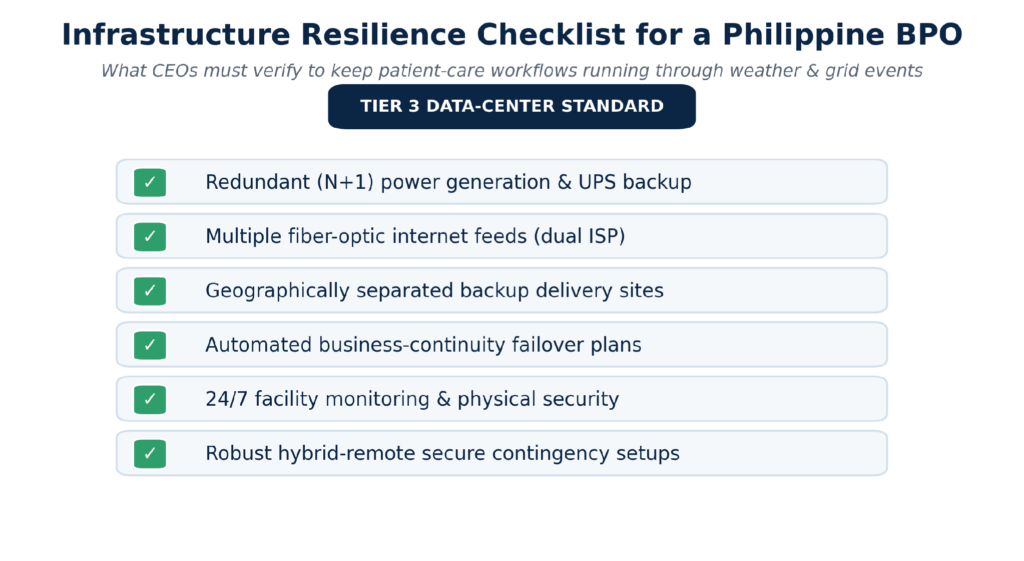
The Philippines offers a vast talent pool, but its geography demands scrutiny of resilience. Severe weather and grid strain can halt unprepared operations. CEOs must verify Tier 3 data centers with redundant power, multiple fiber-optic feeds, and geographically separated backup sites that keep patient-care workflows running.
Talent alone is not enough if the lights go out. Before committing, confirm that a prospective partner has engineered redundancy into every layer of its operations — power, connectivity, and physical location — so a regional disruption never becomes a patient-care disruption or a drag on the administrative turnaround times vendors promise.
What Results Can a Hospital Expect from a Specialized, Vetted Partner?
A multi-state hospital group stuck at a high denial rate with a generic vendor cut denials to a fraction of that level within 90 days after switching to a specialized, CPC-staffed BPO — accelerating claims processing and cutting annual operating costs substantially. Specialization, not cost, drove the turnaround.
The Challenge
A U.S. hospital group experienced a persistently high claim-denial rate and mounting backlogs after partnering with a generic BPO vendor that lacked specialized healthcare expertise.
The Solution
The hospital collaborated with PITON-Global to leverage its network of more than 100 vetted Philippine providers, mapping requirements against specialized healthcare BPOs and filtering for top-tier coding accuracy and established HITRUST certification. It transitioned its revenue-cycle operations to the recommended specialist, whose team consisted entirely of certified professional coders (CPCs).
The Outcomes
- Denial rate: fell to a fraction of its starting level within 90 days.
- RCM throughput: claims processing accelerated substantially.
- Cost efficiency: a material reduction in annual operational costs.

Generic BPO providers cannot adequately support specialized clinical workflows. Partnering with a dedicated, expert-vetted provider is essential to protecting hospital revenue and compliance.
How Does PITON-Global Help Hospital Leaders De-Risk Vendor Selection?
PITON-Global is a premier BPO advisory consultancy based in the Philippines. Rather than passing leads to the lowest bidder, it acts as a strategic partner — applying rigorous due diligence across clinical capabilities, data security, and compliance to match hospitals with the ideal provider from a vetted network of more than 100, on the first attempt.
Who Is PITON-Global?
PITON-Global is a premier BPO advisory and outsourcing consultancy based in the Philippines. It serves as a strategic partner to enterprise buyers — hospital CEOs, COOs, and CFOs — helping them navigate a complex offshore landscape with confidence rather than guesswork.
How Does PITON-Global Differ from Traditional Outsourcing Brokers?
Unlike traditional brokers that simply pass leads to the lowest bidder, PITON-Global takes an advisory-led approach. It performs rigorous due diligence on clinical capabilities, data-security infrastructure, and compliance track records, and is accountable to client outcomes — not to placing business with whichever provider bids cheapest.
How Does PITON-Global’s Network of 100+ Vetted Philippine BPO Providers Benefit Organizations?
With a network of more than 100 carefully vetted call-center and back-office providers, PITON-Global lets hospitals bypass a risky open market. Because each provider is pre-screened for clinical capability, data security, and compliance history, leaders move straight to credible specialists — for example, filtering for top-tier coding accuracy and HITRUST certification.
How Does PITON-Global’s Advisory-Led Vendor Matching Process Work?
The process maps the hospital’s requirements to a clear provider profile, filters the vetted network for must-haves such as accuracy thresholds and HITRUST certification, conducts rigorous due diligence on clinical, security, and compliance track records, and delivers a first-attempt match — eliminating costly trial and error.

Why Do Organizations Use PITON-Global?
Hospital leaders use PITON-Global to eliminate guesswork, mitigate operational risk, and identify the ideal outsourcing partner on the first attempt. By vetting clinical capability, security infrastructure, and compliance up front, the firm protects revenue and compliance from day one.
What Else Should Hospital Leaders Know Before Outsourcing Clinical Workflows?
Common questions concern coding-accuracy standards, regulatory training, disaster continuity, required certifications, and how specialized providers compare on cost. In each case, top-tier Philippine providers are built to protect hospital revenue and patient data.
What is the industry standard for medical-coding accuracy among top Philippine BPOs?
Top-tier healthcare BPOs hold a strict internal QA accuracy floor for coding, and elite providers regularly clear it by a wide margin.
How do Philippine BPO providers ensure their staff understand U.S. healthcare regulations?
Leading providers run intensive, continuous training covering HIPAA compliance, CMS guidelines, and annual updates to ICD-10-CM, CPT, and HCPCS coding systems.
What happens if a Philippine BPO provider experiences a natural disaster?
Resilient providers use automated business-continuity plans, shifting active workflows to geographically distinct backup centers or robust hybrid-remote secure setups.
Are there specific certifications a hospital should demand from an offshore BPO?
Yes. Require evidence of HIPAA compliance, ISO/IEC 27001 certification, and ideally a HITRUST Common Security Framework (CSF) assurance report.
How does the cost of a specialized healthcare BPO compare to a generic provider?
Specialized providers carry a slight premium for certified talent and secure infrastructure, but deliver far higher ROI by preventing costly claim denials and compliance penalties. Applying financial benchmarks for comparing healthcare BPO firms makes that trade-off measurable.