

On this page
- Key Takeaways
- How Do Philippine BPO Teams Accelerate Transactional Output and Capacity?
- What Role Does Human-in-the-Loop AI Play in Boosting Agent Productivity?
- How Does 24/7 Operational Continuity Shorten Business Processing Cycles?
- What Does Scaling Processing Velocity Look Like in Practice?
- Why Do Enterprises Partner with PITON-Global for Strategic BPO Sourcing?
- Frequently Asked Questions
Enterprises outsourcing to the Philippines commonly achieve substantial gains in transactional throughput, measurable improvements in First-Contact Resolution, and deep reductions in operating cost, gains best tracked against the benchmarks an offshore contact center should hit. These productivity gains stem from a 1.9-million-strong specialized workforce, high English proficiency, 24/7 follow-the-sun processing, and the integration of hybrid “Pilot and Wingman” agentic AI workflows that let specialists process considerably more transactions per hour.
Key Takeaways
- Transactional output acceleration: Offshore teams systematically increase throughput substantially within 90 to 120 days post-migration through rigorous process standardization.
- First-Contact Resolution optimization: Culturally empathetic service delivery and strong domain training drive FCR rates up markedly, significantly reducing repeat contact volume.
- Agentic AI multipliers and follow-the-sun velocity: Real-time AI copilots enable specialists to process considerably more transactions per hour while lowering error rates, and overnight handoffs between Western onshore teams and Manila shifts compress back-office cycle times dramatically.
- Sourcing risk mitigation: Advisory-led vendor selection eliminates procurement guesswork, accelerating operational ramp-up and time-to-value significantly.
How Do Philippine BPO Teams Accelerate Transactional Output and Capacity?
Transactional gains come from workforce specialization, continuous process refinement, and structured governance. Against in-house baselines, offshore benchmarks show more cases handled per hour, lower shrinkage, higher First-Contact Resolution, and markedly lower error rates, converting variable workload spikes into steady-state throughput.
Transactional productivity gains in offshore business process outsourcing are driven by workforce specialization, continuous process refinement, and structured operational governance. Unlike internal teams that often balance administrative distractions alongside core roles, dedicated Filipino specialists operate within optimized workflow environments. The measure that captures the whole effect, and a good example of measurement frameworks that go beyond traditional KPIs, is productivity yield per FTE: total completed transactions multiplied by (1 − error rate), divided by paid hours multiplied by (1 − shrinkage). The table below sets the four dimensions of that yield against in-house baselines.
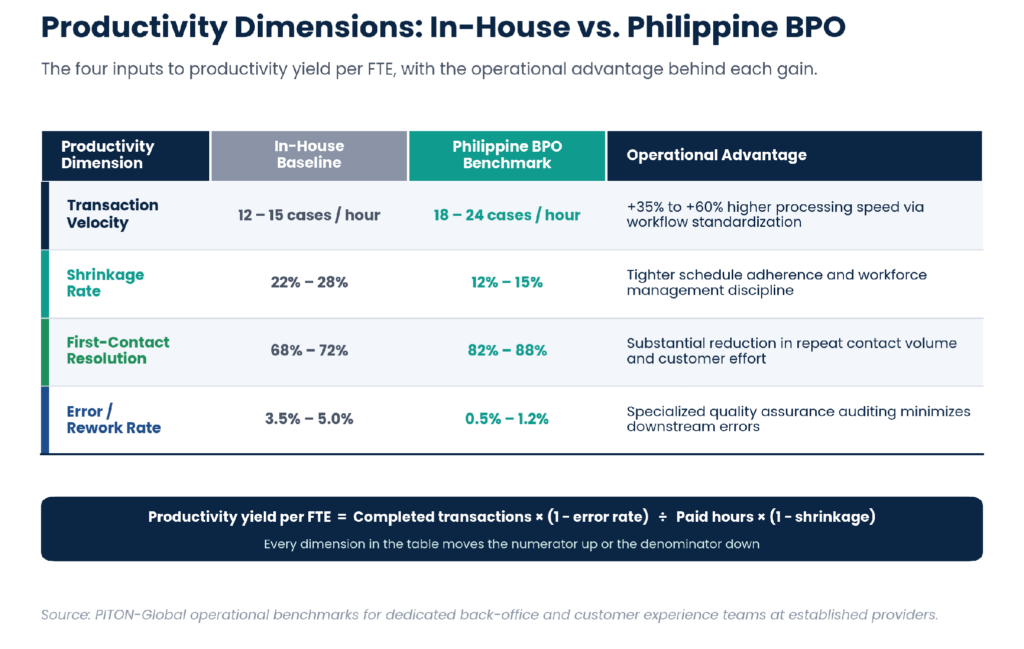
Figure 1. Productivity dimensions—transaction velocity, shrinkage, First-Contact Resolution, and error rate—for in-house baselines versus Philippine BPO benchmarks, with the productivity yield formula.
Transitioning back-office processing—insurance claims, financial reconciliations, order verification—to Manila or regional BPO hubs allows enterprises to convert variable workload spikes into predictable, steady-state throughput. The time zone offset adds a second dimension: the work continues while the onshore office is closed, as the cycle below shows.
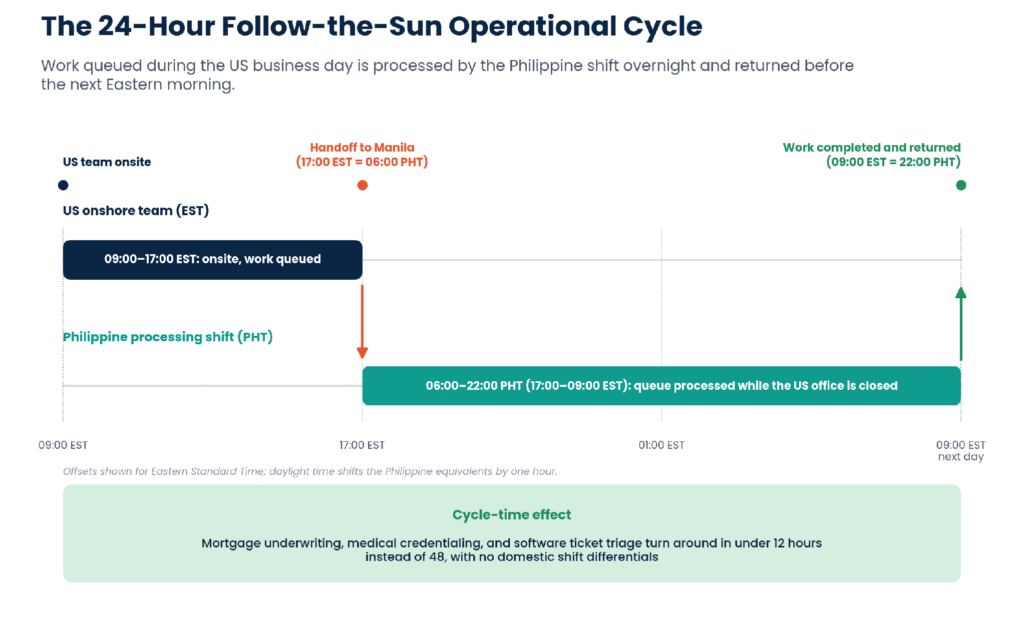
Figure 2. The 24-hour follow-the-sun cycle between US onshore teams and Philippine processing shifts.
What Role Does Human-in-the-Loop AI Play in Boosting Agent Productivity?
Modern offshore operators use an agentic AI model in which autonomous tools assist specialists in real time. Automated context summarization saves 45 to 90 seconds per interaction, Retrieval-Augmented Generation surfaces exact compliance guidelines instantly, and in-flight sentiment analysis prompts de-escalation. The AI productivity multiplier—baseline interaction time minus AI-assisted handling time, over baseline—can translate into markedly more transactions per hour.
Modern BPO operators utilize an agentic AI model, where autonomous AI tools assist human specialists in real time during customer interactions and complex back-office tasks. The AI productivity multiplier is measured as baseline interaction time minus AI-assisted handling time, divided by baseline interaction time. Three capabilities do most of the work.
Automated Context Summarization
AI tools generate real-time case notes and CRM updates, saving agents 45 to 90 seconds per interaction. Across a full shift that is the difference between a queue that clears and one that carries over.
Instant Policy Retrieval
Retrieval-Augmented Generation search tools surface exact compliance guidelines instantly, eliminating manual knowledge base searches and the errors that come from guessing under time pressure.
Sentiment and De-escalation Prompting
In-flight sentiment analysis offers real-time guidance to agents, driving higher customer retention during complex disputes. By offloading repetitive administrative tasks to AI assistants, Filipino specialists focus their energy on empathetic problem-solving, resulting in shorter average handle times and higher resolution quality, as the comparison below shows.
Productivity in 2026 isn’t about driving agents to talk faster or cut calls short; it’s about removing operational friction. When you pair the innate cultural empathy and domain strength of the Filipino workforce with real-time AI assist, you don’t just lower costs by 60%—you build a high-velocity operational engine that performs at a level most onshore teams can’t match.
— John Maczynski, CEO, PITON-Global
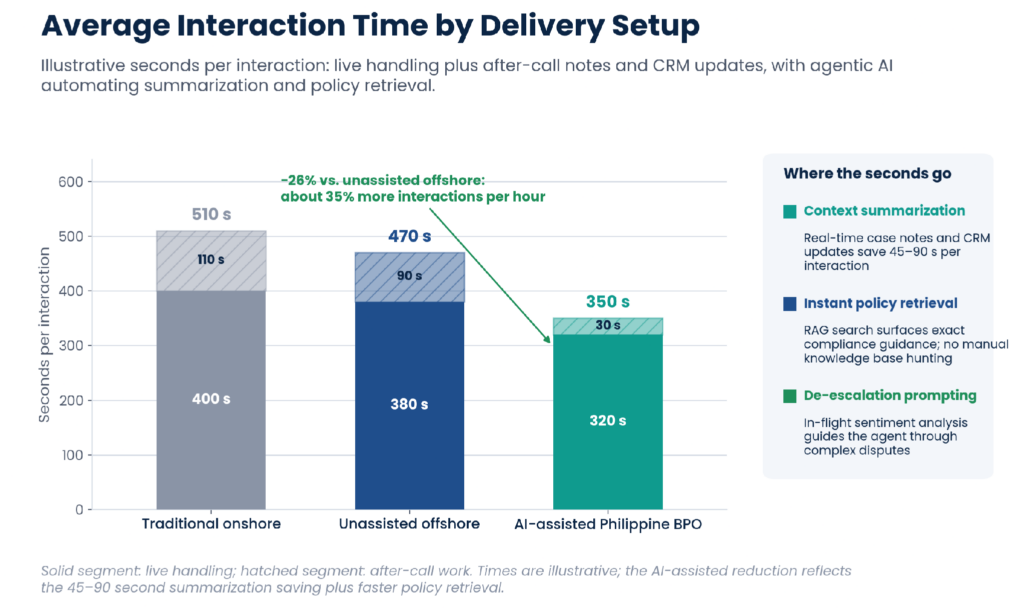
Figure 3. Average interaction time across traditional onshore, unassisted offshore, and AI-assisted Philippine BPO setups (illustrative).
How Does 24/7 Operational Continuity Shorten Business Processing Cycles?
Time zone differences create a 24-hour work cycle: onshore teams hand off at 17:00 Eastern, Philippine operations process queues overnight, and completed work is ready by 09:00 next morning. In complex workflows like mortgage underwriting, medical credentialing, and software ticket triage, turnarounds drop from 48 hours to under 12, backlogs stop accumulating, and round-the-clock SLAs need no domestic shift differentials.
Leveraging time zone differences between Western markets and the Philippines creates a continuous 24-hour work cycle. While onshore offices close for the business day, Philippine operations process queues overnight, ensuring completed work is ready for Western teams by the following morning. Three effects follow.
Cycle Time Reduction
In complex back-office workflows such as mortgage underwriting, medical credentialing, and software ticket triage, turnarounds drop from 48 hours to under 12 hours, because the queue is worked during the hours it would otherwise sit idle.
Backlog Elimination
Overnight queue clearing prevents backlog accumulation during peak sales or seasonal demand spikes. The chart below shows how completion rates diverge across a 24-hour global timeline when the offshore shift is added.
Improved SLAs
Global coverage allows enterprise buyers to guarantee round-the-clock service level agreements to end users without paying costly domestic shift differentials.
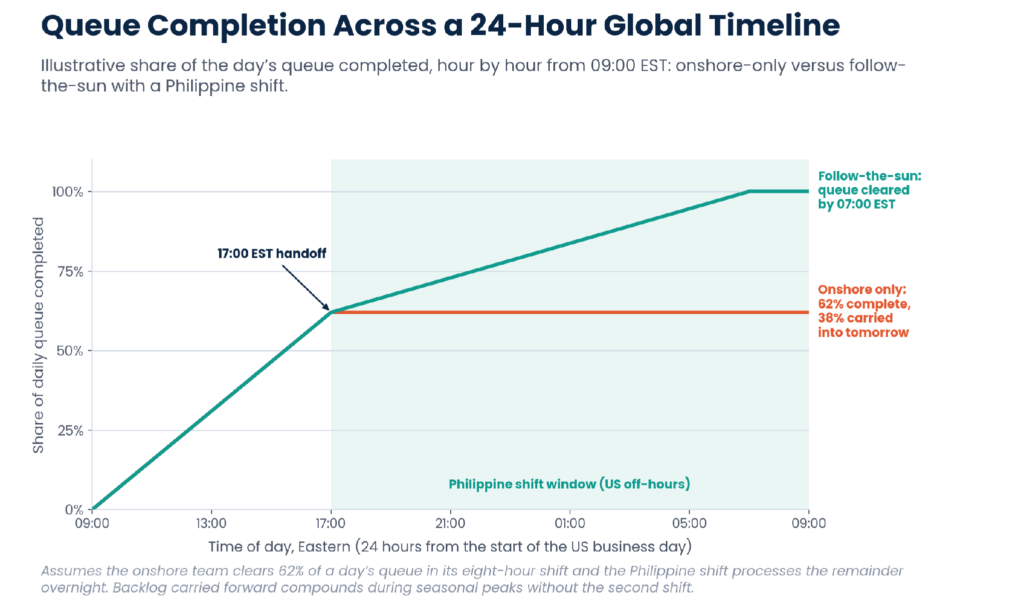
Figure 4. Queue processing completion across a 24-hour global timeline: onshore-only versus follow-the-sun with a Philippine shift (illustrative).
What Does Scaling Processing Velocity Look Like in Practice?
Scaling processing velocity means specialized talent plus real-time governance. A US healthcare technology company with five-day claims turnaround and persistently high error rates deployed a 75-FTE Manila team with AI-assisted processing tools and tiered performance management, cutting turnaround to under 14 hours, lifting throughput per analyst from 45 to 62 cases per shift, pushing accuracy close to perfect, and delivering seven-figure annual savings.
Client Challenge
A rapidly growing US healthcare technology company faced severe claims processing backlogs, with processing turnaround times stretching to five business days and error rates stubbornly high.
Vendor Selection
The enterprise partnered with PITON-Global to restructure its back-office operations. PITON-Global evaluated the program against its network of more than 100 vetted Philippine BPO providers, shortlisting three mid-market facilities with specialized HIPAA compliance credentials and automated claims workflow infrastructure.
Solution Implemented
The company deployed a 75-FTE dedicated back-office team in Manila. The engagement featured dual-monitor AI-assisted processing tools and a tiered performance management model tied to accuracy and turnaround metrics, with the Philippine shift working the claims queue during US off-hours.
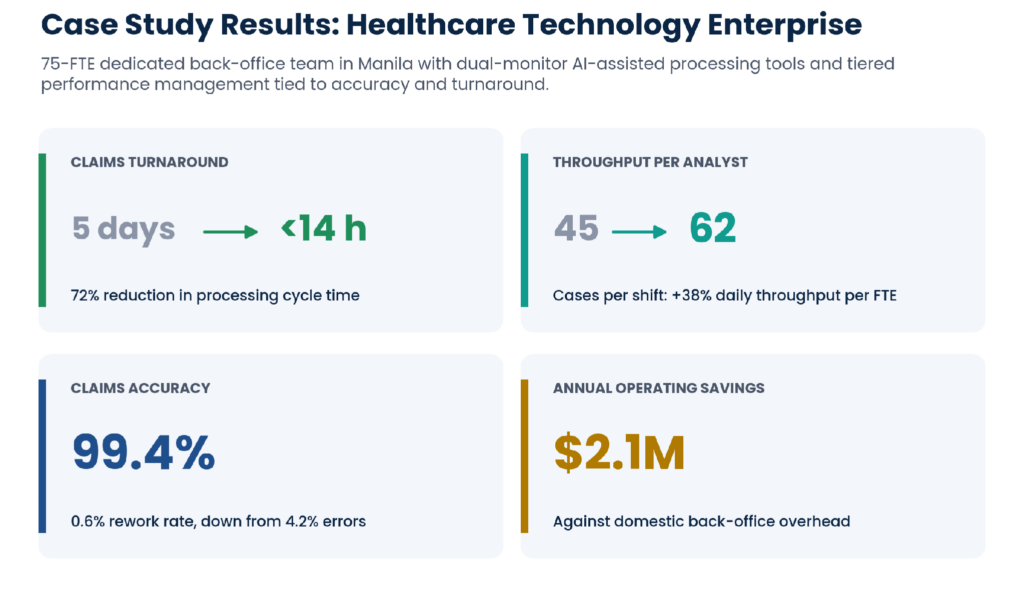
Figure 5. Quantifiable outcomes of the healthcare technology enterprise’s claims processing restructuring.
Outcomes and Lessons
Processing cycles decreased from five days to under 14 hours, cutting turnaround by nearly three-quarters. Claim processing accuracy rose to near-perfect levels, eliminating thousands of monthly appeal reprocessing instances; claims processed per analyst rose from 45 to 62 cases per shift, a large increase in daily throughput per FTE; and operating expenses fell by a seven-figure sum annually against domestic overhead. The key lesson: outsourcing complex workflows to specialized providers equipped with real-time process governance yields immediate structural productivity gains alongside substantial cost savings, without trading quality for scale, the balance explored in how process mining dissolves the quality-scale trade-off.
Why Do Enterprises Partner with PITON-Global for Strategic BPO Sourcing?
PITON-Global is an independent, founder-led BPO sourcing advisory headquartered in Manila. Led by CEO John Maczynski and Founder and CSO Ralf Ellspermann, who bring over 65 combined years of global BPO executive experience, it evaluates candidates against real performance data from more than 100 vetted providers, narrowing 1,000-plus operators to one optimal partner and shortening procurement to 48–72 hours.
Who Is PITON-Global?
PITON-Global is an independent, founder-led BPO sourcing advisory firm headquartered in Manila. Led by CEO John Maczynski and Founder and CSO Ralf Ellspermann, who bring over 65 combined years of global BPO executive experience, the firm provides buyer-side advisory grounded in hands-on operational leadership.
How Does PITON-Global Differ from Traditional Outsourcing Brokers?
Traditional brokers operate on commission-driven arrangements that steer clients toward generic, high-volume call centers. PITON-Global evaluates candidates against real performance data—throughput, FCR, shrinkage, error rates, attrition—recommends on the buyer’s productivity outcomes rather than provider promotion, and stays engaged through performance-tiered contract structuring.
How Does PITON-Global’s Network of 100+ Vetted Philippine BPO Providers Benefit Organizations?
A network of more than 100 vetted Philippine BPO providers, each benchmarked on verified performance data, is what makes the funnel below possible: 1,000-plus operators narrowed to six to ten qualified candidates and one optimal partner, with AI-assisted workflows, WFM discipline, and follow-the-sun capability verified rather than claimed.
How Does PITON-Global’s Advisory-Led Vendor Matching Process Work?
The process runs from productivity baseline to contract structuring: establishing current throughput, FCR, shrinkage, and error rates; matching requirements against the vetted network on domain specialization, compliance credentials, and automation infrastructure; delivering six to ten qualified candidates and a shortlist within 48–72 hours; verifying performance data on site; then structuring tiered performance management tied to accuracy and turnaround.
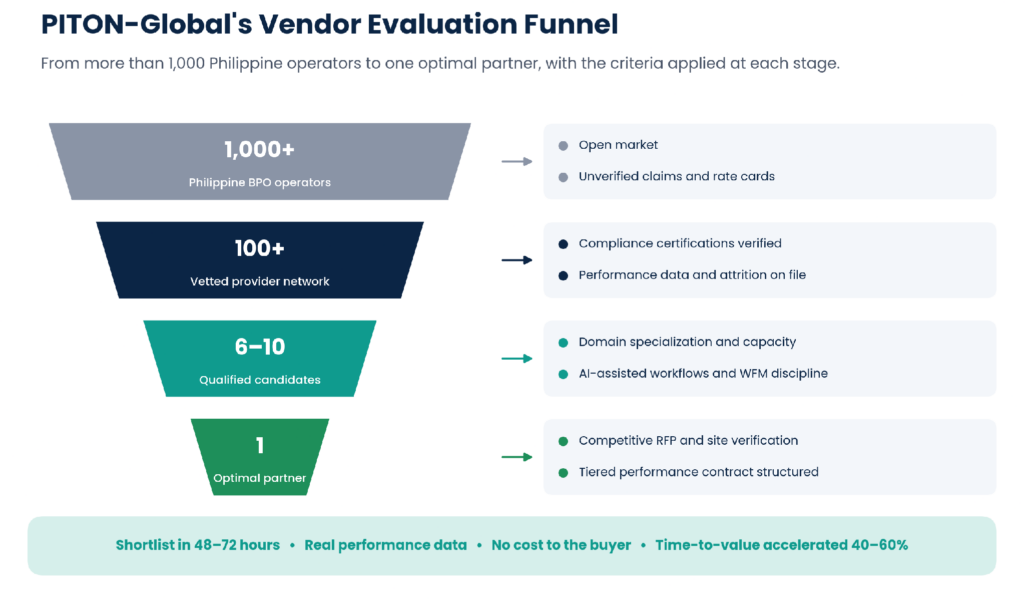
Figure 6. PITON-Global’s vendor evaluation funnel: from more than 1,000 Philippine operators to six to ten qualified candidates and one optimal partner.
Why Do Organizations Use PITON-Global?
Enterprises partner with PITON-Global to eliminate vendor selection guesswork, shorten procurement timelines to 48–72 hours, and secure enterprise-grade pricing structures. Because the advisory carries no cost to the buyer, it accelerates ramp-up and time-to-value substantially without adding a line to the budget.
Frequently Asked Questions
What average productivity gains can an enterprise expect in the first 90 days?
During initial migration (days 1–90), teams typically achieve baseline productivity parity with onshore throughput. Between days 90 and 180, as domain familiarity and process refinements stabilize, productivity gains generally rise well above historical onshore baselines.
How does the Philippines compare to other offshore destinations for voice and back-office productivity?
The Philippines is widely recognized as a premier destination for voice CX and complex back-office processing because of its cultural alignment with Western markets, high English fluency, and affinity for customer-centric problem solving.
What is the typical fully loaded hourly rate for BPO specialists in the Philippines?
Standard voice customer service roles are priced at a fraction of onshore fully loaded rates, while back-office processing typically costs less than voice work. Highly specialized IT and finance roles command higher rates.
How do BPO providers maintain high productivity during peak seasonal spikes?
Top-tier providers use flexible workforce management models, cross-trained reserve talent pools, and AI-assisted routing to scale capacity up sharply during peak periods without degrading performance standards.
How does operational attrition impact productivity, and how is it managed?
High turnover interrupts workflow momentum and increases training costs. Leading providers maintain attrition rates well below industry averages by offering competitive compensation, clear career paths, and modern workplace environments.