

On this page
- Key Takeaways
- Why Is Full Cost Unbundling Essential for B2B Outsourcing?
- How Do Hidden Fees Undermine Philippine BPO Partnerships?
- What Financial Audits Should Enterprise Buyers Enforce?
- How Do Transparent and Opaque Pricing Models Compare Over a Full Contract Term?
- What Does a Transparent Pricing Structure Look Like in Practice?
- How Does PITON-Global Mitigate BPO Sourcing Risks?
- Frequently Asked Questions
The pricing transparency businesses should require from outsourcing companies in the Philippines is a fully unbundled cost model: itemized direct labor rates, verified statutory benefit remittances, a capped vendor margin, and technology billed as pure pass-through against original invoices—in short, a rate card that shows its working. Transparent structures eliminate hidden markups, prevent the wage compression that drives attrition, and align buyer and provider incentives across the life of the program.
Key Takeaways
- Mandate fully unbundled billing. Require direct frontline compensation, statutory benefits, facility overhead, IT infrastructure, and vendor margin as distinct invoice line items.
- Audit statutory labor compliance. Verify monthly remittances for SSS, PhilHealth, and Pag-IBIG, plus 13th-month pay mandated under Presidential Decree 851.
- Benchmark operational margins. Hold vendor management fees inside a verifiable, benchmarked corridor so ROI is not funded by suppressing agent pay.
- Eliminate opaque pass-throughs. Disallow non-itemized software, telecom, and hardware markups by requiring original third-party invoices for every pass-through cost.
- Structure dynamic volume thresholds. Tie margin compression and efficiency rebates to multi-year growth milestones and SLA attainment, agreed at signature rather than at the milestone.
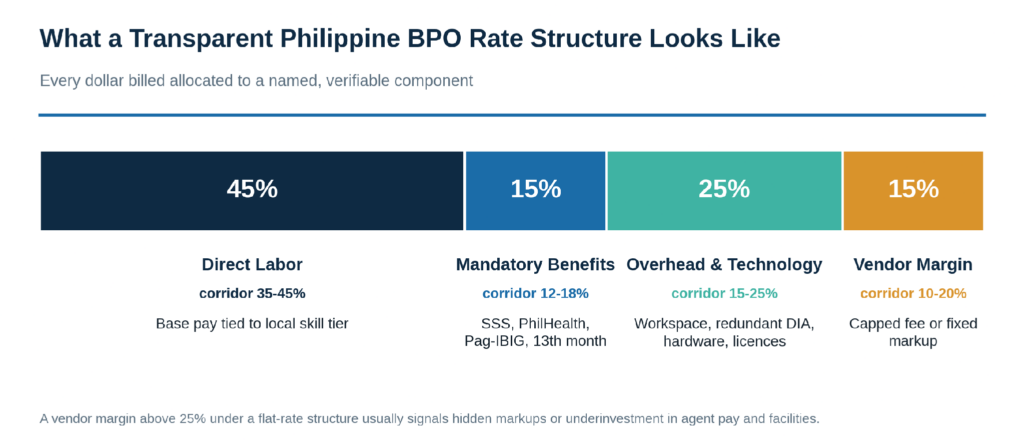
Figure 1. A transparent Philippine BPO rate structure, with the benchmark corridor for each component.
Why Is Full Cost Unbundling Essential for B2B Outsourcing?
Unbundling lets procurement distinguish direct frontline compensation from vendor profit. Under a flat hourly rate for voice support, the buyer has no visibility into how much reaches the agent — which is precisely the gap that allows wage compression to fund margin without any change to the invoice.
A flat rate is a single number covering labor, benefits, facilities, technology, supervision, and profit. Nothing in it is wrong; the problem is that it conceals the one variable most predictive of program performance, which is what the agent is actually paid. When a provider comes under margin pressure mid-term — from a wage order, an FX movement, or an aggressive renewal negotiation — a flat-rate contract gives it exactly one silent lever: reduce agent compensation while holding the bill rate constant.
What Wage Compression Does to a Program
The consequences are operational, not theoretical, and they arrive in a predictable sequence. Attrition rises past the Philippine industry band, taking domain knowledge with it. Replacement hiring drives up recruitment, classroom training, and nesting costs, all of which are absorbed into a rate the buyer believed was fixed. Then service quality follows: inexperienced replacements resolve fewer contacts on first attempt, which raises repeat-contact volume and depresses both first contact resolution and Net Promoter Score. The buyer ends up paying the same rate for a materially weaker team, with no line item anywhere to explain why.
An unbundled, open-book structure removes the lever. When direct labor is a named line and statutory benefits are verified, competitive wages are preserved by the contract itself rather than by the provider’s goodwill — which is what protects talent quality, team stability, and program performance over a multi-year term.
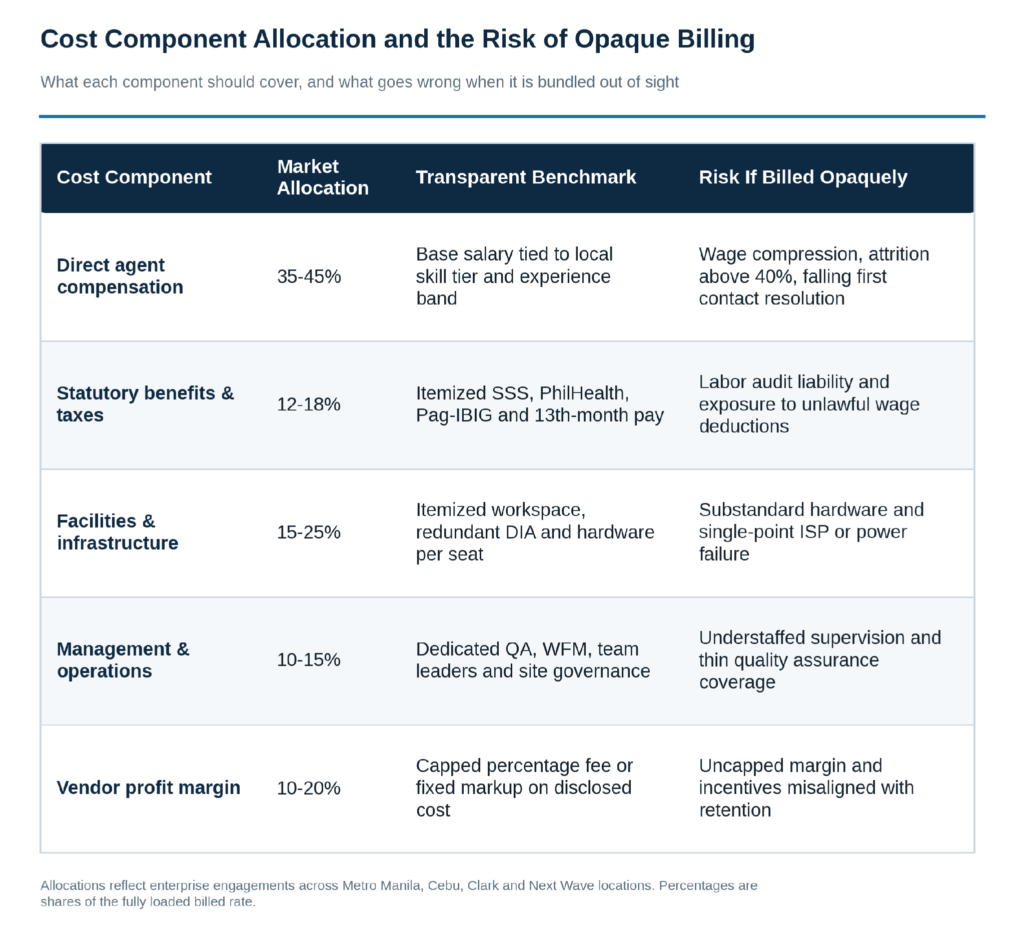
Figure 2. Cost component allocation, the transparent pricing benchmark for each, and the operational risk when the component is billed opaquely.
How Do Hidden Fees Undermine Philippine BPO Partnerships?
Hidden fees rarely appear as explicit charges. They are embedded in operational line items, technology licensing, shift differentials, and currency conversion buffers — where the provider bills a premium above its actual cost and retains the spread. Requiring original third-party invoices for every pass-through cost removes the mechanism.
The clearest example is the night-shift differential. The Philippine Labor Code mandates a minimum premium of one-tenth of base wages for hours worked between 10:00 p.m. and 6:00 a.m. — the window covering US and European business hours. Opaque providers routinely bill clients a flat night surcharge at a multiple of that floor across an entire team and keep the difference between the statutory requirement and the client billing. The surcharge looks like compliance; it functions as margin.
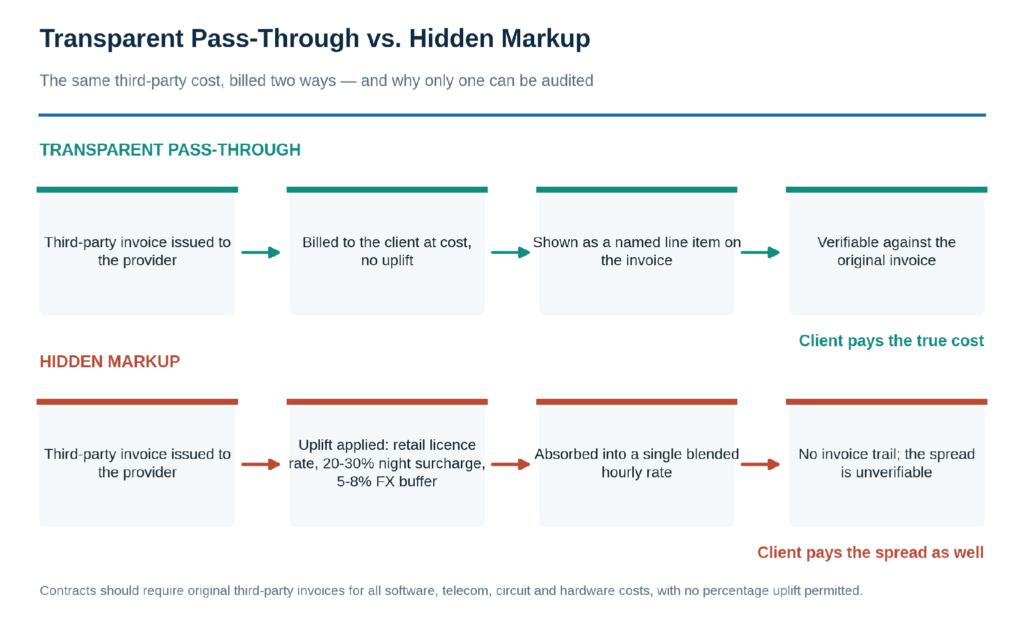
Figure 3. The same third-party cost billed two ways: transparent pass-through against original invoices versus hidden markup absorbed into a blended rate.
Inflated Software Seat Licenses
Providers acquire CRM, CCaaS, and AI tooling at volume discounts, then bill the client at retail list price. The gap on a single enterprise CCaaS seat is material on its own, and across 100 seats and three years it becomes a substantial transfer with no corresponding service.
Telecommunications and DIA Surcharges
Percentage markups applied to Dedicated Internet Access circuits, SIP trunking, or telecom usage are common and rarely disclosed. Because these costs scale with volume, the markup grows silently as the program succeeds.
Opaque Currency Conversion Buffers
Providers billing in USD while paying costs in pesos face genuine FX exposure, and sharing that risk is legitimate. What is not legitimate is an undisclosed buffer built into the rate in place of a transparent spot-rate mechanism. A defensible structure fixes USD billing inside a stated exchange-rate corridor, with pre-agreed adjustments triggered only when rates move beyond the boundary for a sustained period, typically 90 days.
True cost transparency in the Philippines isn’t just about auditing vendor margins — it’s about ensuring that every dollar invested directly strengthens frontline talent retention, infrastructure reliability, and end-user operational performance.
— John Maczynski, CEO, PITON-Global
What Financial Audits Should Enterprise Buyers Enforce?
Write audit rights into the master services agreement covering four areas: statutory remittance verification, overtime and holiday pay compliance, infrastructure and license reconciliation, and an annual margin and rate-card true-up. Each clause must name a cadence, a document set, and a remedy for shortfall.
Transparency that depends on vendor cooperation is not transparency. Audit rights convert disclosure from a courtesy into an obligation, and they should extend to the accounting records specific to the buyer’s dedicated account — not the provider’s consolidated financials, which reveal nothing about a single program.
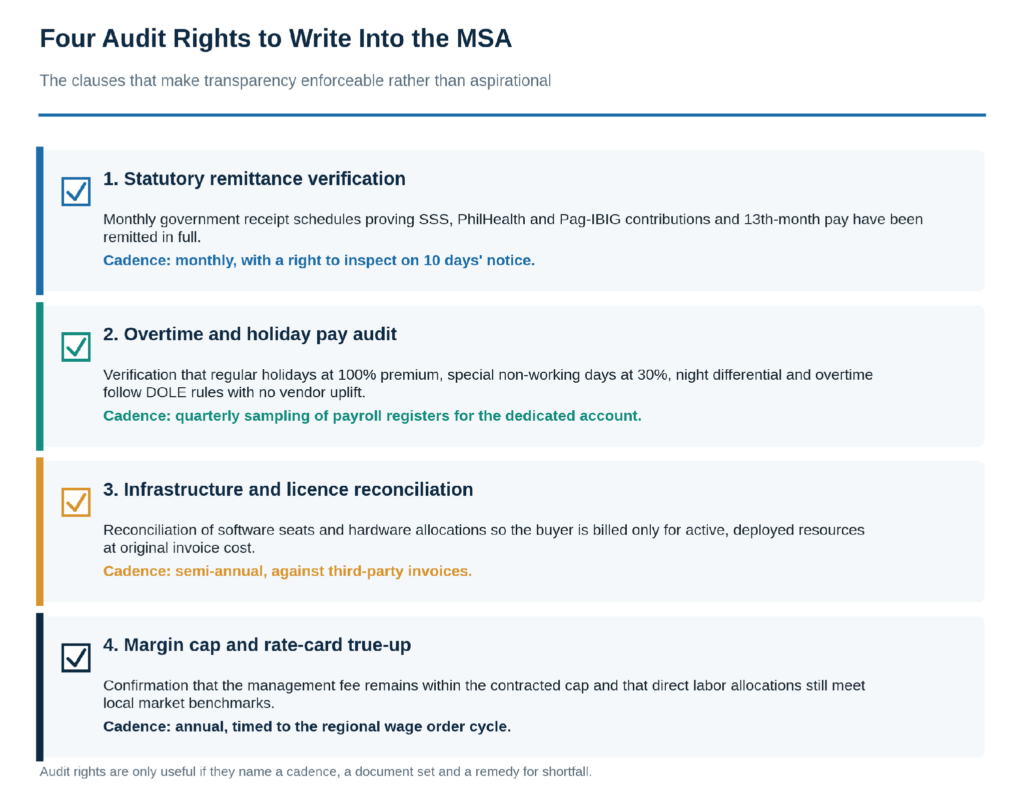
Figure 4. The four audit rights that make pricing transparency enforceable, with the cadence and document set for each.
Verify Against the Statutory Baseline, Not Just the Invoice
Philippine wage floors are set regionally and move on their own cycle: Metro Manila’s non-agricultural daily minimum rose to ₱755 on 25 July 2026 under Wage Order NCR-27, reaching ₱780 in January 2027. Regular holidays carry 100% premium pay and special non-working days 30%, per Department of Labor and Employment rules. An audit that only reconciles the invoice to the contract misses the more important question: whether the direct labor line still clears the statutory baseline and the local market benchmark for the skill tier being delivered. Time the annual true-up to the wage order cycle so the answer stays current.
How Do Transparent and Opaque Pricing Models Compare Over a Full Contract Term?
Over a three-year term the gap compounds. A flat rate typically carries a fixed annual escalator with no visibility into what the increase funds, while an open-book model passes only statutory wage increases through on a disclosed cost base. On a 75-seat program that difference compounds into a very large sum.
The single-year comparison understates the effect, because the two models escalate differently. A flat rate is renegotiated as a whole number, so every increase is a negotiation the buyer cannot evidence against. An open-book rate moves only where the disclosed cost base moves — a wage order, a license renewal, a headcount change — and each movement arrives with documentation attached.

Figure 5. Cumulative program cost over 36 months for an illustrative 75-seat program: opaque flat rate versus open-book cost-plus.
Two caveats keep this honest. An open-book model transfers administrative work to the buyer, who must maintain the comparison sheet and run the audits; a program without the governance capacity to do that will not capture the benefit — though for buyers who ultimately want to own the operation, a build-operate-transfer arrangement makes that visibility the default. And open book is not automatically cheaper on day one — a transparent provider quoting a fair margin may price above an opaque competitor quoting a suppressed labor line. The advantage shows up in year two and three, when the transparent program still has its tenured team.
What Does a Transparent Pricing Structure Look Like in Practice?
A North American fintech paying a flat hourly rate, with high attrition and no visibility into allocation, moved a 75-seat team to an open-book structure at a lower all-in rate. Year-one cost fell while agent pay rose; attrition dropped sharply and first contact resolution improved materially.
Client Challenge
A mid-market fintech operating in North America faced steadily escalating costs with a mid-sized Manila call center. Despite paying a premium flat rate per agent, the program ran at high annual agent attrition with lagging SLA performance and no visibility whatsoever into how the billing rate was distributed between labor, infrastructure, and margin.
Vendor Selection Process
PITON-Global assessed the client’s operational requirements against its network of more than 100 vetted Philippine providers and shortlisted three high-performing candidates willing to contract on an open-book, cost-plus basis. Willingness to open the books was itself a selection criterion, and it eliminated several otherwise capable providers.
Solution Implemented
The 75-seat customer success and fraud prevention team transitioned to a top-tier provider under a fully itemized rate: direct agent salary as its own line, positioning pay near the top of the local market; itemized statutory benefits and taxes; facilities and technology, covering redundant DIA, enterprise hardware, and security compliance; and a fixed, capped management fee.

Figure 6. Rebuilding an opaque flat rate as a fully itemized rate, with the resulting operational outcomes.
Outcomes and Lessons
The counterintuitive result is the important one: the agent was paid more while the client paid less. That is only possible because the spread between the billed rate and the delivered cost had previously been retained as margin rather than invested in the program. Attrition fell to a fraction of its former level, which removed most of the recurring recruitment and training overhead, and first contact resolution improved materially within six months as domain knowledge accumulated in a team that stopped turning over. The broader lesson is about relationship dynamics: transparent pricing shifts the engagement from transactional vendor management toward a partnership where both parties can see what performance costs.
How Does PITON-Global Mitigate BPO Sourcing Risks?
PITON-Global is a BPO advisory and management consultancy that matches enterprise buyers with vetted Philippine providers and enforces open-book pricing standards across its network. It supports SLA structuring, MSA negotiation, audit rights, and ongoing governance rather than ending its involvement at introduction.
Who Is PITON-Global?
PITON-Global is an advisory firm specializing in Philippine outsourcing, working at the point where an enterprise buyer meets a provider market of more than 1,000 contact centers and back-office operations. Its expertise covers provider selection and the commercial evaluation that precedes it: labor costing, statutory compliance verification, and pricing structure design. That local knowledge matters because the variables that determine whether a program succeeds — wage benchmarks by skill tier and city, real estate costs, realistic margin expectations, attrition history on comparable accounts — are not visible from a rate card.
How Does PITON-Global Differ from Traditional Outsourcing Brokers?
Traditional brokers charge transactional finder’s fees, which means their recommendation set narrows to whichever providers pay best and their involvement ends at the introduction. PITON-Global operates as an advisory partner embedded in the procurement process: independent evaluation of candidates, objective recommendations that may include providers with no commercial relationship to the advisor, and continued engagement through contracting and governance. On transparency work the distinction is concrete, since an intermediary paid on placement has no incentive to tell a buyer that every shortlisted proposal carries an inflated margin.
How Does PITON-Global’s Network of 100+ Vetted Philippine BPO Providers Benefit Organizations?
The network spans enterprise-grade providers across voice, back-office processing, IT services, and AI-assisted operations in Manila, Cebu, Clark, and Davao — including the regulated-industry specialists behind biotech back-office programs. Because candidates have already been assessed for capacity, certifications, financial stability, and attrition performance — and screened for willingness to price transparently — buyers skip the discovery phase and move directly to qualified providers matched on domain and program size. Vendor qualification compresses from months to weeks.
How Does PITON-Global’s Advisory-Led Vendor Matching Process Work?
Matching runs from needs assessment through to selection support. Workflows, volumes, coverage hours, compliance obligations, and growth projections are documented; the vetted network is filtered for specialization, location tier, and right-sized capacity; a shortlist is delivered and validated on security posture, business continuity, attrition history, and SLA record; competing proposals are restated onto one fully loaded, like-for-like basis so each cost line can be tested against market corridors; and the buyer is supported through reference calls, negotiation, and the construction of audit rights and governance cadence. Risk reduction is built into each stage rather than addressed at signature.
Why Do Organizations Use PITON-Global?
- Reduced outsourcing risk. Independent diligence on delivery capability, statutory compliance, and attrition history surfaces problems before they become contractual.
- Enforced pricing transparency. Open-book standards, transparent labor costing, and verifiable statutory compliance are applied across network partners.
- Improved provider fit. Multi-factor matching on domain expertise, cultural fit, scalability, and pricing structure rather than size or headline rate.
- Accelerated vendor selection. A pre-qualified shortlist compresses a discovery cycle that typically runs for months.
- Lifecycle governance support. Guidance on SLA structuring, MSA negotiation, audit rights, and the ongoing governance that keeps transparency enforceable.
Frequently Asked Questions
What is a typical profit margin for BPO providers in the Philippines?
Healthy operational margins for established providers sit in a moderate, benchmarkable band. Margins well above that band under a flat-rate structure usually signal hidden markups or underinvestment in agent compensation and facilities — both of which surface later as attrition and quality problems.
What statutory benefits are mandatory for BPO workers in the Philippines?
Employers must remit Social Security System, PhilHealth, and Pag-IBIG contributions and pay a 13th-month salary equal to one twelfth of annual basic pay, mandated under Presidential Decree 851. Together these add a meaningful layer above base direct labor wages, before night differential and holiday premiums.
How should currency fluctuations be structured in outsourcing contracts?
Establish an explicit FX risk-sharing corridor. Billing remains fixed in USD within a baseline exchange-rate band, with pre-agreed adjustments triggered only if rates move beyond the boundary over a defined period such as 90 days. This replaces an undisclosed buffer with a mechanism both parties can verify.
What is the difference between flat-rate hourly pricing and cost-plus models?
Flat-rate pricing charges a single hourly fee covering labor, technology, overhead, and margin with no line-item visibility. Cost-plus pricing itemizes raw labor, statutory benefits, and infrastructure costs, then applies a transparent, capped management fee to the disclosed cost base.
How does price transparency prevent attrition in Philippine contact centers?
Transparency keeps the direct labor allocation visible and therefore benchmarkable against local market rates, which removes the provider’s ability to erode agent wages to protect margin. Competitive, sustained compensation is the single largest driver of retention, and retention is what protects service quality.
What documentation should businesses require to verify pass-through costs?
Require original third-party invoices for software licenses such as CCaaS and CRM, telecom usage, dedicated circuit bandwidth, and specialized hardware procurement — with a contractual prohibition on percentage uplift and a semi-annual reconciliation against active, deployed resources.