
The total cost of ownership (TCO) of healthcare BPO in the Philippines typically runs $18,000 to $28,000 per full-time equivalent (FTE) per year, or $54,000 to $84,000 cumulatively over three years. This figure spans direct labor, fully loaded facilities, technology infrastructure, implementation, governance, and operational risk mitigation.
Key Takeaways
- Comprehensive TCO framework: Direct salaries are only 55% to 65% of true cost; facilities, connectivity redundancy, and governance make up the rest.
- Year 1 implementation spike: First-year costs are front-loaded 15% to 25% by data migration, HIPAA compliance training, and system integration.
- Economies of scale: Scaling from a 10-FTE pilot to a 50+ FTE enterprise tier cuts per-unit governance and management overhead by roughly 18%.
- Risk-adjusted valuation: Modeling attrition mitigation and business continuity upfront prevents unexpected mid-contract cost escalations.
- Rate is not cost: A low seat rate often signals thin security protocols or stretched supervisory ratios that erode every dollar of projected labor arbitrage.
What Core Cost Components Comprise the Healthcare BPO TCO?
A true three-year TCO isolates three layers: direct loaded labor (about 60%), infrastructure and security (about 20%), and governance plus onboarding (about 20%). Evaluating only hourly vendor rates ignores the compliance, redundancy, and oversight costs that determine whether savings actually hold.
Evaluating offshore clinical and administrative operations requires looking far beyond basic hourly vendor rates. A defensible framework separates direct labor, indirect operational overhead, and capital deployment so that no major cost driver is left unmodeled.
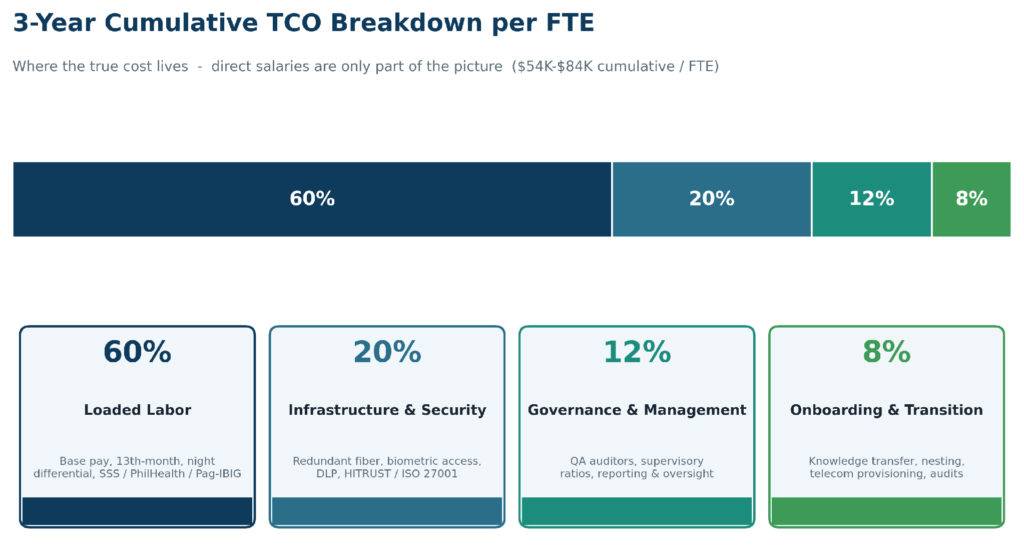
Figure 1. Three-year cumulative TCO per FTE, divided into loaded labor, infrastructure and security, governance, and onboarding.
Direct Labor and Loaded Benefits
Labor in the Philippine healthcare BPO sector is stratified by skill. Registered Nurses performing clinical utilization review or complex case management command premium compensation versus agents handling medical billing or scheduling. Fully loaded labor includes base salary, the mandatory 13th-month bonus, night-differential pay of roughly 10% to 20% for U.S. shift alignment, and statutory SSS, PhilHealth, and Pag-IBIG contributions.
Infrastructure, Technology, and Compliance Overhead
Healthcare data demands stringent technical safeguards, and a premier provider builds those costs directly into the seat rate. The core elements include:
- Security infrastructure: Active Directory integration, biometric access control, and endpoint data loss prevention (DLP) software.
- Network redundancy: Dual-provider fiber internet termination with automatic failover and backup power generation.
- Compliance certification: Amortized costs for continuous auditing of HIPAA, HITRUST, and ISO 27001 frameworks.
Three-Year Cost Amortization Model
Once steady state is reached in Years 2 and 3, annual TCO per FTE settles into predictable bands that scale with workflow complexity. Low-complexity billing and administrative roles land near $18,000 to $23,000, while clinical and RN-level work runs $26,000 to $34,000.
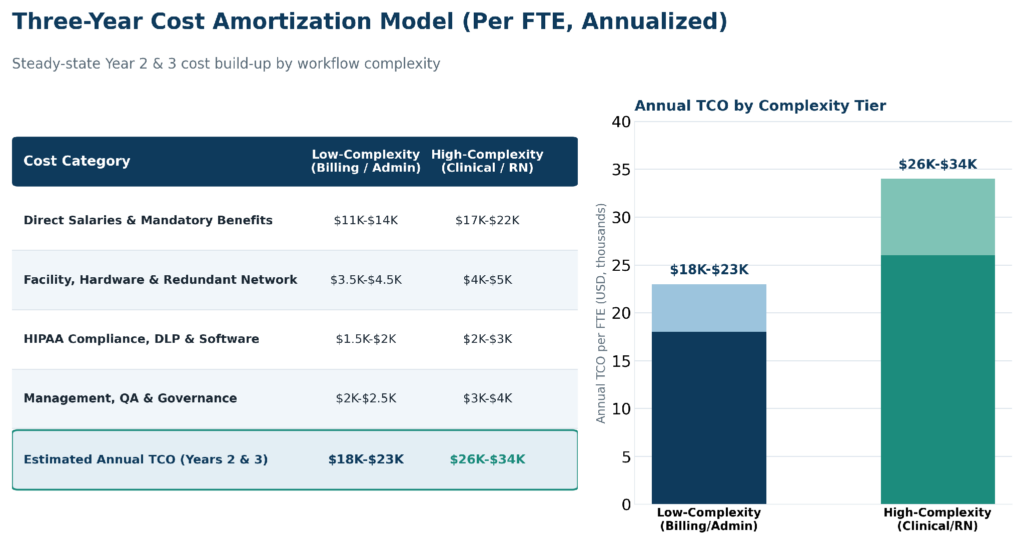
Figure 2. Steady-state Year 2 and 3 annualized cost per FTE by complexity tier, with the underlying cost categories.
How Do Transition and Implementation Costs Impact Year One Financials?
Transition costs front-load Year 1 by 15% to 25% through non-recurring expenses: secure telecom provisioning, lengthy clinical knowledge transfer, and third-party compliance auditing. Assuming steady-state costs from day one is the most common TCO miscalculation health systems make.
The initial 180 days of a healthcare offshoring initiative carry non-recurring expenses that inflate the Year 1 budget. Organizations frequently understate TCO by assuming steady-state operational costs from the first day of go-live, when in reality the ramp period is its own distinct cost phase.

Figure 3. A representative 90-day implementation timeline across telecom integration, knowledge transfer, and hypercare.
- Knowledge-transfer long tail: Healthcare workflows require lengthy nesting. A standard customer-service agent may reach production in two weeks, but a medical-coding team needs four to six weeks of clinical documentation improvement (CDI) training, during which the buyer pays for under-utilized hours.
- Telephony and telecom integration: Establishing dedicated secure MPLS circuits or encrypted site-to-site VPN tunnels between the U.S. health system and the Manila operations center carries distinct provisioning fees.
- Legal and compliance auditing: Before live PHI crosses borders, third-party compliance officers must validate the offshore environment, creating initial legal and consultative outlays.
Many enterprise buyers mistake low hourly seat rates for long-term fiscal efficiency. If a provider quotes an unsustainably low rate, they are likely cutting corners on data security protocols or supervisory ratios. In healthcare BPO, a single security vulnerability or a 40% attrition rate will completely obliterate any projected labor arbitrage.
— John Maczynski, CEO, PITON-Global
What Hidden Risks and Friction Costs Can Inflate the Three-Year TCO?
Two friction costs most often inflate a three-year TCO: specialized-talent attrition, which forces continuous recruitment and re-credentialing, and stretched management ratios, which raise coding error rates and payer denials. Both are byproducts of choosing the lowest seat rate over a verified provider.
Unanticipated operational friction can quietly degrade the financial viability of an offshore healthcare program when it is not modeled into the TCO from the outset. Two failure modes account for most of the damage.
Attrition and Recruitment Cycles
The Philippine BPO sector sees intense competition for specialized clinical talent. A provider with high attrition passes the costs of continuous recruitment, credential verification, and onboarding straight into performance, dragging on first-contact resolution and days in accounts receivable.
Sub-Optimal Management Ratios
A low-cost vendor often stretches spans of control, assigning a single team leader to as many as 25 medical billers. That dilution of oversight typically escalates coding error rates, directly degrading clean-claim rates and producing costly payer denials.
What Did a U.S. Hospital Network Achieve by Optimizing Revenue Cycle Management Offshore?
A multi-state U.S. hospital network deployed a 45-FTE team of certified coders and AR specialists with a 1:12 supervisor ratio. Over 36 months it cut operating costs 62% versus domestic baselines, lifted its clean-claim rate to 96.4%, and reduced days in AR from 52 to 34.
The network faced climbing labor costs and a 22-point clean-claim-rate deficiency that was constraining cash flow. Rather than work open-market brokers, it partnered with PITON-Global to evaluate three highly specialized, pre-vetted Manila providers with verified HITRUST certifications.
The selected provider deployed a 45-FTE team of certified medical coders and AR specialists in a biometric-restricted facility, running a disciplined 1:12 supervisor-to-agent ratio backed by dedicated quality-assurance auditors.
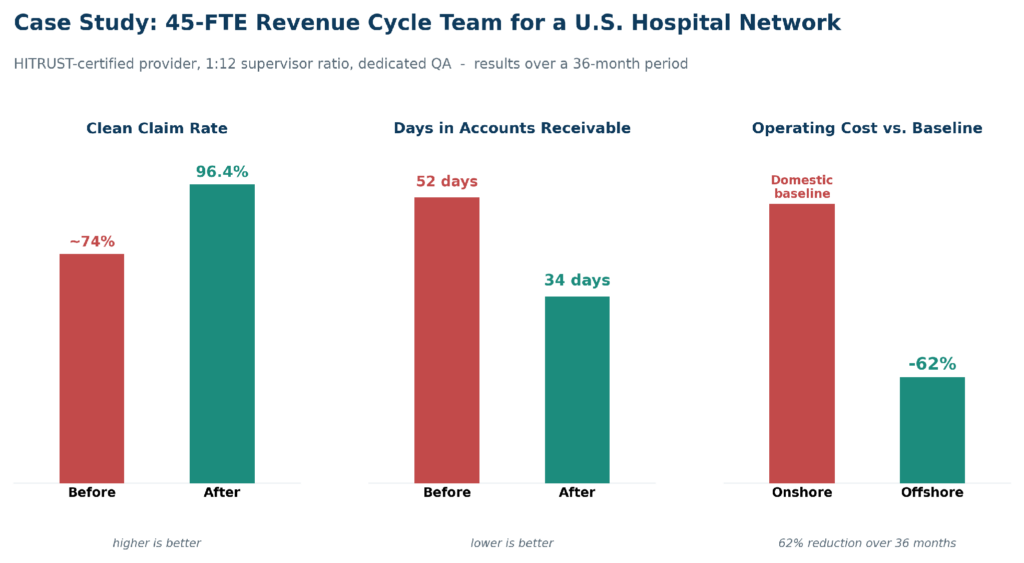
Figure 4. Before-and-after revenue cycle results for the 45-FTE engagement over a 36-month period.
Upfront investment in dedicated QA resources and a higher-tier provider delivered exponentially higher returns through yield optimization than chasing the lowest baseline seat rate would have.
What Role Does PITON-Global Play in De-Risking Healthcare Outsourcing?
PITON-Global is an independent, advisory-led BPO consultancy that maps a health system’s technical, compliance, and volume requirements against verified provider capabilities. Drawing on a vetted network of 100+ Philippine providers, it eliminates the structural blind spots that cause offshore healthcare partnerships and TCO projections to fail.
Who Is PITON-Global?
PITON-Global is an independent, premium business process outsourcing advisory and consultancy based in the Philippines, led by seasoned BPO executives with decades of hands-on experience managing multi-million-dollar global programs. Within the Philippine outsourcing market it serves as a strategic navigator, applying deep operational expertise in BPO advisory and provider selection so health systems can model and capture predictable three-year cost structures.
How Does PITON-Global Differ from Traditional Outsourcing Brokers?
Traditional brokers pass leads to the highest bidder, an incentive that distorts recommendations. PITON-Global instead provides advisory-led structural alignment built on independent provider evaluation and objective vendor recommendations. The focus is on client outcomes rather than provider promotion, so the guidance a buyer receives serves its TCO and risk goals, not a vendor’s sales pipeline.
How Does PITON-Global’s Network of 100+ Vetted Philippine BPO Providers Benefit Organizations?
The firm maintains direct, continuous oversight of a curated network of more than 100 deeply vetted call center and back-office providers spanning industries and service categories. Because partners are pre-vetted for infrastructural redundancy, clinical talent pipelines, and compliance history, organizations gain a broad provider ecosystem and dramatically faster vendor discovery and qualification without absorbing exhaustive due-diligence costs themselves.
How Does PITON-Global’s Advisory-Led Vendor Matching Process Work?
PITON-Global begins by mapping an enterprise buyer’s precise technical, compliance, and volume requirements. It then shortlists providers from its vetted network, audits capability and compliance records, builds a risk-adjusted three-year TCO model complete with escalation clauses, and supports final selection and governance design. This sequence eliminates procurement blind spots and locks in a predictable cost structure before contracts are signed.
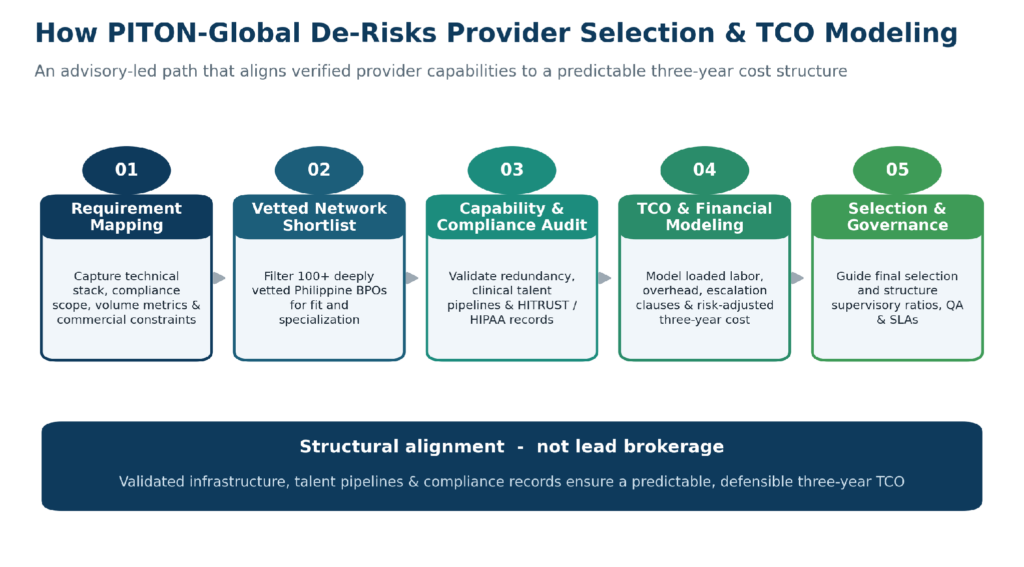
Figure 5. PITON-Global’s advisory-led workflow, from requirement mapping through risk-adjusted TCO modeling to governance.
Why Do Organizations Use PITON-Global?
Organizations engage PITON-Global to reduce outsourcing risk, improve provider fit, and accelerate vendor selection. The advisory model produces better outsourcing outcomes and provides strategic guidance throughout the evaluation, converting a high-stakes, error-prone procurement decision into a structured, evidence-based match between need and verified capability.
What Else Should Health Systems Know About Philippine Healthcare BPO Costs?
Common questions concern RN cost savings, software licensing, multi-year escalation, location economics, and embedded HIPAA costs. In short: clinical RNs save 60% to 70% fully loaded, core EHR software stays client-provisioned via VDI, model 3% to 5% annual escalation, next-wave cities cut overhead 10% to 15%, and compliance costs are built into the infrastructure.
What is the typical salary differential for a Philippine RN versus a U.S. RN in a BPO setting?
A Philippine registered nurse performing clinical tasks generally represents a fully loaded cost saving of 60% to 70% compared with a U.S.-based equivalent, while maintaining strict adherence to U.S. clinical guidelines and utilization-management criteria.
How are software licensing fees handled in a standard healthcare BPO contract?
Core proprietary software such as Epic, Cerner, or customized clearinghouses is typically provisioned by the client through secure virtual desktop infrastructure (VDI), while standard operating-system, productivity, and endpoint-security licenses are bundled into the provider’s seat rate.
What inflation or cost-escalation factors should be modeled into Years 2 and 3?
A realistic three-year TCO should include a 3% to 5% annual escalation clause to accommodate mandatory statutory wage increases in the Philippines, local inflation, and performance-based retention incentives for specialized talent.
Does the TCO model change significantly between Manila and next-wave cities?
Yes. Operating in provincial next-wave cities such as Iloilo, Davao, or Dumaguete can reduce facility and labor overhead by 10% to 15% versus Metro Manila, though Manila offers a denser concentration of specialized clinical and tertiary healthcare talent.
How do providers ensure HIPAA compliance within the TCO framework?
Compliance costs are woven into the operational infrastructure: zero-trust network architectures, paperless clean-desk environments, disabled USB ports, continuous video surveillance, and mandatory annual HIPAA recertification for all personnel.