

On this page
- Key Takeaways
- What Specific Expense Components Sit Inside an All-Inclusive Bill Rate?
- How Do Fully Loaded Costs Vary Across Roles and Geographic Tiers in the Philippines?
- What Are the Hidden Risks of Accepting Below-Market BPO Quotes?
- What Does a Transparent, All-Inclusive Contract Deliver in Practice?
- How Does PITON-Global Help Organizations Optimize BPO Investments?
- Frequently Asked Questions
The fully loaded cost per FTE for BPO services in the Philippines sits within a predictable hourly band for voice customer experience and back-office operations, with specialized functions—IT support, financial services, healthtech billing, and Knowledge Process Outsourcing—running materially higher. The live figure for your function, headcount, and coverage is modeled on our pricing page, which is the right starting point for comparing quotes on a like-for-like basis. The rate covers salary, statutory benefits, technology, enterprise infrastructure, and vendor margin.
Key Takeaways
- Standard cost baseline: Entry-to-mid-level voice and administrative FTEs sit at the low end of the fully loaded range and deliver a deep direct cost reduction compared with onshore markets.
- Component build-up: Direct worker compensation is the largest share of the bill rate, followed by facilities and technology; management, QA, and vendor margin; and the statutory burden.
- Geographic tiering: Tier-1 hubs such as Metro Manila command the highest rates for specialized expertise, whereas Tier-2 and Tier-3 regional hubs (Cebu, Clark, Iloilo) offer lower rates for high-volume support.
- Capital efficiency and TCO protection: A fully loaded structure converts real estate and IT CapEx into predictable OpEx, while quotes priced well below the market band often omit statutory contributions, redundant security, and adequate supervisory ratios.
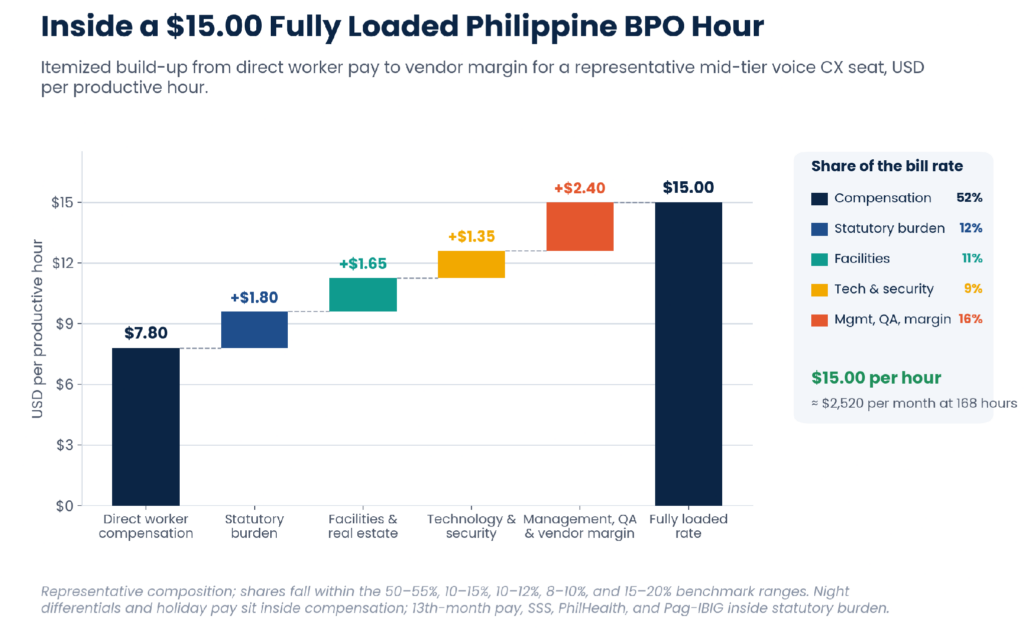
Figure 1. Itemized build-up of a representative fully loaded Philippine BPO hour, from direct worker pay to vendor margin (representative composition).
What Specific Expense Components Sit Inside an All-Inclusive Bill Rate?
A fully loaded BPO rate consolidates direct salary, mandatory government benefits, IT hardware and software, enterprise facilities, management supervision, and vendor margin into one predictable bill rate. Direct worker compensation is the single largest component; management, QA, and vendor margin form the next-largest block, with statutory burden, facilities, and technology and security accounting for the remainder.
Enterprise procurement teams evaluate five core cost drivers when reviewing vendor pricing. Figure 1 shows how they stack up inside a representative hourly rate; the table below lists what each category actually contains, which is the checklist buyers should use to test whether a quote is genuinely all-inclusive.
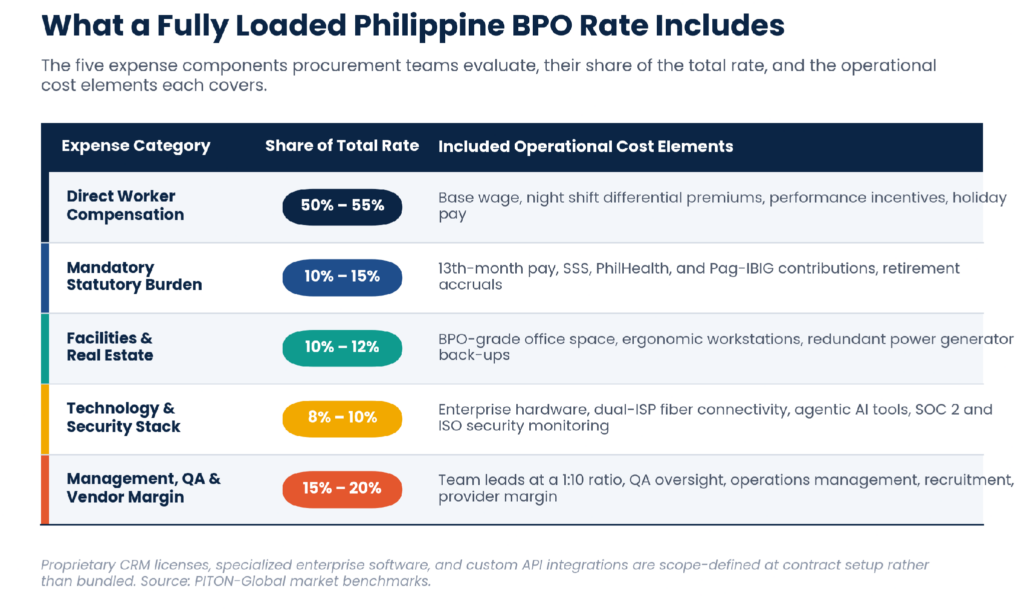
Figure 2. The five expense components of a fully loaded Philippine BPO rate, with their share of the total and the operational cost elements each includes.
Consolidating these expenses into an all-inclusive rate shields enterprise balance sheets from unexpected capital calls, real estate liabilities, and local HR administrative burdens. It also makes like-for-like comparison with onshore cost possible: a US onshore FTE carries the same five categories, but at a far higher fully loaded hourly cost, as the chart below shows.
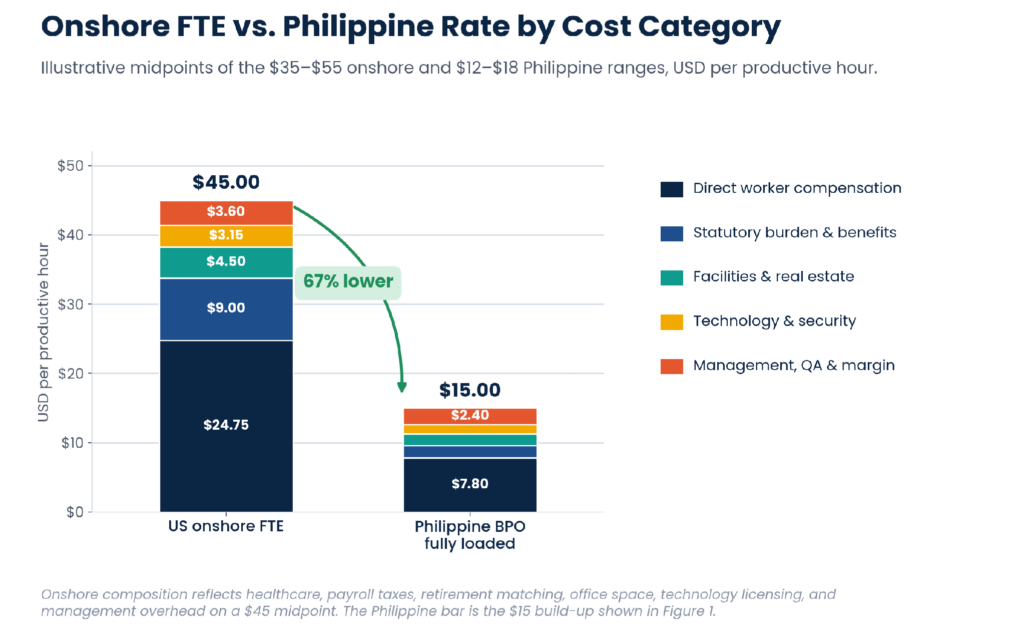
Figure 3. US onshore FTE cost versus Philippine fully loaded rate by cost category (illustrative midpoints, USD per hour).
How Do Fully Loaded Costs Vary Across Roles and Geographic Tiers in the Philippines?
Fully loaded costs scale with technical skill complexity, regulatory requirements, and delivery location. Tier-3 hubs such as Iloilo and Bacolod deliver back-office and chat support at the lowest fully loaded rates; Tier-2 hubs such as Cebu and Clark deliver voice CX and technical support at a modest premium; Tier-1 Metro Manila districts (BGC, Makati) deliver KPO, finance, and healthcare work at the top of the range.
Operating in Tier-1 Metro Manila districts provides dense pools of licensed professionals and specialized talent, while expanding into Tier-2 and Tier-3 provincial hubs offers lower operating structures and, typically, lower attrition. The hierarchy below maps delivery location to the functions each tier serves best and the fully loaded rate to expect.
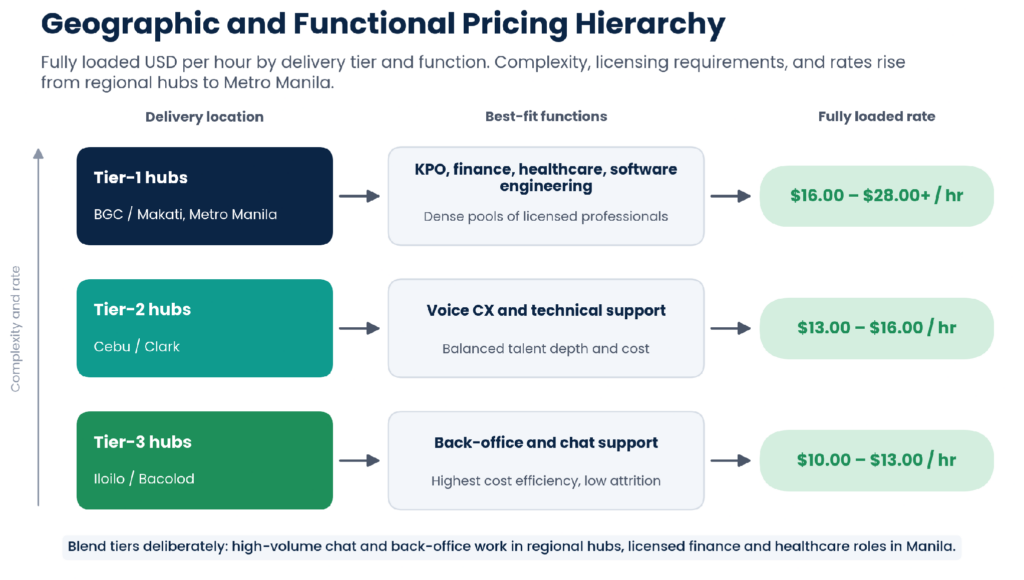
Figure 4. Geographic and functional pricing hierarchy: fully loaded USD per hour by delivery tier and function.
Transactional workflows leverage regional hubs for maximum cost efficiency, whereas complex compliance, financial processing, and software engineering benefit from Manila’s concentration of licensed professionals. Many enterprise programs blend tiers deliberately—placing high-volume chat and back-office work in Cebu or Iloilo and specialized finance or healthcare roles in Manila—to optimize the blended rate without compromising expertise where it matters. The same blending shows up in sector programs, from automotive support operations balancing cost and quality to food-delivery support run at scale.
What Are the Hidden Risks of Accepting Below-Market BPO Quotes?
Quotes priced well below the market band introduce statutory non-compliance penalties, elevated attrition, compromised security, and degraded service quality. They typically stretch team-leader ratios to 1:25 or higher against a 1:10 benchmark, omit 13th-month pay and SSS reserves, lack dual-ISP redundancy and endpoint security, and pay sub-market wages that push attrition to unsustainable levels.
Low-cost proposals usually compromise key operational controls rather than discovering efficiencies the market has missed. Each of the four compromises below shows up later as a cost the buyer pays, not the vendor.
Diluted Supervisory Ratios
Budget vendors stretch team leader spans of control to 1:25 or higher, versus the industry benchmark of 1:10, degrading quality control, coaching, and escalation handling. The saving on the rate card is a few cents per hour; the cost appears in first-contact resolution and customer satisfaction—the metrics a BPO performance-management framework is built to track.
Statutory Non-Compliance
Quotes below regional minimum-wage models often omit mandatory statutory reserves—13th-month pay, SSS, PhilHealth, and Pag-IBIG contributions—creating legal and operational risk. Non-compliance can surface as labor claims, provider instability, or surprise rate increases once the shortfall has to be funded.
Substandard Technology Infrastructure
Inexpensive quotes frequently lack dual-ISP fiber redundancy, endpoint security, and compliance monitoring, exposing operations to outages and data breaches. For regulated data the exposure is not just downtime; it is the cost of a breach and the loss of the certifications the buyer depends on.
Elevated Turnover Overhead
Sub-market compensation accelerates agent attrition to unsustainable levels, resulting in continuous retraining costs and inconsistent performance. Every percentage point of attrition above the market average is paid for in ramp time, quality dips, and management attention.
Evaluating an offshore partnership purely through the lens of baseline hourly rates is a fundamental miscalculation. True cost control stems from long-term operational continuity, high first-contact resolution rates, and partner retention metrics that safeguard your corporate reputation.
— John Maczynski, CEO, PITON-Global
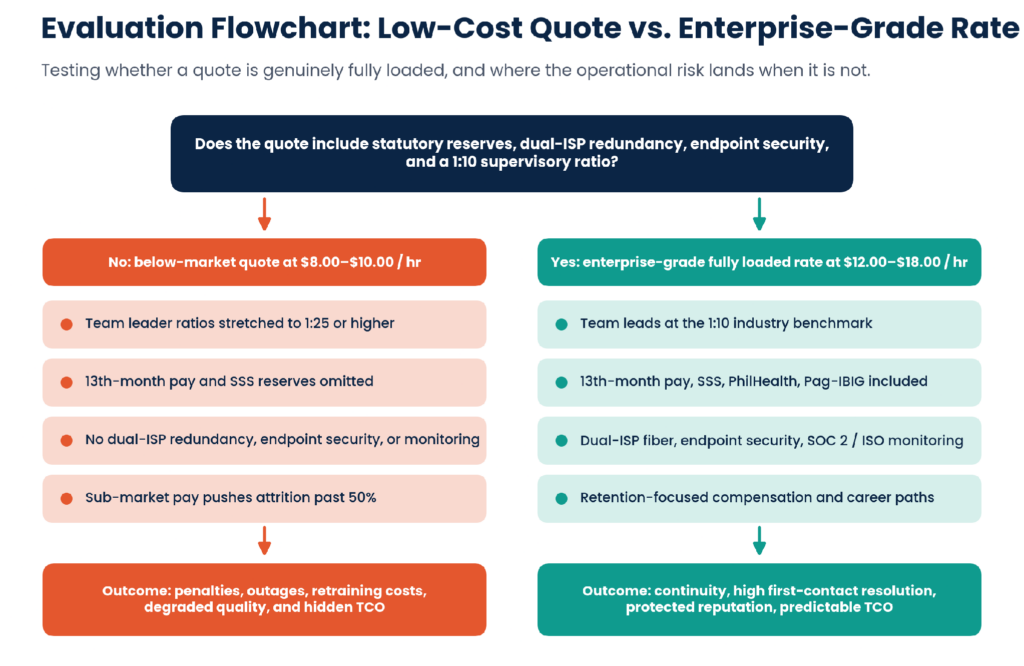
Figure 5. Strategic evaluation flowchart: the operational risks of low-cost quotes versus an enterprise-grade fully loaded vendor framework.
What Does a Transparent, All-Inclusive Contract Deliver in Practice?
A transparent fully loaded contract protects the buyer from surprise fees while guaranteeing security and performance. A fast-growing US healthtech firm moved patient billing to a 40-FTE Manila team under a fully loaded, HIPAA-compliant contract, cut operating expenses sharply, accelerated backlog processing at near-perfect accuracy, and reached payback within months.
Client Challenge
A fast-growing US healthtech firm experienced severe patient billing backlogs and rising support expenses. Onshore operational cost per FTE had climbed to a level that made 24/7 coverage prohibitively expensive and left backlogs growing overnight.
Vendor Selection
PITON-Global evaluated its network of vetted Philippine BPO operators to identify partners with active HIPAA certifications and specialized medical billing expertise, and scored candidates on the transparency of their fully loaded rate structure rather than on headline price.
Solution Implemented
PITON-Global matched the client with a Manila-based provider, deploying a dedicated 40-FTE team under a fully loaded contract covering HIPAA-compliant workspace, team leads at benchmark ratios, continuous QA, and secure redundant connectivity.
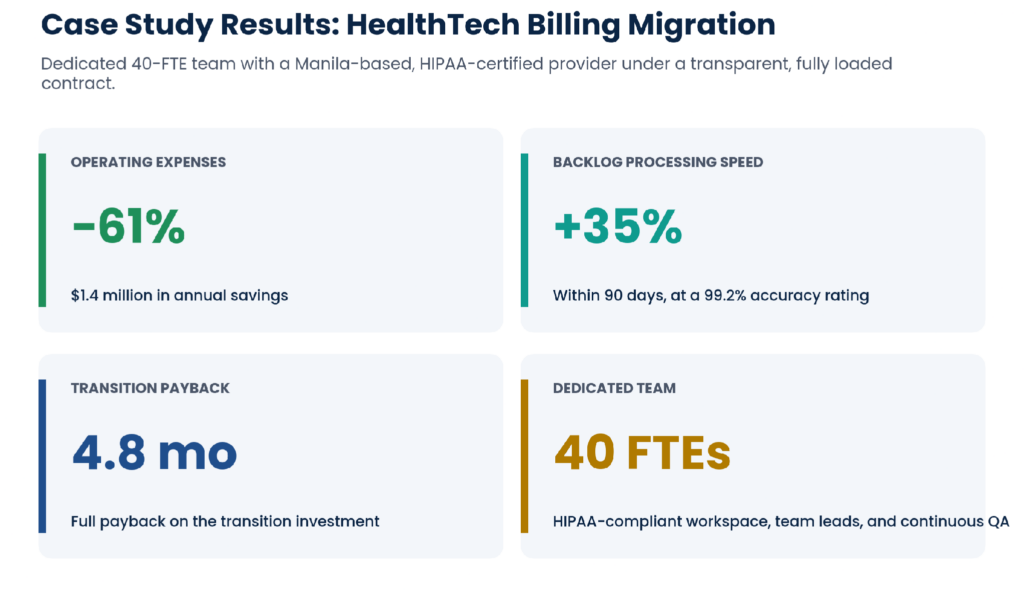
Figure 6. Quantifiable business outcomes of the healthtech billing migration.
Outcomes and Lessons
Operating expenses decreased sharply, generating substantial annual savings. Backlog processing accelerated within 90 days while maintaining near-perfect accuracy, and full transition payback was achieved within months. The lesson: securing a transparent, fully loaded rate structure protected the client from unexpected infrastructure fees while guaranteeing enterprise security and performance SLAs.
How Does PITON-Global Help Organizations Optimize BPO Investments?
PITON-Global optimizes BPO investments by providing independent advisory, vendor matching, and contract structuring without charging advisory fees to buyers. With a network of more than 100 vetted providers across the Philippines, it matches organizations with operators on operational maturity, technical alignment, and scale, analyzing cost structures, compliance profiles, and service capabilities to secure competitive fully loaded rates.
Who Is PITON-Global?
PITON-Global is a dedicated, vendor-neutral BPO advisory firm headquartered in Manila, led by senior operators with more than 65 combined years of global outsourcing governance. It simplifies vendor selection for executive teams navigating a market of more than 1,000 providers, bringing operator-level knowledge of what a Philippine bill rate should contain to every engagement.
How Does PITON-Global Differ from Traditional Outsourcing Brokers?
Traditional brokers earn commissions on placement and have every incentive to present the lowest headline rate. PITON-Global evaluates providers independently on operational maturity, technical alignment, and scale, decomposes every quote into its fully loaded components so buyers compare like for like, recommends on the buyer’s outcomes rather than provider promotion, and stays engaged through contracting and transition.
How Does PITON-Global’s Network of 100+ Vetted Philippine BPO Providers Benefit Organizations?
A network of more than 100 vetted call center and back-office providers across Manila, Cebu, Clark, and regional hubs lets organizations skip months of discovery. Every provider has already been assessed for statutory compliance, security certifications, supervisory ratios, retention performance, and rate transparency, so buyers are never exposed to a sub-market quote that omits mandatory costs.
How Does PITON-Global’s Advisory-Led Vendor Matching Process Work?
The process runs from cost-structure assessment to selection support: establishing the onshore baseline and the required functions, tiers, and compliance profile; filtering the vetted network for operational maturity, technical alignment, and scale; delivering a shortlist within 48–72 hours with rates normalized to a fully loaded basis; verifying statutory reserves, redundancy, supervisory ratios, and retention; then structuring the contract, SLAs, and the scope for licenses and integrations.
Why Do Organizations Use PITON-Global?
Organizations use PITON-Global to secure competitive, fully loaded rates, mitigate operational risk, and accelerate time-to-value. Because the advisory service carries no fee for the buyer, it adds an experienced operator’s view of what a rate must contain at the exact point where a below-market quote is most tempting.
Frequently Asked Questions
What is the average fully loaded monthly cost per FTE in the Philippines?
The fully loaded monthly cost per FTE for voice customer support and back-office roles sits in a predictable band, and higher-complexity functions in IT, finance, and healthcare run materially higher. The live figure for a specific function, headcount, and coverage pattern is modeled on our pricing page.
Does a fully loaded BPO rate include night differential and holiday pay?
Yes. A true fully loaded rate incorporates all local labor mandates, including night shift premiums, regular and special holiday pay, 13th-month pay, and government social contributions.
What is the difference between a direct hire captive model and a managed BPO fully loaded rate?
A direct hire captive model requires the enterprise to directly fund real estate, entity incorporation, IT infrastructure, and local administrative staff. A managed BPO rate consolidates these costs into a single hourly bill rate.
Are enterprise software licenses included in the fully loaded rate?
Basic hardware workstations, security monitoring tools, and core telephony are included. Proprietary CRM software, specialized enterprise software licenses, and custom API integrations are scope-defined during contract setup.
How do Philippine fully loaded rates compare with other offshore destinations?
Philippine fully loaded rates sit in the competitive band for offshore delivery while offering strong Western cultural affinity for voice CX, which makes the country cost-effective for enterprise voice and back-office operations. A side-by-side view of the leading destinations is modeled on our pricing page.