

On this page
- Key Takeaways
- What Drivers Directly Reduce Unit Transaction Costs in the Philippines?
- How Does Operational Flexibility Keep Unit Economics Stable Through Demand Swings?
- Why Is Workflow Standardization Necessary to Realize Full Savings?
- What Does Unit-Cost Optimization Look Like in Practice?
- How Does PITON-Global Eliminate Sourcing Risk and Optimize Unit Economics?
- Frequently Asked Questions
Outsourcing to the Philippines lowers cost per transaction through structural labor arbitrage, capital expenditure avoidance, process optimization, and human-in-the-loop AI integration. By converting fixed operational overhead into a single fully loaded hourly rate per agent—our open cost calculator models that rate live for any function and headcount—enterprise buyers lower unit transaction costs while increasing throughput and quality.
Key Takeaways
- Direct arbitrage savings: Capture a deep reduction in net operational spend without sacrificing service quality or technical compliance.
- CapEx elimination: Shift physical real estate, IT hardware, software licensing, and recruitment costs into flat, predictable operational expenses.
- AI-enhanced throughput and error reduction: Deploy “Pilot and Wingman” architectures that pair autonomous AI agents with specialists to lift transaction volume per FTE substantially, while standardized workflows governed by strict SLAs and ISO/SOC certifications lower friction costs, late penalties, and rework.
- Retention stability: Avoid hidden turnover expenses by tapping a mature 1.9-million-strong talent market with higher retention rates than onshore hubs.
What Drivers Directly Reduce Unit Transaction Costs in the Philippines?
Three drivers compress unit costs beyond wage arbitrage: fully loaded rate consolidation, which bundles payroll taxes, health coverage, office footprint, and supervisory overhead into one hourly seat rate; agentic AI integration, where AI Wingmen execute retrieval, validation, and system updates while human Pilots handle exceptions and judgment; and multi-shift utilization that processes transactions 24/7 during onshore off-hours without overtime premiums.
Direct labor wage differences provide immediate cost relief, but sustained reduction in cost per transaction requires structural operational efficiency. Specialized Philippine delivery centers leverage centralized scale to compress unit costs far beyond basic wage arbitrage.
Fully Loaded Rate Consolidation
In-house back-office operations absorb heavy indirect costs—payroll taxes, health coverage, office footprint, workstation licensing, and supervisory overhead. Philippine delivery models bundle these into a single hourly seat rate, drastically lowering unit costs. The comparison below maps a fully loaded onshore FTE and an all-inclusive Philippine seat against the transactions each produces.

Figure 1. Onshore internal FTE (fully loaded) versus Philippine BPO seat (all-inclusive) mapped against transaction output, with the resulting cost per transaction (illustrative).
Agentic AI Integration
Modern delivery in Manila uses AI Wingmen to execute data retrieval, validation, and system updates, while human Pilots handle exception handling and complex judgment calls. This Pilot and Wingman structure drastically expands transaction throughput per seat.
Multi-Shift Utilization
Round-the-clock operating schedules maximize capital asset efficiency, processing transactions during onshore off-hours without overtime premiums. A transaction that lands at 6 p.m. Eastern is processed overnight and returned before the onshore team logs in.
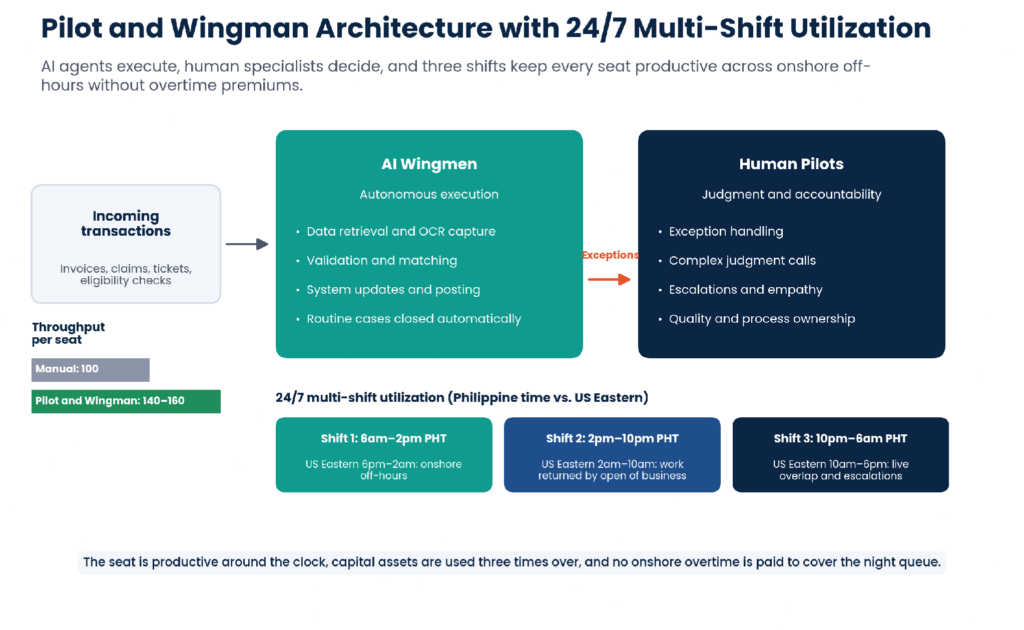
Figure 2. The Pilot and Wingman architecture with 24/7 multi-shift utilization: AI agents execute, human specialists decide, and three shifts keep the seat productive across onshore off-hours.
The combined effect shows up function by function. The table below sets average onshore unit costs against Philippine BPO unit costs for four high-volume transaction types, with the efficiency engine behind each reduction. Sector-specific variants of the same math—cost optimization in publishing operations, for example—follow the same pattern.
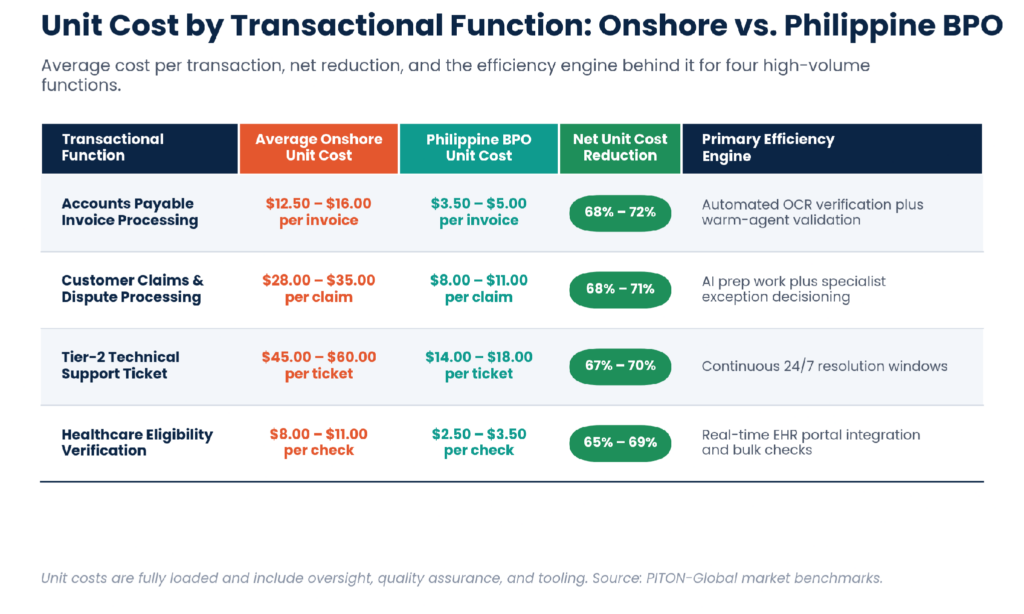
Figure 3. Average onshore versus Philippine BPO unit cost for four transactional functions, with net unit cost reduction and the primary efficiency engine.
How Does Operational Flexibility Keep Unit Economics Stable Through Demand Swings?
Internal back-office infrastructure carries fixed costs sized for peak volume, so during seasonal dips or market contractions cost per transaction escalates as fixed expenses spread across fewer transactions. Offshore partnerships replace that infrastructure with usage-matched models: seats scale seamlessly in high-volume periods without hardware or real estate outlays, and flex-capacity terms protect buyers from carrying idle overhead in lulls.
Maintaining internal back-office infrastructure forces organizations to carry fixed costs designed for peak volume. During seasonal dips or market contractions, cost per transaction escalates rapidly as fixed expenses are spread across fewer transactions.
Offshore partnerships replace fixed corporate infrastructure with flexible, usage-matched models. During high-volume periods, offshore teams scale seats seamlessly without requiring capital outlays for hardware or real estate; during lulls, flex-capacity terms protect buyers from carrying idle overhead. The chart below shows what that does to cost per transaction across peak and off-peak cycles.
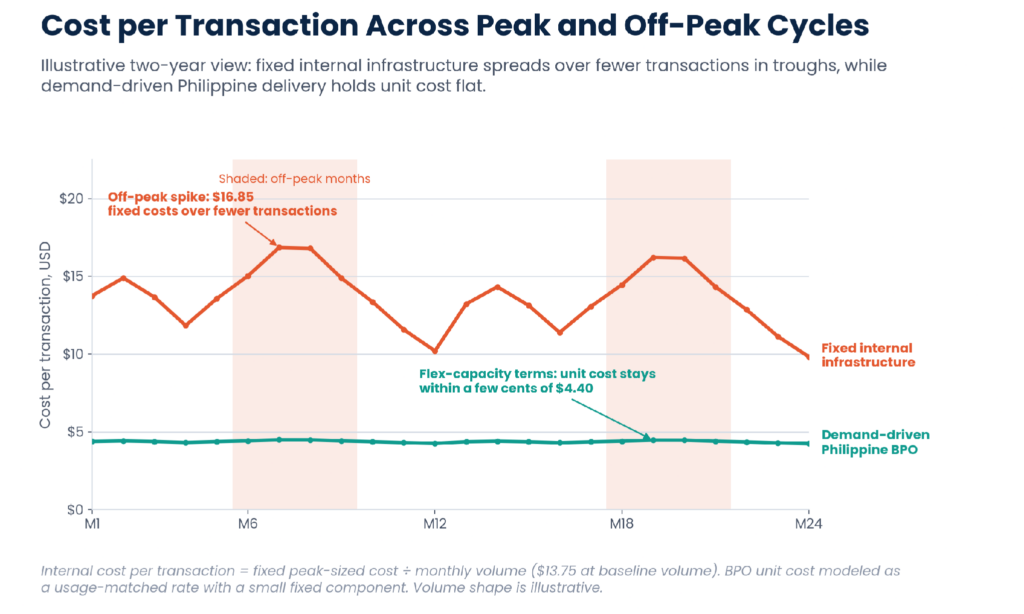
Figure 4. Cost per transaction under fixed internal infrastructure versus elastic, demand-driven Philippine BPO delivery across peak and off-peak cycles (illustrative).
Lowering transaction costs isn’t just about buying cheaper hours—it’s about deploying a smarter operational architecture. While AI handles raw execution speed, the cultural empathy, complex judgment, and accountability of the Filipino workforce solve the escalation layer. Combining agentic AI with domain-trained specialists drives unit costs down while elevating overall output quality.
— John Maczynski, CEO, PITON-Global
Why Is Workflow Standardization Necessary to Realize Full Savings?
Migrating unstandardized, manual workflows offshore replicates bottlenecks at a lower hourly rate. Philippine delivery teams audit existing operations with Process Definition Documents, streamlining handoffs, eliminating redundant data entry, and standardizing desktop environments before execution. Standardized workflows cut transactional error rates dramatically, and KPIs such as First Contact Resolution and Average Processing Time are tied to contractual SLAs.
Capturing maximum reduction in cost per transaction requires systematic workflow optimization prior to migration. By streamlining handoffs, eliminating redundant data entry steps, and standardizing desktop environments, providers eliminate waste before execution begins—and two disciplines keep it eliminated.
Friction Elimination
Standardized workflows cut transactional error rates dramatically, directly lowering the secondary cost of rework, customer churn, and compliance corrections. Every error avoided is a transaction that is paid for once rather than twice.
Contractual SLA Enforcement
Key performance indicators—First Contact Resolution and Average Processing Time among them—are tied directly to contractual SLAs, so processing speed and accuracy are governed by the agreement rather than by goodwill. Where a buyer wants to go further, outcome-based pricing models tie the invoice itself to those results.
What Does Unit-Cost Optimization Look Like in Practice?
Unit-cost optimization in practice combines standardization with automation. A mid-sized international logistics provider paying a high per-transaction cost across freight auditing and accounts payable, with a 30-day backlog and manual errors, deployed a dedicated 35-seat Manila team, cutting cost per transaction to a fraction of its former level, clearing the backlog in 60 days, and pushing error rates down to a negligible level.
Client Challenge
A mid-sized international logistics provider struggled with a high cost per transaction across freight auditing and accounts payable, driven by a 30-day processing backlog and manual data entry errors.
Vendor Selection
PITON-Global conducted an operational audit and matched the client with a specialized mid-sized Philippine BPO partner from its vetted network, selected for supply chain finance expertise and desktop automation capability.
Solution Implemented
A dedicated 35-seat team in Manila took over freight auditing, AP processing, and vendor communications using desktop automation and standardized validation workflows defined in a Process Definition Document audit before go-live.
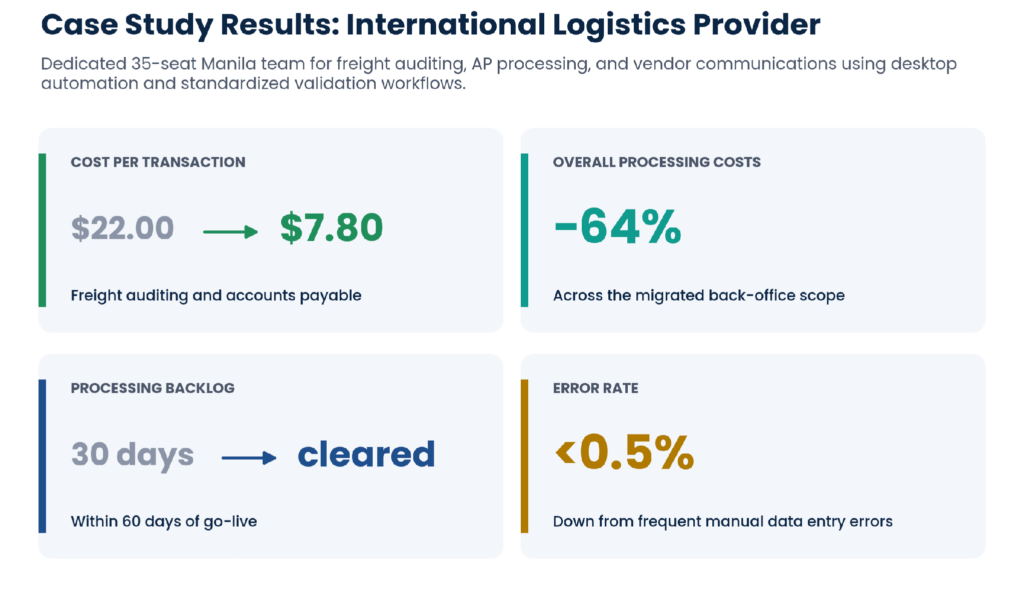
Figure 5. Quantifiable outcomes of the logistics provider’s unit-cost optimization.
Outcomes and Lessons
The client achieved a steep reduction in overall processing costs, dropping cost per transaction to a fraction of its former level, while clearing the 30-day backlog in 60 days and reducing error rates to a negligible level. The lesson: partnering with a specialized provider that implements workflow standardization delivers immediate cash-flow improvements that extend far beyond baseline labor savings.
How Does PITON-Global Eliminate Sourcing Risk and Optimize Unit Economics?
With more than 1,000 BPO companies in the Philippines, an ill-fitting provider means migration delays, service degradation, and cost overruns. PITON-Global is an independent BPO advisory consultancy led by executive operators that provides vendor-neutral advisory at no cost to buyers, evaluating candidates from a network of more than 100 vetted partners on operational metrics, compliance certifications, and vertical expertise.
Who Is PITON-Global?
PITON-Global is an independent, vendor-neutral BPO advisory and sourcing consultancy headquartered in Manila, led by executive operators with decades of global experience and more than 65 combined years of outsourcing governance. It guides enterprise buyers through partner selection in a market where finding the right delivery partner among more than 1,000 providers can be daunting.
How Does PITON-Global Differ from Traditional Outsourcing Brokers?
Traditional brokers promote preferred vendors and earn commissions on placement. PITON-Global evaluates candidate providers on objective operational metrics, compliance certifications, and specialized vertical expertise, recommends on the buyer’s unit economics rather than provider promotion, and stays engaged through SLA architecture and contract execution.
How Does PITON-Global’s Network of 100+ Vetted Philippine BPO Providers Benefit Organizations?
A network of more than 100 thoroughly vetted Philippine BPO partners, screened for the capabilities that actually move cost per transaction—standardized workflows, agentic AI tooling, 24/7 operating models, and vertical depth in finance, claims, IT support, and healthcare—lets buyers compare providers on unit economics rather than headline hourly rates.
How Does PITON-Global’s Advisory-Led Vendor Matching Process Work?
PITON-Global’s vendor vetting framework runs in five steps: an operational audit that establishes the current cost per transaction and its drivers; capability matching against the vetted network; a competitive RFP with unit-cost benchmarking; SLA architecture tying FCR, processing time, and accuracy to the agreement; and contract execution with flex-capacity and transition terms.
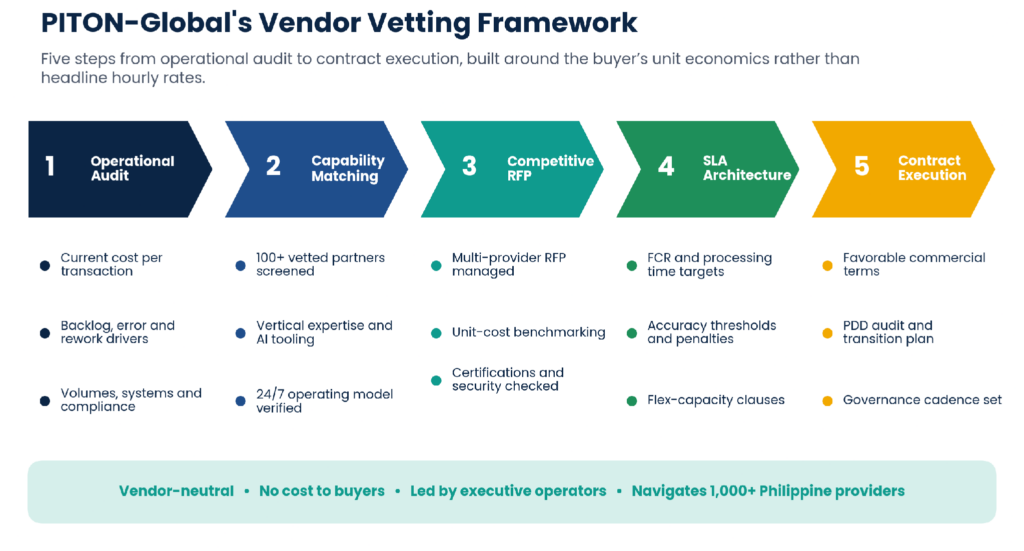
Figure 6. PITON-Global’s vendor vetting framework: operational audit, capability matching, competitive RFP, SLA architecture, and contract execution.
Why Do Organizations Use PITON-Global?
Organizations use PITON-Global to secure favorable commercial terms, robust SLAs, and sustainable unit-cost reductions without sourcing risk. Its advisory and matching services are completely free to enterprise buyers; the firm operates through standard industry advisory structures while remaining vendor-agnostic, advocating for the buyer’s operational and financial interests.
Frequently Asked Questions
What back-office functions offer the fastest reduction in cost per transaction?
High-volume transactional functions such as Accounts Payable, Accounts Receivable, claims processing, and Tier-1/2 IT support deliver the fastest returns. These standardized processes allow rapid migration and typically reach positive ROI within 60 to 90 days; on the front-office side, the ROI businesses can expect from Philippine call center services follows the same logic.
How do Philippine BPO providers maintain data security during transactional processing?
Top-tier Philippine providers maintain SOC 1/2/3, ISO 27001, PCI DSS, and HIPAA certifications. Operations run in clean-desk environments equipped with encrypted VPNs, multi-factor authentication, and strict data loss prevention controls.
Will outsourcing back-office transactions negatively affect quality or accuracy?
No. Quality often improves because specialized offshore teams focus entirely on transactional processing as a core competency. Operations run under strict SLA benchmarks, real-time quality monitoring, and automated performance tracking.
How long does it take to transition transactional processes to a Philippine BPO?
A standard migration takes between 6 and 12 weeks, depending on process complexity. This covers workflow mapping, system integration, agent training, shadow operations, and final operational sign-off.
How does PITON-Global offer vendor-neutral advisory services at no cost to buyers?
PITON-Global’s advisory and matching services are completely free to enterprise buyers. The firm operates through standard industry advisory structures while remaining vendor-agnostic, advocating for the buyer’s operational and financial interests.