

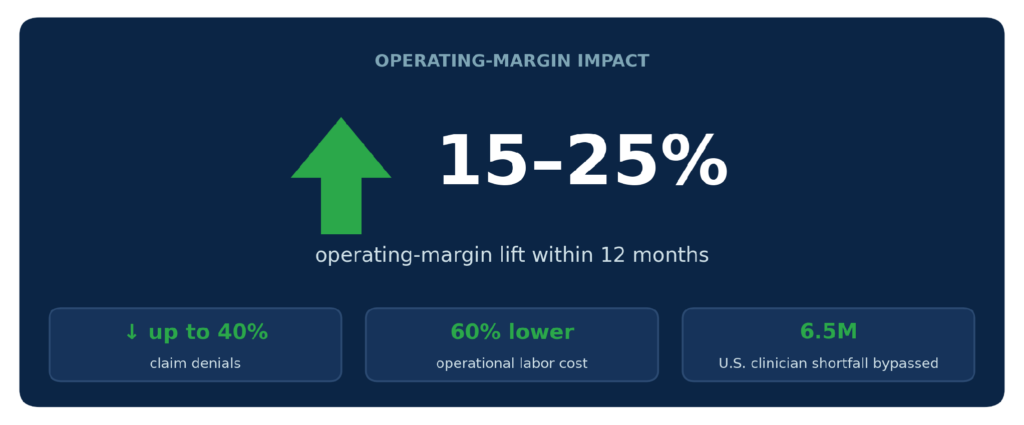
Strategic integration of Philippine-based healthcare BPO providers can materially improve hospital operating margins within 12 months. The gains come from shifting to an “intelligence-augmented” model that uses specialized Filipino clinical talent to validate AI-driven coding, cut claim denials sharply, and eliminate the compounding costs of domestic staff turnover, the core promise of denial-focused revenue-cycle outsourcing for hospitals.
Key Takeaways
- Clinical intelligence vs. volume: Use Filipino nurses and coders as a human-in-the-loop audit layer for the complex minority of cases AI cannot resolve—not just for headcount savings.
- Results-based commercials: Shift contracts from billable hours to performance-tied outcomes (net revenue improvement, denial reduction) so vendors fix the root causes of data errors.
- The “zero-touch” benchmark: Track Zero-Touch Throughput—interactions resolved without manual rework—as the primary KPI for operational health.
- Mitigating the talent cliff: Tap the Philippines’ deep pool of licensed clinical professionals to bypass the projected 6.5 million-professional U.S. healthcare shortfall.
- Risk-adjusted scaling: Prioritize mid-market specialists over big-box generalists for executive-level attention and greater regulatory agility.
How Does the “Intelligence-Augmented” Model Outperform Traditional Outsourcing?
Traditional volume-focused BPO creates an “efficiency paradox”: automating inaccurate claims simply generates denials faster. The intelligence-augmented model puts Filipino clinical specialists over the AI as a real-time governance layer—auditing coding and denials to build a high-fidelity trust layer that shortens revenue cycles.
In 2026, healthcare operations are squeezed between rising administrative complexity and shrinking domestic labor. Traditional BPO models answer with staffing volume and automation, but if the underlying claims are inaccurate, faster processing just means faster denials—the efficiency paradox. Reversing it requires judgment, not just throughput.
The intelligence-augmented model adds that judgment. Filipino clinical specialists—licensed nurses and certified coders—act as a governance layer over agentic AI, auditing automated coding and denial management in real time. The two models diverge sharply on the metrics that drive margin.
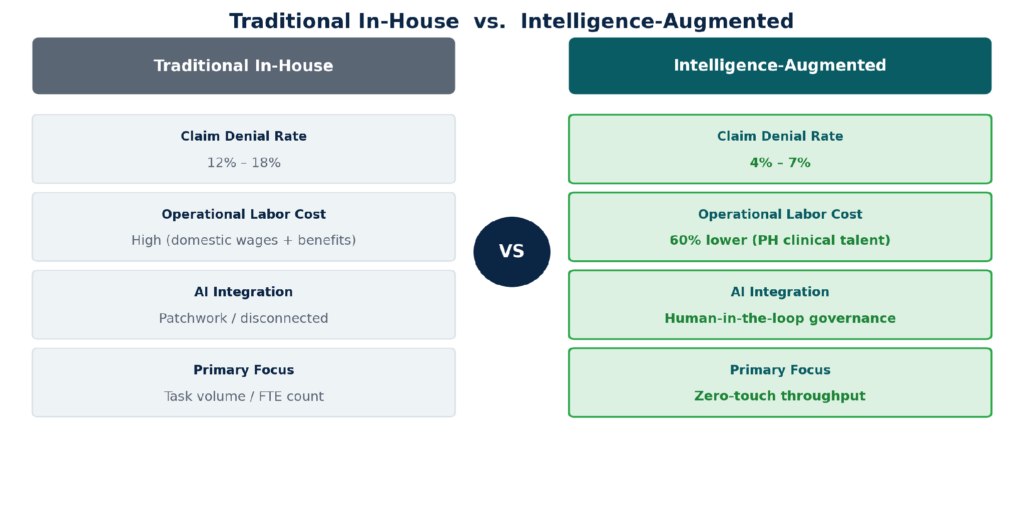
Figure 1. Traditional in-house versus the intelligence-augmented model across four operational metrics.
Viewed as a capability profile, the contrast is even clearer: the intelligence-augmented model extends outward on every dimension that protects revenue integrity.
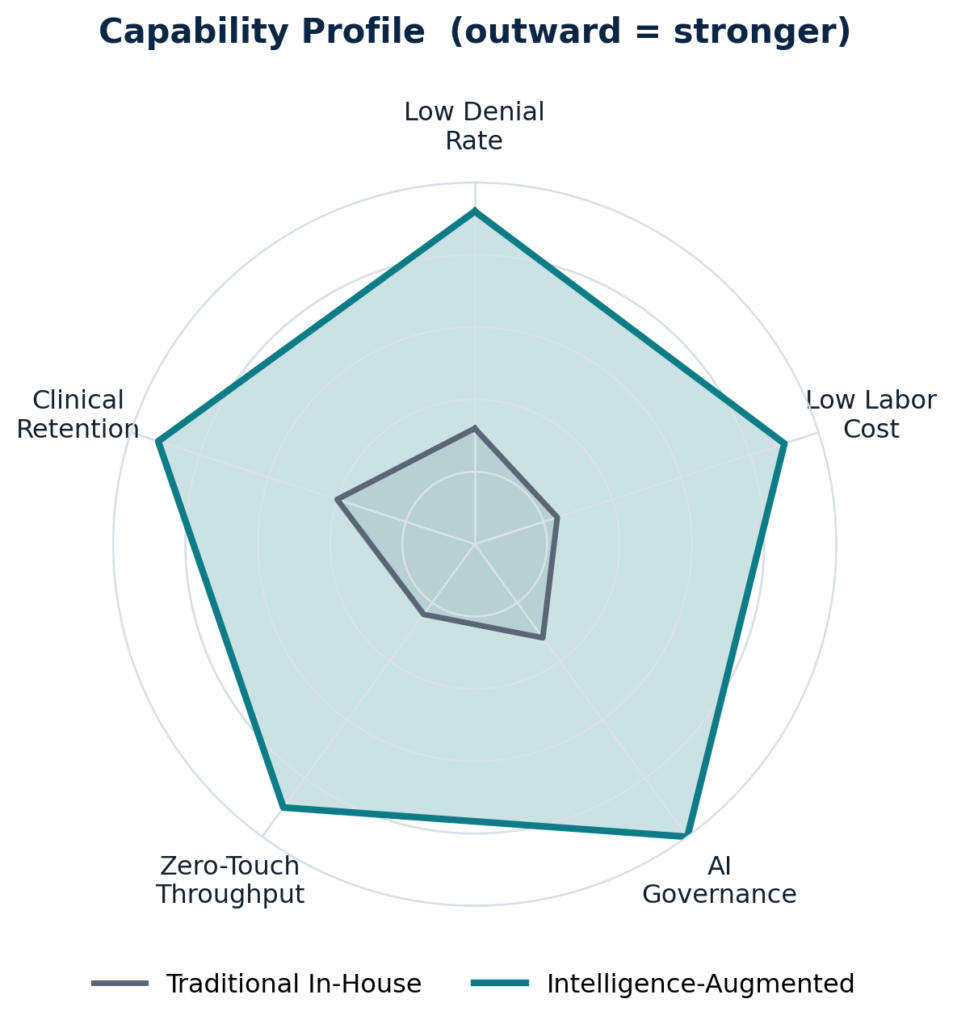
Figure 2. Capability profile: the intelligence-augmented model is stronger on every margin-relevant axis.
What Financial Benchmarks Should Executives Demand From Partners?
Replace cost-per-hour contracts—which punish hospitals for vendor efficiency—with outcome-based agreements. Within 90 days, a high-performing partner should measurably improve first-pass clean-claim rates, cut technical denials through upstream validation, and keep annual clinical turnover low.
Legacy cost-per-hour contracts quietly work against the hospital: the more efficient the vendor becomes, the less it bills, which removes the incentive to fix root-cause errors. Outcome-based agreements realign that relationship around the bottom line. The benchmarks below are the targets a serious partner should commit to hitting within the first 90 days, and they belong alongside the financial assumptions in your business case.

Figure 3. The 90-day performance benchmarks executives should write into outcome-based contracts.
“The single biggest failure I’ve witnessed over 25 years is the attempt to ‘set and forget’ automation in clinical environments. True leaders are those who shift the commercial relationship from ‘hours worked’ to ‘outcomes achieved,’ effectively turning the BPO partner into a stakeholder in your financial health. You aren’t just buying labor; you are buying revenue cycle stability.” — John Maczynski, CEO of PITON-Global.
What Do Real-World Results Look Like?
A U.S. regional health system with a high denial rate and severe RCM attrition—millions in annual leakage—deployed an “Agentic Shield” with Filipino clinical experts auditing its AI coding tools. Denials fell sharply within 120 days, turnover stabilized, and the system reclaimed a large share of that leakage in year one.
The system was losing millions of dollars a year to a high denial rate and heavy attrition in its revenue-cycle department. PITON-Global identified a specialized mid-sized Philippine provider that placed clinical experts as an audit layer over the hospital’s existing AI coding tools—an “Agentic Shield” that validates output before submission.
As audited clinical hours scaled, the denial rate fell and then flattened—reaching an inflection point where operating margins stabilized. The relationship between rising audit coverage and falling denials is the clearest signal of a healthy revenue cycle.

Figure 4. As outsourced clinical audit scales, denials fall steeply and margins stabilize around month four.
How Can Organizations De-Risk the Selection Process?
Avoid the “double penalty”: a global giant too large to prioritize your program, or a provider too small to carry the compliance load. The safe zone is a mid-market specialist with the right scale and executive-level attention—validated through a capability audit, a scalability check, and attention-alignment.
Provider selection fails in two opposite ways. Choose a big-box giant and your program is deprioritized whenever enterprise-wide surges hit; choose a provider that is too small and it cannot carry the HITRUST- and ISO-grade compliance load. A simple positioning view shows where the safe zone sits.

Figure 5. The “double penalty” matrix: the sweet spot is a mid-market specialist with scale and focus.
In practice, a three-step framework keeps selection disciplined: a capability audit (HITRUST/ISO compliance and AI maturity), a scalability check (can the partner grow with you), and executive-attention alignment (will your program command senior focus). Together they steer organizations toward the upper-right quadrant and away from both penalties, the same mid-market logic behind the competitive advantages health systems can build.
How Does PITON-Global Help Health Systems Capture Margin?
PITON-Global is a vendor-neutral BPO advisory firm funded by its network of 100+ vetted mid-sized Philippine providers, so advisory is free to the client. It maps provider capabilities—AI maturity and regulatory posture—against a hospital’s needs through a rigorous, competitive RFP that ensures executive-level fit.
Who Is PITON-Global?
PITON-Global is a vendor-neutral BPO advisory firm that simplifies the search for high-performance healthcare partners. It maintains a curated network of more than 100 vetted mid-sized Philippine providers and maps their capabilities—such as AI logic maturity and regulatory posture—against a hospital’s specific operational needs.
How Does PITON-Global Differ From Traditional Outsourcing Brokers?
Unlike traditional brokers, PITON-Global is funded by its provider network, which means its advisory services are at no cost to the client. That model removes the commission-driven incentive to push a particular vendor and keeps the focus on executive-level fit, regulatory posture, and the hospital’s margin—not on the highest-paying placement.
How Does a Network of 100+ Vetted Philippine BPO Providers Benefit Organizations?
The network is composed of mid-sized providers vetted specifically for healthcare-grade compliance and AI maturity—the segment most likely to deliver both capacity and executive attention. Because candidates are pre-screened, hospitals can run a competitive comparison quickly and avoid both sides of the “double penalty.”
How Does PITON-Global’s Advisory-Led Vendor Matching Process Work?
PITON-Global maps requirements and compliance scope, matches providers on AI maturity and regulatory posture, runs a rigorous competitive RFP, guides an executive-fit selection, and governs a de-risked 90–120-day transition. The cycle is designed to ensure the chosen partner is scaled and specialized for the hospital’s exact needs.
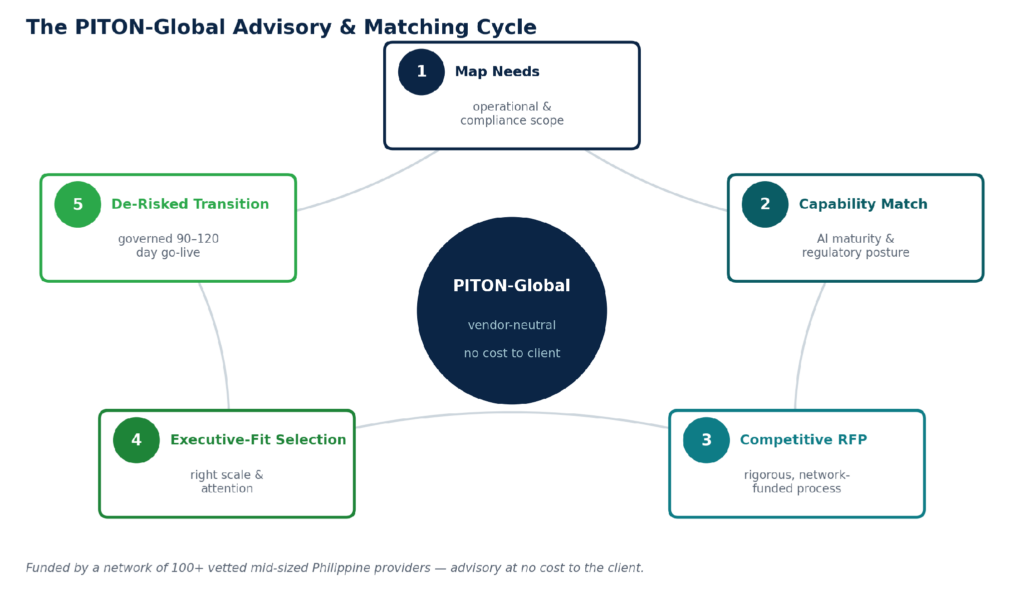
Figure 6. PITON-Global’s advisory and matching cycle, from mapping needs to a de-risked transition.
Why Do Organizations Use PITON-Global?
Organizations use PITON-Global to de-risk selection and accelerate the transition while protecting margin. Its competitive, network-funded RFP process maps capabilities against operational needs, ensures executive-level fit, and removes the evaluation burden—helping health systems reach a high-performing, intelligence-augmented partnership at no advisory cost.
What Else Should Executives Know About Philippine Healthcare BPO?
Common questions cover HIPAA compliance, the depth of clinical expertise, time-zone coverage, why zero-touch throughput matters, and transition length. In short: leading providers run HITRUST-certified environments, employ licensed clinicians for complex work, operate 24/7 for follow-the-sun throughput, and reach stable production in 90–120 days.
How do Philippine providers ensure HIPAA compliance?
Leading providers use HITRUST CSF-certified environments, forensic audit trails for all AI-automated outputs, and dedicated HIPAA Security Officers to manage data governance.
Is Philippine healthcare expertise limited to simple data entry?
No. The country is a clinical-intelligence hub with over 200,000 licensed clinical professionals performing complex medical coding, utilization review, and clinical audit work, as well as patient-facing roles such as pharma patient-journey support.
How does this model handle time-zone differences?
Philippine teams operate 24/7. Aligning shifts with U.S. hours delivers follow-the-sun throughput, so claims are processed and ready by the start of the domestic workday.
Why is zero-touch throughput important?
It measures automation quality. A vendor processing high volumes without fixing underlying data errors is masking systemic issues rather than increasing margin.
How long does the transition to a Philippine partner take?
With a structured, advisory-led implementation, most organizations reach stable production within 90 to 120 days.