

The biggest hidden costs come from “fit-gap” attrition, misaligned management overhead, and clinical-accuracy degradation. Hospital CEOs should favor specialized, domain-native providers over low-cost generalists to avoid the hidden tax of claim rework, high turnover, and operational volatility—costs that frequently exceed the initial labor savings. The benchmark is what a specialized healthcare outsourcing program should include: HIPAA-trained staff, certified coders, and denial-focused revenue-cycle work.
Key Takeaways
- Operational risk vs. labor arbitrage: Generalist BPO models often trade clinical accuracy for volume, creating unbudgeted internal costs for denial management and claims rework.
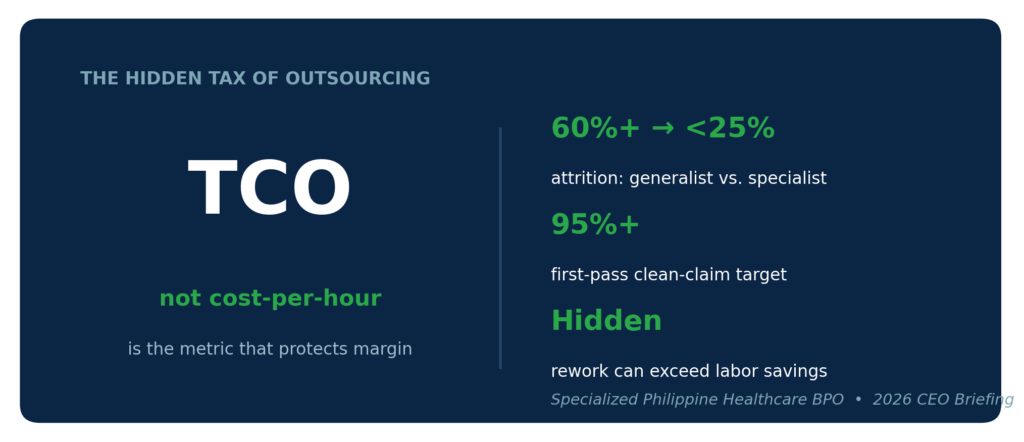
- The “specialization premium”: Specialized healthcare providers show much lower attrition than generalists, protecting the institutional knowledge of your revenue cycle.
- Total-cost-of-ownership metrics: Look past hourly rates to first-pass clean-claim rates and management-to-agent ratios to find true ROI.
- Governance as strategy: Avoid the “oversight trap,” where leadership spends more time managing vendor incompetence than advancing patient-care initiatives.
- Entity alignment: Choose partners whose frameworks—HIPAA, SOC 2, clinical-coding standards—mirror your internal compliance and quality-assurance protocols.
Why Do “All-In” Hourly Rates Often Mask Downstream Operational Liabilities?
Because cost-per-hour ignores what happens after the claim leaves Manila. If a vendor lacks clinical domain expertise, your internal team becomes the second layer of quality control—correcting denials, absorbing rework, and managing constant ramp-up. Those downstream costs can erase the entire labor-arbitrage saving.
Hospital systems habitually evaluate outsourcing on a single “cost-per-hour” figure, which is a dangerous simplification in a clinical setting. Headline rates routinely mask significant downstream liabilities. When a provider misses a high first-pass clean-claim target, your internal revenue-cycle staff must pivot to correcting denials—a cost that completely negates the labor arbitrage achieved offshore.
High-attrition generalists compound the problem by forcing you into a permanent state of training and ramp-up, consuming the executive bandwidth that should be focused on patient care. The most useful way to see this dynamic is as an iceberg: the hourly rate is the visible tip, while the larger mass of cost sits below the waterline. Workforce stability is the lever underneath, which is why evaluating a provider’s labor cost stability belongs in every shortlist review.

Figure 1. The visible hourly rate is dwarfed by submerged operational and opportunity costs.
Broken out by category, the hidden costs map to four recurring risks—each with a direct line to hospital margin. Infrastructure, compliance, and governance line items add a second register, covered in our breakdown of commonly overlooked cost categories.

Figure 2. A hidden-cost register: where headline rates quietly erode margin, ranked by severity.
How Does “Structural Misalignment” Impact Long-Term ROI?
Scale cuts both ways. A 50-seat program is a flagship relationship for a specialized boutique—earning executive attention—but a minor line item for a big-box generalist that may deprioritize you during enterprise-wide surges. Misalignment shifts risk onto your revenue cycle, not off it.
A 50-seat hospital revenue-cycle program means very different things to different providers. To a specialized boutique, it is a flagship account that commands executive-level attention; to a multi-vertical giant, it can be deprioritized whenever enterprise-wide seasonal surges or talent shortages hit. Specialized providers embed your governance protocols into their architectural DNA, functioning as a natural extension of your team rather than a separate entity requiring constant correction. That embedded model is what a modern healthcare back-office operation looks like in practice.
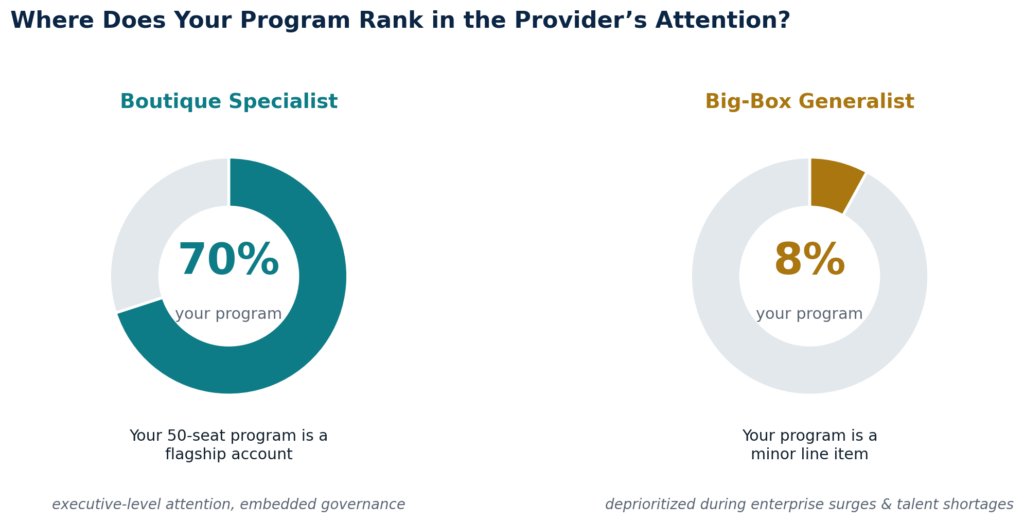
Figure 3. The same program can be a flagship account or a rounding error, depending on provider fit.
“The most successful healthcare outsourcing engagements are not those that chase the lowest cost-per-hour, but those that achieve the lowest total cost of ownership. When you choose a partner that isn’t a structural fit, you aren’t saving money—you are simply shifting your operational risks from your payroll to your vendor’s P&L, often with disastrous results for claim velocity.” — John Maczynski, CEO, PITON-Global.
What Do Real-World Results Look Like?
A regional U.S. health system with a high denial rate and severe annual turnover at a big-box generalist migrated to a boutique provider specializing in medical coding. Within 90 days, denials fell sharply, the first-pass clean-claim rate reached target, and the hidden cost of internal rework vanished.
The system’s original partner—a massive, multi-vertical BPO—treated medical-record coding as generic data entry. The result was chronic annual turnover and persistent coding errors that created a backlog deferring millions in revenue. PITON-Global audited the requirement and migrated the client to a boutique Philippine provider specializing exclusively in medical coding and clinical documentation.
The transformation was both fast and measurable, and it reframed the relationship from cost arbitrage to clinical alignment. The clearest lesson: domain-specific expertise is the single strongest indicator of long-term partnership success.
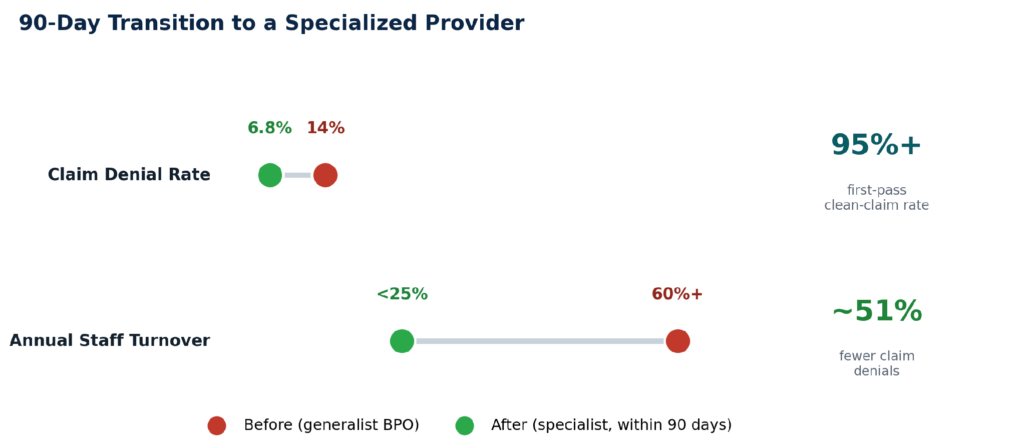
Figure 4. Before-and-after metrics after migrating from a generalist to a specialized coding provider.
How Does PITON-Global Help CEOs Avoid These Hidden Costs?
PITON-Global is a strategic advisor that bridges hospital requirements and Philippine operational realities. It curates 100+ specialized providers—deliberately excluding generalist giants—and uses advisory-led matching plus a rigorous audit framework to ensure the first partner you choose is the right one.
Who Is PITON-Global?
PITON-Global is a strategic advisory firm for hospitals modernizing operations through Philippine-based outsourcing. It has curated a network of more than 100 specialized Philippine BPO providers and works to bridge the gap between a hospital’s clinical requirements and the operational realities of the offshore market—so leaders can bypass the costly “trial and error” phase of vendor selection.
How Does PITON-Global Differ From Traditional Outsourcing Brokers?
Rather than pushing the generalist giants that create structural mismatch, PITON-Global deliberately excludes them from its network. It operates as a strategic advisor focused on fit and total cost of ownership, not on placing whichever vendor offers the lowest headline rate—keeping its guidance aligned with the hospital’s long-term outcomes.
How Does a Network of 100+ Vetted Philippine BPO Providers Benefit Organizations?
The curated network gives hospitals direct access to specialized, domain-native providers that have already been screened for clinical expertise, security, and operational stability. Because the generalists most likely to cause misalignment are filtered out, organizations reach qualified, well-matched candidates faster—and avoid the hidden costs of a poor structural fit.
How Does PITON-Global’s Advisory-Led Vendor Matching Process Work?
PITON-Global deconstructs the hospital’s clinical workflows and quality-assurance standards, then matches them to a provider that mirrors those standards. Its audit framework reviews physical security, redundant connectivity, and—crucially—the provider’s clinical training methodology. The five-stage process moves from requirements through a clinical audit to a parallel-processed transition.

Figure 5. PITON-Global’s five-stage vetting process, from requirements to a parallel-processed transition.
Why Do Organizations Use PITON-Global?
Organizations use PITON-Global to bypass the trial-and-error phase of outsourcing and ensure the first partner chosen is the right one for long-term transformation. By matching hospitals to domain-native providers that mirror their quality-assurance standards, PITON-Global reduces selection risk, protects margin, and shortens the path to a stable, high-performing revenue cycle.
What Else Should Hospital CEOs Know Before Selecting a Provider?
Common questions cover verifying clinical expertise, whether small BPOs are secure, the standard phase-in period, protecting patient data, and audit cadence. In short: ask for clinical training syllabi and sub-specialty case studies, expect a 60–90-day phased transition, require VDI with no local PHI storage, and govern quarterly.
How do I verify a BPO’s clinical domain expertise?
Request their specific clinical training syllabus and ask for case studies within your exact medical sub-specialty—generic references are a red flag.
Are small BPOs less secure than large ones?
No. Many “hidden champion” boutique BPOs in the Philippines hold superior HIPAA and SOC 2 Type II certifications compared with legacy giants.
What is the standard “phase-in” period for hospital BPO transitions?
Typically 60 to 90 days, which allows for rigorous parallel processing to confirm accuracy before full operational cutover.
How do I protect patient data during the transition?
Require Virtual Desktop Infrastructure (VDI) and strictly prohibit local PHI storage, ensuring compliance with global healthcare standards.
How often should we audit our Philippine provider?
High-performance healthcare programs warrant quarterly performance governance and annual security and compliance audits to stay proactive.