
The strongest outcomes come from a hybrid, high-visibility governance structure that pairs centralized U.S. clinical and compliance oversight with a localized Philippine Command Center. Enforcing clear role demarcation, programmatic workflow auditing, and a joint operating committee preserves data sovereignty while driving down denial rates and accelerating the revenue cycle.
Key Takeaways
- Centralized oversight, local execution: Retain final medical and compliance authority in the U.S. while a dedicated Philippine leadership tier runs daily operations.
- Structured role demarcation: Clearly separate data-intensive administrative work offshore from high-risk clinical decisions and final payer arbitration.
- Outcome-driven tiered KPIs: Shift from headcount SLAs to value metrics like first-pass clean-claim rate and clinical-document turnaround.
- Embedded compliance cascades: Enforce HITRUST-aligned data sovereignty through secure VDI where PHI never leaves the encrypted cloud.
- Visibility over arms-length control: Real-time queue visibility lets leaders catch pattern-based denials before they compound.
Why Does Traditional Vendor Management Fail in High-Stakes Healthcare Offshoring?
Generalist BPO management relies on headcount and basic SLAs — fine for retail support, but it collapses under healthcare’s regulatory and revenue-cycle complexity. Treating a specialized offshore team as an isolated vendor silo, rather than a native operational extension, surfaces visibility, training, and compliance failures that directly hit cash flow.
In healthcare operations, a single misassigned ICD-10 modifier or a delayed prior-authorization filing immediately affects cash flow and compliance exposure. An arms-length model creates three recurring friction points that compound over time.
- The “black box” effect: without real-time visibility into the offshore queue, internal leaders cannot spot pattern-based denials before they multiply.
- Syllabus disconnect: generic training fails to capture the nuances of specific U.S. commercial-payer behaviors and local Medicaid rules.
- Compliance drift: without continuous auditing, offshore data-security practices quietly diverge from domestic frameworks.
Capturing the substantial 62–73% cost reduction the Philippine talent ecosystem offers — without importing operational risk — requires an integrated governance architecture rather than a transactional contract.
How Is an Effective Hybrid Governance Model Structured?
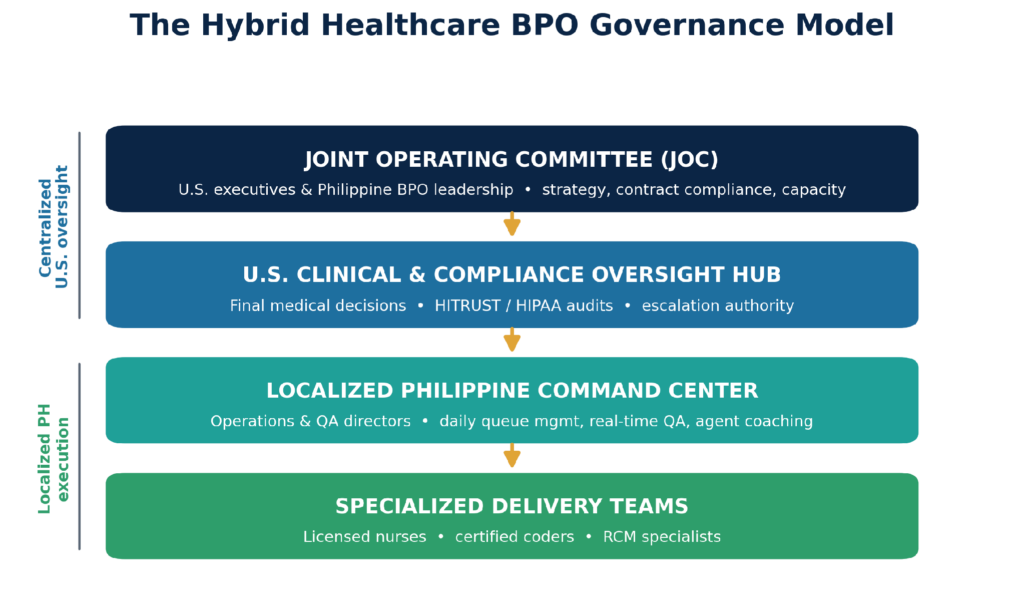
The most resilient structure splits responsibility into four tactical tiers: a Joint Operating Committee for strategy, a U.S. Clinical & Compliance Oversight Hub for final authority, a localized Philippine Command Center for daily execution, and specialized delivery teams. Clear lines run from the executive suite to the production floor.
The Joint Operating Committee (JOC)
Operating at the executive level, this bi-weekly or monthly forum aligns the health system’s C-suite (CFO, COO) with the BPO partner’s leadership. It focuses on macro-metrics, capacity planning, contract compliance, and systemic operational friction.
The U.S. Clinical and Compliance Oversight Hub
This internal team retains absolute authority over high-risk workflows, serving as the final escalation point for complex clinical judgment, medical-necessity determinations, and formal compliance interpretations.
The Localized Philippine Command Center
Led by an on-site Program Director and dedicated QA managers within the Philippine BPO, this hub oversees daily queue execution, real-time performance coaching, and frontline adherence to standard operating procedures.
What Performance Metrics and KPIs Should Govern the Partnership?
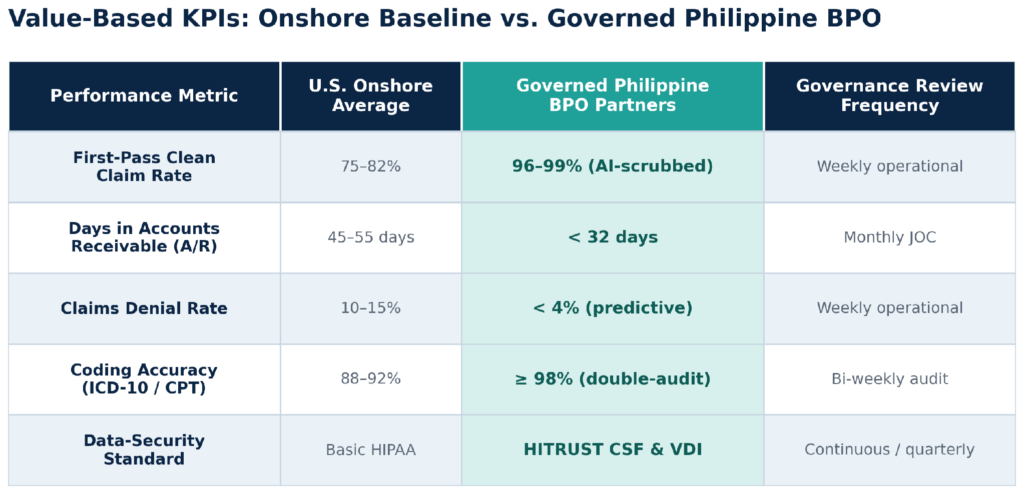
Governance should run on value-based benchmarks, not volume. Properly governed Philippine teams reach 96–99% first-pass clean-claim rates, under 32 Days in A/R, denial rates below 4%, and ≥98% coding accuracy — each tied to a defined review cadence from weekly operational huddles to the monthly JOC.
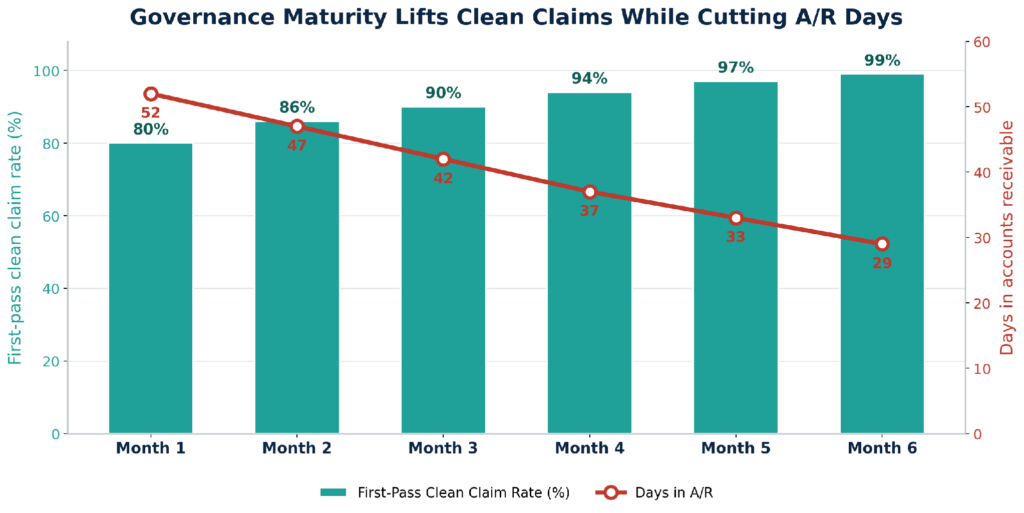
These gains are not switched on overnight; they accrue as governance matures. Across a typical six-month ramp, clean-claim rates climb while Days in A/R compress in lockstep — the visible signature of a well-run program.
How Do Enterprise Health Systems Ensure Uncompromising Data Sovereignty?
Build security into the technical environment, not onto it. A governed framework mandates a zero-footprint VDI where PHI is processable but impossible to extract or retain locally, physical clean-room floors with biometric access and no devices, and continuous automated auditing that intercepts anomalous data movement in real time.
Control is never lost when work moves offshore — it is lost when visibility is low. The strongest partnerships succeed because they don’t treat data security as a checklist. They engineer a zero-trust architecture where patient data is accessible for processing but structurally impossible to extract, clone, or retain locally. — John Maczynski, CEO, PITON-Global
Three Architectural Guardrails
- Zero-footprint VDI: all coding, billing, and documentation occur in a secure encrypted private cloud; no data resides on local Philippine endpoints.
- Physical clean-room floors: biometric access, total prohibition of personal recording devices, and endpoints that disable external storage and printing.
- Continuous automated auditing: real-time screen recording, DLP software, and behavioral analytics flag and intercept anomalous data movement instantly.
What Results Can a Health System Expect from Structured Governance?
A multi-state MSO stuck at a 16% denial rate and 52 Days in A/R cut denials below 3.5% and compressed A/R to 29 days within five months under a structured governance framework — lifting net collections 4.2% and reducing administrative overhead 48%.
The Challenge
A multi-state U.S. healthcare management organization faced an escalating 16% claims-denial rate and a prior-authorization bottleneck that drove Days in A/R above 52. Domestic recruitment constraints left its internal billing team understaffed against changing commercial-payer policies.
The Solution
The MSO engaged PITON-Global to bypass unguided vendor sourcing. From its network of more than 100 vetted providers, PITON-Global ran a specialized audit and, within nine days, presented a shortlist of three HITRUST-certified, specialty-aligned mid-market providers. The chosen partner deployed a dedicated 40-person RCM team on a phased 90-day plan — starting with low-risk eligibility verification before scaling to complex coding and denial management — integrating a Philippine Command Center with the client’s compliance hub via a joint operating committee and a zero-footprint VDI.
The Outcomes
- Denial rate: fell from 16% to under 3.5% within five months.
- Days in A/R: compressed from 52 days to 29.
- Net collections: increased 4.2% through proactive denial tracking and appeals.
- Operating margin: 48% reduction in administrative overhead, converting fixed payroll into a flexible cost structure.

Early integration of the client’s internal clinical leadership during initial training is vital. Establishing real-time queue visibility prevents operational silos and lets the offshore team adapt rapidly to subtle payer-rule updates.
How Does PITON-Global Help Health Systems Select the Right Philippine BPO Partner?
PITON-Global is a specialized BPO advisory consultancy — not a broker. Operating with direct executive oversight and decades of experience, it maps an organization’s volume, technology, and compliance mandates to proven provider capabilities across a vetted network of more than 100 premium providers, compressing time-to-contract and safeguarding intellectual property.
Who Is PITON-Global?
PITON-Global is a specialized BPO advisory and outsourcing consultancy that acts as a strategic bridge between healthcare systems and a meticulously vetted network of more than 100 premium call-center and back-office providers across the Philippines, backed by decades of global outsourcing experience.
How Does PITON-Global Differ from Traditional Outsourcing Brokers?
Unlike traditional brokers that optimize for contract volume and referral fees, PITON-Global delivers independent, advisory-led vendor matching. It maps specific volume metrics, technology stacks, and compliance mandates to proven capabilities — accountable to client outcomes rather than referral revenue.
How Does PITON-Global’s Network of 100+ Vetted Philippine BPO Providers Benefit Organizations?
The curated network of more than 100 vetted providers lets enterprise buyers skip a high-risk open-market search. Because each provider is pre-screened for healthcare compliance, technical integration, and clinical capability, organizations reach a credible shortlist quickly — in one engagement, three HITRUST-certified providers within nine days.
How Does PITON-Global’s Advisory-Led Vendor Matching Process Work?
The process maps requirements to a clear provider profile, matches them against the vetted network, runs a specialized audit of compliance, technology, and clinical fit to produce a shortlist, then compresses time-to-contract while safeguarding intellectual property — eliminating guesswork from selection.

Why Do Organizations Use PITON-Global?
Organizations use PITON-Global to eliminate guesswork, compress time-to-contract, and stand their offshore initiative on a stable operational foundation from day one — matched to the precise provider their scale, technology, and compliance requirements demand.
What Else Should Health Systems Know About Governing Offshore Healthcare Workflows?
Common questions concern transition timelines, knowledge transfer, error remediation, EHR support, and how governance adapts to payer-policy change. In each case, a disciplined governance model keeps quality, compliance, and the revenue cycle on track.
How long does it take to transition healthcare workflows under this governance model?
A disciplined, risk-mitigated migration typically spans 60 to 90 days, allowing for system integration, custom agent training, and a phased pilot to stabilize quality and compliance before scaling to full volume.
How are clinical training and localized knowledge transfers handled?
Training follows a “train-the-trainer” framework: domestic specialists document protocols and run intensive sessions with the partner’s corporate trainers, who replicate the curriculum on-site, backed by continuous monitoring and testing loops.
What happens when an offshore agent makes a critical coding or billing error?
The framework enforces an immediate remediation loop: a flagged claim is routed to a senior reviewer for correction before submission, while a root-cause analysis triggers targeted coaching to prevent recurrence.
Can a Philippine BPO support niche healthcare IT platforms and proprietary EHRs?
Yes. Vetted providers operate via secure VDIs that connect directly to existing software — including Epic, Cerner, and eClinicalWorks — without complex external development or data migration.
How does governance adapt to changing U.S. payer policies and regulations?
The Joint Operating Committee integrates regulatory and payer-behavior updates immediately: the U.S. Compliance Hub processes changes and systematically updates the offshore Command Center’s scripting, workflow logic, and automated pre-submission scrubbing.