
In the Philippine healthcare outsourcing sector, annual attrition typically runs 30–45%. Large, volume-driven global providers cluster at the higher end, while specialized, mid-sized firms frequently hold turnover far lower — often 15–25% — by prioritizing clinician-led management and clear paths for clinical and technical advancement.
Key Takeaways
- Benchmark reality: Expect annual turnover near 40% at generalist BPOs; specialized healthcare firms often deliver 15–25% stability.
- The specialist advantage: Mid-sized firms (roughly 10–200 agents) use “pod” structures that outperform industry giants on retention through personalized management.
- The cost of churn: Each agent departure costs an enterprise roughly $6,000–$10,000 in lost productivity, recruitment, and clinical training.
- Strategic levers: Attrition is driven by management quality, shift flexibility, and clear advancement paths — not wage rates alone.
- Risk mitigation: High churn degrades HIPAA compliance and RCM accuracy, so retention belongs among the primary KPIs in vendor due diligence.
Why Do Healthcare BPOs Face Higher Turnover Than Other Verticals?
Because they depend on licensed professionals — registered nurses, pharmacists, and certified coders — who are in constant demand from domestic hospitals and global health systems. When demand spikes, generalist BPOs lose staff to poaching, and without genuine clinical mentorship the rigorous, continuous training the work requires leads straight to burnout.
Context explains the pressure. Philippine BPO attrition has long been among the highest of any local industry — CCAP/Willis Towers Watson data put total turnover around 45% in 2022 — and industry leaders peg generalist contact centers near 40%, versus just 10–15% for global in-house centers that invest in their people. Healthcare roles are not interchangeable call-center seats; they demand ongoing certification and clinical judgment. Firms that retain staff treat their clinical workforce as healthcare professionals first and BPO agents second.
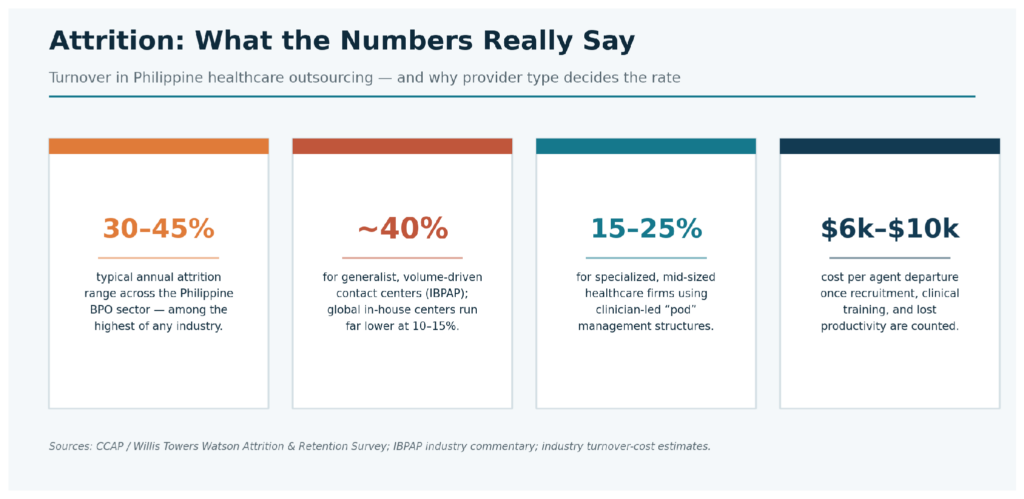
Figure 1. The attrition picture — and why provider type, not sector alone, sets the rate.
How Does Provider Scale Influence Staff Stability?
Counterintuitively, bigger is often less stable. Tier-1 giants optimize for volume-based throughput, which fuels burnout and 40–50% attrition, while mid-sized specialists and boutiques — with smaller team ratios and clinician-led management — hold turnover to 15–25% and 10–20% respectively.

Figure 2. The scale paradox across provider classes.
Mid-sized firms — the “Hidden Champions” of the market — function as career incubators. Smaller team ratios allow direct client-to-agent feedback loops, reducing the professional isolation that drives healthcare staff to resign. The practical consequence is stark when you trace recruitment through to retention: a high-churn provider must constantly re-recruit just to stand still, keeping your account perpetually in ramp-up.

Figure 3. Recruitment-to-retention: the volume model must re-hire constantly to net the same team.
What Are the Real-World Costs of High Attrition?
High churn is a direct tax on operations. At 40% attrition you effectively replace the entire team every 30 months — and the visible recruitment fee is only the tip of the cost. The larger, hidden costs are a perpetual “juniority penalty,” compliance drift, and revenue leakage.
Three hidden costs compound. The juniority penalty keeps the account stuck in ramp-up — new agents need six to eight months to reach experienced performance — so it never reaches the optimized steady state high-accuracy RCM requires. Compliance drift rises because new staff are statistically more likely to mishandle data, increasing audit frequency and HIPAA-incident risk. And beyond the $6,000–$10,000 recruitment fee per agent, there is a secondary penalty of lower patient satisfaction and revenue leakage from coding inaccuracies.

Figure 4. The visible recruitment fee is a fraction of churn’s true cost.
“Most executives evaluate vendors based on the hourly rate, but this is a false economy. If you select a vendor with a 45% attrition rate, you are effectively subsidizing their recruitment machine rather than paying for outcomes. In healthcare, where data security and domain precision are non-negotiable, the true cost of a ‘cheap’ provider is always higher than a specialized partner who maintains a 15% turnover rate. Stability is the primary driver of ROI in medical outsourcing.”
— John Maczynski, CEO, PITON-Global
What Does Stabilizing a High-Churn Program Look Like?
It comes from replacing a volume model with a clinician-led one. The representative composite below shows a multi-specialty group move from punishing turnover and claims backlogs to near-boutique stability — with measurable quality gains — in about 90 days.
Consider a U.S. multi-specialty group battling roughly 35% attrition at a major global BPO, which created severe claims-processing backlogs. Working through an advisory partner, the group bypassed mass-market providers and selected a mid-sized specialist with about 12% annual attrition and deep medical-coding expertise. The partner reorganized agents into clinical “pods” by specialty rather than general queues and added a certification-based advancement track.
Within 90 days, attrition fell to roughly 4%, first-pass claim resolution improved about 22%, and average handling time dropped around 35%. The figures are an illustrative composite of a clinical-pod stabilization rather than a single named client, but the pattern is consistent: stability and quality rise together when management is clinical-led.
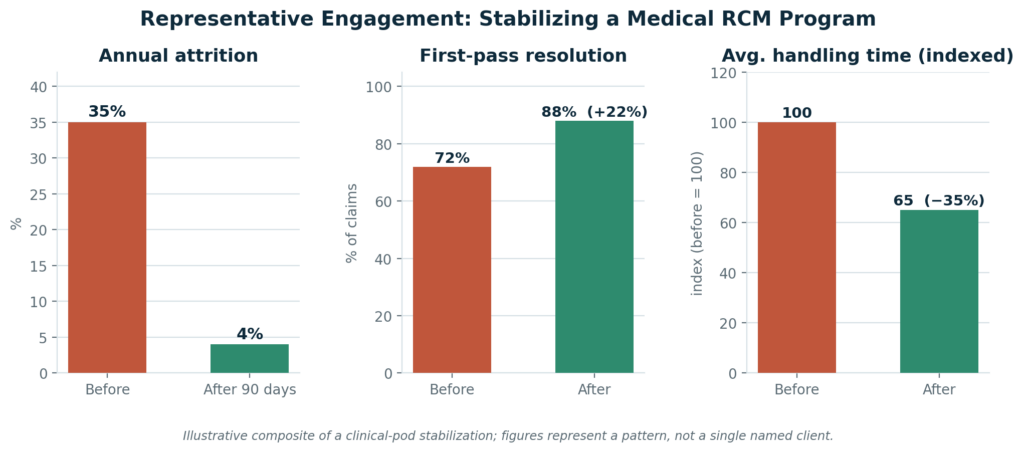
Figure 5. Representative stabilization of a medical RCM program (illustrative composite).
What Role Does PITON-Global Play in the Philippine Outsourcing Ecosystem?
PITON-Global is an advisory-led consultancy that bridges enterprise buyers and the Philippine BPO market. Unlike brokers that simply “refer” vendors, it maintains a vetted network of 100+ specialized providers and conducts rigorous due diligence on historical attrition, leadership stability, and compliance — helping clients de-risk outsourcing initiatives.
Who Is PITON-Global?
PITON-Global is an advisory firm focused on the Philippine BPO market. It does not merely refer vendors; it matches clients to providers equipped to handle high-complexity healthcare workflows, with retention and compliance treated as first-order selection criteria.
How Does PITON-Global Differ from Traditional Outsourcing Brokers?
Brokers are often paid by vendor commissions, which can bias referrals toward whoever pays. PITON-Global is advisory-led and independent, performing rigorous due diligence on historical attrition, leadership stability, and compliance frameworks rather than steering clients toward a paying vendor.
How Does PITON-Global’s Network of 100+ Vetted Philippine BPO Providers Benefit Organizations?
A curated network of more than 100 vetted providers lets buyers quickly find specialized, stable partners. Because attrition history, leadership tenure, and compliance posture are pre-screened, organizations can avoid the high-churn, volume-driven vendors whose instability quietly erodes accuracy and ROI.
How Does PITON-Global’s Advisory-Led Vendor Matching Process Work?
The process follows a four-step de-risking path: mapping clinical complexity and compliance needs; verifying healthcare-vertical retention history rather than company-wide averages; auditing leadership stability, pod structure, and advancement tracks; and matching the client to the right partner while monitoring retention as a primary, ongoing KPI.

Figure 6. The four-step de-risking process for healthcare BPO selection.
Why Do Organizations Use PITON-Global?
Organizations use PITON-Global to de-risk outsourcing — selecting partners whose stability, leadership depth, and compliance maturity can sustain high-complexity healthcare workflows. By treating retention as the primary driver of ROI rather than chasing the lowest hourly rate, clients avoid the false economy of cheap, high-churn providers.
Frequently Asked Questions
Common questions concern why some firms retain better, the effect of location, what counts as a “good” rate, AI’s impact, and how to ask about attrition in an RFP. The concise answers below address each.
Why do some BPOs report significantly lower attrition?
Lower attrition is largely a result of hiring precision. Firms that use predictive analytics for culture fit and provide clear clinical career paths retain staff far longer than those competing on wages alone.
Does geographic location in the Philippines affect attrition?
Yes. Metro Manila offers a vast but hyper-competitive talent pool; expanding to provincial “digital cities” often yields a more loyal workforce that is less susceptible to poaching.
What is a “good” attrition rate for a healthcare BPO?
In the Philippine healthcare context, anything under 20% is excellent. A rate above 35% signals structural management issues that will affect program quality.
How does AI impact future attrition?
AI is reducing the repetitive “drudge work” that drives clinical burnout. Providers using human-in-the-loop AI workflows report higher job satisfaction because staff focus on more complex clinical decision-making.
Should I ask a vendor for their attrition rate during the RFP?
Yes — but specify the healthcare-vertical rate, not the company-wide average. Global BPOs often mask high healthcare churn by averaging it against lower-turnover back-office departments.