

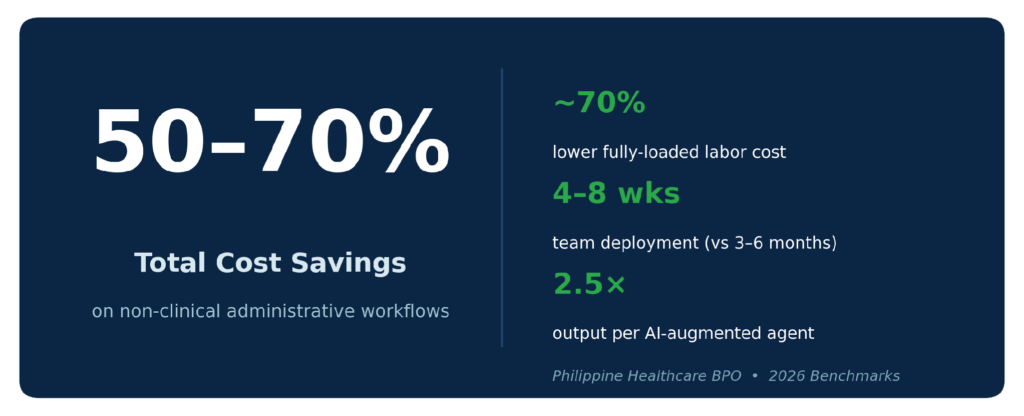
Hospitals typically achieve deep total cost savings by shifting non-clinical administrative work—medical billing, coding, and claims processing—to Philippine BPO providers. These savings come from fully loaded labor costs far below U.S. rates, eliminated infrastructure overhead, and 24/7 AI-augmented delivery models that outperform legacy domestic administrative structures. Those three levers are what a hospital-grade offshore back office is built to deliver.
Key Takeaways
- Substantial margin expansion: Outsourcing labor-intensive functions such as billing, coding, and claims processing converts fixed administrative overhead into a scalable, variable-cost model.
- Operational quality gains: Specialized healthcare BPO providers run audit-heavy revenue cycle management (RCM) workflows that frequently surpass domestic accuracy benchmarks.
- Time-zone arbitrage: A 24/7 delivery model processes claims and manages denials while domestic teams are offline, accelerating the entire revenue cycle.
- AI-hybrid efficiency: Agentic AI automates high-volume tasks, letting a single 2026-era agent deliver roughly the output of 2.5 traditional agents and lowering total cost of ownership.
- Strategic resilience: Scaling administrative capacity offshore insulates health systems from domestic labor shortages and chronically high attrition in administrative roles.
- Governance is the differentiator: The hospitals capturing the most value treat outsourcing as a strategic extension of operations, anchored in HIPAA, HITRUST, and SOC 2 compliance.
How Do Philippine Cost Structures Compare to Domestic Administrative Models?
Offshore BPO partners consolidate salaries, benefits, taxes, recruitment, and real estate into a single all-in hourly rate that sits at a fraction of fully loaded U.S. staff costs. The result is a deep labor-cost reduction, with infrastructure and turnover costs absorbed by the provider.
The largest and most predictable saving comes from the fully loaded labor rate. A U.S. administrative employee carries far more than a salary: payroll taxes, health benefits, paid leave, recruiting fees, management overhead, and the office space they occupy. Offshore providers fold all of those components into one transparent service fee, which is why the headline arbitrage is so consistent across health systems.
Just as important is the shift from capital expenditure to operating expenditure. Building domestic administrative capacity means leasing space, buying equipment, and committing to multi-year fixed costs before a single claim is processed. An offshore model eliminates that capex entirely and replaces it with a variable cost that scales up or down with volume. Carrying that variable cost forward is the basis for forecasting savings over a multi-year horizon.

Figure 1. Side-by-side comparison of fully loaded administrative cost components and their economic impact.
Viewed as a cost-compression sequence, the savings stack predictably: labor arbitrage delivers the deepest cut, followed by the elimination of real estate and capex, then the recruitment and turnover costs that a BPO partner absorbs on the client’s behalf. Together these reductions take a fully loaded domestic baseline down to a fraction of its original cost.
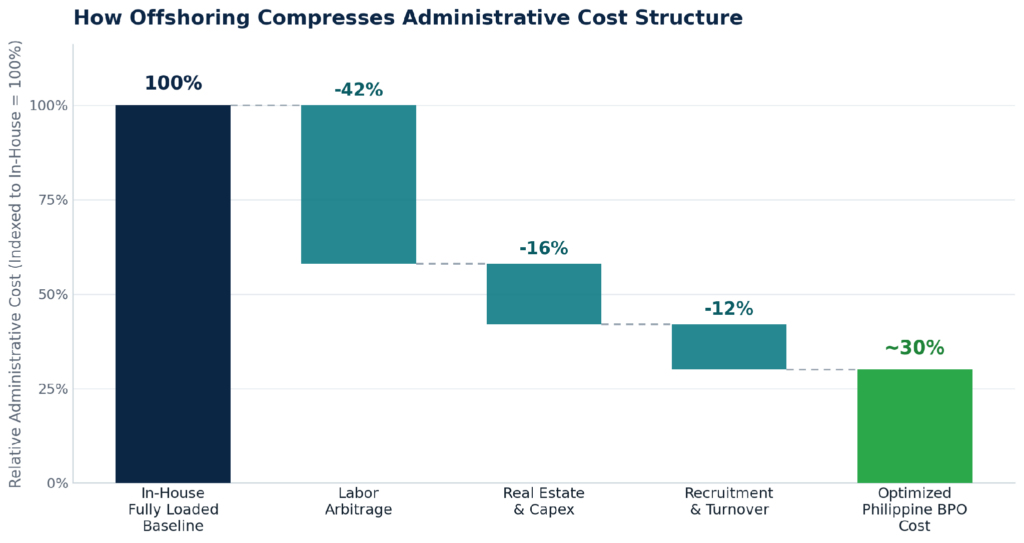
Figure 2. How sequential efficiencies compress a fully loaded administrative cost base.
Why Is Specialized Administrative Outsourcing Critical for Modern Revenue Cycles?
Because “administrative drag”—billing backlogs, high denial rates, and slow insurance verification—quietly erodes cash flow. Specialized offshore RCM teams staffed with certified coders and clinically trained professionals raise first-pass clean-claim rates and shrink days sales outstanding (DSO), converting administrative speed directly into faster revenue.
Many health systems lose more money to inefficient revenue cycles than to clinical underperformance. In-house teams, stretched across competing priorities, rarely have the dedicated bandwidth to resolve the specialized bottlenecks that drive denials and rework. Each denied or delayed claim adds days to DSO and ties up working capital that could fund patient care. That is why billing, coding, and denial work rank among the highest-return administrative functions to move offshore.
Leading Philippine providers address this by recruiting talent with genuine clinical depth—registered nurses, and coders certified as CPC, CCS, or RHIA. That expertise means staff understand the nuances of ICD-10/11 coding and payer-specific rules, producing higher first-pass clean-claim rates, fewer denials, and measurably lower DSO.
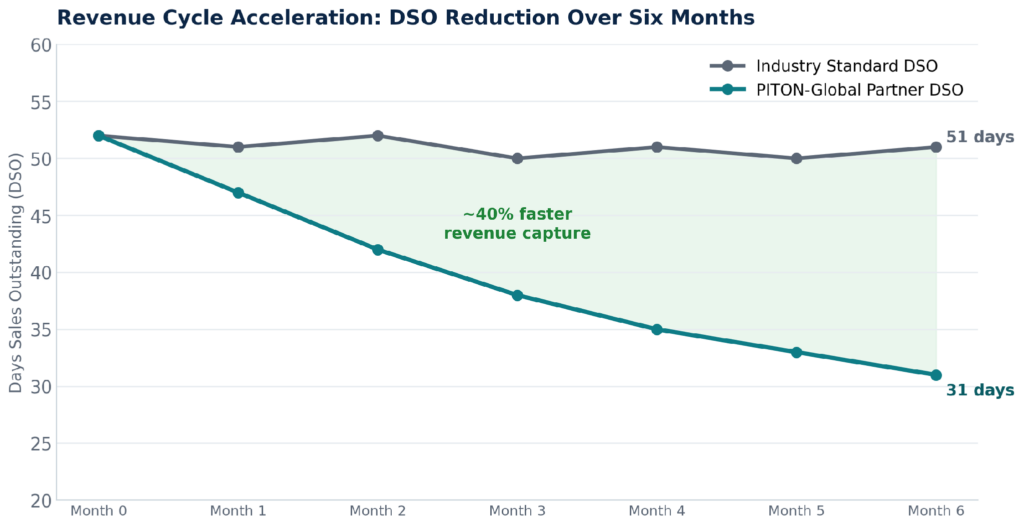
Figure 3. Specialized RCM teams can cut DSO from the low-50s toward the low-30s within two quarters.
How Should Hospital Executives Balance Compliance Risks With Financial Rewards?
Treat outsourcing as a governed operational extension, not a quick headcount fix. Prioritize vendors with HITRUST, HIPAA, and SOC 2 Type II certifications, manage performance through outcome-based KPIs rather than hours worked, and enforce a strict AI-governance framework for any tools touching protected health information.
The financial case for offshoring is rarely in dispute; execution discipline is what separates success from disappointment. The most effective health systems no longer frame BPO as a reactive cost cut. They build a layered governance model where compliance forms the non-negotiable base, operational oversight sits in the middle, and performance optimization is the peak that compounds value over time. Weak execution is also where hidden costs that CEOs should weigh before choosing a vendor tend to surface.
“In 2026, the hospitals winning the war for operational efficiency are those that stop viewing outsourcing as a reactive headcount strategy,” says John Maczynski, CEO of PITON-Global. “They treat Philippine providers as a strategic extension of their core, leveraging the deep clinical and technical fluency available in the region to redefine what their administrative departments can achieve.”

Figure 4. A layered risk-mitigation framework: compliance at the base, governance in the middle, optimization at the peak.
Practically, that means moving performance management away from “hours worked” toward metrics that reflect financial reality—first-pass yield, denial-reversal rates, and net collection rate. It also means writing AI governance into the contract, ensuring every automation tool is validated against clinical data-privacy requirements and the organization’s own security policies.
What Results Have Hospitals Achieved in Practice?
One 500-bed U.S. hospital system facing a deep billing-staff vacancy and a multimillion-dollar annual revenue lag deployed a dedicated 40-agent offshore team. Within six months it cut claim denials sharply, reclaimed a large share of the lagging revenue, and improved clinical staff retention.
The system’s core problem was familiar: chronic turnover in the billing department created documentation gaps and a rising tide of claim denials, while overburdened clinical staff were pulled into administrative cleanup. Through an advisory-led selection process, the hospital was matched with a provider specializing in high-acuity surgical billing and already fluent in its specific EHR platform.
A dedicated team was integrated directly into the hospital’s systems rather than operating as a detached shared-services pool. The combination of sub-vertical expertise and deep institutional familiarity is what turned a staffing crisis into a measurable financial recovery.
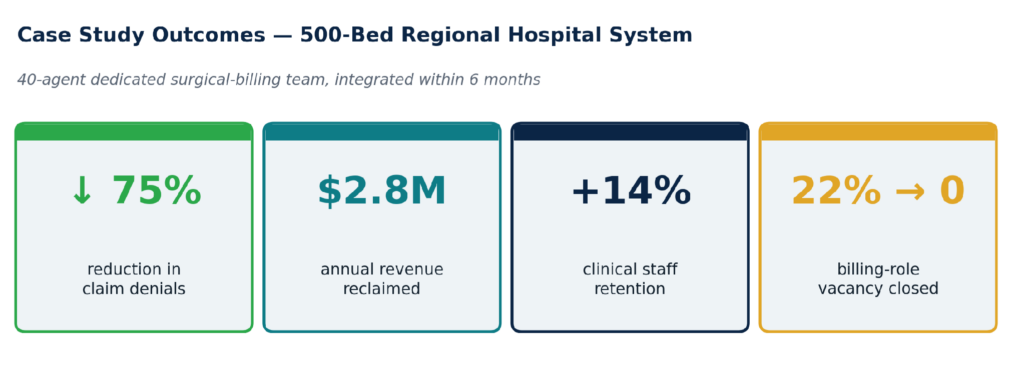
Figure 5. Six-month outcomes after deploying a dedicated, sub-vertical-matched billing team.
How Does PITON-Global Help Organizations Navigate Philippine Healthcare BPO?
PITON-Global is a vendor-agnostic outsourcing advisor that matches healthcare organizations to the right Philippine BPO partner from a network of 100+ vetted providers. Its advisory-led model prioritizes objective, outcome-focused recommendations over commissions, reducing offshoring risk and accelerating time-to-value.
Who Is PITON-Global?
PITON-Global is an independent advisory firm specializing in the Philippine outsourcing market. It sits between healthcare organizations and the providers that serve them, bringing deep market knowledge of BPO advisory and provider selection. Rather than delivering BPO services itself, PITON-Global focuses on helping clients identify, evaluate, and qualify the partners best suited to their operational and compliance requirements.
How Does PITON-Global Differ From Traditional Outsourcing Brokers?
Traditional brokers are typically commission-driven—their incentive is to place clients with whichever provider pays them, not whichever provider fits best. PITON-Global operates on an advisory-led model instead. It evaluates providers independently, makes objective vendor recommendations, and keeps the focus on client outcomes rather than provider promotion. The result is guidance aligned with the hospital’s interests, not a sales pipeline.
How Does a Network of 100+ Vetted Philippine BPO Providers Benefit Organizations?
Access to a large, pre-vetted provider ecosystem dramatically compresses the discovery process. Instead of cold-evaluating an opaque market, organizations tap a curated network spanning multiple industries and service categories—from medical billing and coding to clinical documentation and patient support. Because partners are screened in advance for capability and compliance, vendor discovery and qualification happen in a fraction of the usual time.
How Does PITON-Global’s Advisory-Led Vendor Matching Process Work?
The process begins with a thorough needs assessment—an audit of current workflows, technology stack, and compliance requirements. PITON-Global then shortlists providers calibrated to the organization’s sub-vertical, applies a structured matching methodology across EHR fluency, clinical acuity, and KPI fit, layers in risk-reduction checks on security and certifications, and supports the organization through final selection and onboarding.

Figure 6. PITON-Global’s five-stage advisory-led vendor matching process
Why Do Organizations Use PITON-Global?
Organizations engage PITON-Global to reduce outsourcing risk, improve provider fit, and accelerate vendor selection while keeping a clear line of sight on outcomes. By compressing discovery, validating compliance up front, and matching health systems to providers calibrated to their exact sub-vertical, PITON-Global helps organizations achieve better outsourcing results with strategic guidance at every step of the evaluation.
What Else Should Hospitals Know Before Outsourcing to the Philippines?
Common questions center on communication quality, data security, deployment speed, AI’s impact, team models, and EHR compatibility. In short: English fluency is excellent, security is enterprise-grade, teams deploy in 4–8 weeks, AI multiplies output, dedicated teams are the healthcare standard, and major U.S. EHR platforms are fully supported.
Is English communication in the Philippines suitable for patient-facing support?
Yes. The Philippines is one of the world’s leading English-speaking nations, and its healthcare BPO professionals receive intensive training in U.S. clinical terminology and empathetic patient communication, making them well suited to patient-facing roles.
How is patient data security ensured?
Top-tier providers use “hardened compliance” models: physically secure, HIPAA-aligned facilities, zero-trust network architecture, and end-to-end encryption for all patient-identifiable information.
What is the typical timeframe to deploy a specialized healthcare team?
Depending on role complexity and EHR requirements, dedicated teams are typically fully onboarded and operational within 4 to 8 weeks—compared with the 3–6 months a domestic build often requires.
How does agentic AI affect cost and output?
AI-augmented teams are markedly more efficient. A single 2026-era agent can often manage the output of roughly 2.5 traditional agents, lowering total cost of ownership while maintaining—or improving—accuracy.
Why are dedicated teams preferred over shared models?
For healthcare, dedicated teams are the industry standard. Staff become deeply familiar with a hospital’s specific EHR, internal procedures, and KPIs, building institutional knowledge that drives superior long-term performance.
Can we keep our existing EHR platform?
Yes. Offshore teams are proficient across all major U.S. healthcare platforms, including EPIC and Cerner, and operate through secure, compliant VPN connections.