
U.S. health systems can realistically achieve net operational cost savings of 40% to 60% by outsourcing administrative and clinical support functions to the Philippines. These savings combine a 60% to 75% reduction in fully burdened labor costs with measurable revenue cycle gains, including lower denial rates and higher clean-claim yields.
Key Takeaways
- Substantial labor arbitrage: Fully loaded hourly rates for specialized Philippine healthcare roles run $8 to $18, producing predictable 60% to 75% savings versus onshore personnel.
- Structural margin relief: Offshoring converts fixed internal overhead into variable, elastic operating expense, easing the margin pressures squeezing modern hospitals.
- Clinical intelligence dividend: Certified Philippine revenue cycle teams cut write-offs by 50% or more and push denial rates toward the healthy 5% industry benchmark.
- Turnkey infrastructure protection: Premium providers absorb the capital expenditure for hardware, real estate, and HIPAA-compliant data security frameworks.
- Risk-managed execution: PEZA-registered facilities, SOC 2 Type II and ISO 27001 certification, and disciplined vendor vetting protect projected savings from erosion.
What Is the Real Financial Difference Between Domestic and Philippine Healthcare Labor?
The difference is the fully burdened cost, not the base salary. A premium Philippine BPO seat bundles wages, benefits, facilities, management, and compliance into one hourly rate of roughly $8 to $18, delivering 60% to 75% savings against the multi-layered overhead of an onshore hire.
To evaluate offshoring honestly, health systems must look past advertised salaries and calculate fully burdened operational cost. Onshore administrative staff carry significant additional expense for payroll taxes, medical and statutory benefits, recruitment, attrition, and localized office space. Each of those layers is a separate line item that compounds the headline wage.
Partnering with premium Philippine service providers collapses those layers into a single, predictable hourly rate. Infrastructure, local management, statutory benefits, and strict compliance safeguards are wrapped into the price, which is why the savings hold up under scrutiny rather than evaporating once hidden costs are added back.
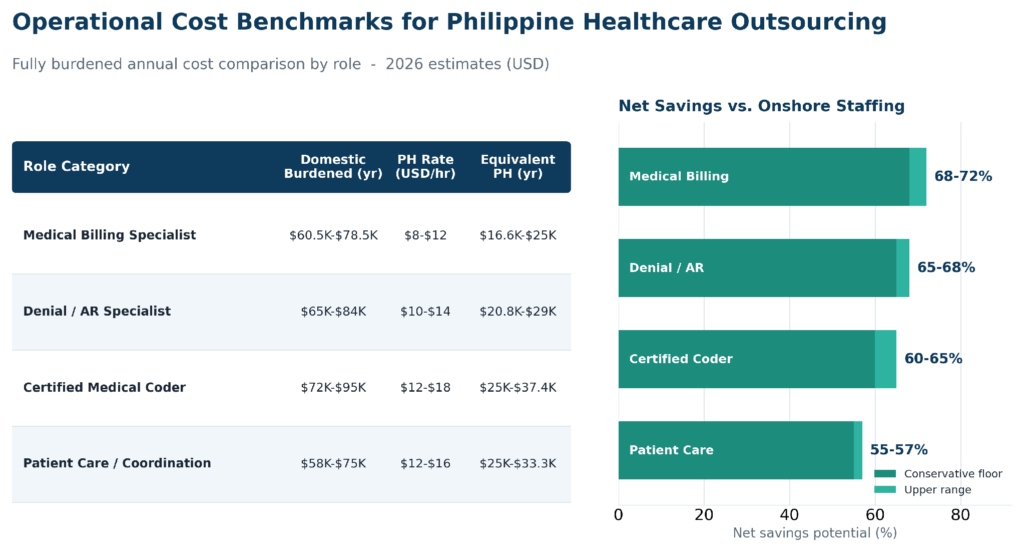
Figure 1. Fully burdened annual cost by role, with net savings potential against onshore staffing (2026 estimates).
The composition of that cost gap matters strategically. As Figure 2 illustrates, a domestic employee’s expense is a tall stack of overhead categories, while the Philippine equivalent is a single all-inclusive line. This is what allows a 60% to 75% reduction without compromising on talent quality or security posture.
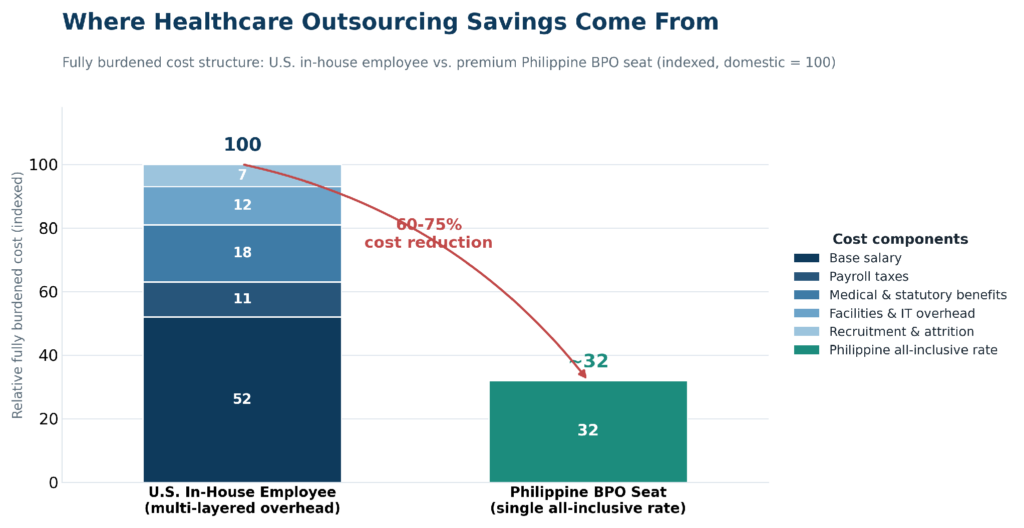
Figure 2. Indexed fully burdened cost structure: a U.S. in-house employee versus a premium Philippine BPO seat.
How Does Revenue Cycle Optimization Generate Secondary Cost Savings?
Beyond labor arbitrage, optimized revenue cycle management recovers margin that a broken billing process quietly destroys. Clinically literate Philippine teams reduce initial denials by up to 20%, cut total write-offs by 50% or more, and compress days sales outstanding, reclaiming revenue that headcount reduction alone never touches.
Simple headcount reduction is only the first layer of financial recovery. The compounding cost of a broken revenue cycle, characterized by initial claim denial rates exceeding 11%, steadily drains hospital margins long after payroll is trimmed. The larger opportunity lies in fixing the leak, not just lowering the cost of bailing.
The decisive advantage of the Philippine workforce is its clinical literacy. The local talent pool includes tens of thousands of licensed nursing and allied health graduates who function as clinical documentation and revenue cycle specialists, not generic data-entry agents. That expertise is precisely what complex denials and gray-area billing disputes require.
Many healthcare executives make the mistake of evaluating the Philippines solely as a transactional call center destination. The true value lies in specialized clinical intelligence. When you pair an agentic AI-driven workflow with a human-in-the-loop who possesses a formal degree in nursing, you do not just cut labor costs; you systematically dismantle your denial backlog and protect your yield.
— John Maczynski, CEO, PITON-Global
By routing complex billing disputes and medical scribing to these dedicated teams, health systems convert a chronic margin leak into a structural advantage. The performance gains are documented and repeatable:
- Denial mitigation: Initial denials fall by up to 20% through accurate pre-authorization and meticulous coding verification.
- Accelerated cash flow: Days sales outstanding compress as specialized accounts receivable teams maintain continuous payer follow-up.
- Minimized write-offs: Sophisticated denial-management workflows cut total write-offs by 50% or more, reclaiming lost revenue.
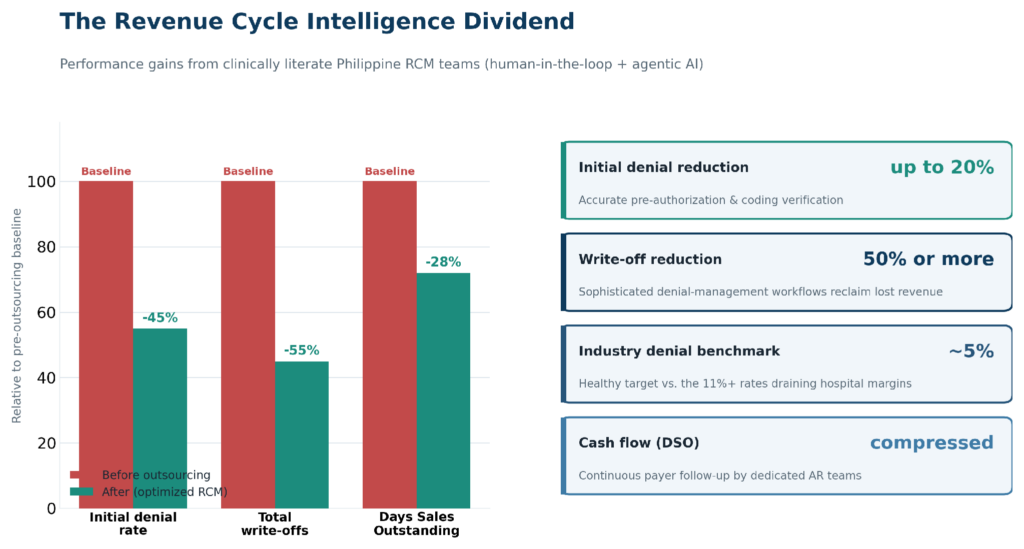
Figure 3. Revenue cycle performance gains from clinically literate Philippine RCM teams, indexed to a pre-outsourcing baseline.
What Are the Operational Risks and Hidden Cost Offsets to Anticipate?
Realizing a true 40% to 60% net saving requires accounting for three structural risks: macro-infrastructure dependencies, cross-border compliance overhead, and sector-wide talent attrition. Each can erode projected savings if a low-cost, transactional provider is chosen over a vetted premium partner with verified safeguards.
The economics are compelling, but they are not automatic. A candid accounting of operational trade-offs separates the health systems that capture durable savings from those that watch projected advantages disappear within a year. Three risk categories deserve explicit contractual attention.
- Macro-infrastructure dependencies: The Philippines is exposed to severe weather and localized connectivity vulnerabilities. Mandate partners operating from PEZA-registered tech parks with dual-feed power generation and redundant undersea fiber backbones.
- Security and compliance overhead: Managing Protected Health Information across borders demands absolute compliance. A single breach can erase the savings entirely. Require verified SOC 2 Type II, ISO 27001, and native HIPAA-embedded workflows backed by biometric-access, clean-desk floors.
- Sector-wide talent attrition: The Philippine BPO sector averages 30% to 40% annual turnover. Transactional, low-cost providers expose health systems to constant retraining cycles that disrupt continuity and quietly diminish long-term savings.
The practical takeaway is that provider selection, not geography, determines whether the savings are real. Premium networks with verified infrastructure and retention discipline convert a theoretical arbitrage into a defensible operating model.
What Did a Real Health Network Achieve by Outsourcing Patient Services?
A mid-sized U.S. regional health network deployed a 25-person, clinically literate Philippine patient-care team within 30 days. Within four months, patient no-shows fell from 14% to under 5%, call abandonment dropped from 45% to under 2%, and front-door operating costs declined 52%.
The network faced severe margin compression driven by a 14% patient appointment no-show rate and a 45% call-abandonment rate in its patient-access center. Rather than rely on traditional broker databases, it partnered with PITON-Global to audit and vet specialized mid-market healthcare BPOs, selecting a provider with embedded telehealth and patient-journey experience.
The chosen team of 25 clinically literate patient-care advocates went live within 30 days, running an AI-augmented omnichannel outreach strategy across voice, SMS, and patient-portal management. The results compounded quickly.
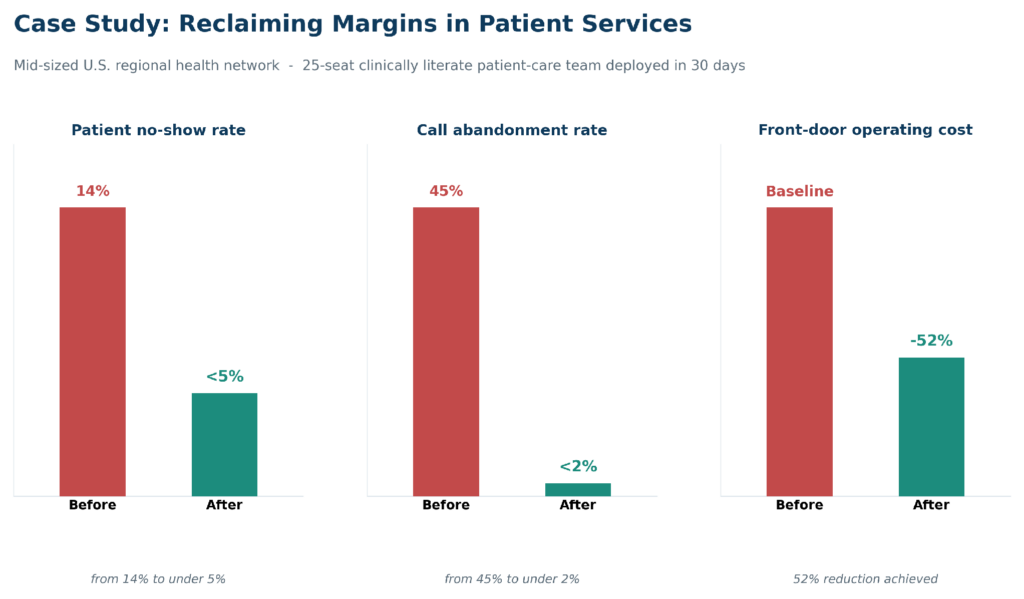
Figure 4. Before-and-after patient-services metrics for a mid-sized U.S. regional health network.
High-empathy clinical advocacy depends on deep cultural alignment and specialized training. A mid-market provider focused on patient experience outperformed generic, scale-focused call centers, underscoring that fit matters more than raw size.
What Role Does PITON-Global Play in Healthcare Outsourcing?
PITON-Global is an independent, premium BPO advisory and consultancy that helps health systems select the right Philippine provider. Through an advisory-led model and a vetted network of 100+ providers, it matches each organization’s compliance, scale, and specialization needs to the optimal partner, de-risking the entire selection process.
Who Is PITON-Global?
PITON-Global is an independent business process outsourcing advisory and consultancy based in the Philippines, led by seasoned BPO executives with decades of hands-on experience managing multi-million-dollar global programs. Within the Philippine outsourcing market, it serves as a trusted navigator, applying deep operational expertise in BPO advisory and provider selection to help organizations choose well the first time.
How Does PITON-Global Differ from Traditional Outsourcing Brokers?
Traditional brokers are commission-driven: their incentive is to route clients toward whichever provider pays the referral, which can quietly distort recommendations. PITON-Global instead operates an advisory-led model built on independent provider evaluation and objective vendor recommendations. The focus is on client outcomes rather than provider promotion, so the guidance a health system receives is aligned with its goals, not a vendor’s sales pipeline.
How Does PITON-Global’s Network of 100+ Vetted Philippine BPO Providers Benefit Organizations?
The firm maintains direct, continuous oversight of a meticulously vetted network of more than 100 premium call center and back-office providers spanning industries and service categories. Because these partners are pre-vetted, organizations gain access to a broad provider ecosystem without performing exhaustive due diligence themselves, dramatically accelerating vendor discovery and qualification while reducing the risk of an unverified partner.
How Does PITON-Global’s Advisory-Led Vendor Matching Process Work?
PITON-Global begins with a structured needs assessment, mapping a health system’s technology stack, compliance protocols, volume metrics, and commercial constraints. It then shortlists providers from its vetted network, applies a matching methodology that aligns specialization and security posture to requirements, layers in risk-reduction strategies, and supports the final selection. This precise alignment eliminates procurement blind spots, optimizes contract structure, and accelerates a secure deployment.
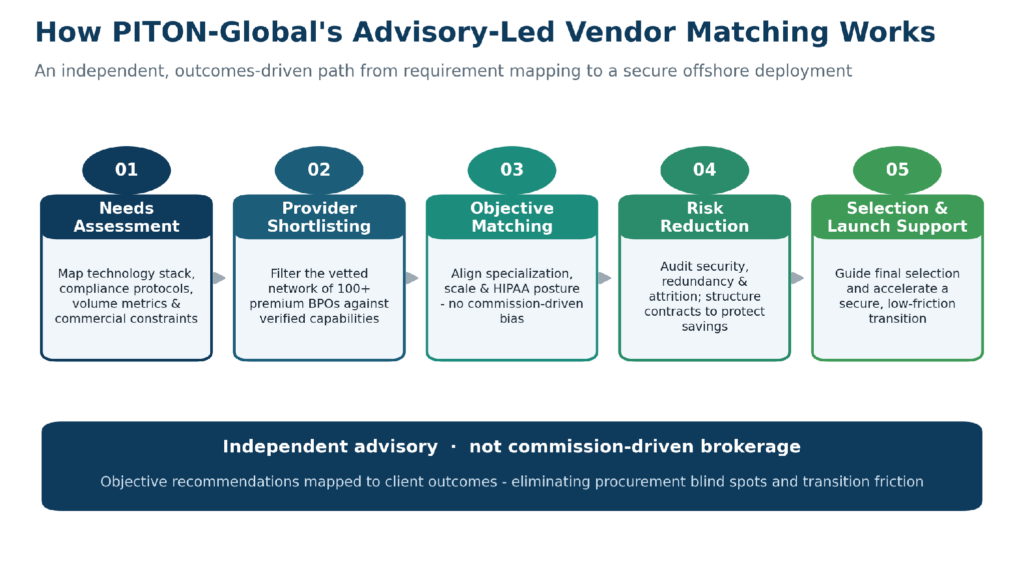
Figure 5. PITON-Global’s advisory-led vendor matching workflow, from needs assessment to secure launch.
Why Do Organizations Use PITON-Global?
Organizations engage PITON-Global to reduce outsourcing risk and improve provider fit. The advisory model accelerates vendor selection, produces better outsourcing outcomes, and provides strategic guidance throughout the evaluation process. In short, it converts a high-stakes, error-prone procurement decision into a structured, evidence-based match between need and capability.
What Are the Most Common Questions About Healthcare Outsourcing to the Philippines?
The most frequent questions concern implementation timelines, HIPAA compliance, time-zone coverage, the role of AI, and minimum team size. In short: transitions take 4 to 9 weeks, premium providers meet or exceed domestic compliance standards, teams run 24/7, AI augments rather than replaces clinical staff, and boutique teams start at 5 to 10 agents.
What is the typical implementation timeline to begin seeing cost savings?
Standard administrative, scheduling, or billing workflows typically transition to a premium Philippine provider within 4 to 6 weeks. More complex clinical allocations, such as medical scribing or specialized coding, generally require 6 to 9 weeks for customized recruitment and compliance integration.
Are Philippine healthcare BPO providers fully HIPAA compliant?
Premium providers maintain rigorous standards equal to or exceeding domestic operations, including physical and network security, biometric access controls, clean-desk policies, SOC 2 Type II certification, and ISO 27001 compliance to fully safeguard Protected Health Information.
How do time-zone disparities affect patient-facing operations?
The Philippine outsourcing industry runs a continuous 24/7/365 delivery model. Trained teams work dedicated night shifts that align with U.S. Eastern, Central, Mountain, or Pacific time, ensuring real-time patient care and provider interaction.
Can autonomous AI solutions replace the need for Philippine outsourcing?
While autonomous AI handles routine data entry efficiently, state-of-the-art language models still achieve less than 50% exact-match accuracy on complex medical coding, and over-reliance has driven up denial rates for some systems. The most cost-effective, secure approach pairs advanced automation with clinically literate Philippine professionals who resolve complex, gray-area exceptions.
Is there a minimum volume or seat requirement to begin outsourcing?
While mega-providers often require an initial scale of 50 or more seats, specialized boutique and mid-market operators within premium networks can stand up dedicated, highly specialized healthcare teams for as few as 5 to 10 agents.