
On this page
- Key Takeaways
- Why Should a Renewal Be Renegotiated Rather Than Rolled Over?
- How Should Enterprise Buyers Structure Renewal Rates to Counter Inflation While Preserving Service Quality?
- What Key Performance Indicators Ensure Continuous Innovation During a Renewal Term?
- How Should Term Length, Capacity, and Governance Be Structured?
- What Does an Optimized Renewal Look Like in Practice?
- How Does PITON-Global Reduce Outsourcing Risk and Optimize Contract Terms?
- Frequently Asked Questions
The strongest long-term value comes from replacing static transactional pricing with dynamic value-sharing: gain-share on transformation, performance-indexed rate caps tied to published benchmarks, structured continuous improvement rebates, and flexible capacity bands. Together these align vendor margin with client business outcomes rather than with billed headcount.
Key Takeaways
- Outcome-linked commercial models. Gain-sharing aligns vendor compensation with the operational efficiencies and margin expansion the client actually realizes.
- Indexed rate cap controls. Tying annual adjustments to the Philippine CPI and DOLE wage directives, capped at 2.5%–3.5%, prevents margin erosion without destabilizing delivery.
- Tiered performance incentives. Sliding-scale bonuses and credits around high-impact KPIs drive improvement beyond the baseline SLA.
- Flexible capacity and term structures. Variable staffing bands let buyers scale dynamically while locking in long-term volume discounts.
- Governance that keeps terms live. Quarterly and annual steering reviews keep the agreement aligned with shifting business goals rather than frozen at signature.
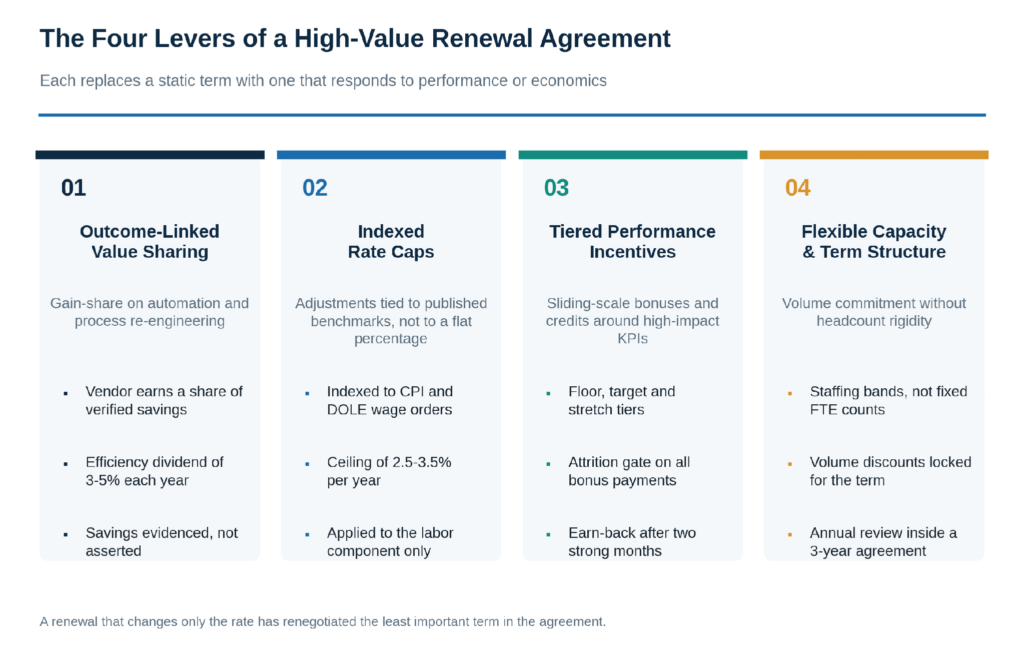
Figure 1. The four levers of a high-value renewal agreement, with the typical parameters for each.
Why Should a Renewal Be Renegotiated Rather Than Rolled Over?
Because second-term economics differ from first-term economics. Transition cost is spent, the team is tenured, infrastructure is amortized, and processes are documented. A renewal that repeats the original terms prices a mature operation as though it were a standing start, and hands the resulting efficiency entirely to the provider.
The renewal conversation usually opens with a proposed increase, which frames the negotiation around a single number and obscures the more important question: what has changed about the cost of delivering this program? By the end of a first term, the provider has recovered its build-out, retained agents have moved past the productivity ramp, and the account has become predictable to staff. Each of those is a real efficiency. Whether the buyer sees any of it depends entirely on how the second-term agreement is structured.
Leverage also peaks at exactly this moment and declines immediately afterwards. Before signature, the buyer has a credible alternative and the provider has a renewal at risk. Twelve months into the second term, neither is true. Terms that are straightforward to secure during renewal — an efficiency dividend, an attrition gate, a capped index — become concessions the provider has no reason to grant once the agreement is executed.
How Should Enterprise Buyers Structure Renewal Rates to Counter Inflation While Preserving Service Quality?
Replace flat annual step-ups with Performance-Indexed Rate Adjustments. Price movements track published benchmarks — Philippine CPI and DOLE wage directives — capped at a negotiated ceiling of roughly 2.5% to 3.5%, applied to the labor component only, and released only where SLA and quality thresholds have been met.
Cost escalation driven by wage inflation and attrition is the primary financial risk in a multi-year Philippine agreement, and the two standard responses both fail. A fixed annual step-up of 5% is unpredictable in real terms and entirely decoupled from performance: the provider earns the increase whether the program improved or degraded. A flat multi-year renewal looks like the stronger commercial outcome and is usually the weaker one, because the provider absorbs statutory increases it cannot avoid — wage orders, 13th-month pay, night differential — and recovers the difference from the wage line, which surfaces as attrition in the second year.
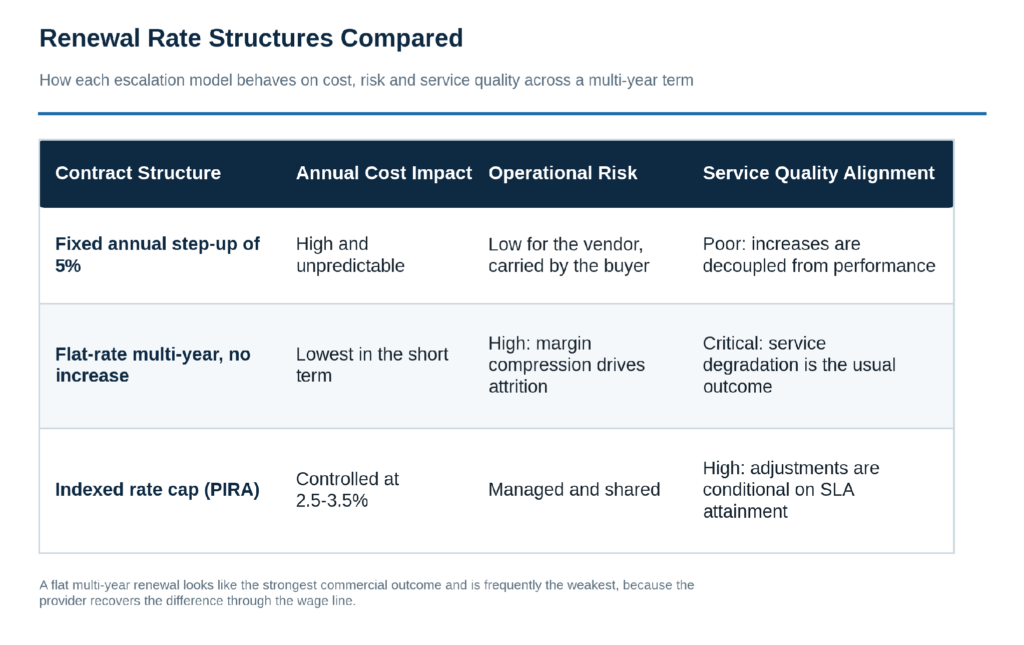
Figure 2. How each renewal rate structure behaves on cost, operational risk, and service quality alignment.
How the Indexed Adjustment Actually Works
Under a performance-indexed structure, three inputs feed the annual calculation: published regional CPI, DOLE wage order movement, and any statutory benefit change. The indexed result is then tested against a negotiated ceiling, and finally gated on the vendor’s scorecard for the preceding twelve months. Where performance thresholds were met, the capped adjustment applies. Where they were not, the adjustment is deferred until remediation is evidenced.
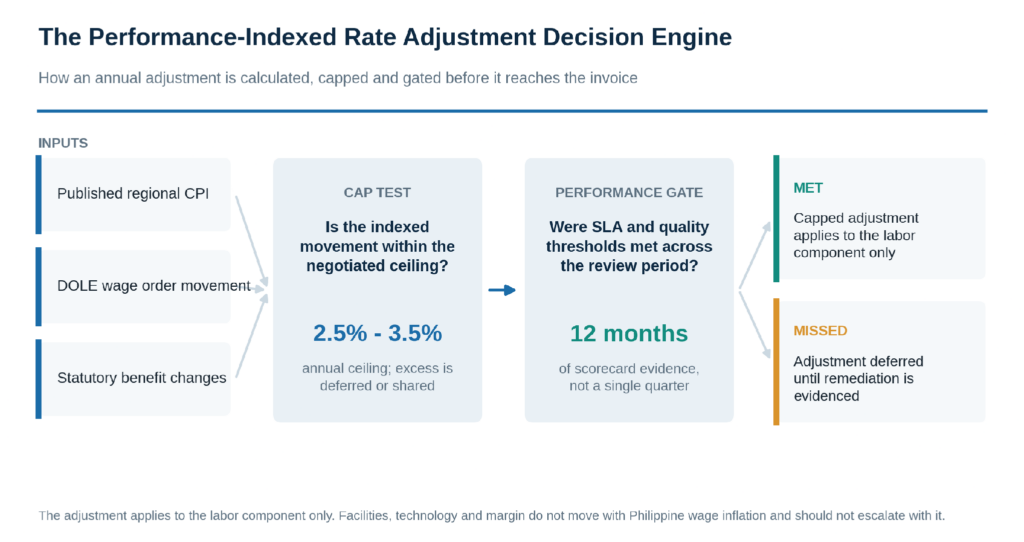
Figure 3. The Performance-Indexed Rate Adjustment decision engine, from published inputs through cap test and performance gate to the invoice.
Apply the Index to the Right Base
The detail that carries most of the value is the base to which the index applies. A blanket percentage applied to the total invoice compounds against facilities, technology, and vendor margin — none of which rise with Philippine wage inflation. Applying the adjustment to the labor component alone, with statutory increases flowing through separately at documented cost, typically halves the effective escalation over a three-year term without the provider absorbing anything it should not.
What Key Performance Indicators Ensure Continuous Innovation During a Renewal Term?
Baseline SLAs secure the floor; tiered incentives drive movement above it. Build a schedule with floor, target, and stretch bands on CSAT, first contact resolution, handle time paired with repeat-contact rate, and a verified efficiency dividend — with annualized attrition acting as a gate on every bonus payment.
A second-term agreement should reward transformation rather than continuity. Under a gain-share transformation framework, the provider earns margin bonuses for delivering automation, process re-engineering, or AI-assisted workflow changes that permanently reduce operating expenditure. The critical word is permanently: savings must be verified against the disclosed cost base and sustained across a measurement period, not asserted in a quarterly business review.
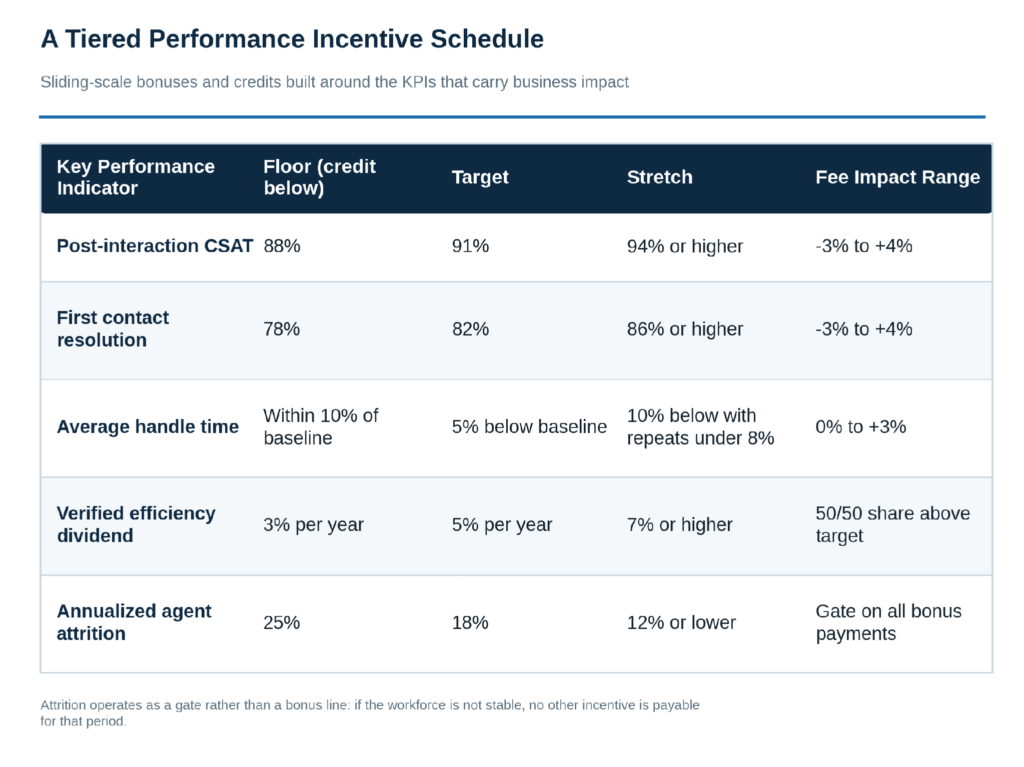
Figure 4. A tiered performance incentive schedule, with floor, target, and stretch bands and the fee impact of each.
The Efficiency Dividend
Mandate an annual efficiency dividend, typically 3% to 5%, derived from automation and operational maturity rather than from wage suppression. The distinction matters commercially as well as ethically: a dividend funded by process improvement is repeatable and compounds, while one funded by cutting agent pay produces a one-off saving followed by an attrition cycle that costs more than it returned. Structure the dividend so savings above the target threshold are shared, which gives the provider a reason to exceed it.
Continuous Improvement Rebates
A continuous improvement rebate credits a portion of invoice value back to the buyer when pre-agreed innovation or optimization targets are missed. It functions as the counterweight to the gain-share upside: the provider participates in the benefit of transformation and carries a defined consequence for failing to deliver it. Without both sides, a transformation commitment is a roadmap slide rather than a contractual term.
Attrition as a Gate, Not a Metric
Workforce stability belongs in the incentive architecture as a gate rather than as another scored line. If annualized attrition exceeds the agreed threshold, no other bonus is payable for that period regardless of CSAT or handle time. This prevents the most common failure in performance-based renewals, where short-term metric gains are purchased by running a team harder than it can sustain.
Contract renewals should never be a copy-paste exercise of the original terms. The most successful enterprise partnerships treat the second-term contract as a transformation blueprint — trading legacy headcount-based pricing for measurable business impact and long-term cost optimization.
— John Maczynski, CEO, PITON-Global
How Should Term Length, Capacity, and Governance Be Structured?
A three-year term with annual performance reviews balances rate discounts against agility. Pair it with variable staffing bands rather than fixed FTE commitments, workforce stability clauses covering compensation and career pathing, and a quarterly and annual steering cadence with named executive sponsors on both sides.
Commit to Volume, Not to Headcount
Volume discounts are worth securing; rigid headcount commitments are not. Structure capacity as bands — a committed floor, a flex range priced at the same unit rate, and a defined lead time for movement between them — so the buyer captures scale pricing without paying for seats a seasonal trough does not need. Agree the notice period for movement within the band at signature, since that is what determines whether the flexibility is usable in practice.
Workforce Stability Clauses
Protection against sudden attrition is contractible. Require the provider to maintain compensation at or above a named local market benchmark for the skill tier, to operate structured career development for the account, and to report tenure mix quarterly. These clauses cost the provider nothing if it was already doing them, which is precisely why willingness to sign is informative during renewal negotiation.
Governance That Reviews Terms, Not Just Metrics
Quarterly operational reviews and an annual executive steering session keep the agreement aligned with shifting business goals and market conditions. The annual review should explicitly revisit the commercial terms — index performance, dividend delivery, tier attainment, capacity band usage — rather than only the scorecard. An agreement reviewed only through its metrics will drift out of alignment with the business it was written to support.
What Does an Optimized Renewal Look Like in Practice?
A North American FinTech facing a 12% renewal increase alongside stagnant CSAT restructured instead: a three-year agreement with a zero-increase baseline, a 15% variable performance bonus, and a mandatory 5% annual efficiency dividend delivered through RPA. Costs fell 22% over 36 months while CSAT rose from 81% to 94%.
Client Challenge
A North American financial technology firm was facing a 12% renewal price increase from its incumbent Philippine back-office provider while customer satisfaction had been flat for two review cycles. The proposed increase was presented as a wage-driven necessity, but nothing in the existing agreement made it possible to test that claim or to connect the higher price to any improvement in outcome.
Audit and Vendor Selection
PITON-Global conducted an operational audit of the account and matched the client with a vetted mid-market Philippine provider offering deep FinTech domain expertise and demonstrated process automation capability. The audit established what the program actually cost to deliver, which converted the renewal from a negotiation over a percentage into a discussion about the cost base.
Solution Implemented
The resulting three-year agreement combined a zero-increase baseline with a 15% variable performance bonus linked to CSAT and handle-time efficiency, and a mandatory 5% annual efficiency dividend realized through robotic process automation. The structure meant the provider’s route to higher margin ran through automation and quality rather than through the rate card.
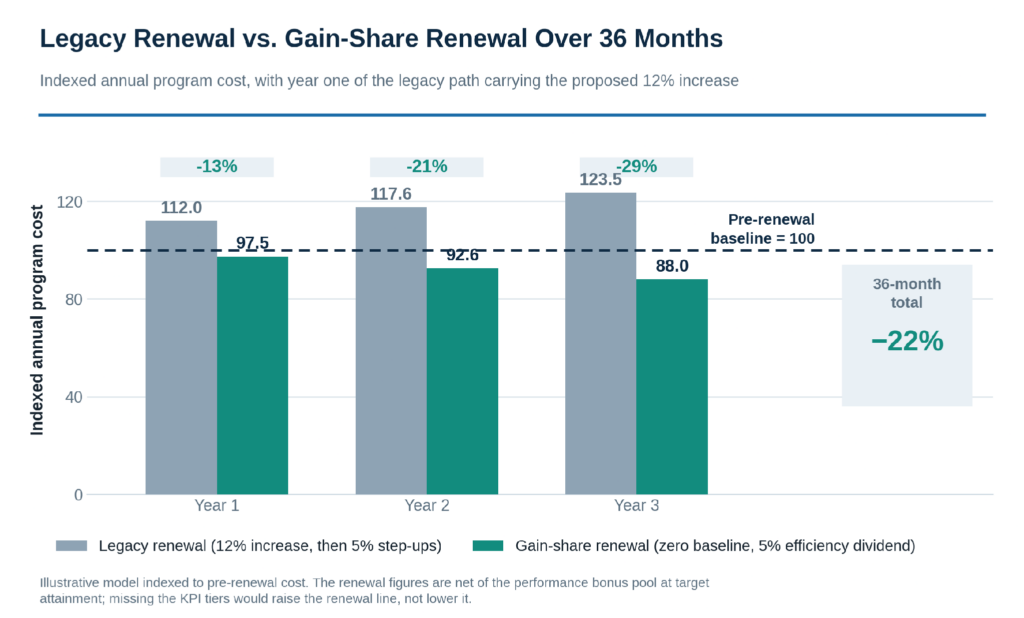
Figure 5. Legacy renewal versus gain-share renewal across 36 months, indexed to pre-renewal program cost.
Quantifiable Business Outcomes
- 22% lower contract costs across 36 months against the legacy renewal trajectory.
- CSAT from 81% to 94% over the first year of the new term.
- Agent turnover from 35% to under 12% annually, stabilizing domain knowledge on the account.
Lessons Learned
Decoupling cost reduction from wage suppression is what made the outcome durable. Because the savings came from automation rather than from the pay line, the provider could raise effective agent compensation while the client’s unit cost fell — which is why attrition improved at the same time as price. A renewal that cuts cost by squeezing the wage component produces the opposite pattern, usually within two quarters.
How Does PITON-Global Reduce Outsourcing Risk and Optimize Contract Terms?
PITON-Global is a BPO advisory and outsourcing consultancy specializing in enterprise placements across the Philippines. It operates as an independent strategic advisor rather than a transaction-fee broker, guiding buyers through provider evaluation, commercial structuring, and renewal negotiation.
Who Is PITON-Global?
PITON-Global advises enterprise buyers on Philippine outsourcing across provider selection, commercial structuring, and the governance that follows. Its relevance to renewal work is specific: testing a proposed increase requires knowing what site overhead actually costs in Manila versus Clark, what the local market pays for a given skill tier, and which providers have the automation capability to fund an efficiency dividend rather than absorb it. In a market of more than 1,000 contact centers and back-office operations, none of that is visible from a renewal proposal.
How Does PITON-Global Differ from Traditional Outsourcing Brokers?
Traditional brokers charge transaction fees or promote single-provider agendas, and their involvement typically ends at the introduction — long before a renewal is on the table. An advisory-led model is organized around the client’s outcome: independent evaluation, recommendations that may include providers with no commercial relationship to the advisor, and continued engagement through modeling, negotiation, and governance. At renewal the distinction is concrete, since an intermediary paid on placement has no reason to tell a buyer that the incumbent’s proposed increase is four points above what the cost base supports.
How Does PITON-Global’s Network of 100+ Vetted Philippine BPO Providers Benefit Organizations?
The network spans benchmarked, high-performing providers across voice and CX delivery, back office and finance, healthcare and claims, IT and technical support, AI-assisted operations, and specialist verticals in Manila, Cebu, Clark, and Davao. Because candidates are pre-assessed on domain experience, security compliance, financial stability, and attrition performance, a buyer holds a credible alternative during renewal — which is itself the most valuable negotiating asset in the room.
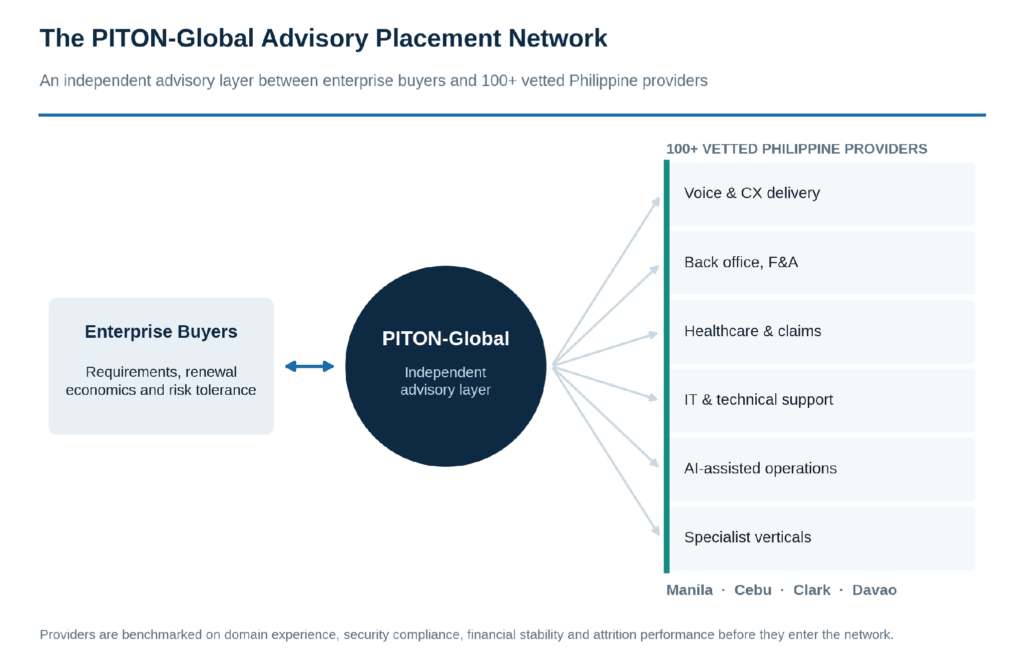
Figure 6. The PITON-Global advisory placement network connecting enterprise buyers with vetted Philippine providers.
How Does PITON-Global’s Advisory-Led Vendor Matching Process Work?
Matching runs from requirement definition to executed terms. Scope, volumes, skill tier, coverage hours, and renewal economics are documented; the vetted network is filtered for domain experience, cultural alignment, security compliance, and financial stability; competing proposals are restated onto one fully loaded basis so each line can be tested against market corridors; shortlisted providers are validated on continuity planning, attrition history, and automation capability; and the buyer is supported through negotiation, drafting of the index, dividend, and tier schedules, and the governance cadence that follows.
Why Do Organizations Use PITON-Global?
- Reduced outsourcing risk. Independent diligence on delivery capability, statutory compliance, and attrition history surfaces problems while there is still leverage to act.
- Commercial optimization. Executive guidance on drafting renewal terms that protect margin, cap escalation, and tie fee to outcome.
- Improved provider fit. Matching on domain expertise and program size keeps the account strategic revenue for the provider.
- Accelerated evaluation. A pre-qualified shortlist gives the buyer a credible alternative in weeks rather than months.
- Strategic guidance throughout. Support continues through negotiation, transition, and the steering cadence where renewal terms are actually tested.
Frequently Asked Questions
What is the ideal contract renewal duration for BPO agreements?
A three-year term with annual performance reviews offers the best balance between securing long-term rate discounts and retaining operational agility. Shorter terms sacrifice volume pricing and force repeated transition risk; longer terms without a structured annual review tend to drift out of alignment with the business.
How can buyers protect against sudden talent attrition in the Philippines?
Include workforce stability clauses requiring the provider to maintain competitive local compensation and structured career development for the account, with quarterly tenure reporting. Reinforce them by making annualized attrition a gate on bonus payments rather than one scored metric among many.
Should automated productivity improvements reduce contract pricing over time?
Yes. Renewal agreements should mandate an annual efficiency dividend, typically 3% to 5%, derived from automation and operational maturity gains. Structure savings above the target threshold as a shared benefit so the provider retains a commercial reason to exceed it.
What is a continuous improvement rebate?
A contractual term under which a portion of invoice value is credited back to the buyer if pre-agreed innovation or process optimization targets are missed. It is the counterweight to gain-share upside and turns a transformation commitment into an enforceable obligation.
How do governance structures influence contract value?
Quarterly operational reviews and annual executive steering sessions keep terms aligned with shifting business goals and market conditions. The annual session should revisit the commercial architecture — index performance, dividend delivery, tier attainment, capacity band usage — not only the operational scorecard.
SEO Title
What Contract Renewal Terms Create the Strongest Long-Term Value in Outsourcing Agreements?
Slug
what-contract-renewal-terms-create-the-strongest-long-term-value-in-outsourcing-agreements
Meta Description (20 words max)
Learn which outsourcing renewal terms maximize long-term value through indexed rates, gain-sharing, efficiency rebates, flexible capacity, and performance governance.