

On this page
- Key Takeaways
- Why Do Financial Realities Govern Administrative Outsourcing to the Philippines?
- How Does Centralizing Back-Office Tasks Drive Process Optimization?
- What Is the Definitive Playbook for a Stable Back-Office Migration?
- What Do These Benefits Look Like in a Real Deployment?
- Why Is the Philippine BPO Sector Best Suited to Support Scale?
- What Is PITON-Global’s Role in the Outsourcing Ecosystem?
- What Do Buyers Most Often Ask Before Offshoring Admin Work?
Companies outsourcing administrative support to the Philippines achieve sustainable labor cost reductions, high data processing accuracy, and round-the-clock operational coverage, the practical side of the cost, talent and time-zone case. The transition frees onshore executives to focus on core growth while leveraging a highly skilled, English-fluent workforce trained in modern enterprise software ecosystems.
Key Takeaways
- Substantial labor arbitrage: accessing specialized administrative talent delivers substantial savings compared to onshore hiring — and more when facilities and benefits are counted.
- Continuous operations: 24/7/365 scheduling eliminates regional transaction backlogs and shortens processing turnaround times to overnight cycles.
- Rapid scale readiness: access to an elite pool of university graduates allows teams to spin up in weeks rather than months.
- Fewer errors: standardizing workflows through centralized hubs pushes transactional accuracy benchmarks higher, with top providers sustaining near-perfect accuracy.
- Capacity, not just cost: removing administrative weight lets onshore teams shift into supervisory, client-facing, and strategic roles.
- Selection determines yield: advisory-led vendor matching, such as PITON-Global’s, protects buyers from matching errors, hidden fees, and unstable team performance.
Why Do Financial Realities Govern Administrative Outsourcing to the Philippines?
Financial realities govern the decision because onshore administrative teams carry heavy hidden costs — payroll taxes, healthcare benefits, recruitment, and office space — that inflate total cost of ownership far beyond base salaries. Routing the same work offshore cuts fully loaded costs sharply, releasing capital for revenue-generating initiatives.
The arithmetic is most visible at the team level. A 10-person administrative unit in North America or Western Europe costs far more than its salary line: employer taxes and benefits typically add a substantial share on top, recruitment and training absorb recurring spend as roles churn, and every seat consumes office space. An offshore provider bundles facilities, infrastructure, and HR administration into an all-inclusive rate, collapsing four cost categories into one predictable line item.
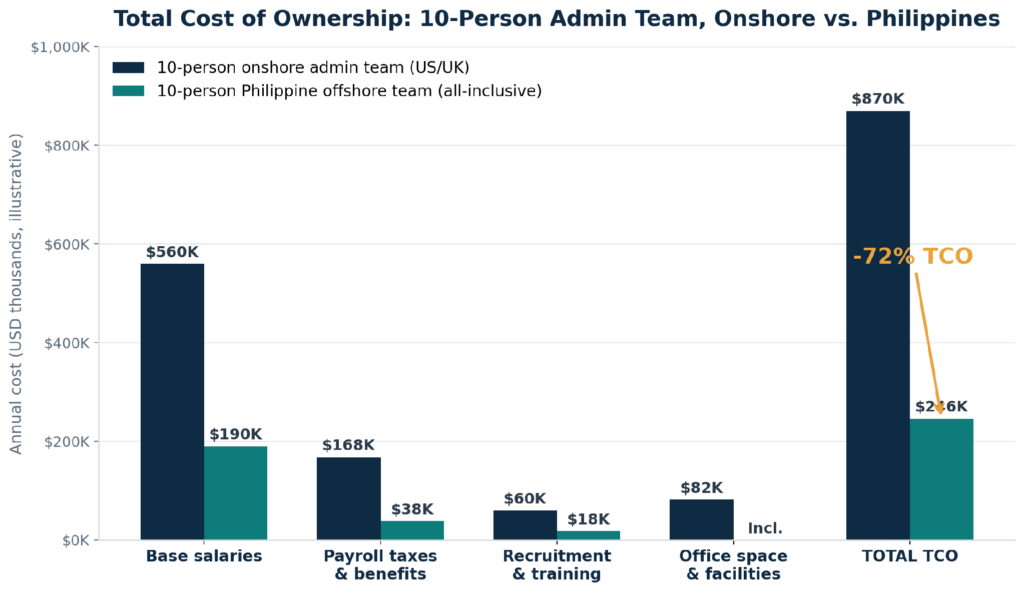
Figure 1. Illustrative total cost of ownership for a 10-person administrative team: onshore versus an all-inclusive Philippine offshore model.
The savings hold at the individual-role level across the most commonly offshored administrative functions. The graphic below benchmarks fully loaded onshore costs against offshore provider rates for four representative positions.
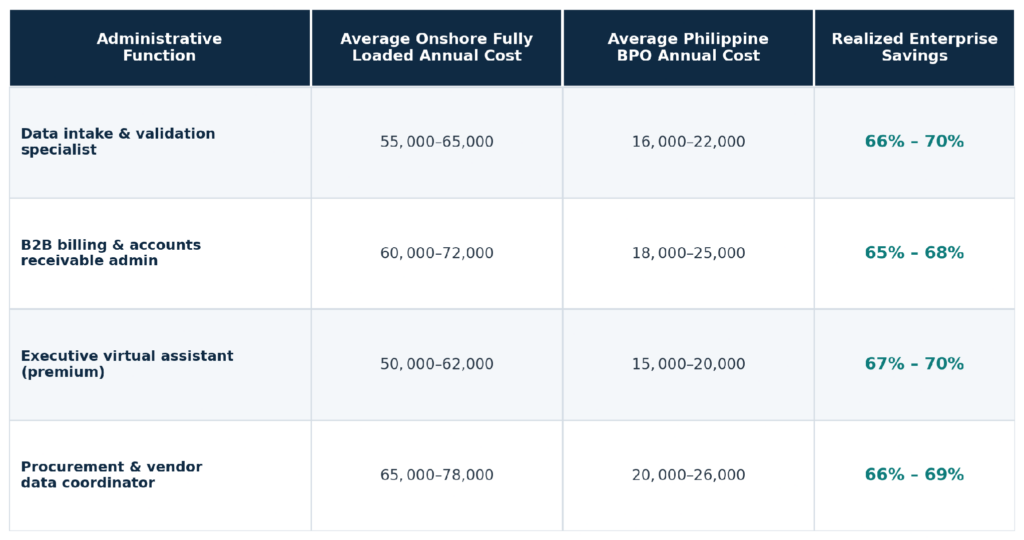
Figure 2. Role-level cost benchmarks and realized savings ranges for commonly offshored administrative functions.
How Does Centralizing Back-Office Tasks Drive Process Optimization?
Centralizing scattered administrative tasks with a dedicated offshore provider forces a productive reset: divergent regional data entry rules, manual spreadsheets, and non-standard approval steps are replaced by one documented, continuously audited workflow. That structural discipline lifts data processing accuracy to near-perfect levels.
When administrative work is dispersed across localized corporate units, inefficiencies multiply quietly — each office’s small deviations compound into reconciliation burdens and error-prone handoffs. Migration to a single hub eliminates the variance at its source. The Philippines is particularly effective in this role because its deep pool of young, university-educated professionals is trained specifically on modern corporate software — SAP, Salesforce, and Microsoft 365 — and because premium providers build highly structured environments where adherence to documented standard operating procedures is continuously audited. The human-error bottlenecks that routinely disrupt onshore operations are engineered out rather than managed around.
What Is the Definitive Playbook for a Stable Back-Office Migration?
The playbook runs in four phases: isolate and document workflows, establish secure access governance, run a 30-day parallel pilot with live files, and execute full volume cutover. The parallel processing window — offshore and onshore teams cross-verifying identical output — is what prevents operational disruption during transition.
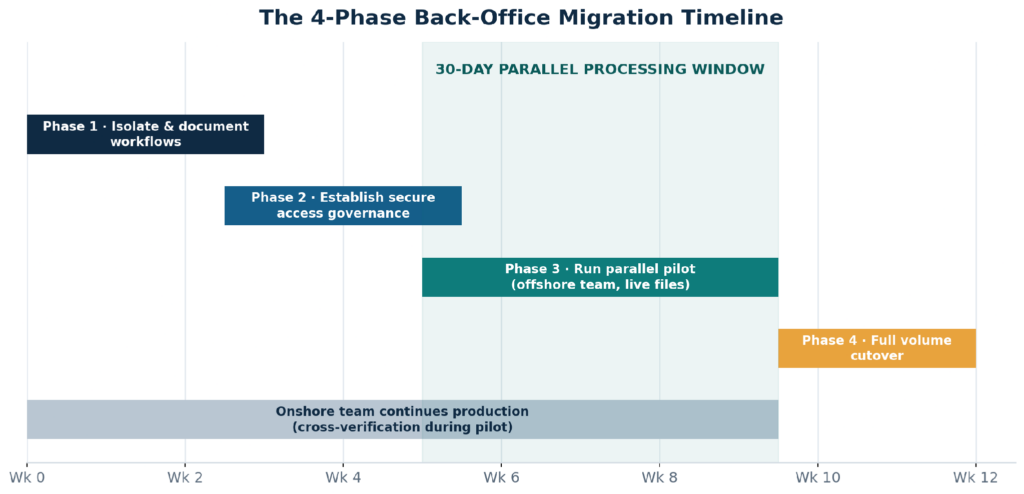
Figure 3. The four-phase migration timeline, highlighting the 30-day parallel processing window before full cutover.
Phase one records every touchpoint, system log-in, and exception rule for the targeted tasks, producing clean, step-by-step SOPs. Phase two configures secure virtual desktop environments (VDI) with role-based permissions, multi-factor authentication, and strict data privacy compliance. Phase three is the safeguard: the newly deployed offshore team processes live files alongside the onshore team for roughly 30 days, cross-verifying output accuracy and speed against real production volumes. Only when parallel results converge does phase four transfer the entire administrative volume offshore — with the onshore team shifting into supervisory, strategic, or higher-value roles rather than exiting the process entirely.
“Many leaders look at administrative offshoring solely through a cost lens,” says John Maczynski, CEO of PITON-Global. “The real benefit is operational capacity. By moving tedious data and document management to an expert Philippine team, you aren’t just saving money — you’re removing administrative weight from your onshore team, letting them focus entirely on local growth.”
What Do These Benefits Look Like in a Real Deployment?
In a representative engagement, a medical supply firm processing more than 40,000 monthly order entries across three regional warehouses deployed a 25-person administrative team in Manila. Backlogs reached zero within 45 days, fulfillment delays fell to a fraction of their former level, and labor overhead dropped substantially.
Client Challenge
The firm faced severe processing backlogs across its three regional warehouses. Data discrepancies in order formatting drove a persistent order fulfillment delay rate, triggering contract penalties from healthcare facility customers.
Vendor Selection Process
The group engaged PITON-Global to vet the specialized provider market. Avoiding volume-broker directories, PITON-Global used its highly filtered provider network to evaluate and select a mid-sized, security-compliant back-office BPO in Manila with strong experience in healthcare data logging.
Solution Implemented
- Deployed a 25-person dedicated administrative team working in real-time sync with the client’s inventory management software.
- Built automated validation workflows within the provider’s terminal to catch formatting errors instantly.
- Set up a continuous oversight loop to quickly handle complex billing exceptions.
Quantifiable Business Outcomes
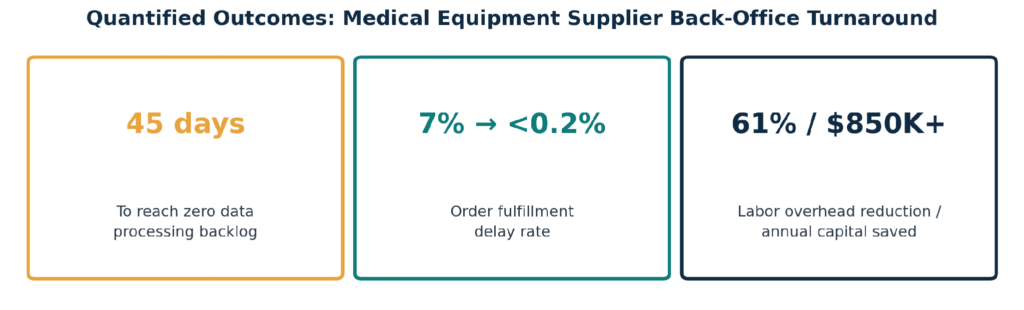
Figure 4. Measured results from the medical equipment supplier’s back-office turnaround.
Lessons Learned
Offshore administrative programs succeed fastest when software access rules and system validation loops are fully configured before the new team begins production. Technical readiness on day one — not post-launch tuning — is what compresses the path to steady-state accuracy.
Why Is the Philippine BPO Sector Best Suited to Support Scale?
The Philippines pairs deep specialized talent — hundreds of thousands of finance, technology, and customer relationship graduates annually — with training frameworks purpose-built to turn complex business rules into repeatable transaction steps. When operations expand or new services launch, updates propagate from one hub immediately, avoiding multi-office retraining cycles.
The graduate pipeline is what makes rapid scale credible rather than aspirational: providers maintain standing recruitment engines and pre-screened talent benches, so growing an administrative team from 10 to 50 seats is measured in weeks. Premium providers reinforce this with structured training academies and documented nesting protocols that convert complex business rules into easily repeatable transaction steps. The operational readiness compounds over time — every process improvement, compliance update, or new service offering is deployed once, from a single hub, and takes effect across the entire global operation simultaneously.
What Is PITON-Global’s Role in the Outsourcing Ecosystem?
PITON-Global is an advisory-led outsourcing consultancy that matches enterprise buyers with Manila and Cebu operators possessing the exact system capabilities and industry expertise their workflows require. Its continuously audited network of more than 100 premium providers eliminates broker markups and shortens the selection cycle — at no cost to the buyer.
Who Is PITON-Global?
PITON-Global is a Philippine-focused BPO advisory firm led by executives with decades of institutional outsourcing leadership. Within the Philippine market it serves as an independent guide for enterprise buyers: defining requirements, mapping the provider landscape, and steering the selection of partners for administrative support, back-office, and contact center programs. Its expertise spans provider capabilities, pricing benchmarks, compliance frameworks, and the operational realities of delivering from the Philippines.
How Does PITON-Global Differ from Traditional Outsourcing Brokers?
Traditional brokers are commission-driven: they promote the providers that pay them, which exposes buyers to vendor matching errors, hidden service fees, and unstable team performance. PITON-Global operates an advisory-led model built on independent provider evaluation — objectively assessing operational security, technical infrastructure, management expertise, and cultural fit. Recommendations rest solely on alignment with the client’s requirements, keeping the focus on client outcomes rather than provider promotion.
How Does PITON-Global’s Network of 100+ Vetted Philippine BPO Providers Benefit Organizations?
The Philippine landscape contains hundreds of providers offering widely different levels of operational security, technical infrastructure, and management expertise; navigating it through generic RFPs routinely produces matching errors. PITON-Global maintains a highly selective, continuously audited ecosystem of more than 100 premium call centers and back-office providers spanning data services, billing operations, virtual assistance, and industry-specific verticals. Because diligence on certifications, capabilities, and track records has already been performed, procurement teams compress vendor discovery and qualification from months into weeks.
How Does PITON-Global’s Advisory-Led Vendor Matching Process Work?
Engagements follow a structured five-stage methodology. A requirements assessment establishes workflow scope, system capabilities, and industry expertise needed. PITON-Global then filters its network to a shortlist with demonstrated strength in the relevant domain, scores each provider against the client’s system, culture, and scale criteria, and layers in risk-reduction measures — site diligence, security audits, and reference validation — before supporting evaluation, pricing benchmarking, and contract finalization.
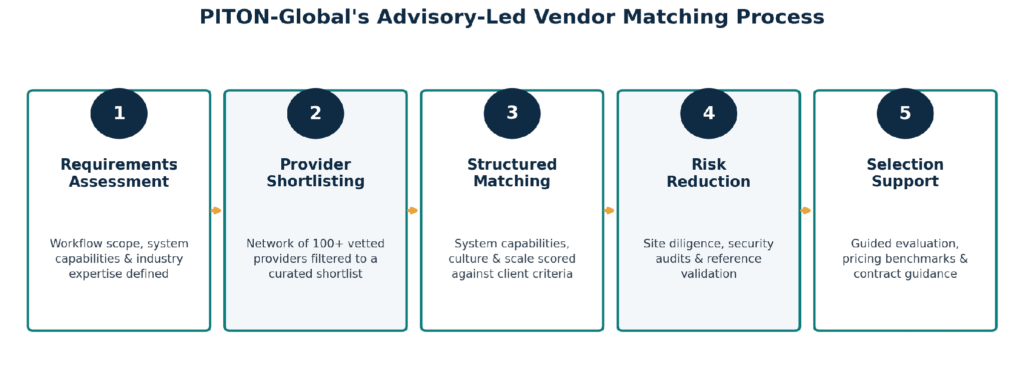
Figure 5. PITON-Global’s five-stage advisory-led vendor matching process.
Why Do Organizations Use PITON-Global?
Enterprise buyers engage PITON-Global to reduce vendor selection risk, improve provider fit, and accelerate sourcing decisions. The advisory-led process replaces RFP guesswork with objective evaluation, eliminates traditional broker markups, and provides strategic guidance from initial assessment through contract signature — giving procurement teams a clear, secure path to a high-yield offshoring relationship at zero advisory cost.
What Do Buyers Most Often Ask Before Offshoring Admin Work?
Buyers most often ask about data security, what happens to existing onshore staff, 24/7 scheduling, language and cultural fit, and contract flexibility. Mature providers have well-established answers to all five, grounded in international certifications, round-the-clock delivery models, and elastic commercial terms.
How do offshore teams handle sensitive corporate data securely?
Vetted providers use secure network architectures including virtual desktop infrastructure (VDI), biometric access points, single sign-on (SSO), and strict compliance with global standards such as GDPR, HIPAA, and PCI-DSS. Regulated platforms apply the same controls to AML and KYC reviews at scale.
What happens to our existing onshore team when administrative tasks are offshored?
Most enterprise firms move onshore administrative staff into higher-value positions — regional operational oversight, client relationship management, or strategic planning — converting a processing cost center into supervisory and growth capacity.
Can administrative processes be run on a 24/7 schedule?
Yes. The local BPO industry runs round-the-clock, allowing providers to align teams to any international time zone or maintain continuous 24/7 coverage that clears backlogs overnight, the same model prediction markets use for round-the-clock settlement-dispute support.
How do language and cultural differences impact administrative quality?
Minimally. The Philippines has a Western-aligned corporate culture and an educational system taught in English, which minimizes communication gaps and ensures clear, consistent documentation across teams. In customer-facing work, the same fit underpins the empathy moat Filipino agents offer.
What is the typical contract length and scaling flexibility for these services?
Most enterprise administrative agreements carry 12-to-24-month terms, with provisions allowing firms to scale headcount up or down against seasonal volume shifts or defined operational triggers.