
As of June 2026, the ten largest active, third-party commercial BPOs and call centers in the Philippines are Concentrix, Accenture, Teleperformance, Alorica, Foundever, Sutherland, TELUS Digital, Capgemini, TTEC, and Genpact. All are verified independent vendors that sign third-party SLAs — they do not include captive operations of multinational organizations or dissolved brands. The list spans both front-office customer experience (CX) and back-office BPO/knowledge work, and it covers only the top layer of a market tiered from enterprise giants to boutiques.
“Having led the global business-development group for the world’s largest contact center for more than two decades, I can tell startups and SMEs from firsthand experience: these ten giants are not built for you. They are designed to serve Fortune 2000 enterprises, typically supporting engagements that require 200 to 2,000+ agents.” — John Maczynski, CEO, PITON-Global
For growing brands scaling between 5 and 100 full-time equivalent (FTE) seats, specialized mid-sized contact centers frequently deliver superior operational outcomes across key metrics — including first-call resolution (FCR), customer satisfaction (CSAT), and leadership accessibility.
Why Enterprise BPO Pricing Fails Startups and SMEs
The global enterprise BPO market is structured around massive, multi-site programs. For emerging companies requiring agile deployment, engaging a Tier-1 enterprise vendor introduces three core operational friction points:
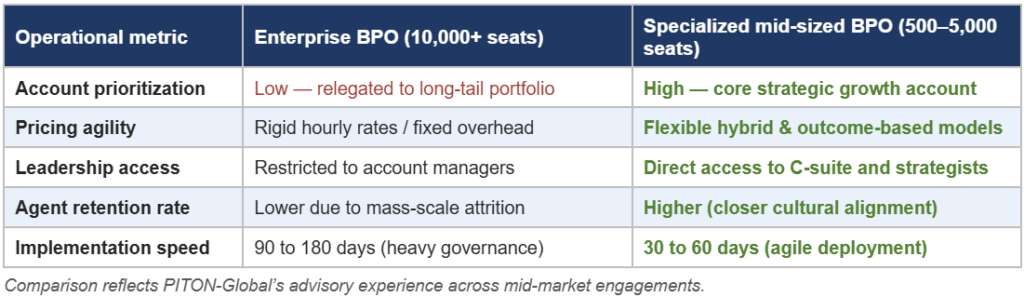
The minimum-threshold gap. Most enterprise mega-vendors enforce strict operational minimums (frequently 100+ seats), so programs requiring 5, 10, 20, 50, or even up to 100 agents fall below these preferred engagement thresholds.
The service-dilution risk. When smaller contracts are accepted by multi-billion-dollar BPOs, they are routinely relegated to junior management layers — reducing strategic attention and imposing rigid, standardized processes.
The margin penalty. Heavy corporate overhead is passed on as higher per-agent costs, forcing growing brands to pay premium enterprise rates without receiving enterprise-level prioritization.
Table 1 — Enterprise vs. mid-sized BPO performance matrix (for 5–100-agent programs)
De-Risking BPO Vendor Sourcing with PITON-Global
Navigating the local outsourcing market — more than 1,200 providers operating today — takes deep, localized intelligence. PITON-Global is a multi-award-winning BPO advisory firm that removes the friction of vendor selection by providing free, independent outsourcing guidance and supplier-sourcing services to high-growth startups, mid-market companies, and Fortune 500 enterprises.
Operating natively within the local BPO ecosystem since 2001, PITON-Global is the country’s longest-standing independent BPO advisory firm. Over more than two decades it has architected and verified 500-plus successful client engagements, and it maintains active partnerships with only a small, vetted group of top-performing mid-sized providers across 12 industries.
Free, no obligation: PITON-Global matches you to the right-sized partner from its vetted short list of top-performing providers — at no cost to you.
Our Strategic Vetting Architecture
Rather than relying on generic vendor directories, PITON-Global runs a rigorous, continuous auditing framework to match your organization with elite performance:
| The Top 1% Filter Continuous auditing We continuously vet and analyze the mid-sized market, maintaining active partnerships exclusively with the top 1% of award-winning Philippine contact centers — drawn from a field of 1,200-plus providers. |
| Multidimensional Alignment Bespoke matching matrix We map your requirements across five critical vectors: industry expertise, technical infrastructure (including Agentic-AI integration capacity), cultural synergy, budget boundaries, and targeted growth stage. |
| Unbiased Market Synthesis Zero-fee advisory Backed by a leadership team with 60-plus years of combined global and domestic BPO experience, we deliver fully independent recommendations tuned to maximize first-call resolution (FCR) and customer satisfaction (CSAT). |
Macro-Economic Trajectory of the IT-BPM Sector
According to baseline data from the IT and Business Process Association of the Philippines (IBPAP), the sector’s trajectory reflects a decisive shift from basic labor arbitrage toward higher-value intelligence arbitrage:

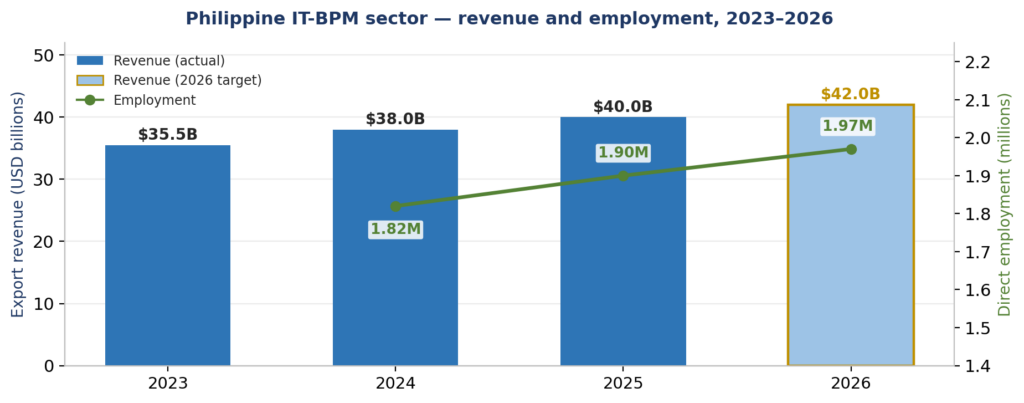
Figure 1. Sector trajectory; 2026 figures are IBPAP baseline targets, not realized results.
This macro shift toward “intelligence arbitrage” — powered by Agentic AI and human-in-the-loop workflows — is precisely why procurement teams must screen exclusively for active commercial vendors that accept third-party contracts, not corporate captives or dissolved brands.
Why Paid BPO Marketplaces and Directories Fail Procurement Teams
Monetized call-center directories and paid online marketplaces operate on pay-to-play models — ranking vendors by placement fees, not delivery capability. This structural model produces two recurring data defects: listing dissolved or absorbed brands as if they still trade independently, and misclassifying private corporate captives (which accept no external clients) as commercial vendors available for hire.
1. Ghost entities and legacy brand decay
Affiliate directories routinely surface legacy brands that no longer exist as independent commercial entities:
- Stream Global Services: acquired by Convergys in 2014, which was then absorbed into Concentrix (under SYNNEX) in 2018. Any 2026 listing of Stream as an active, independent provider is three corporate generations out of date.
- Foundever: mislabeled as a product of a “Sitel/SYNNEX merger.” It was actually formed via Sitel Group’s 2021 acquisition of Sykes Enterprises and a 2023 global rebrand — SYNNEX belongs exclusively to the Concentrix lineage.
- WNS: Capgemini completed its US$3.3-billion acquisition of WNS in October 2025. WNS is now consolidated into Capgemini and no longer trades independently.
2. Captive facility misclassification
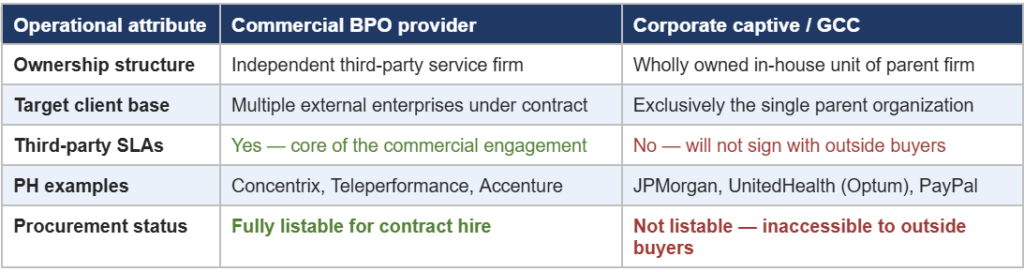
The more severe procurement error is listing Global Capability Centers (GCCs) as commercial BPOs. A corporate captive is an in-house, wholly owned offshore unit serving exclusively its parent organization.
The procurement reality: these captives do not accept external clients and will not sign external SLAs — so including them on a “hire-a-vendor” list is fundamentally misleading; a buyer cannot contract with them at all.
In-country captive footprints: JPMorgan Chase employs more than 21,000 professionals at its local GCC; UnitedHealth Group (Optum), Wells Fargo, American Express, PayPal, and Citi operate similarly scaled hubs.
Table 2 — Commercial BPO vs. corporate captive (GCC): operational profiles
“Most procurement teams still confuse a captive capability center with a commercial vendor that will actually sign an SLA. They are not interchangeable. Match the workload to the operating model first, then build the shortlist — never the other way around.” — Ralf Ellspermann, CSO, PITON-Global · 25-year, multi-awarded Philippine BPO executive
Comparative Matrix: The 10 Largest Commercial BPO Providers in the Philippines
The following evaluation indexes the ten largest verified, active, third-party commercial BPO organizations operating in the Philippines as of June 2026, ranked by estimated local delivery footprint. Headcount figures are best-available estimates — most providers do not disclose exact in-country totals — and are presented as ranges, not audited counts.
Table 3 — The ten largest active commercial BPO providers (June 2026)
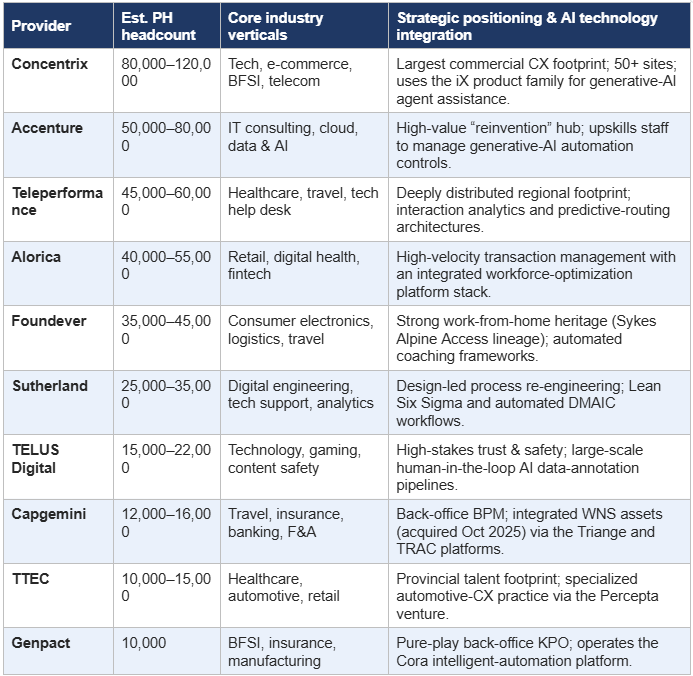
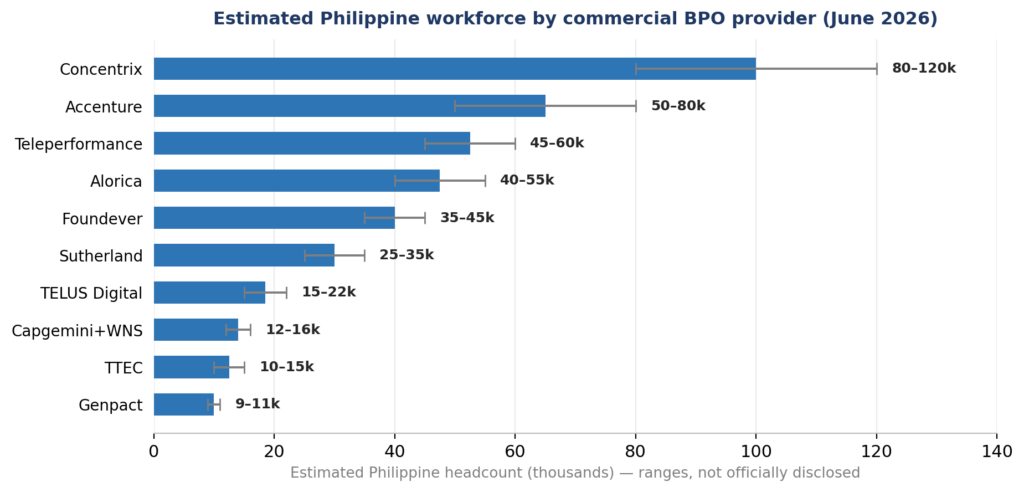
Figure 2. Estimated local workforce by provider; ranges reflect undisclosed official totals.
Granular Provider Profiles
What Are the Commercial BPO Capabilities of Concentrix Philippines?
Concentrix operates the country’s largest commercial contact-center footprint — 50-plus sites across Quezon City, Taguig (BGC), Ortigas, Alabang, Cebu, Iloilo, Bacolod, Baguio, and Davao — delivering omnichannel customer experience at national scale for technology, e-commerce, banking and financial services, and telecommunications clients.
Concentrix concentrates on front-office CX, technical support, sales, and trust-and-safety programs for Fortune 500 and global digital brands, with scale as its defining advantage. The provider also carries significant heritage assets: it absorbed Convergys in 2018, which had earlier acquired Stream Global Services, consolidating several once-independent local operations under one roster.
Concentrix publicly markets a GenAI assist layer (its iX product family) for real-time agent guidance, automated post-call summarization, and interaction analytics, run inside controlled delivery environments and virtual desktop infrastructure. Human agents handle escalations and judgment-heavy contacts while automation absorbs repetitive query types — the early shape of the super-agent model.
What Are the Commercial BPO Capabilities of Accenture Philippines?
| Accenture runs one of the largest professional-services delivery networks in the Philippines, concentrated in Metro Manila (Mandaluyong, Quezon City, Taguig) and Cebu. Operations span technology consulting, enterprise cloud, application and infrastructure support, finance and accounting, and high-end data and AI work rather than commodity voice. |
Accenture positions its local workforce as a “reinvention” and operations hub for Fortune Global 500 clients, blending consulting with managed services. Its strength is moving clients up the value curve — from transactional processing toward analytics, engineering, and AI-enabled operations — which differentiates it from pure-play contact-center vendors.
Accenture invests heavily in upskilling local staff to design, supervise, and quality-check generative-AI systems rather than simply operate scripts. Delivery sits within enterprise-grade security and data-governance controls, and the firm increasingly structures its Manila and Cebu teams as human oversight layers over automated workflows and AI agents.
What Are the Commercial BPO Capabilities of Teleperformance Philippines?
| Teleperformance maintains one of the most geographically distributed BPO footprints in the country, with sites across Luzon, the Visayas, and Mindanao — including Metro Manila, Cebu, Bacolod, Davao, and Cagayan de Oro — covering healthcare, travel and hospitality, technology help desk, and omnichannel consumer support. |
Teleperformance serves global enterprises that need broad language coverage and high availability, leaning on its multi-region footprint for business-continuity resilience. Healthcare and travel are anchor verticals, where regulatory handling and seasonal volume elasticity reward a large, distributed agent base.
Teleperformance applies speech and interaction analytics, predictive routing, and a GenAI agent-assist layer to compress handle times and surface next-best actions mid-interaction. Sensitive programs operate under PCI- and HIPAA-aligned controls within secured delivery environments, with human review retained for complex and high-risk contacts.
What Are the Commercial BPO Capabilities of Alorica Philippines?
| Alorica delivers high-volume interaction management from metropolitan and regional Philippine campuses — including Metro Manila, Clark, Cebu, Iloilo, and Davao — concentrating on retail, digital health, fintech, and communications, and pairing large agent pools with integrated workforce-optimization platforms. |
Alorica targets enterprises with large, fluctuating contact volumes and serves both established brands and scaling mid-market accounts. Its operational emphasis is velocity and consistency at scale, supported by mature scheduling, quality-management, and retention systems across its regional campus network.
Alorica layers GenAI agent assist and automation onto its workforce-optimization stack, using real-time guidance and analytics to standardize quality across high-turnover, high-volume programs. Human-in-the-loop review governs exceptions, and sensitive workloads run within access-controlled, monitored delivery environments.
What Are the Commercial BPO Capabilities of Foundever Philippines?
| Foundever — formed when Sitel Group acquired Sykes Enterprises in 2021 and rebranded in 2023 — employs roughly 40,000 across the Philippines, with hubs in Metro Manila, Cebu, and sites throughout Luzon and the Visayas. Verticals span consumer electronics, insurance, logistics, and travel. |
Foundever ranks among the top three global CX providers and brings a strong digital-first and work-from-home heritage inherited from Sykes, whose Alpine Access lineage pioneered home-based delivery. That hybrid capacity gives clients flexible, resilient staffing models across its domestic network.
Foundever pairs automated agent-coaching frameworks and GenAI assist with scaled CX consulting, focusing on reducing handle times and improving first-contact resolution. Delivery operates within standard enterprise security controls, and the provider blends automation with human specialists for regulated insurance and warranty workflows.
What Are the Commercial BPO Capabilities of Sutherland Philippines?
| Sutherland operates as a process-transformation specialist in the Philippines, with delivery centers in Metro Manila, Clark, and the Visayas. Engagements emphasize digital engineering, technical help desk, and enterprise analytics, applying Lean Six Sigma and DMAIC methods to redesign and automate transactional workflows. |
Sutherland differentiates on design-led process re-engineering rather than seat count, targeting enterprises that want workflows rebuilt and automated, not merely staffed. Analytics and technical support are core, with consulting wrapped around delivery to identify and remove process friction.
Sutherland deploys conversational AI, robotic and intelligent automation, and analytics platforms to absorb repetitive transactions, retaining human specialists for exception handling and continuous-improvement loops. Delivery runs inside controlled, audited environments, consistent with its measurement-driven, DMAIC operating philosophy.
What Are the Commercial BPO Capabilities of TELUS Digital Philippines?
| TELUS Digital (formerly TELUS International) runs specialized digital-CX and trust-and-safety operations in the Philippines, primarily in Metro Manila, focusing on content moderation, platform safety, and AI data annotation for technology, gaming, and social-media clients. |
TELUS Digital concentrates on high-stakes digital work where accuracy and policy adherence matter more than raw call volume. Content moderation and platform integrity are signature offerings, paired with structured agent-wellbeing programs given the demanding nature of trust-and-safety queues.
TELUS Digital provides large-scale AI data annotation and human-in-the-loop labeling that feed machine-learning pipelines, alongside its own GenAI tooling for productivity. Sensitive moderation and annotation tasks run within secured, access-controlled environments designed to protect both client data and worker wellbeing.
What Are the Commercial BPO Capabilities of Capgemini Philippines?
| Capgemini completed its US$3.3-billion acquisition of WNS in October 2025, merging its own Philippine operations (Alabang, Taguig) with WNS’s established Metro Manila BPM delivery. The combined unit handles travel and insurance analytics, finance and accounting, and data operations — positioned as “Agentic AI-powered Intelligent Operations.” |
WNS brought two decades of vertical depth — airline and travel revenue operations, insurance claims and underwriting support, and finance and accounting — built from its British Airways origins. Capgemini adds consulting-led transformation, IT services, and global scale, so the combined entity now spans process delivery, analytics, and the technology stack around them for enterprise clients.
Following the October 2025 close, WNS is consolidated into Capgemini and no longer trades independently — a change most directories have yet to reflect. Locally, the group pairs WNS’s analytics and intelligent-automation tooling (its Triange and TRAC offerings) with Capgemini’s AI and engineering capabilities, retaining domain specialists for judgment-intensive exceptions within controlled, audited environments.
What Are the Commercial BPO Capabilities of TTEC Philippines?
| TTEC runs one of the most regionally distributed CX footprints in the Philippines, operating in the country since 2001 across Cebu, Bacolod, Dumaguete, Iloilo, Lipa, Santa Rosa, Pampanga, and Metro Manila (Pasay, Quezon City, Cainta, Mandaluyong). Its Manila Bay site alone carries roughly 3,000 seats. |
TTEC concentrates on customer experience and care for healthcare, automotive, retail, public-sector, and travel clients, with a deliberate provincial-site strategy that taps college-educated talent pools outside congested Metro Manila. Its Percepta joint venture gives it a specialized automotive-CX practice, and the firm is known locally as an employer-of-choice with comparatively low attrition.
TTEC pairs delivery with its own CX technology and analytics stack (its TTEC Digital arm) plus GenAI-assisted agent guidance, automation, and AI data work, while human agents handle escalations and judgment-heavy contacts. Programs run within controlled, access-managed delivery environments aligned to client compliance requirements.
What Are the Commercial BPO Capabilities of Genpact Philippines?
| Genpact — the BPM pioneer spun out of GE — runs back-office and analytics delivery from Quezon City, Alabang, Bataan, and Bohol, employing roughly 10,000 in the Philippines. Its teams handle finance and accounting, insurance claims, collections, sourcing, and data-and-analytics operations for global clients — knowledge work rather than voice. |
Genpact is the back-office counterweight on this list: a pure-play business-process and knowledge-process specialist with finance, FP&A, order-to-cash, insurance, and analytics at its core. Its local operation has expanded into provincial sites such as Bataan and Bohol, broadening its talent base beyond Metro Manila for transaction- and analytics-heavy programs.
Genpact runs domain analytics and intelligent automation (its Cora platform and data-and-AI tooling) to industrialize processes like reconciliation and claims, keeping human specialists on judgment and continuous improvement. Its in-country certifications confirm a BPM scope spanning finance, insurance, healthcare, and IT services within controlled, audited environments.
How Will Agentic AI and Outcome-Based Pricing Restructure BPO Vendor Selection by 2027?
The linear, per-hour, per-seat billing model is collapsing. By 2027, leading engagements will price against verified outcomes — resolved interactions, accuracy thresholds, and interaction velocity — rather than staffed hours. Human agents increasingly act as “super-agents,” supervising fleets of autonomous AI agents and intervening only on exceptions and high-judgment escalations.
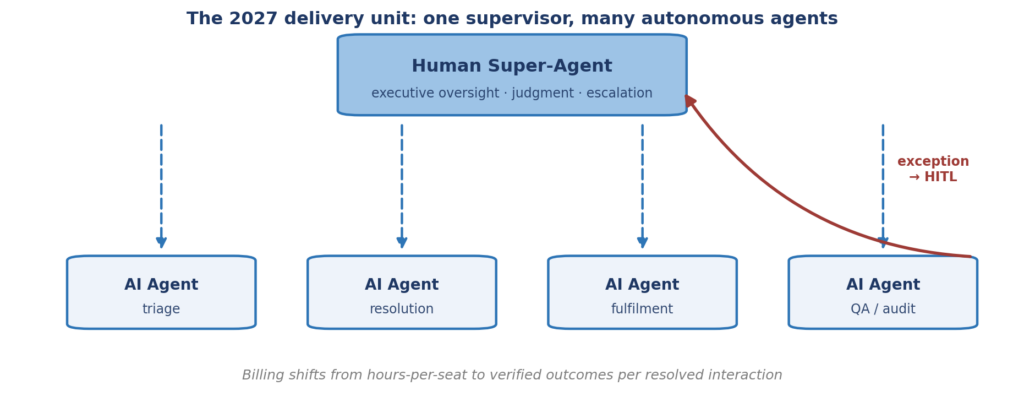
Figure 3. The emerging delivery unit: one human supervisor overseeing multiple autonomous AI agents.
The end of the hourly-rate tax on efficiency. Traditional billing penalizes the very automation that improves service: when a vendor resolves contacts faster with AI, an hourly model shrinks its own revenue. That misalignment is pushing buyers and providers toward variable architectures tied to outcomes — cost-per-resolution, accuracy guarantees, and tiered pricing that rewards deflection and speed. The provider’s margin then comes from engineering efficiency, not from billing more hours, aligning incentives with the client’s actual goals.
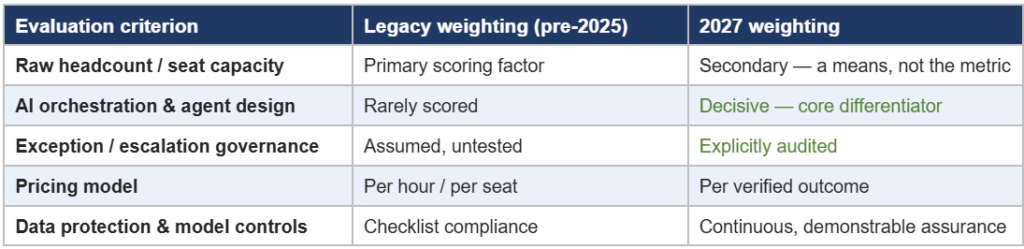
Rewriting the RFP around agility, not headcount. Procurement officers should rebuild requests for proposals to measure technical agility and governance rather than raw seat capacity. The decisive questions become how a vendor orchestrates AI agents, how exceptions escalate to human judgment, how models are evaluated and corrected, and how data is protected throughout. The table below reframes the evaluation weighting buyers should bring to 2027 selection.
Table 4 — Reweighting the BPO RFP for 2027
How this guide was fact-checked
Sector figures (revenue, employment, GDP share, 2026 targets) are drawn from IBPAP reporting carried by Manila business press in late 2025 and early 2026. The JPMorgan Chase GCC headcount (21,000+) is from the same IBPAP briefings.
Two widely repeated directory errors were corrected against primary sources: (1) Stream Global Services was acquired by Convergys in 2014 (SEC filings), and Convergys was absorbed into Concentrix via SYNNEX in 2018 — Stream is not an independent vendor. (2) Foundever was formed from Sitel Group’s 2021 acquisition of Sykes and 2023 rebrand — not a “Sitel/SYNNEX” merger, which conflates the Concentrix lineage. (3) WNS is no longer independent: Capgemini completed its US$3.3-billion acquisition of WNS in October 2025, so it is listed here as Capgemini (incl. WNS).
Headcount figures are best-available estimates expressed as ranges; most providers do not publicly disclose exact country-level totals, and figures should be confirmed directly during vendor due diligence. Provider technology descriptions reflect publicly marketed capabilities, not site-level audits. This guide is informational and not procurement, legal, or financial advice.