
For professional-grade AI-voice agents in Philippine BPOs, the ideal P95 latency is under 800ms to preserve natural conversational flow. Sub-1,000ms is acceptable for basic transactional tasks, but P95 above 1,500ms is disruptive — driving caller frustration, higher abandonment, and a robotic feel that breaks the illusion of a human interaction. Those thresholds now shape how buyers judge voice AI and agent assist in outsourced CX.
In 2026, the AI-voice battleground in Philippine outsourcing is no longer which model you use — it is how fast that model can respond. As providers pivot toward agentic AI architectures, the winners compress every millisecond of the round trip through local edge-compute and co-located telephony. The sections below define how those standards are measured, benchmarked, and achieved.
How Is Conversational Latency Actually Measured?
Latency is the cumulative time of four technical stages: network ingress, speech-to-text (ASR), LLM inference, and text-to-speech (TTS). Humans take conversational turns within a ~200ms gap, so an AI agent must compress all four stages to feel natural. Philippine providers win by shrinking them with local edge-compute and co-located telephony.
In human conversation, the gap between one speaker finishing and the next beginning averages roughly 200 milliseconds. An AI agent cannot match that across a full round trip, but the closer it gets, the more lifelike the exchange feels. Every stage adds to the budget, and the slowest link — usually a distant LLM call or an extra vendor hop — sets the ceiling for the entire interaction.
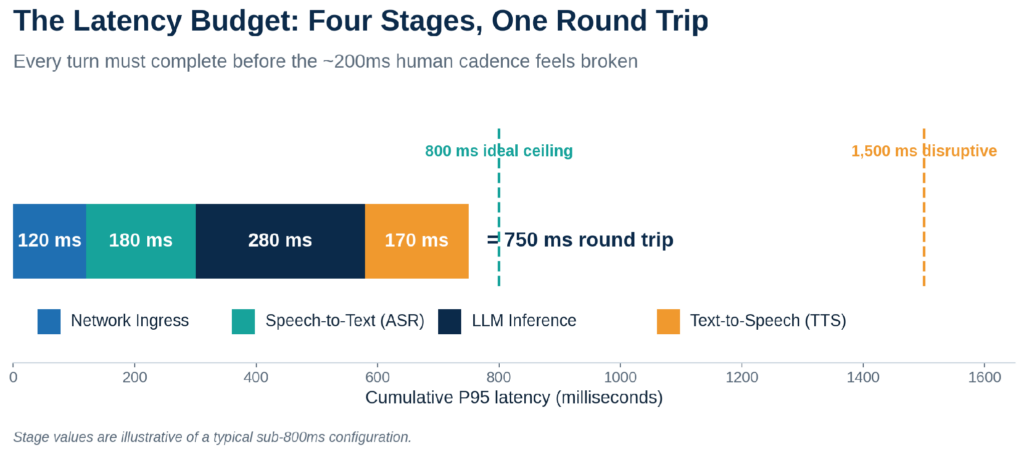
Network Ingress
The time for the caller’s audio to travel from the phone network to the processing node. Co-located telephony keeps this near-zero; routing over the public internet inflates it.
Speech-to-Text (ASR)
Converting spoken audio into text the model can read. Streaming recognizers that transcribe as the caller speaks shave precious milliseconds off this stage.
LLM Inference
Usually the largest single contributor. What matters is time-to-first-token — how quickly the model starts responding — not just how fast it finishes.
Text-to-Speech (TTS)
Rendering the model’s text back into natural audio. Streaming synthesis lets the agent begin speaking before the full sentence is generated.
What Are the P95 Latency Benchmarks by Use Case?
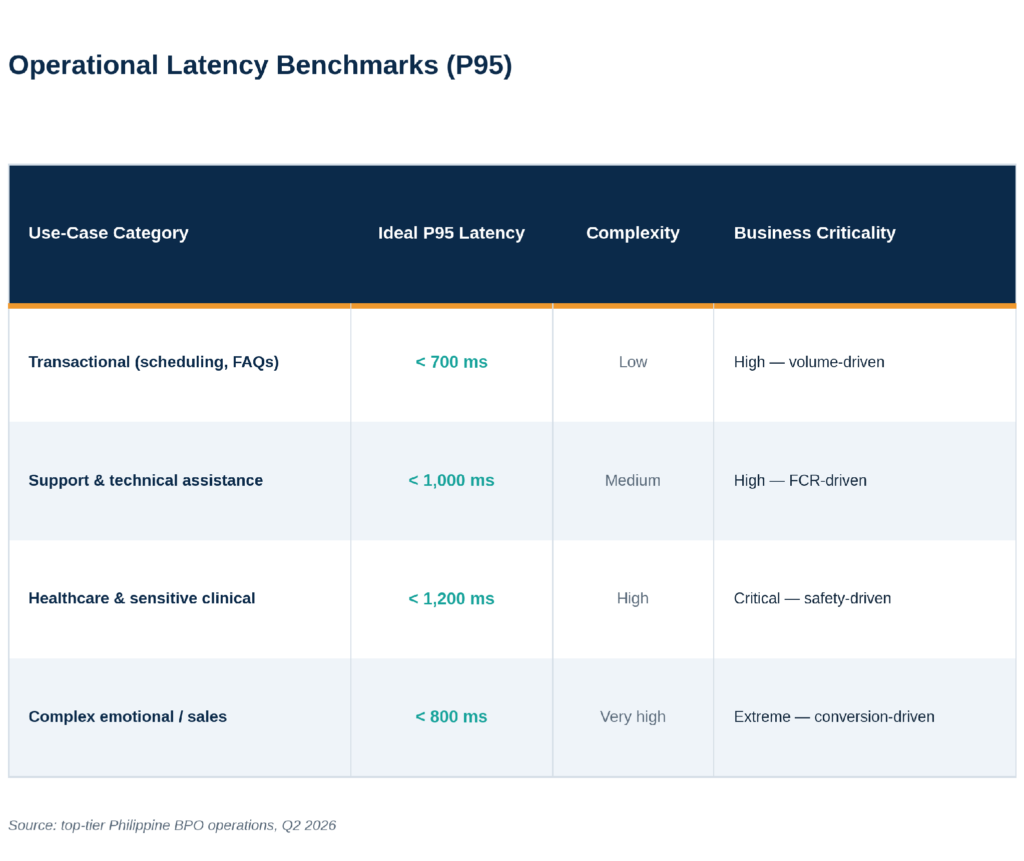
They vary by interaction type. Transactional tasks such as scheduling and FAQs target under 700ms; support and technical assistance under 1,000ms; healthcare and sensitive clinical under 1,200ms; and complex emotional or sales conversations under 800ms, where a natural cadence directly shapes conversion.
These thresholds are not arbitrary — they track the cost of a misstep. High-volume transactional flows demand the tightest budgets because small delays compound across millions of calls. Clinical interactions tolerate slightly more latency in exchange for accuracy and safety checks, while sales and emotionally charged conversations need a tight, lifelike rhythm: hesitation reads as uncertainty and erodes trust at the exact moment a customer is deciding.
Why Does Infrastructure Matter More Than Model Power?
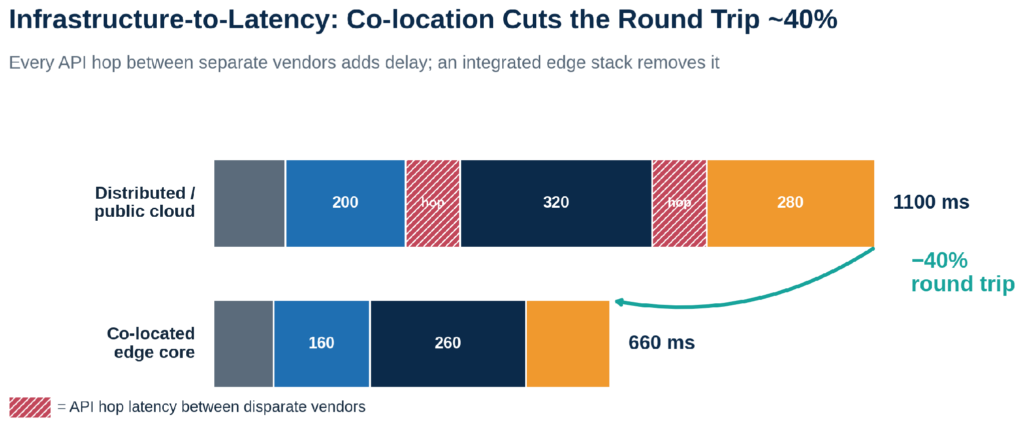
Because co-locating the inference engine with the cloud-telephony core can cut round-trip time substantially versus distributed, public-cloud architectures. Every API hop between separate ASR, LLM, and TTS vendors adds delay. The fastest Philippine operators integrate the full stack at the telephony edge to hold P95 latency consistently sub-800ms.
The most common strategic error is obsessing over model selection while ignoring the path the audio actually travels. A “stitched” architecture — where ASR, LLM, and TTS each live with a different vendor — pays a latency tax at every handoff. Integrating the stack at the telephony core eliminates those hops and is the single biggest lever on perceived responsiveness. Mature automation also reshapes staffing, as the process maturity paradox shows: the most automated operations often employ more people, not fewer.
“The most common strategic failure in outsourcing AI is obsessing over the LLM model while ignoring the plumbing. Our leading partners are abandoning ‘stitched’ architectures, because every API hop introduces latency that kills the ‘human’ feel. If your AI agent sounds robotic or sluggish, it isn’t the model’s intelligence — it’s the network architecture.”
— John Maczynski, CEO, PITON-Global
How Does Lower Latency Translate to Business Results?
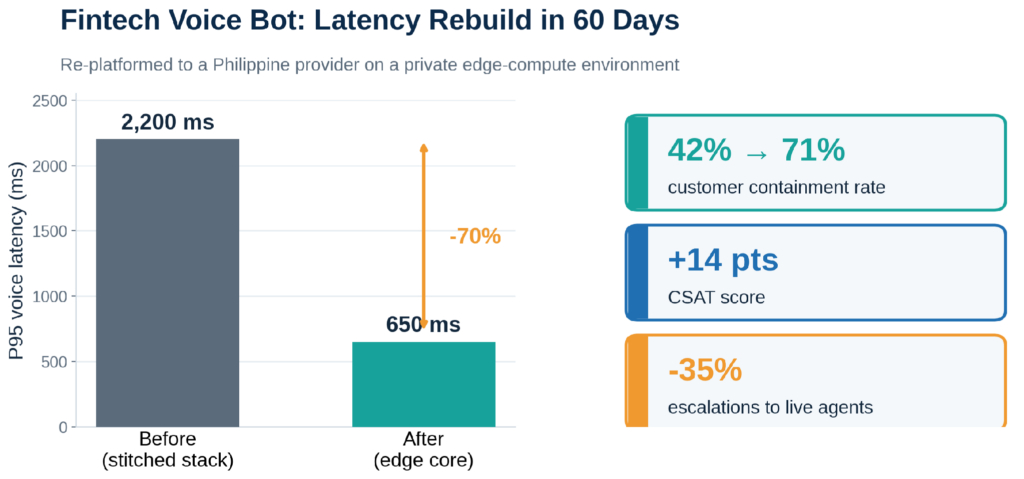
A U.S. fintech client cut voice-bot latency from 2,200ms to 650ms by moving to a Philippine provider running a private edge-compute environment. Within 60 days, customer containment rose sharply, escalations to live agents fell, and CSAT climbed markedly — lowering cost-per-contact along the way.
At 2.2 seconds, the bot was slow enough that callers assumed it had stalled and talked over it — “barge-ins” that derailed conversations and pushed roughly a third of all interactions to human agents. Collapsing latency to 650ms restored a natural turn-taking rhythm, so callers let the AI finish and trusted its answers. The downstream economics followed: more contained conversations, fewer costly escalations, and measurably happier customers. The calls that still escalate go to people freed for harder work, the territory explored in whether AI-augmented Filipino agents can cover Tier 2.
How Should Buyers Evaluate an AI-Voice Vendor’s Latency?
Ask for P95 latency figures, not averages — averages hide the worst calls that frustrate users. Confirm the stack is integrated at the telephony core rather than stitched from separate vendors, verify edge-compute co-location, and request use-case-specific benchmarks tied to your traffic rather than generic marketing numbers.
Most latency disappointments trace back to weak due diligence. Before signing, pressure-test these four points:
- Demand P95, not averages — a flattering mean can still hide a long tail of calls that feel broken.
- Probe the architecture — ask whether ASR, LLM, and TTS are integrated at the telephony core or stitched across separate vendors.
- Verify edge co-location — confirm the inference engine sits close to the telephony layer, not in a distant public-cloud region.
- Match benchmarks to your use case — a 700ms FAQ target tells you nothing about whether a sales line will hold sub-800ms.
In voice AI, intelligence is table stakes; speed is the differentiator. The Philippine providers pulling ahead treat latency as an architectural discipline, not a model-selection afterthought, and buyers should factor that discipline in when they compare outsourcing spend with automation investments.