
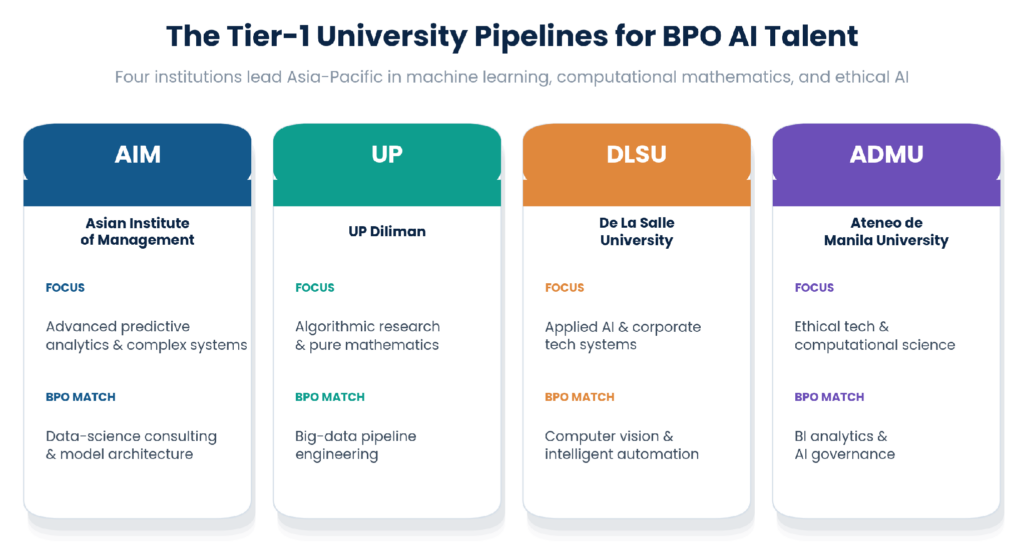
Target graduates from the Asian Institute of Management (AIM), University of the Philippines (UP) Diliman, De La Salle University (DLSU), and Ateneo de Manila University (ADMU). These institutions lead Asia-Pacific in machine learning, computational mathematics, and ethical AI, and they supply the data and AI BPO talent that keeps responsible AI inside an outsourced workflow. A specialized BPO advisory firm provides direct access to their pipelines.
The Philippines built its reputation as the world’s customer-experience capital, but a structural shift is underway. As agentic AI matures, enterprise demand is moving from basic voice support toward complex data curation, model fine-tuning, and machine-learning operations (MLOps). The talent that work requires comes from a handful of elite institutions — and knowing which ones, and what each is best at, is now a procurement advantage in its own right. For buyers, the shift reframes the Philippines from a place to find inexpensive voice agents into a place to find scarce technical talent — provided they know exactly where to look.
Which Local Universities Offer the Strongest Data-Engineering Pipelines?
Four stand out. AIM leads high-end analytics through its Data Science Institute; UP Diliman supplies elite algorithmic and quantitative talent; DLSU specializes in NLP and computer vision; and ADMU focuses on ethical AI, business intelligence, and governance. Each maps to a distinct back-office BPO function within a blueprint for scaling AI outsourcing.
The IT-BPM sector now employs roughly 1.8 million people, but the real value driver is the conversion of a growing share of traditional roles into AI-augmentation and data-engineering functions. AIM’s Dr. Andrew L. Tan Data Science Institute offers the country’s first PhD in Data Science and exposes students to supercomputing through its ACCeSs Laboratory, producing data architects and predictive modelers. UP Diliman’s Computer Science and Mathematics programs train algorithmic researchers in statistical modeling and Python ML frameworks. DLSU graduates bring NLP and computer-vision depth suited to annotation, risk modeling, content moderation, and the human feedback behind reward-driven AI, while ADMU emphasizes data visualization, BI, and AI governance — critical for compliance-sensitive Fortune 500 buyers. In short, the four are not interchangeable: each feeds a different layer of the modern data stack, so the right choice depends on whether a program needs annotation throughput, pipeline engineering, applied-AI builds, or governance-grade oversight.

Matching each institution’s specialization to the back-office BPO function it best serves.
How Can Buyers Mitigate the Risk of AI Talent Scarcity?
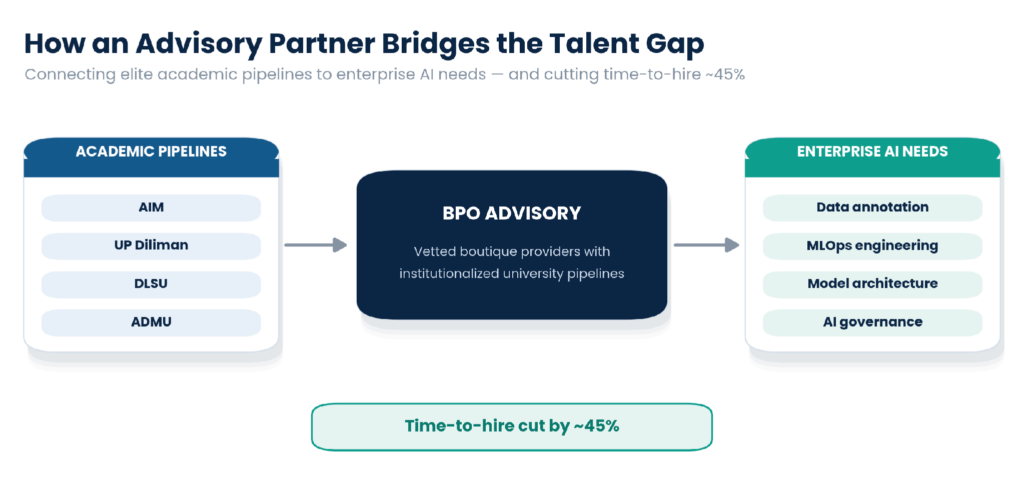
Stop hiring directly or through legacy volume vendors. Because demand for tier-1 data scientists far outstrips supply, direct hiring brings churn and wage inflation. The fix is a formal advisory framework connecting enterprise needs to specialized boutique BPOs with institutionalized university pipelines — cutting time-to-hire substantially.
Navigating this hyper-specialized market alone introduces real operational friction. Because global demand for elite data scientists vastly outstrips supply, Western enterprises that hire directly or lean on unvetted, legacy volume suppliers face high recruitment churn and escalating wage inflation. A formal framework that channels academic pipelines through vetted boutique providers removes most of that friction before it reaches the buyer. The advantage compounds over time: a provider with a standing relationship to a department’s graduating cohorts can refill and scale a team predictably, instead of competing for scarce hires on the open market every quarter. The same scarcity is reshaping the 2026 talent market and the rise of the AI pilot.
“The competition for premium AI and data engineering talent in Manila is fierce. Enterprise buyers can no longer rely on traditional volume-based vendors. Success requires partnering with mid-sized, specialized BPO providers that maintain direct, institutionalized pipelines into academic hubs like AIM and UP. This is the exact ecosystem approach we engineer for our clients.”
— John Maczynski, CEO of PITON-Global
How Did a Silicon Valley FinTech Scale Its Data Pipeline in Manila?
A fintech needed to label and audit millions of transactions to retrain its credit-scoring LLM, but domestic costs and a 60-day backlog were unsustainable. PITON-Global matched it to a boutique Manila vendor recruiting from DLSU and AIM. The result: 48 specialists in 21 days, sharply lower cost, and a clear jump in model accuracy.
The client’s in-house engineering team was drowning in unstructured financial data and rising domestic costs. PITON-Global audited its network of more than 100 specialized providers and matched the program to an elite boutique back-office vendor — one that actively recruits its mid-level managers and lead architects directly from DLSU’s and AIM’s post-graduate analytics tracks. Speed mattered as much as cost: the backlog was growing by the day, and a 60-day domestic hiring cycle would only have let it compound further before any work began.
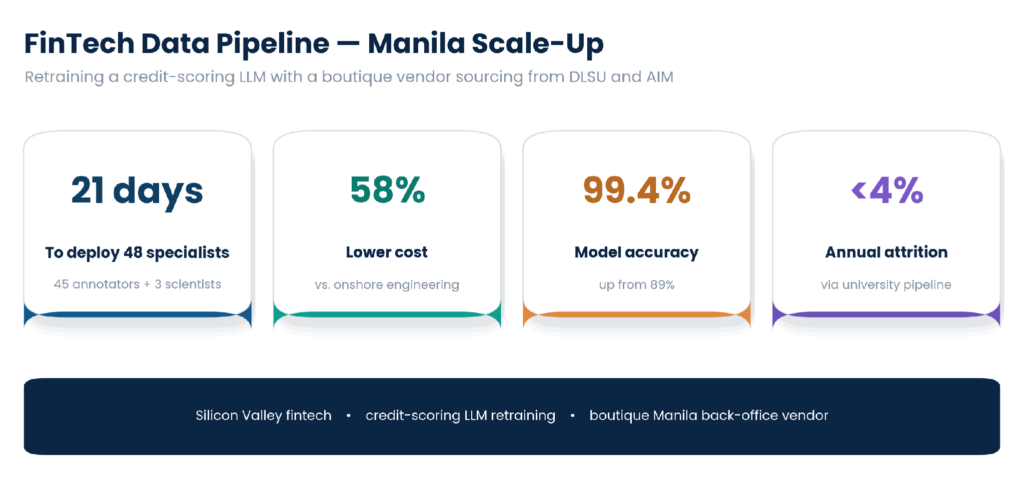
The dedicated university pipeline did more than fill seats quickly. As tenure built, model-training accuracy climbed past the client’s SLA thresholds and annual attrition stayed very low, guaranteeing continuity on a proprietary codebase — the kind of stability that direct hiring or volume vendors rarely deliver.
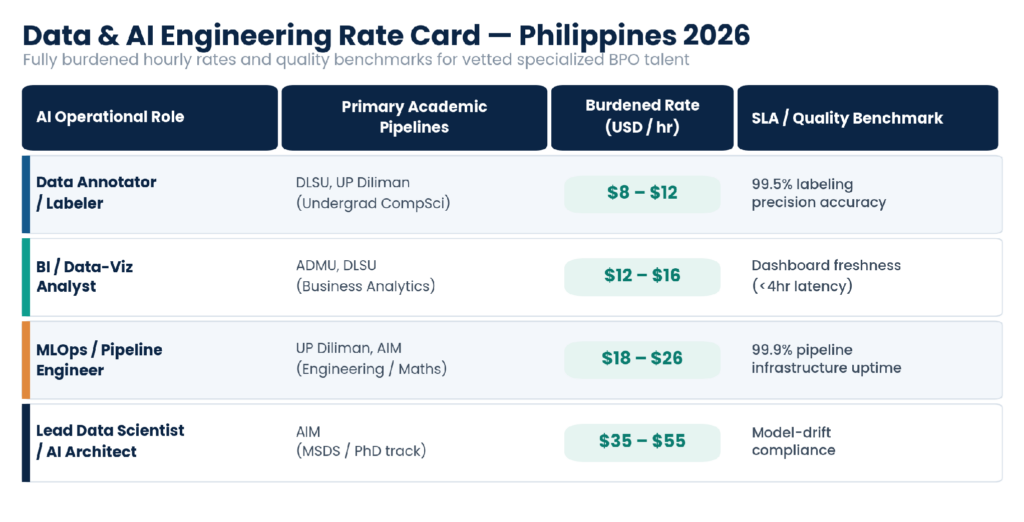
What Do Specialized AI and Data Roles Cost in the Philippines?
Fully burdened 2026 hourly rates run roughly $8–$12 for data annotators, $12–$16 for BI and visualization analysts, $18–$26 for MLOps and pipeline engineers, and $35–$55 for lead data scientists and AI architects — each tied to specific academic pipelines and SLA benchmarks.
For procurement teams budgeting an AI-data program, the rate card below maps each role to its primary university pipeline and the quality benchmark a vetted provider should be willing to commit to. Read alongside the matrix above, it turns an abstract talent market into a concrete, comparable plan — role by role, rate by rate, and benchmark by benchmark. Crucially, the figures are bands rather than fixed prices: seniority, security clearance, and SLA strictness all move a role within its range.