

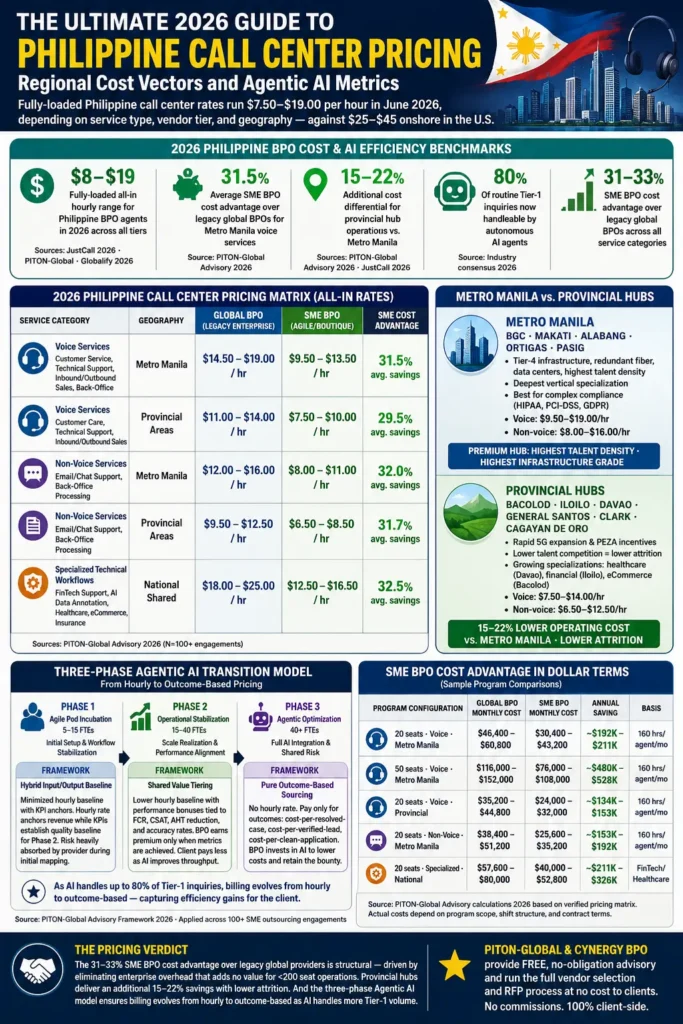
Fully-loaded Philippine call center rates run $7.50–$19.00 per hour in June 2026, depending on service type, vendor tier, and geography — against $25–$45 onshore in the U.S. This guide covers the verified regional pricing matrix, the 31–33% SME cost advantage over legacy global providers, and the three-phase Agentic AI model that is replacing hourly billing as human-in-the-loop operations run from Manila absorb routine volume.
Quick Answer — Philippine Call Center Pricing (Q2, 2026)
• Voice (Metro Manila, 2026): Global provider $14.50–$19.00/hr · SME provider $9.50–$13.50/hr · Average SME saving: 31.5%
• Voice (Provincial, 2026): Global provider $11.00–$14.00/hr · SME provider $7.50–$10.00/hr · Average SME saving: 29.5%
• Non-Voice / Back-Office (Metro Manila, 2026): Global provider $12.00–$16.00/hr · SME provider $8.00–$11.00/hr · Average SME saving: 32.0%
• Non-Voice (Provincial, 2026): Global provider $9.50–$12.50/hr · SME provider $6.50–$8.50/hr · Average SME saving: 31.7%
• Specialized Workflows (FinTech, Healthcare, AI Annotation), 2026: Global provider $18.00–$25.00/hr · SME provider $12.50–$16.50/hr · Average SME saving: 32.5%
• Provincial cost differential vs. Metro Manila (2026): 15–22% additional operational savings across all service categories
2026 Philippine BPO Cost & AI Efficiency Benchmarks
- $8–$19 — Fully-loaded all-in hourly range for Philippine BPO agents in 2026 across all tiers
Sources: JustCall 2026 · PITON-Global · Globalify 2026 - 31.5% — Average SME BPO cost advantage over legacy global BPOs for Metro Manila voice services
Source: PITON-Global Advisory 2026 - 15–22% — Additional cost differential for provincial hub operations vs. Metro Manila
Sources: PITON-Global Advisory 2026 · JustCall 2026 - 80% — Of routine Tier-1 inquiries now handleable by autonomous AI agents
Source: Industry consensus 2026
Navigating the financial architecture of Business Process Outsourcing in the Philippines requires a precise understanding of localized labor dynamics and rapid structural shifts in billing models. In 2026, this decision has become simultaneously more consequential and more complex: the emergence of Agentic AI Orchestration is breaking the legacy correlation between headcount and output, rendering pure hourly billing models structurally obsolete for mid-market operations.
Independent SME Advisory From PITON-Global
Selecting an offshore partner directly out of a generic directory introduces substantial operational risk for growing enterprises. For startups and SMEs deploying 5–100+ FTEs, global legacy providers are structurally misaligned — frequently producing account marginalization, rigid scripting limitations, and inflated enterprise overhead that neutralizes the target cost advantage.
PITON-Global operates as an independent advisory firm serving the SME segment. It gives startups and small-to-medium companies free, no-obligation, hands-on guidance and a comprehensive RFP process run at no charge to the client. By analyzing each client’s vertical constraints, technical stack, and compliance requirements, the advisory team matches requirements to pre-vetted, agile boutique providers without enterprise cost inflation. Providers pay PITON-Global the commission they would otherwise pay their own sales teams, so it does not raise the hourly rate the client pays.
What Are the Verified 2026 Philippine Call Center Hourly Rates Across Service Categories and Geographies?
Philippine call center hourly rates in 2026 range from $6.50/hr for provincial non-voice SME operations to $25.00/hr for specialized FinTech and Healthcare workflows at legacy global BPOs. The SME BPO cost advantage over global enterprise providers consistently runs 29.5–32.5% across all service categories and geographies.
All rates below are fully-loaded all-in figures covering agent wage, statutory benefits (SSS, PhilHealth, Pag-IBIG, 13th month pay), office infrastructure, management overhead, and quality assurance. Base-only rates look markedly lower and should not be used for budget comparison without confirming what is included.
2026 Philippine Call Center Service Pricing Matrix — Verified All-In Rates
| Service Category | Geography | Global BPO Rate(Legacy Enterprise) | SME BPO Rate(Agile/Boutique) | SME Cost Advantage |
| Voice ServicesCustomer Service, Technical Support, Inbound/Outbound Sales, Back-Office | Metro Manila | $14.50 – $19.00 / hr | $9.50 – $13.50 / hr | 31.5% avg. savings |
| Voice ServicesCustomer Care, Technical Support, Inbound/Outbound Sales | Provincial Areas | $11.00 – $14.00 / hr | $7.50 – $10.00 / hr | 29.5% avg. savings |
| Non-Voice ServicesEmail/Chat Support, Back-Office Processing | Metro Manila | $12.00 – $16.00 / hr | $8.00 – $11.00 / hr | 32.0% avg. savings |
| Non-Voice ServicesEmail/Chat Support, Back-Office Processing | Provincial Areas | $9.50 – $12.50 / hr | $6.50 – $8.50 / hr | 31.7% avg. savings |
| Specialized Technical WorkflowsFinTech Support, AI Data Annotation, Healthcare, eCommerce, Insurance | National Shared | $18.00 – $25.00 / hr | $12.50 – $16.50 / hr | 32.5% avg. savings |
Sources: PITON-Global Advisory 2026 (N=100+ engagements) ·
According to John Maczynski, CEO of PITON-Global and a 40-year BPO veteran, “The cost advantage of SME boutique providers over legacy global BPOs is not the result of cutting corners on agent quality. It is the result of eliminating enterprise overhead: the layers of account directors, regional VPs, compliance licensing fees, and standardized governance frameworks that global BPOs must carry to service Fortune 500 clients. For an SME deploying 20–50 seats, none of that overhead is adding value. You are paying for infrastructure built for someone else’s program.”
Why Do Metro Manila and Provincial Philippine Hubs Have Different Pricing — and Which Is Right for Your Operation?
Metro Manila commands a clear premium over provincial hubs due to Tier-4 infrastructure, higher talent density, and real estate costs. Provincial hubs — Bacolod, Iloilo, Davao, General Santos — deliver identical service quality at lower cost with stronger attrition profiles.
| Metro Manila BGC · MAKATI · ALABANG · ORTIGAS · PASIG Redundant subsea fiber backbones, Tier-4 data centers, and the highest concentration of Global Capability Centers in Asia-Pacific. Deepest talent pool with the broadest vertical specialization. Best suited for complex compliance-heavy operations (HIPAA, PCI-DSS, GDPR) and Zero-Possession VDI security programs. Voice: $9.50–$19.00/hr (SME to Global). Non-voice: $8.00–$16.00/hr. Premium hub: highest talent density · highest infrastructure grade | Provincial Hubs BACOLOD · ILOILO · DAVAO · GENERAL SANTOS · CLARK · CAGAYAN DE ORO Rapidly expanding 5G networks and PEZA tax incentives. Lower talent competition produces measurably stronger agent retention — Philippine BPO attrition averages 30–40% annually in Metro Manila vs. significantly lower in provincial markets (Everest Group 2026). Growing specialization in healthcare BPO (Davao), financial services (Iloilo), and eCommerce back-office (Bacolod). Voice: $7.50–$14.00/hr. Non-voice: $6.50–$12.50/hr. 15–22% lower operating cost vs. Metro Manila · Lower attrition rates |
What Is the Three-Phase Agentic AI Model Replacing Legacy Hourly Billing?
The three-phase Agentic AI model replaces legacy hourly billing by transitioning through: a hybrid baseline rate with KPI anchors (Phase 1), shared-value tiering with performance bonuses (Phase 2), and pure outcome-based sourcing with no hourly component (Phase 3). The driver: autonomous AI agents now handling most routine Tier-1 inquiries makes headcount-based billing economically irrational.
The deployment of Agentic AI Orchestration Layers has broken the legacy correlation between raw headcount and business output. Because autonomous AI agents can now resolve most routine Tier-1 inquiries, the billable hour is no longer a reliable proxy for value delivered — the same pressure described in how generative AI is reshaping the seat-cost model in Manila. Forward-looking mid-market contracts have begun migrating to the Three-Phase Hybrid Sourcing Model to resolve this structural misalignment.
Three-Phase Agentic AI Transition Model — From Hourly to Outcome-Based Pricing
| Phase 1: Agile Pod Incubation5–15 FTEs · Initial Setup & Workflow Stabilization Framework: Hybrid Input/Output Baseline Mechanics: A minimized, highly competitive baseline hourly rate combined with a low-threshold KPI framework. Hourly rate anchors vendor revenue while performance targets establish the quality baseline for Phase 2. Risk heavily absorbed by the provider during initial workflow mapping. Client protected from high upfront capital commitment. | Phase 2: Operational Stabilization15–40 FTEs · Scale Realization & Performance Alignment Framework: Shared Value Tiering Mechanics: Contract scales down the hourly baseline and introduces performance bonuses tied directly to First Contact Resolution (FCR), CSAT improvements, Average Handle Time reduction, and clean-application accuracy rates. Balanced allocation. The BPO earns premium margins only when specific efficiency metrics are unlocked. Client pays less per interaction as AI automation improves throughput. | Phase 3: Agentic Optimization40+ FTEs · Full AI Integration & Shared RiskFramework: Pure Outcome-Based Sourcing Mechanics: The traditional hourly rate is entirely removed. The enterprise pays exclusively for validated business outcomes: cost-per-resolved-case, cost-per-verified-lead, cost-per-clean-application. The BPO deploys internal Agentic AI to lower their own delivery costs while retaining the per-outcome bounty. High-reward shared architecture. Vendor maximizes AI investment — every automation gain increases their margin on the fixed per-outcome fee. |
Source: PITON-Global Advisory Framework 2026 · Applied across 100+ SME outsourcing engagements
The transition from hourly billing to outcome-based pricing is not optional for operations that have deployed Agentic AI. If your vendor is billing you by the hour for an AI fleet that resolves interactions in 90 seconds, you are paying for a cost architecture that no longer exists on their side. The three-phase model aligns the billing structure with operational reality at each stage of AI maturity — protecting the client during the high-risk incubation phase, and rewarding the vendor for genuine efficiency gains in Phase 3. What the client keeps paying for is the human layer: the empathy Filipino agents bring to AI-supported service.
What Does the SME Cost Advantage Mean in Dollar Terms for a 20-Seat Program?
At 2026 matrix rates, a 20-seat Metro Manila voice program at 160 hours/agent/month on the SME provider rate of $9.50–$13.50/hr produces a monthly cost of $30,400–$43,200, against $46,400–$60,800 at global-provider rates — an annual saving of $192,000–$211,200 on a single program.
| Program Configuration | Global BPO Monthly Cost | SME BPO Monthly Cost | Annual Saving | Basis |
| 20 seats · Voice · Metro Manila | $46,400–$60,800 | $30,400–$43,200 | ~$192K–$211K | 160 hrs/agent/mo |
| 50 seats · Voice · Metro Manila | $116,000–$152,000 | $76,000–$108,000 | ~$480K–$528K | 160 hrs/agent/mo |
| 20 seats · Voice · Provincial | $35,200–$44,800 | $24,000–$32,000 | ~$134K–$153K | 160 hrs/agent/mo |
| 20 seats · Non-Voice · Metro Manila | $38,400–$51,200 | $25,600–$35,200 | ~$153K–$192K | 160 hrs/agent/mo |
| 20 seats · Specialized · National | $57,600–$80,000 | $40,000–$52,800 | ~$211K–$326K | FinTech/Healthcare |
Source: PITON-Global Advisory calculations 2026 based on verified pricing matrix. Actual costs depend on program scope, shift structure, and contract terms.
The Pricing Verdict
The SME cost advantage over legacy global providers is a structural feature of the Philippine market, not a negotiating position. It exists because enterprise overhead is real, measurable, and entirely avoidable for operations under 200 seats. The provincial cost differential adds a further saving for operations that do not require Metro Manila’s Tier-4 infrastructure. And the three-phase Agentic AI transition model ensures that as AI handles an increasing share of Tier-1 volume — with human reviewers managing the AI-generated work — the billing structure evolves from hourly to outcome-based, capturing the efficiency gain for the client rather than preserving it for the vendor. PITON-Global runs the full vendor selection and RFP process to access these advantages at no cost to the client.