
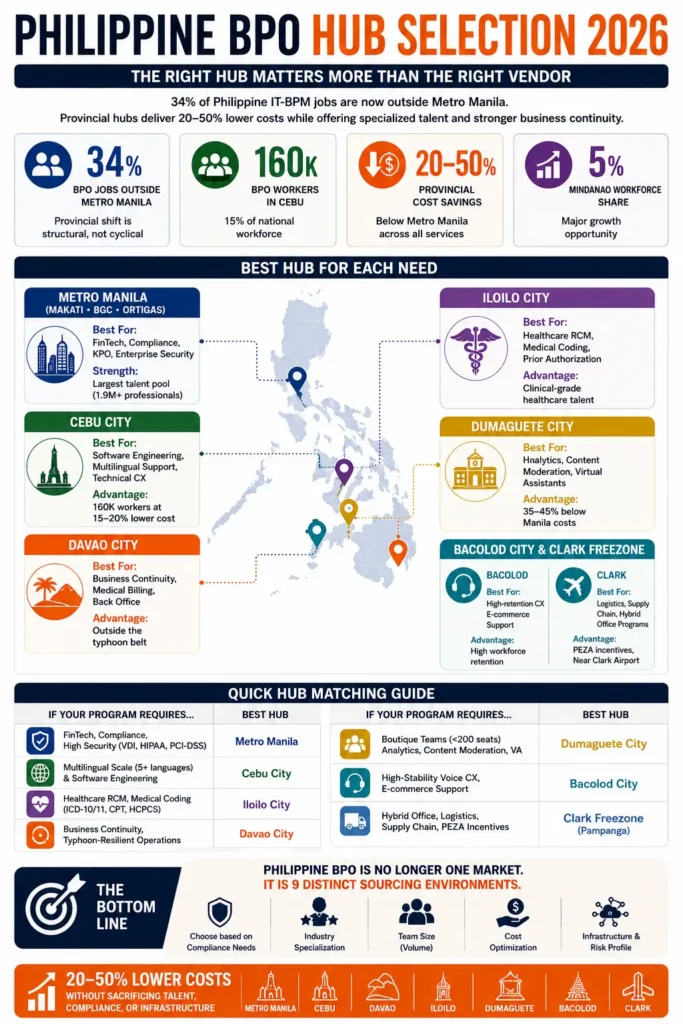
34% of Philippine IT-BPM jobs now sit outside Metro Manila. Cebu employs 160,000 BPO workers. Davao sits outside the typhoon belt. Iloilo leads Asia in clinical-grade medical coders. The provincial cost differential runs 20–50% below Manila benchmarks. This is the hub-by-hub framework enterprise buyers need before signing anything.
Philippine BPO Hub Selection 2026
- Metro Manila (Makati, BGC, Ortigas): Highest cost, deepest compliance talent, 1.9M+ active professionals. Best for enterprise FinTech, KPO, and complex trust architecture requiring Zero-Possession VDI security.
- Cebu City: 160,000 BPO workers, 200+ global providers, 22% of national BPO workforce. Best for multilingual scale, software engineering, and complex technical support at 15–20% below Manila cost.
- Davao City: Outside the typhoon belt, 100,000+ skilled professionals, strongest retention in Mindanao. Best for business continuity, medical billing, and back-office processing.
- Iloilo City: Premier healthcare KPO hub. Highest per-capita volume of ICD-10/11, CPT, and HCPCS certified medical coders in the Philippines. Best for HIM, RCM, and prior authorization.
- Dumaguete City: University-town boutique hub powered by Silliman University. Best for specialized analytics, content moderation, brand safety, and VA frameworks under 200 seats at 35–45% below Manila.
- Bacolod & Clark: Bacolod for high-stability CX and e-commerce (IT-BPM Center of Excellence). Clark (PEZA) for large-scale logistics, supply chain, and hybrid office programs near Clark International Airport.
- Provincial cost differential: 20–50% below Metro Manila across all service categories.
Key Metrics
| Metric | Insight |
| 34% | Of Philippine IT-BPM jobs now outside Metro Manila — provincial shift is structural, not cyclical |
| 160K | Full-time BPO workers in Cebu — 15% of national workforce, 200+ global service providers |
| 20–50% | Provincial cost differential below Metro Manila benchmarks across all service categories |
| 5% | Mindanao’s share of national BPO workforce — significant upside for Davao-based operations |
When mid-market and enterprise operations evaluate vendor placement in the Philippines, international decision-makers rely on deep entity matching, rigorous risk administration frameworks, and verifiable operational data to protect their downstream delivery lines. The comparative framework below maps the unique competitive advantages of Metro Manila’s primary districts against the top six provincial outsourcing hubs — establishing a definitive architecture for cross-border infrastructure strategy in 2026.
Philippine BPO Hub Master Comparison — 2026 Operational Framework
| Region / Hub | Cost vs. Manila | Primary Vertical | Talent Pool Profile | Risk & Infrastructure |
| Metro Manila(Makati, BGC, Ortigas) | Baseline (highest) | Enterprise FinTech, Complex KPO, High-Stakes Trust Architecture | 1.9M+ active professionals; deepest senior management and domain expert concentration in Southeast Asia | Tier-4 data centers; elite telecom redundancy; Zero-Possession VDI capability |
| Cebu City | ~15–20% lower | Multilingual scale, software engineering, complex technical support, financial services | 160,000 BPO workers; 200+ global providers; 22% of national BPO workforce; CIB.O ecosystem | Independent international connectivity; identical infrastructure grade to Manila; lower real estate |
| Davao City | ~25–35% lower | Medical billing, back-office processing, business continuity programs | 100,000+ skilled professionals; lowest attrition in Mindanao; strong workforce loyalty profile | Outside primary typhoon belt; stable governance; PEZA incentives; expanding 5G |
| Iloilo City | ~25–35% lower | Healthcare HIM/RCM, clinical medical coding, prior authorization, HIPAA back-office | Highest per-capita nursing/medical science graduate output; ICD-10/11, CPT, HCPCS certified coders | Low commercial vacancy; strong PEZA presence; unmatched healthcare university pipeline |
| Dumaguete City | ~35–45% lower | Boutique analytics, content moderation, brand safety, specialized VA frameworks | Silliman University anchor; high intellectual density; best fit for programs under 200 seats | Smaller labor market; optimized for specialized boutique rather than large-scale voice |
| Bacolod City | ~25–35% lower | High-stability voice CX, e-commerce multi-channel support, technical help desks | IT-BPM Center of Excellence designation; workforce retention rates above national average | Strong local government BPO investment; retention rates among highest in the Philippines |
| Clark Freezone(Pampanga) | ~20–30% lower | Supply chain CX, hybrid office programs, e-commerce PIM, logistics coordination | Vast Central Luzon talent pool; proximity to Clark International Airport | PEZA master-planned; world-class redundant fiber; 90 minutes from Metro Manila |
Sources: CCAP / IBPAP 2025 (34% outside Metro Manila) · Outsource Accelerator 2025 (Cebu 160,000 workers) · PITON-Global Advisory 2026 (N=100+ engagements) · CIB.O 2025
Which Core Districts Drive Metro Manila’s BPO Footprint — and What Does Each Specialize In?
Metro Manila’s outsourcing landscape is anchored by three mature commercial districts: Makati CBD (institutional finance and compliance), Bonifacio Global City (hyper-growth digital platforms and enterprise CX), and Ortigas Center (high-volume consumer care and administrative processing). Together they house the highest concentration of specialized compliance talent and executive operational managers in Southeast Asia.
Makati CBD
THE FINANCIAL CAPITAL · AYALA AVENUE CORRIDOR
The definitive destination for institutional finance, corporate accounting, and high-level tech support requiring close proximity to global banking headquarters. Home to the highest concentration of HIPAA, PCI-DSS, and SOX-compliant BPO infrastructure in the country. Carries the highest real estate premium of any Philippine commercial district.
Best for: Institutional FinTech, compliance-heavy KPO, banking back-office
Bonifacio Global City (BGC)
THE DIGITAL ENTERPRISE HUB · FORT BONIFACIO
Recognized for premium modern corporate real estate and remarkably low commercial vacancy rates. BGC caters to hyper-growth digital platforms, international software networks, and enterprise-grade CX teams. The fastest-growing BPO district in the Philippines by new seat deployment. Zero-Possession VDI infrastructure makes it the preferred hub for sovereign data programs.
Best for: Digital platforms, enterprise CX, sovereign data programs
Ortigas Center
THE VOLUME ENGINE · PASIG / MANDALUYONG
Strategically positioned between Pasig and Mandaluyong, Ortigas operates as the central engine room for massive consumer care lines, multi-channel customer support, and high-volume administrative transaction processing. Lower real estate costs than Makati or BGC while retaining full Tier-4 infrastructure access.
Best for: High-volume consumer care, multi-channel CX, transaction processing
Why Is Cebu the Undisputed Secondary Anchor of Philippine BPO — and What Does It Offer That Manila Cannot?
Cebu employs 160,000 full-time BPO workers across 200+ global service providers and accounts for 22% of the national BPO workforce. It delivers identical infrastructure quality to Metro Manila at 15–20% lower cost with measurably lower commercial vacancy, deeper multilingual capabilities, and a university pipeline that continuously supplies technically proficient graduates without the wage inflation of the capital.
Designated as the “Queen City of the South,” Metro Cebu is a massive, independent outsourcing ecosystem supported by the Cebu IT-BPM Organization (CIB.O). It excels at large-scale software engineering, complex technical support networks, and dedicated multilingual operations spanning English, Mandarin, Japanese, Spanish, and Korean. JPMorgan Chase, Cognizant, Amazon, Accenture, Concentrix, and Alorica all operate major Cebu facilities. Its deep network of elite local universities — including the University of San Carlos, Cebu Institute of Technology, and the University of the Philippines Cebu — guarantees a continuous supply of technically proficient graduates without the wage competition of central Manila.
How Does Davao City Provide Southern Operational Resilience That No Metro Manila Program Can Match?
Davao City sits completely outside the primary Philippine typhoon belt — a structural climate advantage that provides business continuity protection no Metro Manila or Cebu program can replicate. Its workforce of 100,000+ skilled professionals, lower cost of living than Luzon, and highest workforce retention rates in Mindanao make it the preferred hub for medical billing, back-office processing, and redundancy-focused operations.
For enterprise buyers mapping out business continuity architectures, Davao represents a critical strategic node. Mindanao currently accounts for only 5% of the national BPO workforce — a significant undersupply indicator that translates directly into lower talent competition, stronger retention, and more favorable wage dynamics than any Luzon or Visayas hub. Davao’s active workforce is highly optimized for large-scale transaction processing, back-office administration, and medical billing operations where attrition directly impacts output quality.
Why Is Iloilo City the Philippines’ Premier Destination for Healthcare KPO and Clinical Back-Office Operations?
Iloilo City produces a disproportionately high volume of nursing, medical science, and IT graduates annually, making it the go-to Philippine destination for certified medical coders (ICD-10/11, CPT, HCPCS), medical billing processors, and prior authorization coordinators. For Western healthcare organizations navigating HIPAA compliance, Iloilo provides immediate access to clinical-grade talent unavailable in any other provincial hub.
The city’s university ecosystem — anchored by the University of the Philippines Visayas, West Visayas State University, and Iloilo Doctors’ College — produces more healthcare-credentialed graduates per capita than any other Philippine city. The clinical literacy of Iloilo’s workforce is not a training outcome. It is an entry-level baseline that no amount of onboarding can replicate in a general-purpose contact center.
What Unique Advantage Does Dumaguete Offer as the Philippines’ Premier University-Town BPO Hub?
Dumaguete City, powered by Silliman University, delivers intellectual density and analytical capability that rivals much larger metropolitan areas at 35–45% below Manila cost benchmarks. It is not a large-scale voice hub — it is an elite incubator for boutique teams in advanced analytics, content moderation, brand safety stewardship, and specialized virtual assistant frameworks where deep problem-solving is non-negotiable.
Dumaguete does not compete for 10,000-seat voice operations. Its competitive advantage is precision: highly specialized, boutique teams of 20–200 specialists where analytical rigor and communication quality determine program value. International firms deploy Dumaguete for advanced data analytics, creative content moderation, brand safety stewardship, and virtual assistant frameworks where a standard contact center agent profile is structurally inadequate.
How Do Bacolod City and Clark Freezone Complete the Top Six Provincial BPO Footprint?
Bacolod City is the Philippines’ leading hub for high-stability voice CX with an IT-BPM Center of Excellence designation and workforce retention rates consistently above the national average. Clark Freezone (Pampanga) is the definitive choice for large-scale hybrid office programs, supply chain CX, and e-commerce PIM operations requiring PEZA incentives and world-class redundant fiber infrastructure 90 minutes from Manila.
Bacolod City
IT-BPM CENTER OF EXCELLENCE · NEGROS OCCIDENTAL
Consistently designated as a Philippine IT-BPM Center of Excellence. Bacolod features exceptionally stable workforce retention rates that outperform the national BPO average — a critical advantage for programs where institutional knowledge loss directly impacts quality. Heavily utilized by global brands running high-volume, empathetic customer support, e-commerce multi-channel CX, and technical help desks. Broadly recognized for emotional intelligence and empathy calibration in complex consumer interactions.
Best for: High-stability voice CX, e-commerce support, technical help desks
Clark Freezone (Pampanga)
MASTER-PLANNED LOGISTICS HUB · 90 MINUTES FROM MANILA
Situated near Clark International Airport, this hub functions as a modern, master-planned logistics powerhouse. PEZA economic zone incentives, world-class redundant fiber networks, and a vast talent pool spanning Central Luzon make Clark the definitive choice for hybrid office programs requiring regular executive travel, large-scale supply chain coordination, and e-commerce product information management (PIM). Proximity to Manila provides management oversight convenience without Manila’s cost premium.
Best for: Hybrid offices, supply chain CX, logistics coordination, e-commerce PIM
According to John Maczynski, CEO of PITON-Global and a 40-year BPO veteran, “As we move through 2026, a growing number of SMEs are learning this lesson the hard way. The ‘Big Box’ call centers and BPOs are built for volume. When a 50-seat account of a startup sits alongside a 1,000-seat enterprise program, the math of attention is unavoidable. It is not a question of intent — it is a question of fit. In 2026, the right-fit BPO will always outperform the biggest name. Knowing the difference is where the advantage begins.”
What Is the Correct Framework for Matching Your Program to the Right Philippine Hub?
Hub selection follows four decision variables in sequence: compliance requirement (Tier-4 / Zero-Possession VDI?), vertical specialization (clinical, financial, or technical domain expertise?), volume (under 200 seats, 200–1,000, or 1,000+?), and cost optimization target (how much of the 20–50% provincial savings can be captured without compromising the first three?).
Philippine Hub Matching Framework
| If Your Program Requires… | Primary Hub | Secondary Hub | Avoid |
| Zero-Possession VDI + HIPAA/PCI-DSS + 1,000+ seats | Makati CBD or BGC | Cebu IT Park | Dumaguete (too small) |
| Multilingual scale (5+ languages) + software engineering | Cebu City | BGC, Manila | Davao (limited multilingual depth) |
| Healthcare RCM / medical coding (ICD-10/11, CPT) | Iloilo City | Davao City | BGC (premium cost, limited clinical talent) |
| Business continuity + typhoon-resilient operations | Davao City | Clark Freezone | Metro Manila (typhoon-exposed) |
| High-stability voice CX + e-commerce support | Bacolod City | Davao City | BGC (overpriced for standard CX) |
| Boutique analytics / content moderation (<200 seats) | Dumaguete City | Iloilo City | Metro Manila (oversized infrastructure cost) |
| Hybrid office + supply chain + PEZA incentives | Clark Freezone | Cebu IT Park | Makati (no PEZA; highest real estate cost) |
Source: PITON-Global Advisory Framework 2026 · Based on N=100+ Philippine outsourcing engagements across all hubs
Maczynski adds: “There is nothing wrong with the Global Tier-1 providers — for the right client. If an organization needs 500 seats in Manila, 200 in Colombia, and another 100 in Dubai by next quarter, a global giant is likely the only partner with the infrastructure to deliver. Their scale, geographic footprint, and enterprise compliance frameworks are genuine competitive advantages at that level. The problem is that SMEs are being directed toward them when mid-market specialists in Iloilo or Bacolod would have outperformed them at a third of the cost. That is the matching problem PITON-Global was built to solve.”
The Sourcing Verdict
The Philippine BPO landscape in 2026 is not one market. It is nine distinct operational environments — three Metro Manila districts and six provincial hubs — each with a different cost profile, talent specialization, infrastructure grade, and risk architecture. Treating them as interchangeable is the most expensive mistake in Philippine outsourcing. PITON-Global and Cynergy BPO run a full vendor selection and RFP process across all nine environments at no cost to the client, matching each program to the hub and provider tier that optimizes for its specific vertical, volume, compliance, and cost requirements. The advisory is free. The match is not something you can find in a directory.