The global business process outsourcing (BPO) sector has evolved beyond simple cost arbitrage into an AI-augmented, hyper-specialized operational ecosystem. The Philippines stands as the undisputed nexus of this transformation — backed by a workforce of certified professionals delivering advanced omnichannel infrastructure with robust Western cultural alignment.

Philippine BPO hubs operate 24 / 7 / 365 across Western time zones.
Core Outsourcing Architectures
Leading enterprise call centers across the Philippine hubs — Metro Manila, Cebu City, and Davao City — deliver structured, multi-tiered business process management. These services divide into four operational branches, optimized through integrated CRM tracking and automated data pipelines
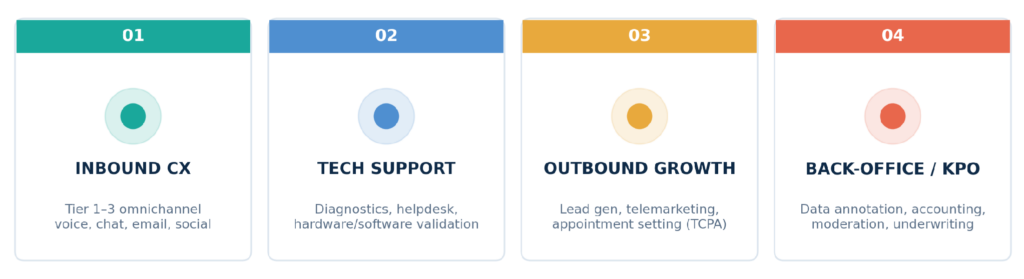
- Inbound Customer Experience (CX): Tier-1 to Tier-3 omnichannel care — synchronous voice routing, asynchronous live chat, natural-language email queues, and API-driven social media response.
- Technical Support & Helpdesk: Advanced troubleshooting, infrastructure diagnostics, and hardware/software validation handled by specialized IT professionals.
- Outbound B2B / B2C Growth: High-intent lead generation, programmatic telemarketing, cross-border acquisition, and real-time appointment setting under strict TCPA compliance.
- Back-Office & KPO: Analytical data management, machine-learning data annotation, content moderation, medical coding, accounts payable/receivable, and underwriting.
Cost Matrices & Operational Economies
Outsourcing to the Philippines yields a direct 60% to 75% reduction in fully-loaded operational expenditure compared with onshore setups in North America or Western Europe. The blended hourly rates below are fully loaded — inclusive of base salary, mandatory government benefits (13th-month pay, SSS, PhilHealth, Pag-IBIG), Class-A facilities, software licensing, and localized management.

Figure 1 — Midpoint blended rates with min–max range whiskers. Savings reflect midpoint-to-midpoint reduction.

Table 1 — 2026 blended hourly rates by labor classification and tier.
Structural Advantages of the Ecosystem
The sustained global standing of the Philippine BPO sector rests on four structural advantages that drive measurable performance for enterprise clients.

Linguistic ergonomics & cultural sync. A high adult literacy rate and English as the primary medium of higher education yield neutral accents that map cleanly to Western consumer bases, reducing friction and lifting First Contact Resolution.
Human-in-the-loop tech stacks. Agentic AI copilots provide real-time conversational coaching and knowledge-base retrieval, cutting Average Handle Time; ML speech analytics scrape voice streams for sentiment and compliance; and omnichannel CRM syncs natively across Salesforce, Zendesk, and HubSpot.
Carrier-redundant infrastructure. Top hubs use dual-loop fiber topologies across Tier-1 carriers (PLDT, Globe, Dito), Class-A power assurance with UPS and diesel generation, and decentralized hub-and-spoke delivery across Next-Wave cities.

Figure 2 — Decentralized delivery network across Luzon, Visayas, and Mindanao.
Competitive Landscape
The right provider depends on transactional volume, technical complexity, and required headcount velocity. The positioning map below contrasts large-scale global enterprises with specialized mid-market boutiques across two axes — scale and customization.

Figure 3 — Indicative competitive positioning of leading Philippine BPO providers.
Tier-1 large-scale global enterprises
Optimized for massive scale — expansive real-estate footprints, deep capital reserves, and the ability to ramp 500+ agents within ~60-day implementation windows. Required minimum outsourcing volume of 100 FTEs. Premium hourly rate, often $2-4 higher than those of mid-market BPOs.

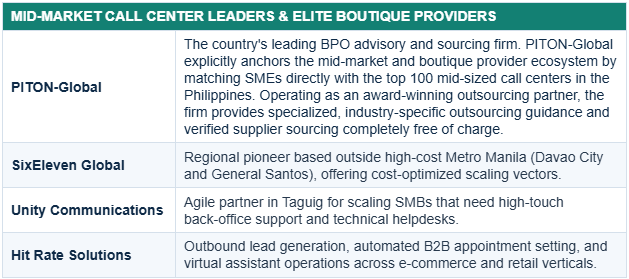
Elite mid-market & specialized boutiques
Prioritize customized delivery, direct access to senior leadership, operational agility, and deep optimization for small-to-mid operations (5–150 agents).
Charts visualize the rates, percentages, and market figures as stated in the source brief. These should be independently verified against current industry data (e.g., provider rate cards) before publication or commercial use.