
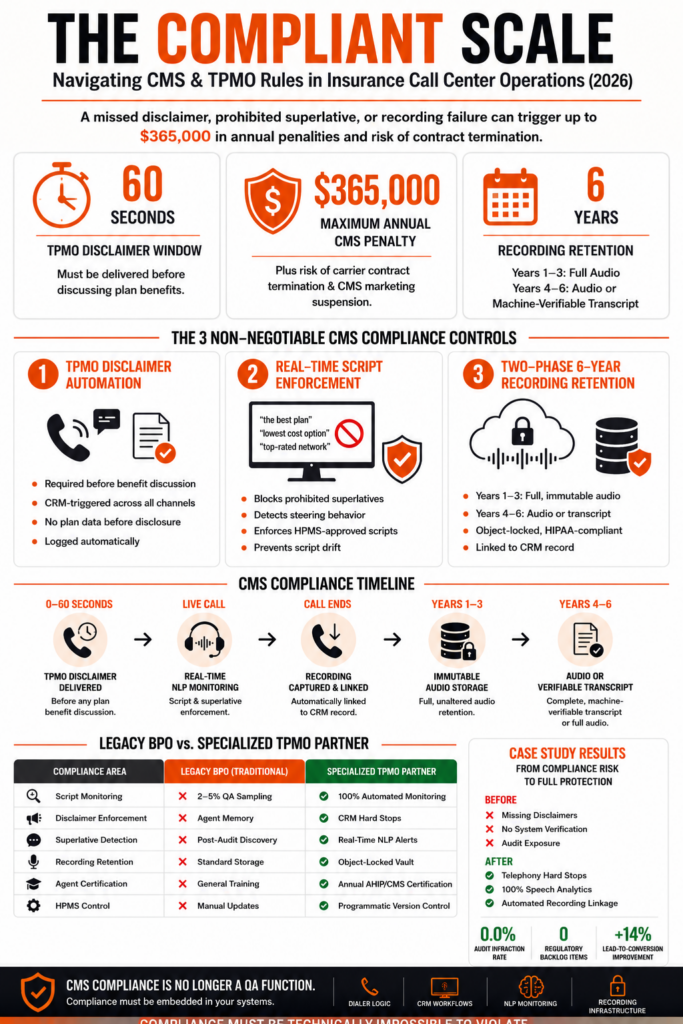
Every independent agent, broker, and external call center is legally classified as a TPMO under CMS rules. A missed disclaimer, a retained superlative, or a corrupted recording carries a $365,000 maximum annual penalty and the immediate risk of carrier contract termination. Compliance is not a QA function. It is the technical foundation upon which sustainable distribution scale is built.
Key Compliance Metrics
| Key Compliance Metric | Details |
| TPMO Disclaimer Delivery Window | 60 sec — Maximum window to deliver the TPMO disclaimer. Updated by the 2026 CMS Final Rule to require delivery prior to discussing plan benefits, with no grace period. (CMS 2026 Final Rule · 42 C.F.R. §§ 422 & 423) |
| Recording Retention Requirement | 6 years — Immutable recording retention mandate: Years 1–3 require full audio retention; Years 4–6 require either full audio or a machine-verifiable transcript. Federal requirements supersede state consent laws. (CMS 2026 Final Rule · NABIP confirmed April 2026) |
| Maximum CMS Non-Compliance Penalty | $365K — Maximum annual CMS penalty for non-compliance, with potential additional consequences including carrier contract termination and CMS marketing suspension. (CMS Enforcement Framework 2026) |
Every independent agent, broker, and external contact center navigating the U.S. Medicare landscape is legally classified as a Third-Party Marketing Organization (TPMO) under CMS rules. In this high-stakes regulatory environment, a single operational lapse — a missed disclaimer, an unverified superlative, or an indexing error in a call recording — carries a maximum annual penalty of $365,000, alongside the immediate risk of carrier contract termination and CMS marketing suspension. Under the 2026 CMS Final Rule (42 C.F.R. §§ 422 & 423), oversight has shifted from reactive post-call auditing to real-time, system-level enforcement.
CMS Compliance Enforcement Windows — 2026 Final Rule
| Compliance Timeline & Requirements |
| 0 to 60 Seconds — Dynamic TPMO Disclaimer Delivery (must precede plan benefit discussion) |
| Live Interaction — Systemic Script Enforcement (automatic superlative and steering blocks) |
| Post-Call Flow — Partitioned 6-Year Storage (Years 1–3: Full Audio | Years 4–6: Audio or Transcript) |
$365K Annual Penalty: What Are the Three Non-Negotiable System-Level CMS Compliance Constraints for Every TPMO?
The three non-negotiable system-level CMS compliance constraints are: dynamic TPMO disclaimer automation prior to plan benefit discussion, programmatic script enforcement with real-time NLP superlative and steering detection, and a two-phase 6-year immutable recording retention architecture. Every constraint must be embedded at the system level — not managed through post-call QA sampling at 2–5% of volume.
| Dynamic TPMO Disclaimer Automation — Prior to Plan Benefit Discussion |
| 0 TO 60 SECONDS · ALL CHANNELS · HARD SYSTEM TRIGGER The 2026 CMS regulatory update altered the disclaimer timing requirement from a loose “within the first minute” to a strict “prior to discussing plan benefits” — allowing initial identity and demographic intake, but creating a hard technical barrier before any plan-related details are introduced. The telephony and CRM layers must dynamically trigger the correct verbal disclaimer version based on the agent’s carrier roster within the consumer’s specific ZIP code. This control must extend across all omnichannel touchpoints — SMS, online chat, and email marketing — ensuring no plan data is transmitted before disclosure confirmation is logged by the system. ✓ CMS 2026: Two disclaimer versions required. Verbal delivery within 60 seconds of sales call initiation. Written/electronic delivery required on all marketing materials. Source: CMS 2026 Final Rule · 42 C.F.R. § 422 |
| Programmatic Script Enforcement & Real-Time NLP Superlative Blocks |
| LIVE INTERACTION WINDOW · CRM UI LEVEL · HPMS VERSION CONTROL Manual QA sampling of 2–5% of call volumes is architecturally incapable of preventing compliance drift during peak enrollment surges. Script enforcement must be managed at the CRM user-interface level. Systems must actively block unapproved superlatives — such as “the best plan,” “the lowest cost option,” or “the top-rated network” — and flag steering behaviors via real-time NLP before call completion. All operational sales scripts must maintain exact version control matching submissions approved through the HPMS Marketing Module. A telephony hard stop must physically mask plan benefit comparison screens until the system verifies verbal disclaimer delivery. ✓ CMS Rule: All sales scripts require HPMS Marketing Module approval. Unverified superlatives are prohibited. Real-time NLP enforcement is the only mechanism capable of preventing systemic scripting drift at scale. Source: CMS Medicare Marketing Guidelines · 42 C.F.R. § 422 |
| Two-Phase 6-Year Immutable Recording Retention Architecture |
| POST-CALL PROCESSING · HIPAA-COMPLIANT PARTITIONED VAULT · 2026 FINAL RULE The historical 10-year retention mandate has been updated to a two-phase 6-year retention structure. All completed interaction data must be routed to a secure, partitioned, HIPAA-compliant storage environment. Years 1–3 require full, unaltered, immutable audio recordings with zero summarization and full metadata tagging. Years 4–6 permit full audio or a complete, machine-verifiable text transcript. Every recording must be programmatically linked to the beneficiary’s unique CRM record upon call termination. This is a federal mandate that supersedes state-level two-party consent laws — beneficiaries cannot opt out of recording if they wish to proceed with the enrollment chain. ✓ CMS 2026: Covers all MA, MAPD, and Part D enrollment calls. Federal rules supersede state consent laws. Transcripts must be complete and machine-verifiable; partial summaries do not satisfy the requirement. Source: CMS 2026 Final Rule · NABIP April 2026 · 42 C.F.R. § 422.504 |
2026 CMS Call Recording Retention Architecture — Verified Against Final Rule
| Retention Phase | Requirements |
| Phase 1 · Years 1–3 | 3 Years — Immutable full audio retention with zero summarization and full metadata tagging. Stored in a partitioned, object-locked, HIPAA-compliant vault with programmatic CRM linkage upon call termination. |
| Phase 2 · Years 4–6 | 3 Years — Full audio or a complete machine-verifiable transcript. Transcripts must be complete and machine-verifiable; partial summaries do not satisfy the retention requirement. |
According to John Maczynski, CEO of PITON-Global and a 40-year insurance operations veteran, “In the current regulatory environment, speed-to-lead means absolutely nothing if your front-line scripts violate CMS compliance. Treating compliance as a secondary QA process is an existential business risk. True operational security means embedding CMS mandates directly into your dialer logic, CRM workflows, and agent routing matrices so that a compliance violation becomes technically impossible to execute.”
Legacy BPOs vs. Specialized Partners: How Does TPMO Compliance Capability Differ by Vendor Architecture?
Legacy commoditized call centers are architecturally incompatible with TPMO compliance requirements because they were built for high-turnover transactional throughput, not regulatory precision. Specialized mid-sized partners combining enterprise-grade data security with Medicare-trained agent cohorts are the only operationally viable model for maintaining 100% script adherence, real-time disclaimer enforcement, and 6-year immutable recording retention.
| Compliance Capability | Legacy Commoditized BPO | Specialized Mid-Sized Partner |
| Script Adherence | Reactive manual QA sampling; only 2–5% of calls reviewed after the fact. | 100% automated speech-to-text monitoring with real-time NLP compliance alerting. |
| TPMO Disclaimer Enforcement | Agent-dependent; relies on human memory without CRM hard stops or system blocks. | CRM-triggered hard stops mask plan data until the system verifies verbal disclaimer delivery. |
| Superlative Detection | Typically discovered post-audit through client complaints or carrier infraction notices. | Real-time NLP flags prohibited terms and steering behaviors before call completion. |
| Call Recording Infrastructure | Standard server environments prone to indexing errors and potential HIPAA exposure. | Partitioned, object-locked storage designed for 6-year CMS retention cycles with automated CRM integration. |
| Agent Certification | General customer service training with high attrition and unverified compliance metrics. | Mandatory annual AHIP/CMS credentialing, testing, and carrier-specific certifications. |
| HPMS Version Control | Managed manually via email, creating significant risk of script drift between approval cycles. | Programmatic document management directly tied to HPMS-approved marketing modules. |
Sources: CMS TPMO guidelines 2026 · NABIP April 2026 · PITON-Global Advisory 2026 · Ritter Insurance Marketing TPMO FAQ
Ralf Ellspermann, CSO of PITON-Global and a 25-year insurance operations veteran: “Large, commoditized call centers are built for simple, high-volume transactions — they are not designed to manage complex compliance tasks. When navigating strict regulations like the CMS final rules, you need a partner that combines enterprise-grade data security with highly focused, specialized team management. Sourcing your operations through a specialized provider gives you access to professionals trained directly on U.S. healthcare compliance, ensuring total script accuracy at an optimized cost.”
Hourly Billing vs. Hybrid Outcomes: How Does the Three-Phase Pricing Matrix Align TPMO Vendor Incentives With Compliance Precision?
Traditional fixed hourly billing structures are fundamentally misaligned with TPMO compliance requirements: vendors compensated solely for billable hours maximize headcount and call duration, not interaction quality and application accuracy. The three-phase hybrid pricing matrix shares risk, rewards operational precision, and creates a direct financial incentive for vendors to invest in the compliance infrastructure that protects the carrier.
| Phase | Compensation Structure | Purpose / Performance Trigger |
| Phase 1 · Infrastructure | Dedicated Hourly Baseline Fee — A stable, optimized baseline hourly rate funds secure physical infrastructure, dedicated workstations, licensing compliance maintenance, and competitive wages for specialized agents. Eliminates revenue volatility that leads to talent churn and perpetual re-training cycles. | Purpose: Infrastructure stability and talent continuity. |
| Phase 2 · Quality Modifiers | Clean-App Premiums & Audit Pass Multipliers — COR Application Yield premiums for batches achieving >98.5% error-free processing, plus Audit Pass Multipliers tied directly to zero-infraction scores on automated speech-to-text CMS audits. Vendor margin rises or falls with compliance precision. | Target: >98.5% COR rate and zero-infraction audit score. |
| Phase 3 · LTV Performance | Conversion & Retention Bonuses — Performance bonuses vest only after an enrolled beneficiary remains active beyond the critical 90-day post-enrollment threshold, aligning incentives with long-term member value rather than short-term enrollments. | Trigger: Policy remains active through the 90-day post-enrollment window. |
100% Compliance Score: How Does a Specialized Provider Remediate TPMO Deficits Before CMS Acts?
A specialized TPMO-compliant provider remediates compliance deficits before CMS enforcement by deploying programmatic system constraints — telephony hard stops, 100% automated speech analytics, and immutable data linking — that make non-compliant delivery technically impossible rather than statistically unlikely.
Case Study
From Systematic Disclaimer Omissions to 100% Compliance Score — Without Sacrificing Conversion
A leading U.S. Medicare distributor faced significant financial exposure when an internal carrier audit revealed that front-line agents at their legacy provider were regularly omitting or misstating the mandatory TPMO disclaimer during high-volume peak enrollment periods. The vendor’s telephony system lacked a programmatic mechanism to verify or enforce disclaimer delivery before plan-specific information was discussed, leaving the distributor exposed to potential multi-million dollar cumulative penalties.
The distributor transitioned to a specialized mid-sized provider deploying 60 compliance-trained specialists within an integrated CRM and telephony environment with three embedded technical controls: a telephony hard stop that physically masked plan benefit comparison screens until the system verified verbal disclaimer delivery; 100% automated speech-to-text scanning all active seats in real time; and automated, encrypted call recording capture that instantly linked multi-format audio payloads to each consumer’s CRM profile upon call termination.
Results
| Metric | Result | Performance Outcome |
| Audit Infraction Rate | 0.0% | Perfect compliance score across all subsequent automated speech-to-text CMS audits. |
| Regulatory Backlog Items | 0 | All compliance issues fully remediated ahead of the mid-year deadline. |
| Lead-to-Conversion Improvement | +14% | Compliance controls and conversion efficiency optimized simultaneously. |
System vs. QA: What Must Be Embedded at the Infrastructure Level vs. Managed Through Human Audit Loops?
CMS compliance controls that can be violated through human error must be embedded at the system level as technical constraints that make violation impossible. QA audit loops should be reserved for the consultative and contextual dimensions of compliance that require human judgment — not as substitutes for system enforcement of mandatory regulatory parameters.
Compliance Enforcement Allocation Framework
System-Level Constraints — Software Enforced
- Pre-Benefit Disclaimer Gate: Telephony routing prevents access to plan details until disclosure scripts are read and system-verified
- Call Recording Initiation: Automation forces recording to begin prior to the first agent utterance, removing manual opt-in vulnerabilities
- Prohibited Vocabulary Stripping: Real-time speech analytics immediately alert floor supervisors if an agent uses a banned superlative
- CRM Ledger Encryption: Automated indexing locks and links audio files to beneficiary accounts in the partitioned HIPAA-compliant vault
Specialized QA Audit Loops — Human Calibrated
- Consultative Accuracy: Auditing depth and accuracy of plan comparison explanations relative to consumer health profiles
- Empathy & Sentiment Calibration: Assessing soft skills, active listening, and consumer trust metrics during complex choice pathways
- Escalation Protocol Adherence: Verifying proper routing for complex Special Enrollment Periods (SEPs) or dual-eligible inquiries
- Part D Formulary Precision: Reviewing accuracy of prescription tier lookups and drug network inclusions
The Compliance Verdict
The 2026 CMS Final Rule has not merely made Medicare distribution more complex — it has made non-compliance instantly detectable through automated federal audit mechanisms. The gap between an operation dependent on manual QA sampling and one protected by programmatic system constraints is now an existential business vulnerability, not a performance optimization. Embedding regulatory mandates directly into dialer logic, CRM workflows, and partitioned recording infrastructure is no longer an auxiliary operational cost. It is the core requirement for commercial survival in the U.S. Medicare distribution market.