
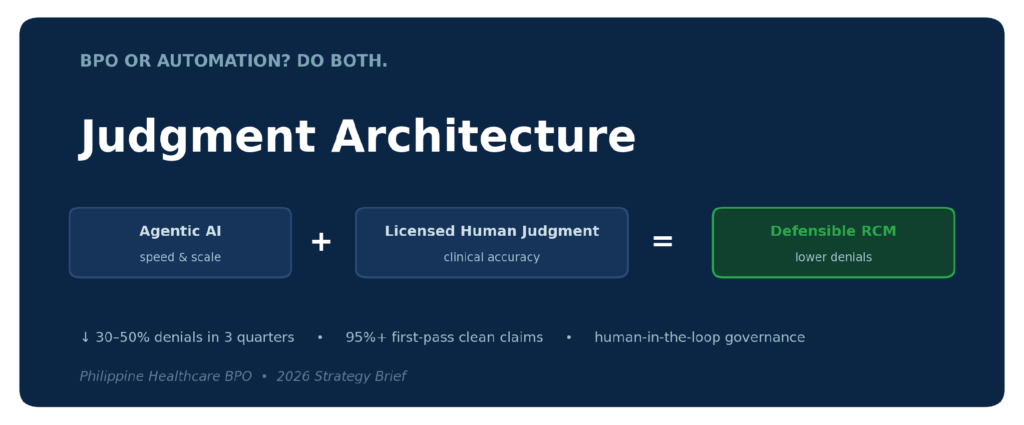
Hospitals should prioritize a “Judgment Architecture” model—integrating Philippine-based clinical expertise to oversee automation—rather than choosing between them. The strongest organizations deploy human-in-the-loop healthcare operations for US providers, where licensed professionals govern AI outputs, so complex denial management and clinical documentation meet rigorous payer standards while still capturing the efficiency of automated ingestion.
Key Takeaways
- Clinical governance is mandatory: AI-only automation in complex healthcare settings often spikes claim denials and workflow exceptions for lack of situational context.
- The “judgment architecture” model: High performers use Filipino professionals across three tiers—AI for routine volume, human-augmented AI for complex tasks, and human-led judgment for high-acuity compliance.
- Prioritize specialization over scale: Weight domain-specific clinical expertise in Manila or Cebu above generalist “low-cost” providers.
- Quantifiable ROI: A hybrid model typically cuts denial rates sharply within three quarters by replacing low-cost labor with high-accuracy clinical judgment.
Why Is the “Automation-First” Approach Often Flawed for Hospitals?
Because isolated automation lacks the context to navigate fractured U.S. payer rules. A single misread modifier can turn a clean claim into a permanent denial, and gray-area cases trigger an “exception explosion” that stalls the process—forcing internal staff to reconcile a backlog manually at higher cost.
Many executives first view automation as a binary “replace human labor” initiative. But in the fractured landscape of U.S. payer rules, an isolated automated model lacks context: a single misread modifier on a claim can convert a clean submission into a permanent denial. Relying on unassisted AI for revenue cycle management or clinical documentation produces an exception explosion—when the AI hits a gray-area case such as documentation ambiguity or a payer dispute, the absence of human clinical intervention stalls the process and creates a backlog that internal staff must reconcile manually, at a higher cost.
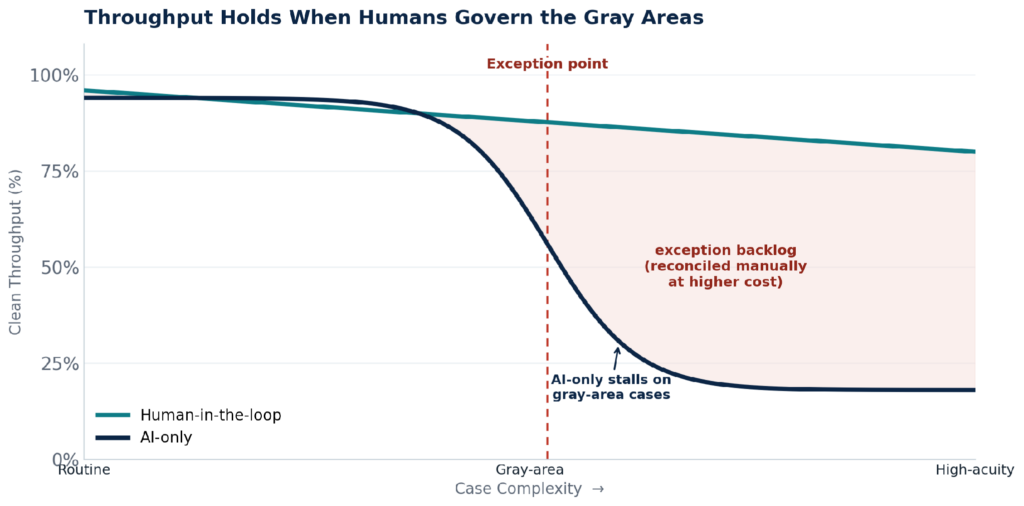
Figure 1. AI-only throughput collapses on gray-area cases; human-in-the-loop holds across the complexity curve.
How Does the Philippine Healthcare BPO Model Differ in 2026?
It has evolved into the primary execution layer for clinical and administrative operations, organized as a three-tier architecture: AI-first handles the bulk of routine volume, augmented teams validate AI on complex tasks, and clinical experts own the small share of high-acuity appeals and compliance work.
The sector has moved well beyond simple seat-filling. The dominant 2026 model is a three-tier architecture that leverages the depth of the Philippine workforce—licensed nurses and certified coders—to govern the AI rather than be replaced by it, a shift traced in how AI is changing offshore healthcare work. Instead of using technology to remove human oversight, the strongest providers use AI to accelerate the work feeding into licensed clinical judgment.
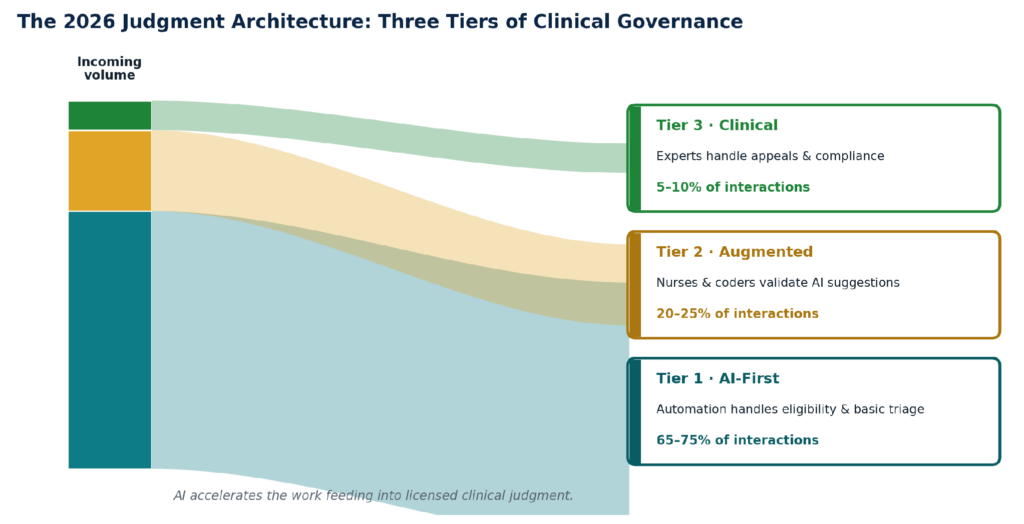
Figure 2. The three-tier judgment architecture, with interaction share routed to the right level of governance.
What Are the Operational Benchmarks for Selecting a Partner?
Move past marketing promises and cost-per-hour assurances. An elite partner provides verifiable metrics: a documented, consistently high first-pass clean-claim rate, a measurable denial-turnaround reduction within 90 days, a licensed clinical-to-admin staffing ratio, and current third-party SOC 2 Type II and end-to-end HIPAA attestations.
When evaluating a Philippine partner, demand evidence rather than vague assurances. The four benchmarks below separate genuine healthcare specialists from generalist providers repackaging call-center capacity.
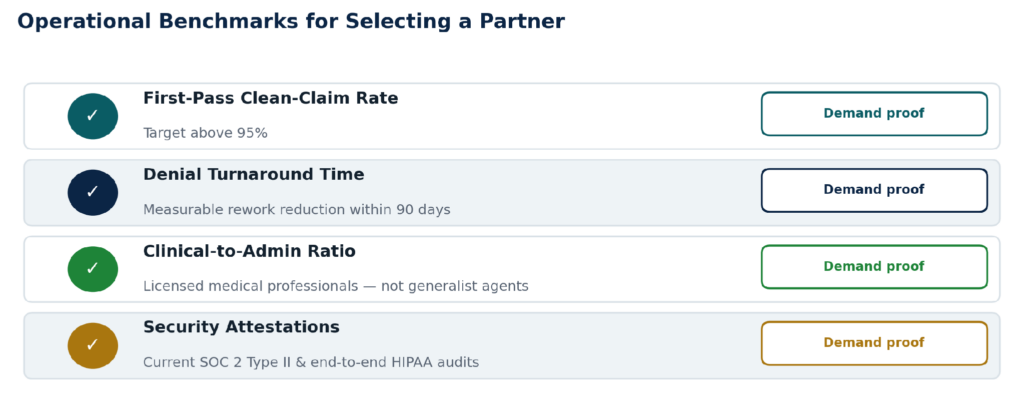
Figure 3. The operational benchmarks to verify—each backed by proof, not promises.
“The defensible position in healthcare outsourcing is no longer the cheapest seat or the most aggressive automation. It is the disciplined pairing of agentic speed with licensed human judgment. We see the most success when clinical judgment is treated as the load-bearing frame of the operation, not an afterthought.” — John Maczynski, CEO, PITON-Global.
What Do Real-World Results Look Like?
A multi-state hospital network with a persistently high denial rate and millions in annual leakage from incomplete prior authorizations deployed a human-in-the-loop workflow via PITON-Global. An AI layer ingested records while Philippine nurses validated clinical necessity; within nine months denials fell sharply, first-pass clean claims climbed, and the program returned 3× its cost.
The network’s prior-authorization bottleneck was draining millions of dollars a year. Working through PITON-Global, it implemented a workflow in which an AI layer ingested medical records while Philippine-based nurses validated clinical necessity against payer portals—agentic speed feeding licensed judgment, exactly the judgment-architecture pattern.

Figure 4. Denials fell sharply as first-pass clean claims rose—a 3× return on program cost.
How Does PITON-Global Help Hospitals Build a Judgment Architecture?
PITON-Global is an advisory-led consultancy, not a broker. It maintains a curated network of 100+ vetted Philippine providers focused on high-acuity healthcare, functions as an extension of your procurement team, and matches you to partners by verifiable clinical domain authority and infrastructure—built for clinical accuracy from day one.
Who Is PITON-Global?
PITON-Global is an advisory-led consultancy that maintains a curated network of more than 100 vetted Philippine BPO providers, specifically focused on high-acuity healthcare and clinical administrative workflows. It functions as an extension of a hospital’s procurement and operations team rather than as a transactional broker.
How Does PITON-Global Differ From Traditional Outsourcing Brokers?
Unlike standard sourcing models, PITON-Global does not simply issue RFPs and step back. It analyzes a hospital’s specific revenue-cycle gaps and matches providers on verifiable clinical domain authority and infrastructure—reducing vendor-selection risk and ensuring the engagement is built for clinical accuracy from day one.
How Does a Network of 100+ Vetted Philippine BPO Providers Benefit Organizations?
The network is curated for high-acuity healthcare specifically, so hospitals reach providers with genuine clinical staffing and healthcare-only infrastructure rather than generalist capacity. Because candidates are pre-vetted on domain authority and security posture, organizations accelerate deployment and avoid the cost of a poor structural fit.
How Does PITON-Global’s Advisory-Led Vendor Matching Process Work?
PITON-Global maps a hospital’s revenue-cycle gaps to verified provider capabilities—clinical domain authority, licensed nurse and coder staffing, HITRUST and SOC 2 Type II attestations, and healthcare-only infrastructure—then matches accordingly. The result is a faster, lower-risk path to a partner equipped to run a true judgment-architecture model.

Figure 5. PITON-Global aligns each hospital’s RCM gaps with verified, healthcare-specific provider capability.
Why Do Organizations Use PITON-Global?
Organizations use PITON-Global to reduce vendor-selection risk, accelerate deployment, and ensure clinical accuracy from day one. By matching revenue-cycle gaps to providers with verifiable clinical domain authority, it helps hospitals stand up a defensible judgment-architecture model rather than gambling on either the cheapest seat or ungoverned automation.
What Else Should Health Systems Know About BPO, AI, and Clinical Judgment?
Common questions cover outsourcing clinical roles, cross-border HIPAA compliance, whether AI will replace outsourced labor, transition timing, distinguishing healthcare from generalist BPOs, and automation sequencing. In short: licensed staff handle complex administrative-clinical work, security mirrors U.S. standards, human judgment remains structural, and partners often deploy automation faster than internal IT.
Is it possible to outsource clinical roles to the Philippines?
Yes, but as administrative and supportive clinicians. They do not provide direct patient care; they handle complex documentation, coding, and clinical-review tasks that require nursing licensure, including real-time medical scribing alongside ambient AI.
How do we ensure HIPAA compliance across borders?
Top-tier Philippine providers maintain the same security protocols as U.S. facilities, including localized secure work environments, encrypted VDI access, and rigorous internal audits.
Will AI eventually replace the need for outsourced labor?
No. As AI becomes more capable, the need for licensed professionals to govern those systems increases. Human clinical judgment in complex revenue cycles remains a structural requirement.
What is the typical timeframe for a transition to a Philippine partner?
A strategic transition—including documentation of SOPs and pilot testing—typically takes 90 to 120 days for a smooth production rollout.
How do I distinguish a “healthcare” BPO from a generalist?
Ask for their clinical-to-admin staffing ratio and whether their infrastructure is built strictly for healthcare workflows or shares floor space with retail and travel accounts.
Should we automate internally before outsourcing?
Outsourcing partners can often deploy their own proven automation stacks faster than an internal IT team can build them—while providing the human oversight to manage the resulting exceptions; our intelligent-automation guide for clinical revenue operations covers the sequencing.