

TL;DR: The Key Takeaway
Semantic segmentation has transcended basic image labeling, becoming a critical process where expert teams in the Philippines deliver the pixel-level accuracy required to build safe and reliable AI systems. This strategic approach ensures that AI models can perceive and interpret complex visual data with human-like understanding. The work follows the pattern set by the service line for AI inside operations: software drafts the masks and people make the final call.
In the evolution of computer vision, recognizing that an object exists is no longer enough. For an autonomous vehicle to navigate a busy intersection or a medical AI to assist in surgery, they must understand the world with pixel-level granularity. Semantic segmentation outsourcing in the Philippines has become the primary global engine for this high-fidelity data. By assigning a specific class label to every individual pixel, Filipino annotation teams provide the dense, contextual maps that allow AI to distinguish between the road and the sidewalk, or a tumor and healthy tissue, with unparalleled accuracy.
Executive Briefing
- Beyond the Box: While bounding boxes identify objects, semantic segmentation defines their exact shape and boundaries, providing the “pixel-level intelligence” required for safety-critical AI.
- The Gold Standard of Precision: The country offers a unique combination of cognitive aptitude and technical focus, essential for achieving the high Intersection over Union (IoU) scores that define top-tier models.
- Strategic Necessity: Leading tech firms no longer view segmentation as a task to be commoditized, but as a “strategic moat” that de-risks the path to commercialization.
- Intelligence Arbitrage: In 2026, the value of the country’s outsourcing sector has shifted from labor cost to “Intelligence Arbitrage”—accessing specialized talent that can interpret visual ambiguity better than automation.
- PITON-Global Connectivity: Acting as a high-fidelity bridge, PITON-Global connects AI innovators with a carefully vetted top tier of Filipino annotation labs specializing in complex, multi-modal segmentation.
Executive Summary
The future of AI depends on its ability to perceive the world with human-like nuance. Semantic segmentation outsourcing in the Philippines is the cornerstone of this effort, providing the pixel-by-pixel foundation that enables machines to see, not just look. This is a sophisticated cognitive discipline, requiring experts to navigate complex environments—from cluttered urban streets to microscopic biomedical scans—and assign meaning to every pixel. As we move further into 2026, the country has solidified its position as the premier destination for this mission-critical work, offering a robust infrastructure and a workforce capable of the high-level judgment that automation cannot replicate.
“In 2026, the single most critical asset for an AI product is the quality of its training data. Our clients come to the Philippines seeking ‘pixel-perfect’ accuracy that creates a moat around their models. This is about ensuring AI performs as intended in the real world, where a few stray pixels can be the difference between a safe stop and a catastrophic error.” — John Maczynski, CEO, PITON-Global
From Bounding Boxes to Pixel-Perfect Understanding
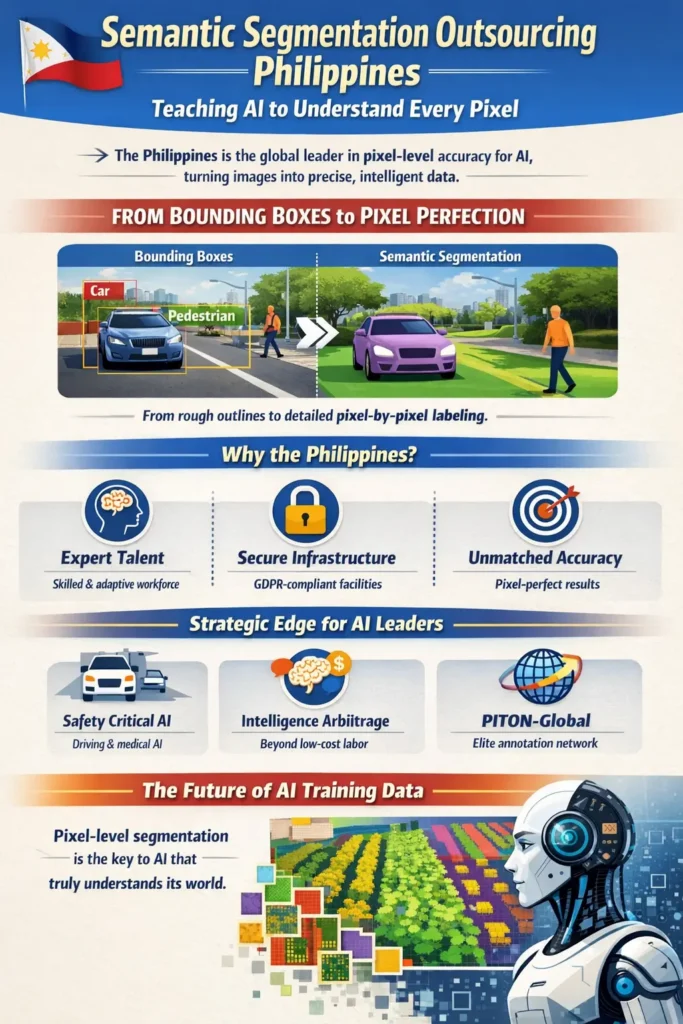
The initial era of computer vision was the era of the bounding box—a simple rectangle that told an AI “there is a car here.” But for modern applications, this is insufficient. A bounding box includes “noise” (pixels of the background) and fails to define the object’s actual footprint.
Semantic segmentation represents a monumental leap. It is the process of color-coding an entire image so that every pixel is identified by its class (e.g., car, road, sky). This level of detail allows an autonomous vehicle to know exactly where the drivable surface ends and the sidewalk begins. It allows a medical AI to map the irregular boundary of a lesion, ensuring a surgeon knows exactly where to intervene.
The Philippine Advantage: Talent Meets Technology
The Philippines has evolved into a “Global Intelligence Hub,” moving past simple data entry into high-value cognitive services. In 2026, this evolution is driven by several key factors:
- Cognitive Flexibility: Filipino annotators possess the English proficiency and cultural alignment to interpret complex, ambiguous instructions that frequently stump automated tools, the same skill behind sentiment analysis training for AI.
- Infrastructure Maturity: The nation’s BPO industry provides “Zero-Trust” security environments, where sensitive data (like medical or financial imagery) is processed via encrypted pixel-streams, ensuring data sovereignty and GDPR 2.0 compliance; the same controls govern how teams ground AI models in client-specific data.
- Intelligence Arbitrage: By 2026, the industry has hit a $42B revenue milestone, reflecting a shift where companies pay for the “human-in-the-loop” judgment that prevents AI hallucinations and ensures model reliability, a trajectory traced in the five-year outlook for AI-enabled outsourcing.
Complexity and Precision: The 2026 Scoring Framework
Not all segmentation tasks are created equal. PITON-Global utilizes a complexity framework to match the right expert team to the specific demands of the project.
| Task Category | Example Application | Complexity (1-10) | Target IoU% | Key Challenge |
| Environmental | Autonomous Driving | 6 | >90% | Distinguishing wet vs. dry asphalt. |
| Biomedical | MRI Tumor Mapping | 9 | >98% | Highly irregular, amorphous boundaries. |
| Retail | Automated Checkout | 5 | >85% | Handling object occlusion and lighting. |
| Agri-Tech | Crop/Weed Detection | 7 | >92% | Texture-based species differentiation. |
| Geospatial | Satellite Analysis | 8 | >95% | Large-scale scenes with diverse classes. |
The Human Element in an Automated World
As AI tools become better at “suggesting” masks, the role of the human expert has shifted from creator to governor. In 2026, Philippine teams use Agentic AI to automate 70-80% of the routine labeling, allowing them to focus 100% of their attention on “edge cases”—the ambiguous regions where the AI is most likely to fail. This hybrid approach ensures that the resulting “ground truth” is not just fast, but mathematically sound.
Expert FAQs
What is the difference between semantic and instance segmentation?
Semantic segmentation classifies pixels by category (e.g., all cars are “blue”). Instance segmentation identifies each individual car separately (e.g., Car 1 is “blue,” Car 2 is “red”). Semantic segmentation is usually the foundational step for broad scene understanding.
How do you measure the quality of a segmentation provider?
The gold standard is Intersection over Union (IoU). It measures the overlap between the expert’s annotation and the model’s prediction. High-precision work (like medical imaging) typically requires an IoU of 0.75 to 0.98, a benchmark consistently met by elite Filipino teams.
Can these teams handle “Sensor Fusion” (e.g., LiDAR + Video)?
Yes. In 2026, the top-tier providers are “Strategic Partners” capable of 3D-aware segmentation. They can synchronize 2D camera pixels with 3D LiDAR point clouds to create a volumetric understanding of the environment.
Is it safe to outsource sensitive medical or satellite data?
Leading providers now operate under a “Zero-Possession” security model. Data never resides on a local drive; instead, analysts interact with an encrypted stream. The data stays in your cloud; only the work travels offshore.