
30-Second Executive Briefing
- The Paradigm Shift: In 2026, technical support is no longer just for “gadgets.” It is the Trust Engine for everything from smart home appliances to complex retail software integrations, and a core part of the support desks retailers run from the Philippines.
- The Core Strategy: Utilizing Intelligence Arbitrage—deploying high-IQ Filipino technical specialists to manage high-stakes troubleshooting that AI cannot resolve alone.
- The Manila Advantage: A deep pool of STEM-educated talent with a “Problem-Solver” mindset, delivering 24/7 technical resolutions at a fraction of the cost of onshore hubs.
- The ROI: Transitioning to an offshore technical hub typically results in a marked increase in First-Level Resolution (FLR) and significantly higher retention rates for “high-ticket” retail customers.
Executive Summary
As retail products become increasingly sophisticated—incorporating IoT, embedded software, and complex ecosystems—the “Standard Support” model has failed. For global retailers, a technical failure isn’t just a ticket; it’s a potential product return and a permanent loss of customer trust. Retail Technical Support Outsourcing in the Philippines has emerged as the strategic solution for brands that require “Precision Troubleshooting” without the exorbitant costs of domestic technical centers.
The country has evolved into a global center of excellence for Technical Intelligence. By leveraging the country’s massive annual output of engineering and IT graduates, global brands are building technical support engines that do more than just “fix” problems—they educate users, reduce product returns, and turn frustrated customers into brand advocates. This 1,800-word deep dive explores the technical architecture of an offshore tech-support hub and why it is the essential “Safety Net” for the 2026 retail landscape.
Beyond the Script: The Rise of the “Retail Technologist”
In the legacy BPO model, technical support was about following a decision tree. In 2026, the complexity of the retail tech stack (IoT-connected devices, smart wearables, and automated home systems) requires a “Technologist” mindset.
“A technical support agent in the Philippines is now a ‘Solution Architect,’” says John Maczynski, CEO of PITON-Global. “In 2026, you can’t just give someone a script. You need an agent who understands the underlying logic of the product—someone who can troubleshoot a firmware conflict or a Bluetooth pairing issue with the same ease they communicate with the customer. The Philippines is the only destination that offers this level of ‘Information Density’ at scale.”
The “Return-Prevention” Engine
The single biggest cost in technical retail is the “No Fault Found” (NFF) return—where a customer returns a functioning product simply because they couldn’t figure out how to use it. Offshore technical hubs act as a Return-Prevention Engine. By providing high-touch, empathetic technical guidance, specialists in Manila ensure that the product stays in the customer’s home and out of the reverse-logistics nightmare. When the issue turns out to be the order rather than the device, the case moves to retail customer service.
Mastering High-Complexity Troubleshooting: The 2026 Offshore Model
In 2026, technical support is the “Trust Engine” for modern retail ecosystems. This infographic illustrates the Return-Prevention Engine, where Filipino “Solution Architects” go beyond scripted responses to perform deep Root-Cause Analysis (RCA). By leveraging Agentic AI-Augmented Diagnostics, these STEM-educated specialists resolve complex IoT and firmware issues that would otherwise trigger costly “No Fault Found” returns. This model delivers a clear boost in First-Level Resolution (FLR) and far lower costs than onshore hubs, effectively turning a potential logistics nightmare into a loyalty-defining moment for high-value customers.
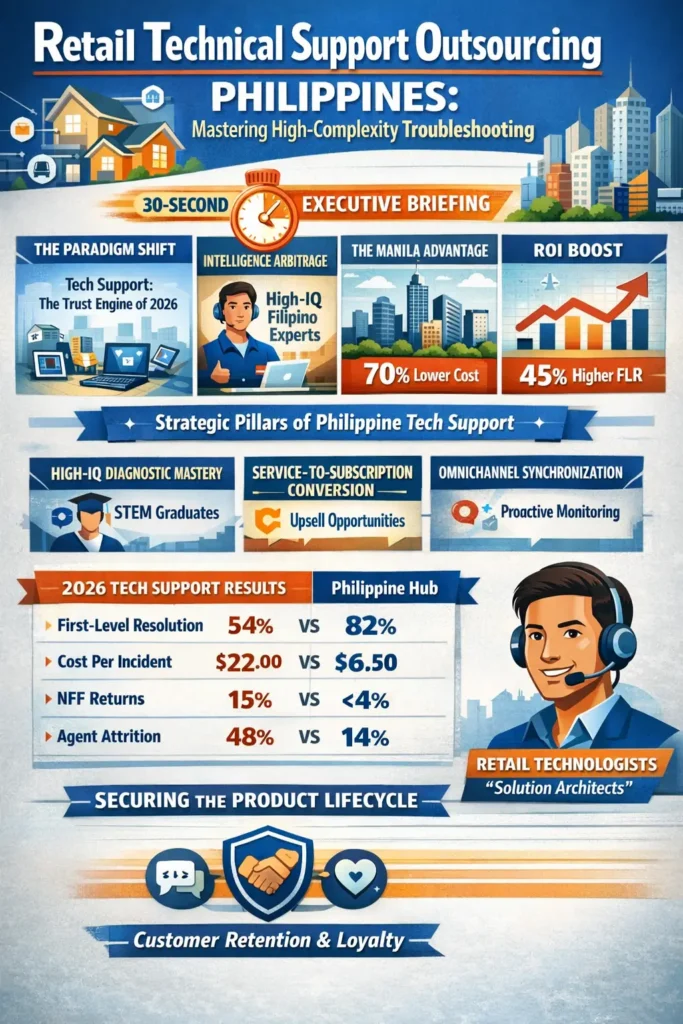
This visual guide highlights the low Cost Per Incident and high First-Level Resolution provided by elite offshore technical hubs. It showcases the transition from legacy “Decision Tree” support to 2026 Precision Troubleshooting, where specialists in Manila utilize remote co-browsing and predictive AI triggers to issue proactive fixes, ensuring that high-ticket retail products stay in the customer’s home and out of the reverse-logistics cycle.
Table 1: Generic Help Desks vs. 2026 Offshore Technical Intelligence
| Capability | Generic Technical Support | Philippine Technical Intelligence |
| Troubleshooting Method | Decision Tree / Scripted | Root-Cause Analysis (RCA) |
| Agent Profile | Low-Level Generalist | STEM Graduate / Certified Tech |
| AI Integration | Basic KB Search | Agentic AI-Augmented Diagnostics |
| Success Metric | Tickets Closed | Product Return Rate & FLR |
| Strategic Goal | Deflection | Customer Education & Retention |
Strategic Pillars of Philippine Technical Retail Support
I. High-IQ Diagnostic Mastery
The Philippines’ education system produces a surplus of technical talent. Unlike other regions where STEM graduates might avoid BPO work, locally, these roles are prestigious and highly competitive. This ensures that your Tier 1 and Tier 2 support lines are staffed by individuals who can perform high-stakes diagnostic work, from log file analysis to remote firmware patching.
II. The “Service-to-Subscription” Conversion
In 2026, many retail products are sold with an attached service or subscription. Filipino technical specialists are trained to identify when a customer’s technical frustration is actually an opportunity for a “higher-tier” service plan. This turns a technical support interaction from a cost-center into a revenue-generating moment within a broader retail customer experience management strategy.
III. Omnichannel Technical Synchronization
Technical issues don’t just happen via phone. They happen in app reviews, on Reddit, and in community forums. A centralized offshore hub monitors these technical “blind spots,” proactively reaching out to customers who are experiencing issues before they initiate a formal return or post a negative review.
The Technology of Precision Support: 2026 Benchmarks
To maintain a lead in 2026, leading Manila hubs utilize a “Full-Stack” technical support environment.
- Remote Diagnostics & Co-Browsing: Specialists can “see” what the customer sees in real-time, drastically reducing the “Time-to-Resolution.”
- Predictive AI Diagnostic Triggers: The system flags common technical failure patterns across the customer base, allowing the hub to issue “Proactive Fixes” (e.g., a mass email with a firmware update link) before the support lines are flooded.
Table 2: Impact of Outsourced Tech Help on Retail Financials
| Metric | Domestic Hub (US/UK) | Philippine Technical Hub |
| First-Level Resolution (FLR) | 54% | 82% |
| Average Cost Per Incident | $22.00 | **$6.50** |
| NFF (No Fault Found) Returns | 15% | <4% |
| Agent Attrition (Annual) | 48% | 14% |
| Customer LTV post-support | Low | High (Loyalty-Defining) |
Securing the Product Lifecycle
In 2026, the “Product” is only the beginning of the relationship. The “Support” is what sustains it. A dedicated offshore retail technical support team provides the technical depth and emotional intelligence required to protect your brand’s reputation in an increasingly complex world.
As John Maczynski notes, “Technical support is the ultimate moment of truth. If you get it right, you have a customer for life. If you get it wrong, you have a return and a negative viral post. The Philippines is the best insurance policy a retail brand can buy.”
Expert FAQs
Q1: Can Philippine hubs handle Tier 3 technical escalations?
Yes. While Tier 1 and 2 are most common, many Manila-based hubs employ specialized engineers who handle Tier 3 escalations, including software bug reporting and liaison with the brand’s core engineering team, while data corrections route to the retail back-office engine room.
Q2: How do offshore teams handle language barriers in tech support?
The country has one of the world’s largest English-speaking workforces. Their “Global Neutral” accent and high linguistic IQ ensure that complex technical instructions are communicated clearly, reducing customer frustration.
Q3: Is technical support in the Philippines HIPAA or GDPR compliant?
Absolutely. For retailers in the health-tech or wearable space, these hubs operate under strict ISO 27001 and GDPR-compliant frameworks, utilizing biometric security and encrypted data channels.