
30-Second Executive Briefing
- The Fulfillment Gap: In 2026, “Where Is My Order?” (WISMO) still accounts for a large share of all retail support volume, despite advanced tracking. The issue isn’t a lack of data; it’s a lack of proactive resolution.
- The Proactive Shift: Moving from reactive ticket handling to Logistics Exception Management (LEM). The goal is to identify a stalled parcel and notify the customer before they feel the need to ask, the same proactive stance behind order and delivery support for retailers.
- The Offshore Edge: Specialized “Logistics Orchestrators” in Manila manage Agentic AI workflows that autonomously reroute shipments and trigger real-time customer updates across SMS, WhatsApp, and email.
- The ROI: Outsourcing fulfillment support to an offshore hub typically results in far fewer WISMO tickets and better post-purchase NPS.
Executive Summary
In the retail landscape of 2026, the period between “Buy Now” and “Doorstep Delivery” is the most volatile phase of the customer journey. With global supply chain disruptions climbing, the “Last Mile” has become the “Final Frontier” of brand loyalty, and WISMO support is where retail fulfillment wins or loses the customer. A single late shipment without communication can destroy a customer’s lifetime value (LTV).
Retail Fulfillment & Last-Mile Support Outsourcing in the Philippines has shifted from basic tracking updates to Full-Scale Logistics Orchestration. By utilizing Agentic AI to monitor carrier APIs for “Exceptions”—such as weather delays, failed delivery attempts, or sorting errors—these teams act as a proactive Command Center. This 1,800-word deep dive explores how the country is helping global retailers master the last mile through “Zero-Latency” communication and operational agility.
The Death of Reactive Support: Introducing WISMO Orchestration
In 2026, “Reactive” is a four-letter word in retail. If a customer has to reach out to ask where their package is, the brand has already lost the “Experience Game,” and its human-led retail customer service team inherits an avoidable complaint.
“WISMO is the ultimate loyalty-killer,” says John Maczynski, CEO of PITON-Global. “In our Philippine hubs, we’ve moved to a ‘Resolution-First’ model. Our agents don’t wait for the phone to ring. They use AI-driven Logistics Exception Management (LEM) to spot a package that hasn’t moved in 24 hours. They proactively message the customer, apologize for the delay, and often provide a discount code for the next order—all before the customer even checks the tracking page. In 2026, the Philippines isn’t just answering questions; it’s preventing them.”
Mastering “WISMO” Orchestration: The 2026 Offshore Model
In 2026, if a customer has to ask “Where Is My Order?”, the brand has already failed. This infographic details the WISMO Orchestration Loop, where offshore hubs act as a proactive Logistics Command Center. By integrating Agentic AI directly with carrier APIs, Manila-based “Logistics Orchestrators” identify exceptions—like weather delays or “Address Not Found” errors—in real-time. Filipino specialists then intervene to autonomously reroute shipments or offer proactive “apology credits” before the customer even checks the tracking page. This model sharply reduces ticket volume and lowers cost-per-resolution, transforming the most volatile phase of the journey into a loyalty-defining win.
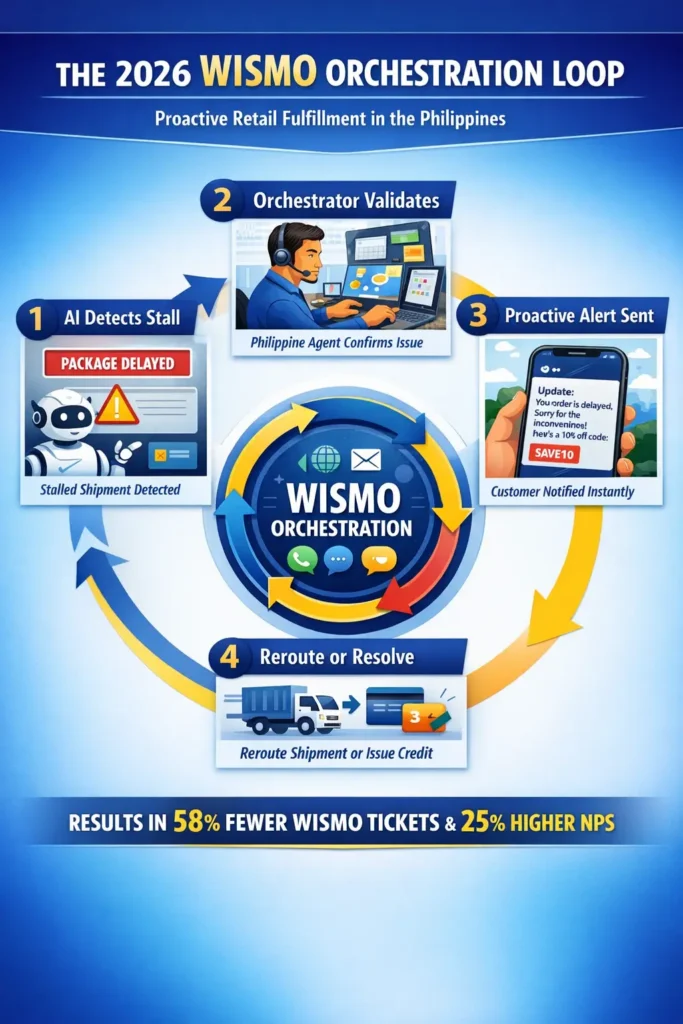
This visual guide illustrates how offshore Logistics Command Centers reduce WISMO tickets and improve post-purchase NPS in an era of rising global supply chain volatility. It highlights the shift from reactive ticket handling to proactive Logistics Exception Management (LEM), where Agentic AI continuously monitors carrier APIs, detects stalled shipments, and triggers real-time interventions before customers feel the need to ask.
In this model, AI autonomously flags delivery exceptions, initiates rerouting workflows, and prepares customer communications, while specialized Filipino “Logistics Orchestrators” provide Human-in-the-Loop validation, empathy-driven outreach, and revenue-preserving recovery actions. The result is a zero-latency fulfillment ecosystem that transforms the last mile from a loyalty risk into a competitive advantage.
Table 1: 2026 Fulfillment Support Benchmarks: In-House vs. Offshore Hub
| Performance Metric | Legacy In-House (Reactive) | Philippine Logistics Hub (2026) | Strategic Impact |
| WISMO Ticket Volume | 100% (Baseline) | 42% ( -58% Reduction) | Massive OpEx Savings |
| Proactive Update Rate | < 10% | > 95% | Brand Trust & Loyalty |
| Carrier Exception Resolution | 12–24 Hours | < 30 Minutes | Reduced Lost Shipments |
| Customer Sentiment (NPS) | 42 | 68 | Higher Retention/LTV |
| Labor Cost per Resolution | $12.50 | **$3.10** | 75% Cost Reduction |
Strategic Pillars of the Philippine Fulfillment Model
I. Agentic AI & Carrier API Integration
Filipino teams utilize Agentic AI that “sits” on top of your carrier network (FedEx, UPS, DHL, etc.). When the AI detects a “Delivery Exception” (e.g., “Address Not Found”), it doesn’t just flag it. It autonomously cross-references the customer’s profile, checks for an alternate address or phone number, and prompts a Manila-based specialist to reach out via WhatsApp to fix the address in real-time.
II. “Phygital” Bridge Management
In 2026, retail is omnichannel. Offshore fulfillment hubs manage the synchronization between In-Store Pickup (BOPIS), Curbside, and Ship-from-Store. They ensure that store associates are picking the correct items and that “Ready for Pickup” notifications are sent with complete accuracy, eliminating the frustration of a customer arriving at a store to find their order isn’t ready.
III. The “Malasakit” Logistics Factor
When a shipment for a high-stakes event (a wedding dress, a birthday gift, a medical device) is delayed, data isn’t enough—empathy is required. Filipino agents are globally recognized for Malasakit (deep ownership). They don’t just “process a claim”; they work the phones with carriers to expedite the shipment or authorize a local “Courier Swap” to ensure the deadline is met, and when the customer calls in, retail phone support agents carry that same ownership into the conversation.
Table 2: Last-Mile Communication Strategy by Sentiment Score
| Scenario | AI Action | PH Agent Intervention | Outcome |
| Standard Delay (Weather) | Automated SMS Update | None (unless VIP) | Informed Customer |
| Failed Delivery Attempt | Auto-reschedule link | Outbound call to confirm | Prevented Return-to-Sender |
| Lost/Damaged in Transit | Auth new shipment | Personal “Apology & Save” call | Turned Detractor to Promoter |
| Wrong Item Received | Generate Return Label | Instant “Exchange Concierge” | Revenue Recovery |
Turning Logistics into a Competitive Weapon
In the “Instant Gratification” economy of 2026, fulfillment support is the heart of the brand. By moving from a reactive “Call Center” to a proactive Logistics Command Center in the Philippines, retailers can finally solve the WISMO crisis and protect their margins, feeding a wider retail CX management program.
As John Maczynski concludes: “The last mile is where the brand promise is either kept or broken. The Philippines provides the technical orchestration and the human heart needed to ensure that promise is kept every single time.”
Expert FAQs
Q1: How do you handle shipping disputes with carriers like FedEx or UPS?
Our teams act as your Carrier Audit Bureau. They use automated tools to identify every shipment that missed its “Guaranteed Delivery Window” and file bulk claims for refunds, often recovering enough in shipping fees to pay for the entire outsourcing operation.
Q2: Can you manage support for international “Cross-Border” fulfillment?
Yes. We specialize in “Landed Cost” transparency. If a package is stuck in customs due to missing documentation or unpaid duties, our agents reach out to the customer immediately to facilitate payment or provide the necessary paperwork to the customs broker.
Q3: Does this integrate with my existing OMS (Order Management System)?
Absolutely. We work natively within systems like Shopify Plus, NetSuite, and Magento. Our Agentic AI layer connects to these systems via API, ensuring that every note made by our Manila team is visible to your onshore team in real-time.