

30-Second Executive Briefing
- The Industrialization of Fraud: In 2026, retail fraud is no longer manual; it is algorithmic. Criminal syndicates use Agentic AI to launch synthetic identity attacks and automated refund abuse at machine speed, and fraud review now sits alongside the customer care and back-office support for retailers that brands already run offshore.
- The Margin Drain: Global retail shrinkage keeps climbing, with “Friendly Fraud” (chargebacks) and account takeovers (ATO) eating a meaningful slice of total revenue.
- The Human-Led Defense: Utilizing Behavioral Biometrics—analyzing typing rhythm, mouse gestures, and navigation flow—to distinguish humans from bots.
- The ROI: A dedicated offshore Fraud Nerve Center delivers a marked reduction in fraud losses and far fewer false positives, protecting legitimate revenue.
Executive Summary
As we move through 2026, the “Digital Shelf” has become a high-stakes battleground. While retailers have invested heavily in AI-driven commerce, fraudsters have matched them, deploying Industrialized Fraud frameworks that can bypass traditional multi-factor authentication (MFA) and static rules. For the modern retailer, the challenge is no longer just “blocking bad actors”; it is doing so without creating “Friction” that drives away legitimate customers.
Retail Fraud & Risk Management Outsourcing in the Philippines has evolved into a sophisticated Defense-in-Depth model. By combining the natural empathy and cultural nuance of Filipino specialists with cutting-edge Behavioral Biometrics and Zero-Trust Architecture, the country has become the global hub for “High-Context” risk mitigation. This 1,800-word deep dive explores how the archipelago is securing the future of global retail.
The Rise of Agentic Attacks: Why Static Rules Failed
In 2026, traditional fraud filters are a liability. Static rules—like blocking specific IP addresses or zip codes—often result in a “False Positive Crisis,” where a brand’s most loyal high-value customers are mistakenly blocked, eroding long-term value (LTV) and undoing the work of a retail customer experience program.
“Fraud in 2026 is about ‘Identity Synthesis,’” says John Maczynski, CEO of PITON-Global. “Fraudsters aren’t just stealing credit cards; they are building ‘Frankenstein Identities’ that look entirely real to an automated system. In our Philippine hubs, we’ve moved from ‘Who is this user?’ to ‘How is this user behaving?’ By analyzing the micro-gestures of a session—typing speed, navigation speed, and even how a phone is held—our specialists can spot an AI bot in seconds. We are no longer just a ‘Support Center’; we are a Global Risk Nerve Center.”
Securing the Digital Shelf: The 2026 Offshore Risk Model
In 2026, retail fraud has been industrialized by Agentic AI, making static rules obsolete. This infographic details the Defense-in-Depth Stack, where offshore hubs act as a Global Risk Nerve Center. By monitoring “Digital Body Language”—typing rhythm, mouse gestures, and navigation flow—Filipino specialists distinguish legitimate human shoppers from automated bots. This Human-in-the-Loop model delivers a high Fraud Catch Rate and keeps false positives to a small fraction of orders, ensuring that your most loyal customers are never accidentally blocked. By combining behavioral intelligence with Zero-Trust Architecture, these hubs protect your EBITDA and turn security into a competitive advantage.
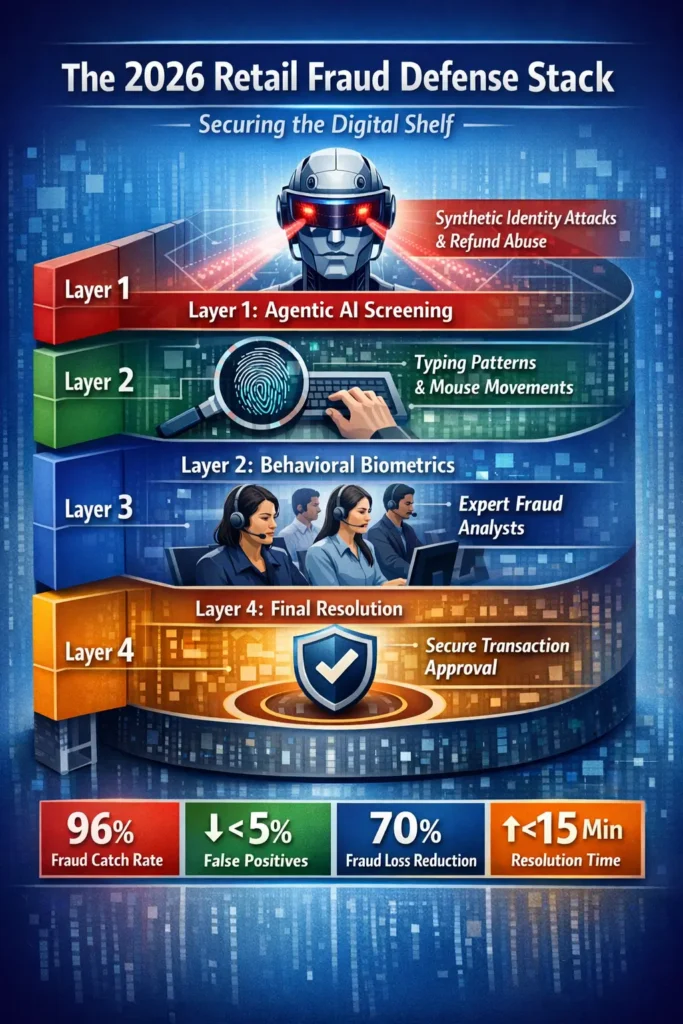
This visual guide illustrates how offshore Fraud Nerve Centers reduce retail fraud losses and sharply cut false positives in an era of algorithmic, Agentic AI-powered attacks. It highlights the shift from static rule-based filters to a 2026 Defense-in-Depth model—where Agentic AI screening, behavioral biometrics, and real-time Human-in-the-Loop triage operate in a synchronized stack.
In this framework, AI detects synthetic identities, refund abuse, and account takeovers at machine speed, while high-IQ Filipino risk analysts analyze digital body language, validate edge cases, and prevent revenue-killing false declines. The result is a frictionless customer experience protected by a hardened perimeter—turning risk management into a front-line margin defense and competitive moat.
Table 1: 2026 Fraud Defense Benchmarks: In-House vs. Offshore Hub
| Metric | Legacy In-House Team | Philippine Risk Hub (2026) | Strategic Impact |
| Fraud Catch Rate | 72% | 96% | Lower Chargeback Costs |
| False Positive Rate | 18% | < 5% | Revenue Recovery |
| Chargeback Reversal Rate | 15% | 48% | Margin Protection |
| Resolution Latency | 4–6 Hours | < 15 Minutes | Zero-Friction CX |
| Operating Cost | 100% (Baseline) | 40–50% of Onshore | 60% EBITDA Boost |
Strategic Pillars of the Philippine Risk Model
I. Behavioral Biometrics & “Digital Body Language”
Philippine teams utilize Behavioral Intelligence to monitor the “Digital Body Language” of a session. While a fraudster might copy-paste a stolen credit card number, a legitimate human has a specific typing rhythm and mouse trajectory. These specialists use AI-augmented dashboards to flag these subtle anomalies in real-time, allowing them to stop a transaction before the payment is even processed.
II. Neutralizing “Fraud-as-a-Service”
The 2026 landscape is plagued by “Dark Web templates” for refund abuse and “Friendly Fraud.” Philippine fraud analysts are trained specifically on these emerging typologies. They perform Three-Way Reconciliation between the customer’s claim, the carrier’s GPS delivery data, and the warehouse’s digital twin to identify “First-Party Fraud” that automated systems often overlook, using the same warehouse records that inventory and catalog audit teams keep accurate.
III. Zero-Trust Architecture & Sovereign Data
To meet global mandates like the EU’s AI Act and the FCA’s Consumer Duty, top-tier offshore providers utilize Sovereign Data Perimeters. This ensures that while the “Analysis” happens in Manila, the sensitive PII (Personally Identifiable Information) never leaves the retailer’s home jurisdiction, maintaining full compliance.
Table 2: ROI Analysis: The Cost of $100 in Retail Fraud
| Expense Category | Without PH Risk Hub | With PH Risk Hub | Recovery Impact |
| Direct Product Loss | $100 | **$0 (Blocked)** | $100 Saved |
| Chargeback & Bank Fees | $35 | **$0** | $35 Saved |
| Operational Labor | $45 | **$18** | $27 Saved |
| Customer LTV Erosion | $27 (False Positive) | **$0** | $27 Recovered |
| Total Cost per Incident | **$207** | $18 | 91% Reduction |
Turning Risk into a Competitive Moat
In 2026, the retailers who win are those who can offer a frictionless experience to nearly every customer while maintaining a hard perimeter against the few bad actors. An offshore retail fraud & risk management team provides the specialized “Intelligence Arbitrage” required to achieve this balance.
As John Maczynski concludes: “Security is no longer a ‘back-office’ expense; it’s a front-line revenue protector. By moving your risk operations to the Philippines, you aren’t just cutting costs—you are building a moat that Agentic AI cannot cross.”
Expert FAQs
Q1: How do you handle “Friendly Fraud” where a customer claims they never received the package?
We use Atomic Reconciliation. Our agents cross-reference the photo-proof of delivery from the carrier with the customer’s historical behavior. If we see a pattern of “Non-Receipt” claims across different marketplaces, our team prepares the evidence for a successful chargeback reversal.
Q2: Does your team handle KYC (Know Your Customer) for high-value purchases?
Yes. For luxury retail or high-ticket items, we execute Liveness Orchestration. We use AI to verify identity documents in seconds, backed by a Manila specialist who can conduct a video-call verification if the AI flags an “Injection Attack” or Deepfake. The same identity checks apply upstream, where marketplace merchant onboarding screens sellers before they ever list a product.
Q3: Can you integrate with my existing fraud tools (e.g., Signifyd, Riskified)? Absolutely. We act as the Human Intelligence Layer on top of your tech stack. We handle the “Manual Review” queue that these tools generate, ensuring that your automated filters aren’t accidentally killing your conversion rate.