

NOAA confirms 55% probability of below-normal 2026 hurricane season. ACA open enrollment for 2027 coverage runs November 1–December 15 — the shortest federal window on record. The agencies reallocating idle P&C bench capacity toward temporary licensed agents now will capture the surge. Those waiting will not. The same reallocation logic applies to carriers already running claims and policy operations from the Philippines.
Executive Summary — 2026 Insurance Staffing Inflection Point
- P&C baseline: NOAA forecasts 55% probability of below-normal 2026 Atlantic hurricane season (8–14 named storms vs. long-term average of 14), driven by developing El Niño conditions. Reactive P&C bench capacity is idle.
- L&H surge: ACA open enrollment for 2027 coverage runs November 1–December 15, 2026 in HealthCare.gov states — the shortest federal window on record, with no January extension permitted for the first time since the ACA’s inception.
- The strategic imperative: Agencies carrying idle P&C bench while underinvesting in temporary licensed agents for the L&H surge are paying double — for capacity they do not need and capacity they cannot access when they do.
- Critical lead time: Licensing verification, compliance onboarding, and system integration for temporary licensed agents requires a minimum 60–90 day runway. Initiate sourcing by August 1, 2026.
Key Metrics
| Metric | Value | Description / Source |
| Probability of Below-Normal Atlantic Hurricane Season | 55% | NOAA’s first forecast of a below-normal Atlantic hurricane season since 2015. (NOAA 2026 Atlantic Hurricane Season Outlook, May 21, 2026) |
| ACA Open Enrollment Window | 45 Days | Effective open enrollment period for 2027 ACA coverage — the most compressed federal enrollment deadline since the ACA’s inception. (HealthCare.gov / CMS 2026 · healthinsurance.org) |
| ACA Marketplace Enrollment | 24.3M+ | Americans enrolled through ACA marketplaces during the prior enrollment cycle, establishing a record demand baseline for 2026 Life & Health insurance operations. (CMS Enrollment Data · healthinsurance.org) |
Why Is the 2026 U.S. Insurance Market Splitting Into Two Conflicting Staffing Models?
The 2026 U.S. insurance staffing environment is bifurcating along a single axis: environmental volatility versus regulatory certainty. P&C operations are managing a flat baseline confirmed by NOAA’s verified below-normal hurricane forecast. L&H operations face a vertical volume spike compressed into a 45-day federal window with no extension. These two dynamics require opposite staffing strategies — and most agencies are still running one.
Property and Casualty operations are experiencing a historically flat demand baseline in 2026. NOAA’s May 21, 2026 forecast — the agency’s first below-normal seasonal outlook since 2015 — projects a 55% probability of reduced Atlantic hurricane activity, driven by developing El Niño conditions that suppress tropical storm formation. For P&C operations that built reactive bench capacity in anticipation of weather-driven volume, this confirms what budget analysts have already been signaling: that bench is idle, and the carrying cost is real.
Conversely, Life and Health workflows face immediate, compressed volume shocks dictated entirely by the federal calendar. Starting with the fall 2026 open enrollment cycle, ACA enrollment for 2027 coverage ends December 15 in all HealthCare.gov states with no January extension permitted — the most compressed window since the law’s inception. With 24.3 million Americans having enrolled in the prior cycle, the volume that once spread across 76 days now concentrates into 45. The staffing math is not linear. It is exponential.
Staffing Model Comparison
| Staffing Vector | P&C Baseline (2026) | L&H Surge Architecture (2026) |
| Primary macro trigger | Reactive — weather disruptions and climate anomalies | Proactive — rigid federal enrollment periods and statutory windows |
| 2026 volume run-rate | Flattened baseline — NOAA 55% below-normal probability confirmed | Exponential vertical scaling over compressed 45-day window |
| Human capital configuration | 90% permanent core / 10% on-demand onshore buffer | 60% stable core / 40% temporary licensed agents |
| Talent acquisition lead time | Just-in-time reactive regional deployment | 60–90 days pre-surge — strict compliance and onboarding runway required |
| Primary risk | Idle bench carrying cost during low-activity season | Capacity shortage during non-renewable federal window — lost enrollments are unrecoverable |
Sources: NOAA 2026 Atlantic Hurricane Season Outlook (May 21, 2026) · CMS / HealthCare.gov 2026 enrollment calendar · healthinsurance.org · PITON-Global Advisory 2026
Expert Commentary
According to John Maczynski, CEO of PITON-Global and a 40-year insurance operations veteran:
“Agencies that continue to approach talent acquisition as a monolithic insurance strategy are bleeding capital. In 2026, sitting on idle, onshore P&C bench capacity in anticipation of a weather spike that meteorologists confirm is not coming is an executive failure. Savvy operations are immediately reallocating that budget toward sourcing flexible, highly responsive L&H capacity that can execute complex health enrollments from the first hour of live operations.”
How Do Temporary Licensed Agents Protect Customer Experience During Peak Volume Shocks?
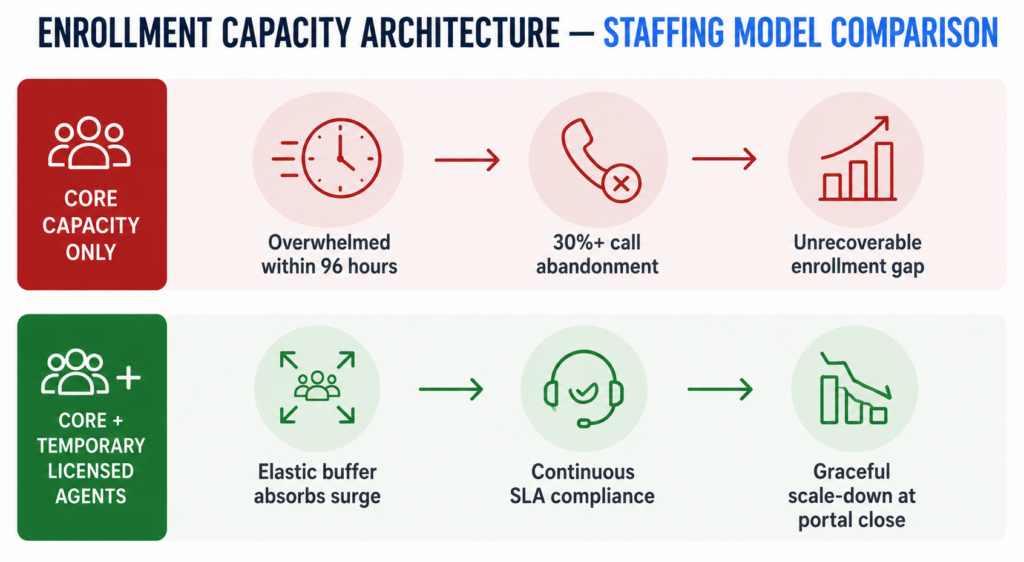
Temporary licensed agents protect customer experience during open enrollment volume shocks by creating an elastic human buffer between fixed core capacity and surge demand — absorbing multi-fold inquiry volume increases without degrading SLA performance, queue times, or abandonment rates. They are not supplemental staff. They are a structural architecture decision.
When consumer inquiry volume multiplies over a compressed enrollment window, traditional fixed-capacity infrastructure degrades rapidly. Elevated Average Speed of Answer (ASA) metrics, long queue wait times, and rising call abandonment rates cause immediate, irreversible pipeline leakage. In ACA enrollment, abandoned calls are not service failures — they are lost premium revenue that cannot be recovered once the federal window closes.
Temporary licensed agents carry the foundational credentials to immediately handle high-intent consumer traffic — plan comparisons, eligibility screenings, subsidy calculations, and enrollment facilitation — without the extended onboarding that unlicensed staff would demand.
What Is the Business Case for Sourcing Temporary Licensed Agents 60–90 Days Before Open Enrollment?
The 60–90 day pre-surge sourcing window for temporary licensed agents is not a preference — it is a compliance prerequisite. Licensing verification, background screening, E&O coverage confirmation, carrier appointment processing, and system integration cannot be compressed below this threshold without creating regulatory exposure or day-one performance gaps. Agents who also handle Medicare plans add the CMS and TPMO disclosure rules to that runway.
The November 1 open enrollment start date is a hard federal deadline. Unlike a weather-driven P&C surge — which telegraphs its arrival through storm tracking and allows reactive deployment — ACA enrollment volume arrives on a known date at a predictable magnitude with a non-negotiable close. Agencies that have not completed the licensing and compliance runway by late October are not late. They are out of the window entirely.
For 2026, the strategic calendar is precise: agencies planning to deploy temporary licensed agents for the November 1 open enrollment start should initiate sourcing no later than August 1, 2026 — providing the minimum 90-day runway for licensing verification, compliance documentation, carrier appointment processing, system credential provisioning, and product training on 2027 plan structures.
Case Study
From Runaway Call Abandonment to an 18-Second ASA: Mitigating Seasonal Capacity Leakage
A mid-market commercial health insurance provider entered the open enrollment cycle relying entirely on an overextended domestic customer support team. Within the first 96 hours, call abandonment rates spiked to unsustainable levels — translating directly into unrecoverable premium pipeline loss and measurable brand damage in a competitive multi-state market.
The carrier restructured its front-end architecture, routing tier-1 plan comparisons and preliminary demographic screenings to an externally sourced, fully integrated unit of 120 temporary licensed agents. The core team retained ownership of complex eligibility determinations, appeals, and underwriting handoffs.
Results
| Metric | Result | Business Impact |
| Average Speed of Answer (ASA) | 4.2 min → 18 sec | Average Speed of Answer reduced by 93% within 72 hours of deployment. |
| Policy Growth | +22% | Year-over-year increase in bound individual policies during the enrollment window. |
| Clean-Claim Transfer Rate | 97% | Clean-claim transfer rate to core underwriting, creating a zero-rework processing pipeline. |
What Does the 2026 NOAA Forecast Mean for P&C Staffing Strategy?
NOAA’s 2026 below-normal hurricane forecast — a 55% probability of reduced Atlantic activity driven by developing El Niño — signals a sustained flat P&C demand environment through primary storm season. For staffing strategists, this is not an all-clear signal. It is a budget reallocation trigger.
The critical caveat embedded in NOAA’s forecast is one every insurance operations leader must internalize: a below-normal storm count does not guarantee a below-normal loss year. As NOAA itself emphasizes, a single major hurricane making landfall in a heavily exposed coastal corridor can generate tens of billions in insured losses regardless of seasonal totals. The operationally sound response is to maintain a lean, rapidly-deployable P&C on-demand buffer, backed by digital claims processing built to scale, while directing freed budget toward the certain, calendar-driven L&H surge beginning November 1.
Carrying full reactive bench capacity against a 55% below-normal probability forecast is not risk management. It is capital misallocation. The probability-weighted expected value of reactive P&C surge demand in 2026 is materially lower than in recent high-activity years — and the opportunity cost of that misallocation compounds every week that temporary licensed agent sourcing is deferred.
The Strategic Verdict
2026 is not a year for monolithic insurance staffing strategy. It is a year for bifurcated resource allocation — a lean reactive buffer for the probability-weighted P&C environment and a fully provisioned elastic architecture for the certain, calendar-locked L&H surge, alongside the permanent bench that year-round Medicare IEP staffing demands. The agencies that act on NOAA’s forecast data now, sourcing temporary licensed agents with the 60–90 day compliance runway the November 1 window requires, will capture enrollment volume when their competitors are managing queue crises. The window is open. The calendar is not negotiable.