

TL;DR: The Key Takeaway
Natural language processing outsourcing in the Philippines is no longer about rote transcription or basic tagging. It has evolved into a highly specialized field where human experts provide the critical cognitive layer that enables AI to understand context, sentiment, and intent, transforming machine understanding into a strategic advantage. For AI labs, it is the language end of how Filipino teams supply LLM training data, RLHF and evaluation.
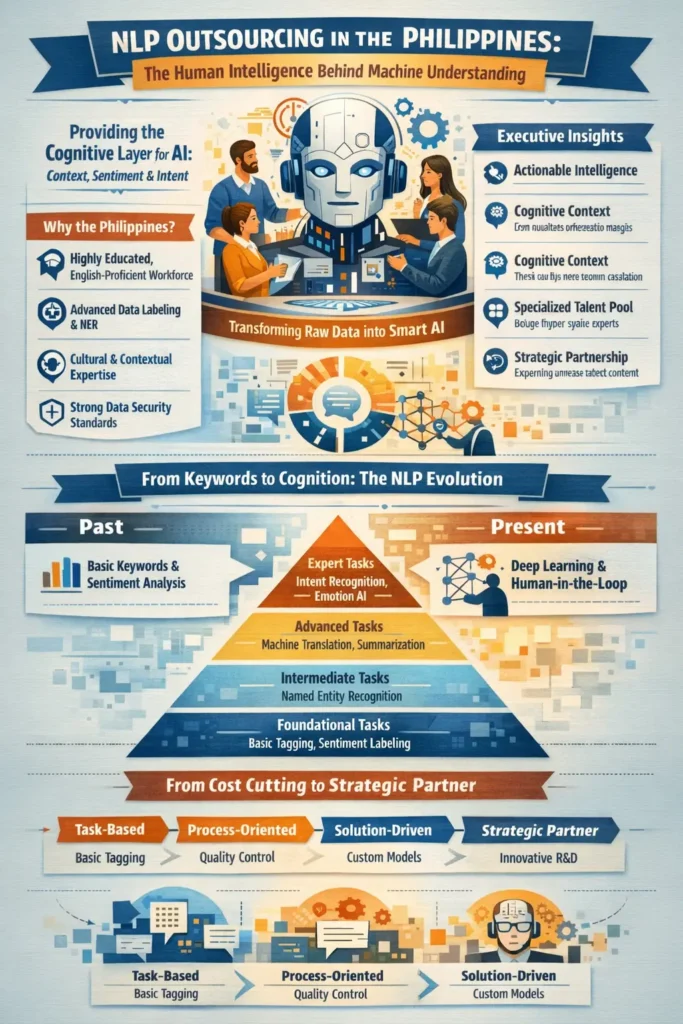
Natural Language Processing (NLP) outsourcing in the Philippines provides the essential “cognitive layer” required for machines to comprehend human context, sentiment, and intent. By leveraging a highly educated, English-proficient workforce for data labeling, named entity recognition (NER), and intent classification, global firms can transform raw unstructured data into actionable intelligence and sophisticated conversational AI.
Executive Briefing
- Actionable Intelligence: Convert massive volumes of unstructured text and voice data into structured, searchable insights for better decision-making.
- Cognitive Context: Utilize Filipino linguistic experts to bridge the gap between literal machine translation and nuanced human understanding.
- Specialized Talent Pool: Access a workforce that combines high English literacy with the analytical skills needed for complex NLP “Human-in-the-Loop” tasks.
- Strategic Partnership: Shift from simple data tagging to collaborative model refinement that improves AI accuracy and reduces systemic bias.
- E-E-A-T & Security: Benefit from a mature BPO sector that integrates Western data privacy standards (GDPR/HIPAA) with deep technical domain expertise.
From Keywords to Cognition: The Journey of NLP
The early chapters of Natural Language Processing were dominated by rigid statistical models and simple keyword identification. Systems could count word frequencies and trigger basic responses, but they remained blind to the “soul” of language. This was the era of clunky sentiment analysis and keyword stuffing—a time when irony, sarcasm, and cultural nuance were the Achilles’ heels of machine learning.
The 2026 landscape of NLP is a different beast entirely. Powered by transformer models and deep neural networks, modern NLP seeks to understand the intent behind the utterance. This leap from recognition to cognition requires more than just better code; it requires massive amounts of “ground truth” data curated by humans. Filipino teams have become a leading source of this curation, providing the human intelligence that teaches machines to dance through the intricacies of human expression.
The NLP Service Stack: A Hierarchy of Cognitive Demand
Not all NLP tasks are created equal. To maximize ROI, organizations must align their project complexity with the appropriate level of Filipino expertise. The same tiering logic applies outside text, from geospatial data annotation to labeling satellite imagery.
| Service Tier | Representative Tasks | Cognitive Demand | Strategic Value |
| Tier 1: Foundational | Text classification, basic sentiment tagging. | Low to Medium | Organizing vast unstructured datasets. |
| Tier 2: Intermediate | Named Entity Recognition (NER), POS tagging. | Medium | Extracting structured entities from text. |
| Tier 3: Advanced | Machine translation, text summarization. | Medium to High | Enabling cross-lingual communication. |
| Tier 4: Expert | Intent recognition, Causal inference, Emotion AI. | High to Very High | Powering predictive models and assistants. |
The Cognitive Value of Human-in-the-Loop
The most sophisticated AI models are never truly “autonomous”—they are the result of a symbiotic loop. While an algorithm can process a billion sentences in seconds, it lacks the common-sense reasoning and lived experience that a human brings to a conversation. Among Filipino providers, the “Human-in-the-Loop” (HITL) model has matured into a high-value service where specialists don’t just label data; they act as “Language Architects.”
“Our clients are moving beyond simple text processing. They are hunting for the ‘why’ behind the words. They need teams that can detect the subtle shift in a customer’s emotion or the hidden intent in a complex query. This is the future of natural language processing outsourcing in the Philippines—it is the human intelligence that turns machine learning into true machine understanding.” — John Maczynski, CEO, PITON-Global
By providing feedback on machine-generated translations or identifying the relationships between disparate entities in a document (the core skill behind structured annotation for knowledge graphs and RAG), Filipino experts provide the high-quality, labeled data that serves as the “fuel” for high-performance AI.
The Philippine Advantage: A Hub of Linguistic Excellence
The country’s strength in NLP work is rooted in its unique cultural and educational framework. The nation possesses a massive, English-fluent population that is culturally attuned to Western nuances—a critical factor when training models for global markets. Furthermore, the local BPO industry has moved up the value chain, shifting from back-office support to high-stakes technical roles.
Beyond linguistic talent, the local infrastructure is purpose-built for AI development. This includes ISO-certified facilities and a regulatory environment that respects international data privacy laws. For a tech firm, this means their intellectual property and sensitive datasets are handled with the same rigor they would expect from an in-house team in Silicon Valley or London.
NLP Maturity Model: From Task-Based to Strategic Partnership
As businesses integrate NLP more deeply, their relationship with offshore providers evolves from a transactional model to a strategic alliance.
| Stage | Primary Focus | Key Activities | Value Proposition |
| 1. Task-Based | Cost Reduction | Data entry, basic tagging. | Labor arbitrage. |
| 2. Process-Oriented | Efficiency | Rule-based annotation, QA. | Consistent accuracy. |
| 3. Solution-Driven | Problem Solving | Custom NLP model training. | Tailored industry solutions. |
| 4. Strategic Partner | Innovation | Collaborative R&D, co-creation. | Long-term competitive edge. |
Expert FAQs
How does the Philippines handle non-English NLP tasks?
While English is the primary strength, the country is a multilingual hub. Many BPO providers employ “language-agnostic” annotation strategies or have access to regional language specialists (Spanish, Mandarin, Japanese) to support global machine translation and localization projects.
What role does NLP play in Generative AI?
NLP is the foundation of Large Language Models (LLMs). The work done by Filipino teams—such as RLHF (Reinforcement Learning from Human Feedback)—is what makes models like GPT-4 or Gemini sound human and stay within ethical boundaries.
How do you measure the quality of an NLP outsourcing project?
Quality is typically measured through “Inter-Annotator Agreement” (IAA) scores and F1 scores (a measure of a model’s accuracy). High-quality teams use multi-layered review processes to keep the “ground truth” data as close to fully accurate as possible.
How is PITON-Global helping firms navigate the NLP landscape?
We act as the strategic bridge, rigorously vetting local NLP providers to ensure they have the specific domain expertise (legal, medical, or technical) required for your project, while providing the governance framework to ensure project success.